This guide compares two common aluminum alloys: 2024 and 7075. Both are widely used in aerospace and other demanding industries for their high strength and strong mechanical performance. Understanding their traits and differences helps you choose the right alloy for your engineering project.
What Are the Differences Between 2024 and 7075 Aluminum Alloys?
The 2024 aluminum alloy offers an excellent strength-to-weight balance. In contrast, the 7075 aluminum alloy is stronger but has lower corrosion resistance. Because 7075 is tougher and stronger than 2024, it fits aerospace applications where strength is critical.
The lower cost of 2024 is attractive for projects that do not need maximum strength. Balance performance with budget. Spending more on 7075 is often worthwhile when a project demands the highest strength and durability.
Understanding 2024 Aluminum Alloy
2024 is one of the strongest aluminum alloys available and is a common choice when strength and workability matter. Many aircraft parts are made from it, which proves it performs well under load.
The alloy contains a high level of copper, which gives it strength and wear resistance and makes it shape well during processing. It resists corrosion poorly, so protection is needed. Cladding or anodizing can reduce this weakness.
Origins and Composition
2024 is primarily a copper alloy. The copper provides strength and hardness and improves response to heat treatment.
Copper does not improve corrosion resistance in wet environments. A protective layer, usually pure aluminum cladding, is applied to exposed surfaces to address this.
This combination of strength and (with protection) corrosion performance makes 2024 useful across many fields. For tempers and sizing details, see our guide to 2024 T351 aluminum.
Key Properties and Applications
2024 suits projects that need strong materials with good wear resistance. It is common in aerospace for aircraft structures, wings, and fuselage components.
It can be vulnerable to stress corrosion in some conditions. Protective measures are important in marine or harsh chemical environments.
2024 remains a strong choice where strength and wear resistance matter. Apply corrosion protection where needed.
Diving Into 7075 Aluminum Alloy
7075 is one of the strongest aluminum alloys by weight. It appears in military and aerospace settings and handles tough structures well.
Its high zinc content gives it strength and durability, so it performs in difficult conditions.

Development and Chemical Makeup
7075 is a major step in material science, known for high strength. Zinc is the main reason for that strength.
7075 contains zinc and magnesium. Magnesium adds strength and hardness, and together they enhance mechanical properties, making 7075 excellent for strong structural uses.
Adding copper and chromium improves performance and lets the alloy suit different industries.
Distinct Characteristics and Applications
7075 is among the strongest aluminum alloys, so it is used where strength matters most, such as aircraft structures and military gear.
It has good fatigue resistance, which helps under repeated stress and is key for parts that cycle through strain.
Its strength and hardness also resist wear, making it a strong option for aerospace parts, high-end sports equipment, and other high-performance projects.

Comparative Analysis of Mechanical Properties
A side-by-side look at the mechanical properties of 2024 and 7075 shows the differences that decide which alloy fits a task.
Tensile strength and fatigue resistance each have trade-offs. Knowing these qualities points to the best uses for each alloy.
| Property | 2024 Aluminum | 7075 Aluminum |
| Main Alloy Element | Copper | Zinc |
| Tensile Strength | 400-450 MPa | 540-570 MPa |
| Yield Strength | 270-310 MPa | 480-510 MPa |
| Density | 2.78 g/cm³ | 2.81 g/cm³ |
| Brinell Hardness | 120 HB | 150 HB |
Strength and Durability Differences
7075 has high tensile strength, so it handles strong forces without bending or failing. This helps in tough construction.
Yield strength shows how much stress a material takes before permanent change. 7075 exceeds 2024 here, so it holds pressure without failing.
7075 also has better fatigue strength, so it resists cracking under repeated stress. This matters for aerospace and automotive parts.
Flexibility and Weight
7075 is stronger, but 2024 is more flexible and easier to handle because of its lower yield strength. It bends and forms without losing strength.
That flexibility and good machinability make detailed designs easier to produce and simplify manufacturing.
Both are strong and light with a high strength-to-weight ratio. 2024 is lighter, so it is the better choice when minimum weight is required.

Thermal and Electrical Conductivity
Neither 2024 nor 7075 retains heat well, mainly because aluminum moves heat efficiently.
Small differences in alloy mix change how well they conduct heat and electricity. These changes are minor but can affect high-temperature or electrical use.
Heat Treatment Responses
Heat treatment, especially precipitation hardening, raises strength and hardness so alloys perform in tough conditions.
2024 and 7075 respond differently. Both benefit, but 7075 becomes much stronger after treatment than 2024.
These differences show why choosing the right alloy matters. Engineers can match material to need when they know the response.
Conductivity for Electronics
Alloys differ in how they carry electricity. They are not the first choice for electrical work, but their mix changes current carrying ability.
2024 and 7075 have average electrical conductivity, so they fit specific electrical tasks where strength and weight matter more than conductivity.
When high conductivity is required, copper is usually better. Weigh conductivity, weight, strength, and cost together.

Manufacturing Processes and Machinability
Both alloys suit extrusion, forging, and machining. Consider their traits when planning production.
Machining, shaping, and welding depend on each material’s features. Knowing the differences improves the process and part quality.
Formability and Workability
2024 stands out for formability. It bends and shapes easily, which fits complex parts.
It cuts, drills, and shapes well because of good machinability, lowering cost and widening design options.
7075 is strong but harder to machine and shape. Its hardness needs special tools and techniques.
Cutting and Welding Techniques
Both can be cut with standard tools such as saws or waterjets. Method affects final quality and may cause distortion, especially with harder 7075.
Welding, especially 2024, needs care with heat to avoid cracking, and the right filler material for a sound joint.
Both fit many processes, but 2024 is usually easier thanks to better machinability and formability, while 7075 may need special tools.
2024 vs 7075 Aluminum Yield Strength
Yield strength shows how much stress a material takes before permanent change. 7075 is stronger than 2024 and holds more stress without changing shape.
Their makeup differs. 7075’s zinc gives a high strength-to-weight ratio close to titanium. 2024 is less strong but resists repeated stress well, so it fits when maximum strength is not required. For more comparisons, read our 6061 vs 2024 aluminum alloys guide.
2024 vs 7075 Aluminum Hardness
Hardness shows resistance to scratches and pressure, affecting strength, toughness, and life. 7075 is harder than 2024 but in some tempers shows lower strength, so it resists surface wear and damage better.
7075’s higher hardness makes machining harder and its thermal conductivity aids cooling, raising cost through special tools. 2024 machines better, so designers can make more complex shapes.
2024 vs 7075 Aluminum Modulus of Elasticity
Young’s modulus shows stiffness, or resistance to change under stress. 2024 and 7075 have a similar modulus in GPa, so both show similar stiffness.
Both bend the same way under the same pressure even if strengths differ. 7075 takes about 280 MPa before permanent change, but both resist shape change similarly while elastic.
2024 vs 7075 Aluminum Price
Price matters. 7075 generally costs more because it is stronger and resists corrosion better.
Which Alloy, 2024 or 7075, Is Better for Aerospace Manufacturing?
2024 is better for extrusions and other shapes, while 7075 is preferred for thicker plate because of its higher strength. 7075 offers better stress corrosion cracking resistance, but 2024 has better formability. The choice depends on the aircraft component’s requirements.

Conclusion
2024 and 7075 serve different needs: 2024 is flexible and formable, while 7075 is stronger and more durable. Choose based on mechanical properties, machinability, and price for your project.
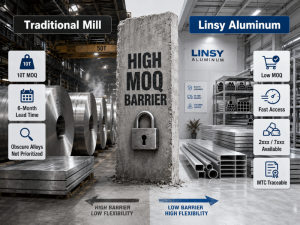
Linsy Aluminum (Premium Alu) is a Shenzhen-based factory with 20+ years of experience and is one of China’s trusted aluminum suppliers. We provide high-quality 2024 and 7075 in forms such as plate, bar, tube, wire, coil, profile, and block, with in-stock standard specs and low-MOQ custom sizes. In-house CNC machining, welding, laser cutting, and surface finishing, plus an MTC for every order and ISO 9001 / 14001 / 45001 certification, back our quality. SGS test reports are available on request at extra cost.
If you need help selecting the right alloy or a quote for your project, contact our team.
FAQ
Can 2024 and 7075 be welded?
Both can be welded, but 2024 needs careful heat control and proper filler to avoid cracking. 7075 is also weld-sensitive in some tempers, so mechanical joining is often preferred for critical structures.
Which alloy machines better?
2024 machines better thanks to lower hardness and good chip formation. 7075 is harder and typically needs rigid setups, sharp tooling, and lower speeds to avoid built-up edge and distortion.
How long does custom 2024 or 7075 take?
Custom production for non-stock sizes typically takes 10-60 days, depending on alloy, dimensions, processing, and order complexity.
Do you provide material certification?
Yes. Linsy issues an MTC for every order after production. SGS test reports are available on request at extra cost.
Which alloy resists corrosion better?
Neither is naturally corrosion resistant. 7075 resists stress corrosion cracking better in some forms, while 2024 needs cladding or anodizing. Both benefit from surface finishing such as anodizing or powder coating.
What product forms are available?
Both alloys are available as plate, bar, tube, wire, coil, profile, and block, in standard stock specs or custom sizes.