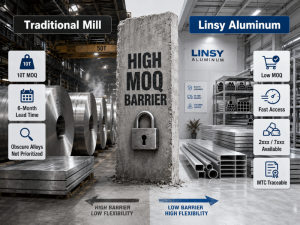
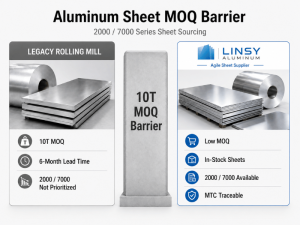
Automated stamping and high-speed roll-forming lines stall immediately when raw material coils carry uneven mechanical tension or surface oxidation defects. The real sourcing challenge is balancing metallurgical precision with volume flexibility — a giant mill’s million-ton capacity becomes an operational liability when its rigid 10-ton MOQ or lack of custom slitting halts your production line.
Why Large Mills Enforce High Aluminum Coil MOQs
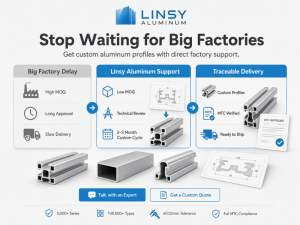
High-speed continuous cold-rolling mills are engineered to process massive tonnages without interruption. Calibrating roll-gap pressures, executing work roll changes, and threading master coils through tension levelers create substantial overhead and scrap costs. To maintain depreciation efficiency, these mills enforce 10-ton minimum order quantities per specification — a production model that makes small-to-medium custom runs economically unviable.
Sourcing teams needing custom slitting widths or uncommon tempers are locked out of traditional mill schedules. State-owned facilities that prioritize massive contracts introduce severe delays for smaller orders compared to agile factory operations.
2026 Comparison Matrix: Top Aluminum Coil Suppliers in China
| Company | Key Alloy Specializations | MOQ | In-House Slitting & Surface Capabilities | Certified Standards |
|---|---|---|---|---|
| Linsy Aluminum | 1000 to 8000 Series (Standard & harder-to-find alloys) | Highly Flexible (Supports small & large batches) | Precision edge slitting, oxidation treatment, custom anodizing & coating | ISO 9001, ISO 14001, ISO 45001 MTC for every order SGS test reports available on request |
| CHALCO | 1000, 3000, 7000 Series (Aerospace & infrastructure) | Rigid 10-ton minimum per specification | Large-scale master coil trimming only | ISO 9001, ASTM, EN Standards |
| Mingtai Aluminum | 1000, 3000, 5000 Series (Commercial sheets & coils) | Flexible for large standard container batches | Standard commercial-level slitting line | GRS 4.0, ISO 9001 |
| Dingsheng New Materials | 1060, 3003, 5052 Series (Ultra-thin battery & HVAC foils) | High tonnage thresholds per gauge selection | High-speed thin substrate foil slitting | CATL & BYD Vendor Certified, ISO 9001 |
| Nanshan Aluminum | Automotive lightweight & aviation grade hard alloys | High enterprise-level tonnage minimums | High-precision integrated automotive sheet finishing | AS9100, NADCAP, IATF 16949, ISO 9001 |
Supplier Profiles
1. Linsy Aluminum — Flexible Stock & Custom Industrial Coils
Linsy Aluminum is a Shenzhen-based aluminum factory with over 20 years of industry experience, supplying aluminum coil products across the full 1000 to 8000 alloy series. The factory-direct model bridges precision metallurgical processing with sourcing flexibility — serving both small-batch validation and high-volume industrial purchasing without the giant-mill MOQ penalty.
In-house production integrates custom slitting lines, annealing furnaces, quenching lines, and oxidation equipment. Every coil delivery undergoes inspection from raw material selection to finished product testing. Custom slitting widths and specialized tempers are available, with non-stock alloy variations supported through custom production at a typical lead time of 10–60 days depending on alloy, dimensions, and processing requirements.
Key Specs
- Lead Time: Immediate for in-stock standard inventory / 10–60 days for custom production
- Width Tolerances: Precision slit edge tolerances down to ±0.10mm
- Certifications: ISO 9001 (Quality), ISO 14001 (Environmental), ISO 45001 (Occupational Health & Safety), MTC for every order, SGS test reports available on request at extra cost
Pros & Cons
- Pro: Broad inventory across multiple alloys reduces wait times for common and harder-to-find specifications
- Pro: In-house edge-trimming machinery produces clean edge finishes with minimal burring
- Pro: MTC documentation issued with every order for full material traceability
- Con: Custom production for non-stock specifications requires 10–60 days depending on alloy and processing complexity
2. CHALCO — State-Owned Infrastructure Scale
CHALCO manages a complete supply chain from bauxite extraction to downstream rolled products, with heavy focus on aerospace plate, military structures, and national electrical grid materials. The company’s website states it added over 500 authorized patents in 2024, backed by significant annual R&D investment. Large-scale continuous rolling line output is an industry benchmark for standard material quality.
The administrative structure operates on traditional state-owned processes. This organizational setup appears better suited for long-term national contract partners than for private mid-market buyers needing quick technical changes or custom coil widths.
Key Specs
- Lead Time: Extended timelines tied to national contract allocation schedules
- Alloy Strengths: Strong capabilities in standard 1000-series and aerospace 7000-series
- Certifications: ISO 9001, ASTM, EN standards
Pros & Cons
- Pro: Metallurgical batch consistency meets international commercial aviation benchmarks
- Pro: Strong environmental macro-metrics with leading red mud utilization rates
- Con: Rigid 10-ton minimum order quantities exclude multi-specification small-to-medium contracts
- Con: Slower communication turnaround times delay urgent supply chain troubleshooting
3. Mingtai Aluminum — High-Volume Commercial Export
Mingtai Aluminum’s website states an annual output capacity of over 1 million tons of rolled sheets, strips, and coils. The company ranks prominently in China’s aluminum plate and coil export volumes, serving the commercial road transport, building facade, and packaging sectors. Strong recycled aluminum integration — with capacity exceeding 1,000,000 tons — limits secondary processing energy to roughly 3–5% of primary smelting.
The facility appears best suited for large standard commercial orders. Low-volume, precision-niche alloy requirements are outside the operational focus of their high-throughput production lines.
Key Specs
- Lead Time: 3–5 months for standard high-volume campaigns
- Gauge Capacity: Full thickness availability across commercial 1000 through 8000 series
- Certifications: GRS 4.0 Global Recycling Standard, ISO 9001
Pros & Cons
- Pro: Competitive cost performance on large contract volumes
- Pro: Flexible logistics supporting Less-than-Container Load (LCL) maritime freight
- Con: Limited catalog depth for military or aerospace-grade hard alloys
- Con: Cosmetic surface consistency can vary across mass-produced commercial batches
4. Dingsheng New Materials — Ultra-Thin Battery & Fin Foils
Dingsheng specializes in ultra-thin aluminum foil and coil, with battery-grade current collector products generating the majority of corporate revenue. The rolling complex maintains stable production capacity for 4.5μm to 8μm ultra-thin substrates and holds multiple core patents for battery-grade foil processing. The company appears to control a substantial share of the domestic HVAC fin coil market.
Dingsheng operates as a verified tier-1 supplier to major lithium-ion battery manufacturers. Because high-speed foil lines require continuous mass-rolling blocks, capacity is structurally reserved for large EV contracts — creating high MOQ barriers for non-EV industrial procurement.
Key Specs
- Lead Time: 3–4 months, linked to battery contract cycles
- Thickness Range: Thin-gauge from 0.20mm down to 4.5μm
- Certifications: CATL & BYD Supplier Certified, ISO 9001
Pros & Cons
- Pro: Elite thickness uniformity for high-speed unwinding and thin-web processing
- Pro: Verified recycled aluminum feeding loop at the Zhenjiang base
- Con: No product coverage for structural industrial plates, bars, or tubes
- Con: High MOQ thresholds exclude general industrial manufacturing from rolling schedules
5. Nanshan Aluminum — Automotive & Aerospace Precision
Nanshan Aluminum’s website states it manages an integrated regional manufacturing loop covering thermal power, alumina refining, smelting, rolling, and scrap recycling within a single geographical zone. The company’s website claims it is among the enterprises in China supplying high-precision aviation blanks to Airbus, Boeing, and COMAC.
The company backs its rolling operations with a national enterprise technology center and a significant patent portfolio. Sourcing teams should note that premium pricing and backlogged production schedules mean the facility appears better suited for long-term aerospace and automotive partnerships than for flexible commercial project procurement.
Key Specs
- Lead Time: Extended timelines due to aerospace and automotive tier-1 allocations
- Technical Focus: Lightweight automotive body sheet coils, aircraft fuselage skin blanks
- Certifications: AS9100 Aviation Quality, NADCAP, IATF 16949, ISO 9001
Pros & Cons
- Pro: Validated aerospace skin panel capability with classification society certifications
- Pro: Low carbon footprint metrics aligned with environmental compliance requirements
- Con: Premium pricing reduces cost competitiveness on standard industrial commodity contracts
- Con: High MOQ thresholds prioritize multi-year corporate partnerships over agile procurement
Technical Evaluation Checklist for Aluminum Coil Sourcing
1. Shape and Flatness Control
Continuous cold-rolling introduces directional internal stresses into the aluminum crystal lattice. Confirm the vendor uses tension-leveling lines and controlled-atmosphere annealing. Proper thermal stress relief ensures uniform mechanical properties across the roll length, preventing coil breaks, strip walking, or dimensional springback when uncoiling into progressive dies.
2. Surface Quality and Finishing Capabilities
Uncontrolled rolling temperatures or improper mill lubrication leave organic oil films on the metal surface. Factories with integrated in-house oxidation and chemical coating lines prevent oil blemishes, corrosion pitting, and finish scratching. Clean degreasing inside annealing loops preserves surface energy above safe dyne thresholds — critical for powder coating adhesion and automated stamping line performance.
3. Precision Edge Slitting and Width Tolerances
Slitting master coils to custom strip widths requires continuous maintenance of rotary slitting knives. Dull or misaligned blades generate micro-scale burrs, edge waves, and stress cracks. A plant maintaining width tolerances down to ±0.10mm ensures consistent material feeding on high-speed roll-forming and stamping lines.
Seamless Global Logistics
Linsy Aluminum’s production base in Guangdong Province provides direct access to China’s industrial light-alloy supply chain, with routing to high-capacity container terminals. A corporate office in Qingdao, Shandong, manages technical data verification and customs dispatch for international procurement. Coils are packed in reinforced steel eye-to-sky or eye-to-wall export wooden cradles, protecting material layers from moisture oxidation during ocean transport.
Conclusion
Sourcing aluminum coil from China forces a clear trade-off: large state-owned mills offer batch consistency and full-chain capacity, but their rigid MOQ thresholds and slow administrative cycles exclude small-to-medium buyers. Factories optimized for niche applications — battery foils at Dingsheng, aerospace grades at Nanshan — deliver elite performance within narrow product windows, not broad industrial coverage.
Linsy Aluminum addresses this gap. As a Shenzhen-based factory with over 20 years of experience, Linsy supplies aluminum coil across 1000–8000 series alloys with flexible MOQs, custom slitting, and in-house surface treatment. In-stock items ship immediately, and non-stock specifications are supported through custom production at a typical lead time of 10–60 days — with MTC documentation for every order and SGS test reports available on request.
If the project requires custom slitting widths, specific alloy coil, or full material traceability, send the drawing or specification for a technical review and quote.
FAQ
Why do most Chinese aluminum coil factories refuse customized slit widths under 5 tons?
Setting up rotary slitting knives for specialized widths requires mill downtime, blade spacing calibration, and trial material testing. In high-volume continuous mills, the setup labor and scrap make short runs financially unviable. Linsy keeps standardized wide master coils in stock across multiple gauges and executes precision slitting and custom narrow-edge cutting on demand without prohibitive tonnage minimums.
Which aluminum coil alloy series is best for severe industrial forming and roofing?
3000-series aluminum-manganese alloys (such as 3003 aluminum) provide an exceptional balance of ductility and atmospheric corrosion protection — the standard choice for building facades and progressive roll-forming. For harsher marine or chemical environments, 5052 and 5083 aluminum-magnesium alloys provide higher strength and better resistance to saltwater pitting.
How does residual rolling oil impact post-processing like powder coating or lamination?
If a rolling plant cuts corners on thermal degreasing during the final annealing cycle, a thin organic layer of lubricant remains on the metal surface. This film lowers surface energy below safe dyne thresholds, preventing powder coatings, anti-corrosion paints, or protective films from forming a stable bond. Linsy runs synchronized degreasing inspection controls so coil surfaces remain clean and ready for downstream processing.
What certifications should an international buyer require for coil mechanical properties?
A quality management framework certified under ISO 9001 is the baseline. Every shipment should include a Material Test Certificate (MTC) listing the heat number, chemical composition analysis, tensile strength, yield point, and elongation percentage. Sourcing from an accredited factory with direct MTC issuance reduces the risk of material substitution that can occur through uncertified trading channels.
What is the typical lead time for custom aluminum coil specifications?
Lead time depends on alloy, dimensions, processing requirements, and order complexity. Large mills with dedicated production schedules may quote 3–6 months or more for non-standard specifications. Agile factory-direct operations like Linsy typically deliver custom coil production in 10–60 days, with in-stock standard items shipping immediately.