2024-T851 Aluminium: Eigenschappen, Temperatuur en Hoe het te Specificeren
Gratis monster
China Fabrikant
Snel antwoord
Bulkaankoop korting
China Fabrikant
Wat is 2024-Aluminium?
2024 is een aluminiumlegering uit de 2000-serie met koper als voornaamste legeringselement (3,8–4,9% Cu) en magnesium (1,2–1,8%) plus mangaan (0,30–0,90%) als secundaire versterkers. Het bereikt hoge sterkte door precipitatieharding na een oplossingswarmtebehandeling, wat het plaatst onder de sterkste vervormbare aluminiumlegeringen.
Dat kopergehalte maakt 2024 ook de minst corrosiebestendige van de gangbare luchtvaartlegeringen en over het algemeen ongeschikt voor smeltlassen — onbeklede secties zijn gevoelig voor interkristallijne en exfoliatiecorrosie en vereisen bekleding, anodiseren of verf ter bescherming. Het is dit sterkte-gewichtsprofiel, gecombineerd met betrouwbare bewerkbaarheid, dat 2024 de standaardkeuze maakt voor vliegtuigconstructies en hoogwaardige structurele onderdelen.
Inzicht in de T851-temper
De aanduiding “T851” beschrijft een drietraps thermisch-mechanische behandeling toegepast op 2024-plaat en vergelijkbare gewalste of gesmede producten:
Oplossingsgloeien. De plaat wordt verwarmd tot ongeveer 493°C (920°F) om koperrijke precipitaten op te lossen in een uniforme vaste oplossing, en vervolgens snel afgeschrikt.
Spanningontlasting door rekken. Binnen een kort tijdsvenster na het afschrikken wordt de plaat 1–3% van zijn lengte gerekt. Deze gecontroleerde plastische vervorming ontspant de restspanningen die door het snelle afschrikken zijn vastgezet.
Kunstmatige veroudering. De gerekte plaat wordt verwarmd tot een lagere temperatuur (ongeveer 190°C / 375°F) om de versterkingsfase te precipiteren, waardoor de sterkte tot zijn piek stijgt.
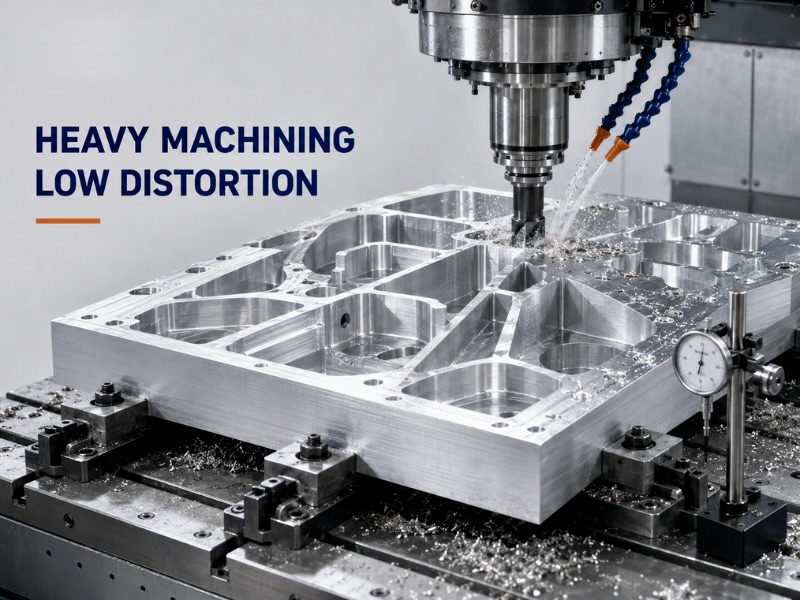
Het praktische resultaat is een 2024-plaat die de maximale statische sterkte van de legering combineert met lage restspanning. Het voordeel wordt zichtbaar tijdens het bewerken: een T851-plaat blijft vlak en stabiel terwijl materiaal wordt verwijderd, daarom wordt het geprefereerd voor precisiebewerkte fittingen en blokken. Voor smeedstukken is de equivalente compressieve spanningsontlastingstemper T852; het achtervoegsel “1” duidt rekontlasting aan voor plaat en gewalst product.
Hoe T851 verschilt van T351
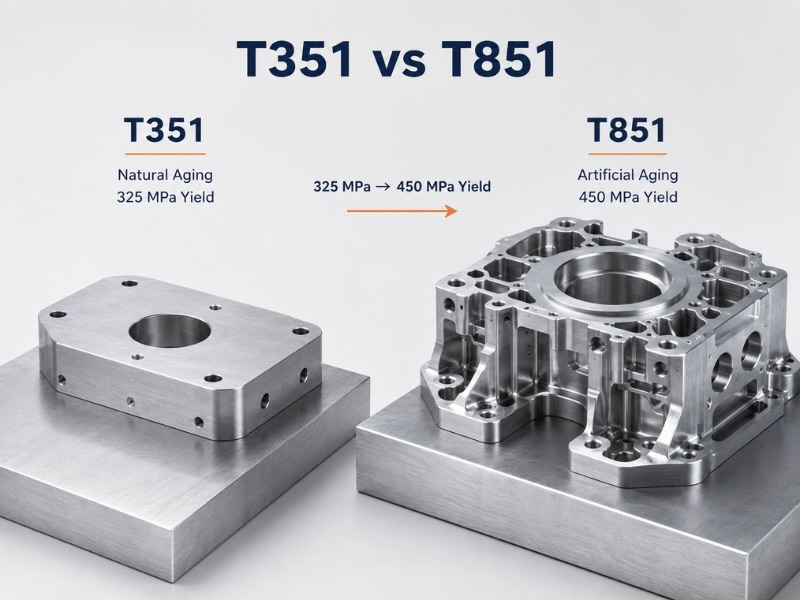
T851 en T351 delen dezelfde oplossingswarmtebehandeling en rekontlasting. Het verschil zit in de laatste stap: T351 wordt natuurlijk verouderd bij kamertemperatuur, terwijl T851 kunstmatig verouderd bij verhoogde temperatuur. Die ene wijziging verhoogt de vloeigrens van ongeveer 325 MPa (T351) naar ongeveer 450 MPa (T851) — de grootste sterkteverbetering tussen twee 2024-tempers — maar verlaagt de rek van ongeveer 19% naar ongeveer 5%. T851 ruilt ductiliteit in voor pieksterkte en bewerkingsstabiliteit.
Mechanische eigenschappen van 2024-T851
Eigendom
Waarde
Opmerking
Dichtheid
2,78 g/cm³
Typisch voor 2xxx-serie
Uiteindelijke treksterkte
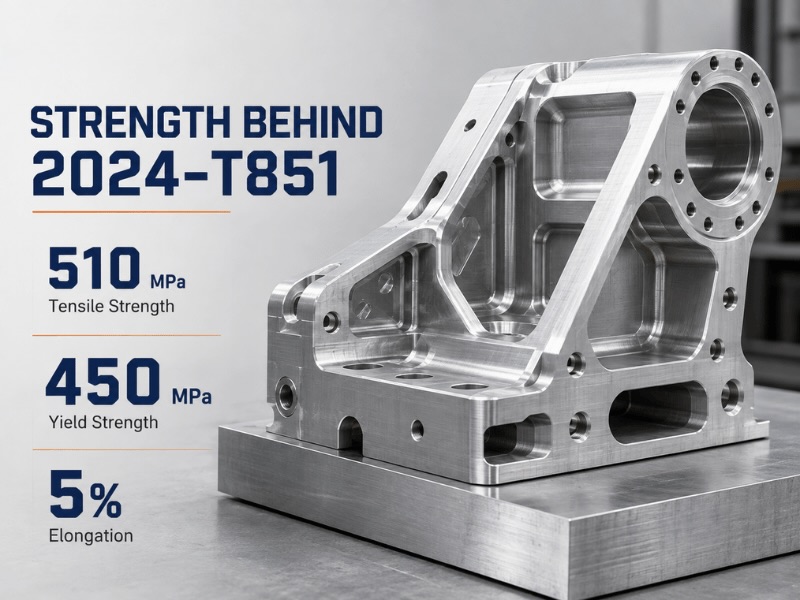
510 MPa (74 ksi)
Plaat, kamertemperatuur
Trekvloeigrens (0,2%-offset)
450 MPa (65 ksi)
Piek onder 2024-tempers
Rek bij breuk
~5%
Veel lager dan T351 (~19%)
Vermoeiingssterkte (5×10⁸ cycli)
~120 MPa (17 ksi)
Glad proefstuk, R = −1
Afschuifsterkte
300 MPa (43 ksi)
Relevant voor bevestigingsverbindingen
Elasticiteitsmodulus
73 GPa (10,6×10³ ksi)
~Een derde van staal
Thermische geleidbaarheid
121 W/m·K
Goede warmteafvoer
Thermische uitzettingscoëfficiënt
23 µm/m·K
-
Specifieke warmtecapaciteit
875 J/kg·K
-
Smeltbereik
502–638°C
Solidus tot liquidus
De vloeigrens van 450 MPa is het getal dat de meeste T851-ontwerpen aandrijft — het ligt ruim boven 6061-T6 (ongeveer 276 MPa) en ongeveer 40% boven T351, waardoor ingenieurs dwarsdoorsneden kunnen verkleinen of marge kunnen toevoegen in compressiekritische onderdelen. De afweging is ductiliteit en corrosie, hieronder behandeld.
Waar 2024-T851 wordt toegepast
De combinatie van pieksterkte, lage restspanning en dimensionale stabiliteit na bewerking maakt T851 de temper van keuze voor dikke 2024-plaat die wordt bewerkt tot hoogbelaste componenten.
Luchtvaart- en defensiestructuren
Vleugelliggers en onderste vleugelhuiden, rompspanten, schotten en structurele fittingen worden vaak gefreesd uit 2024-T851-plaat omdat de spanningsontlaste conditie grote of asymmetrische secties stabiel houdt tijdens het frezen. Landingsgestelcomponenten, hydraulische klephuizen en hogesterktebevestigingen gebruiken dezelfde temper waar statische sterkte en bewerkingsnauwkeurigheid niet onderhandelbaar zijn. In deze toepassingen wordt de plaat normaal gesproken alclad of oppervlaktebeschermd, aangezien onbeklede 2024 agressieve omgevingen niet onbeschermd overleeft.
Precisiegereedschap en hogesterkteblokken
Motorsport-ophangingsdelen, tuimelaars en structurele beugels gefreesd uit T851-plaat leveren gewichtsbesparing op ten opzichte van staal zonder stijfheid in te leveren. Precisiemallen, inspectiefixtures en automatiseringsframes gebruiken T851 omdat het vlak blijft bij temperatuurschommelingen en herhaalde belastingscycli. Waar het onderdeel wordt gelast in plaats van bevestigd, is 6061 meestal het betere uitgangspunt — zie de werkaantekeningen hieronder.
Twee voorwaarden wijzen op T851: het onderdeel is een plaat of gesmeed blok dat zal worden bewerkt, en het vereist de hoogst mogelijke statische sterkte of bewerkingsstabiliteit. Als beide gelden, betaalt de kunstmatige verouderingsbehandeling zich terug in verminderd uitval en herbewerking bij grote, dunne of kritisch gedimensioneerde secties.
Wanneer een andere toestand beter past
Wanneer de geometrie een geëxtrudeerde staaf, buis of profiel is, levert T3511 dezelfde spanningsontlasting in de juiste productvorm. Wanneer matig vormen vereist is, behoudt T351 of T4 voldoende ductiliteit om het onderdeel te buigen of vorm te geven. Wanneer lassen of zoutwatergebruik deel uitmaakt van de vereisten, moet men volledig van 2024 afstappen — 6061 of een 5xxx-legering verwijdert de corrosie- en lasbaarheidsbeperkingen ten koste van lagere sterkte.
Werken met 2024-T851 — wat u moet weten
Bewerking. 2024-T851 laat zich schoon bewerken met goede spaandercontrole en ondersteunt hoge snijsnelheden, daarom is het een basisproduct voor precisie-CNC-plaat en schroefmachineproducten. Gereedschapsslijtage blijft beheersbaar, maar scherpe gereedschapsgeometrie en consistente koelmiddelstroom houden de oppervlakteafwerking strak op dunne secties. De lage restspanning is het echte voordeel: onderdelen blijven vlak tijdens zware materiaalverwijdering.
Lassen en verbinden. Smeltlassen wordt niet aanbevolen voor 2024. De koperrijke samenstelling maakt de las en de warmte-beïnvloede zone gevoelig voor hete scheurvorming, en de sterkte na het lassen kan ver onder het basismateriaal dalen. Gebruik voor samenstellingen klinknagels, bouten of lijmverbindingen; indien een gelaste constructie onvermijdelijk is, wijzig het ontwerp dan naar 6061-T6 en accepteer de lagere sterkte.
Corrosiebescherming. Blank 2024 heeft een slechte corrosiebestendigheid en is kwetsbaar voor interkristallijne en exfoliatie-aantasting, vooral in chloride-omgevingen. Specificeer alclad (een metallurgisch gebonden zuivere aluminium oppervlaktelaag) voor vliegtuighuiden, of combineer anodiseren en verf voor gesloten constructies. Bij directe onderdompeling in zout water of maritieme omgevingen is 2024 de verkeerde keuze, ongeacht de tempering.
Vervormbaarheid. T851 wordt geleverd als kunstmatig verouderde plaat met bijna maximale sterkte, dus het is niet bedoeld voor zware koude vervorming na behandeling — buigen riskeert scheurvorming omdat de ductiliteit slechts ongeveer 5% bedraagt. Vorm of buig het profiel waar mogelijk vóór de uiteindelijke veroudering, of kies T351/T4 als het ontwerp buigingen vereist.
Voor- en nadelen in één oogopslag
Afmeting
Voordeel
Beperking
Sterkte-gewichtsverhouding
Hoogste statische sterkte van gesmeed 2024
-
Bewerkingsstabiliteit
Spanning-ontlastte plaat, lage vervorming
-
Weerstand tegen vermoeiing
Sterk voor constructies met cyclische belasting
Lagere hoge-cyclische vermoeiingsweerstand dan T351
Corrosiebestendigheid
-
Slecht; vereist bekleding of coating
Lasbaarheid
-
Smeltlassen niet aanbevolen
Beschikbaarheid
Standaard en op maat gemaakte plaat beschikbaar
Geen algemene plaatvervanger
Kosten
-
Hoger dan 6061
Conclusie
2024-T851 biedt de hoogste statische sterkte en de beste bewerkingsstabiliteit van alle 2024-temparingen voor dikke plaat en gesmede blokken — maar dit gaat ten koste van ductiliteit, corrosiebestendigheid en lasbaarheid. Deze afweging is alleen beheersbaar met het juiste beschermings- en verbindingsplan, en het verkrijgen van de juiste plaat met documentatie is waar projecten vastlopen.
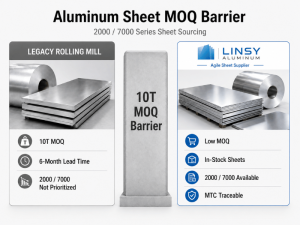
Linsy Aluminum levert 2024 aluminium in plaat, staaf, buis, profiel, en draadvormen — inclusief T851-plaat — met nauwe toleranties en temperingen afgestemd op uw toepassing. Standaardmaten uit voorraad en maatwerkproductie met lage minimale bestelhoeveelheid worden doorgaans binnen 10–60 dagen geleverd, elke bestelling wordt verzonden met een MTC, SGS-testrapporten (inclusief ultrasoon onderzoek voor dikke platen) zijn op verzoek beschikbaar, en de fabriek beschikt over ISO 9001-, 14001- en 45001-certificeringen.
Wat is het verschil tussen 2024-T851 en 2024-T351?
Beide ondergaan een oplossingswarmtebehandeling en rekvrijspanning, maar T351 wordt op natuurlijke wijze verouderd bij kamertemperatuur, terwijl T851 kunstmatig wordt verouderd. Deze ene stap verhoogt de vloeigrens van ongeveer 325 MPa (T351) tot ruwweg 450 MPa (T851) en verlaagt de rek van ongeveer 19% tot ongeveer 5% — T851 ruilt ductiliteit in voor pieksterkte.
Kan 2024-T851 worden gelast?
Nee. Smeltlassen wordt niet aanbevolen. De koperrijke legering scheurt in de las en de warmte-beïnvloede zone en verliest een groot deel van zijn sterkte. Gebruik mechanische bevestiging of lijmverbindingen, of kies 6061-T6 als lassen vereist is.
Is 2024-T851 geschikt voor maritiem of zoutwatergebruik?
Nee. Blank 2024 heeft een slechte corrosiebestendigheid en zal putcorrosie of exfoliatie vertonen in chloride-omgevingen. Voor zoutwater- of maritieme onderdompeling is een 5xxx- of 6xxx-legering de veiligere keuze; 2024 hoort thuis in gesloten of goed gecoate constructies.
Wat zijn de belangrijkste voordelen van 2024-T851?
Piekstatische sterkte onder 2024-temparingen (ongeveer 450 MPa vloeigrens), lage restspanning die grote bewerkte platen vlak en stabiel houdt, en goede vermoeiingsweerstand voor constructies met cyclische belasting. Het is de standaardkeuze voor bewerkte hoogsterkte luchtvaartplaat.
Hoe verhoudt 2024-T851 zich tot 6061-T6?
T851 levert ongeveer 40–60% hogere vloeigrens en betere bewerkingsstabiliteit, maar geeft corrosiebestendigheid en lasbaarheid op en kost meer. 6061-T6 is de betere keuze wanneer het onderdeel moet worden gelast, blootgesteld wordt aan maritieme omstandigheden, of kostenefficiënt moet blijven; 2024-T851 wint wanneer sterkte-gewichtsverhouding en bewerkingsnauwkeurigheid domineren.
David Huang
David Huang is een zeer gerespecteerde expert in China's industrie voor aluminiumlegeringen en heeft meer dan tien jaar ervaring in het ontwikkelen, produceren en toepassen van geavanceerde aluminiumlegeringen. Hij heeft een bewezen staat van dienst in het succesvol leveren van projectoplossingen en technische expertise aan toonaangevende internationale bedrijven in diverse sectoren, waaronder lucht- en ruimtevaart, auto's en de bouw. David is ook een vertrouwde adviseur voor meerdere grote aluminiumfabrikanten in China.
24/7 Service | Antwoord binnen 10 minuten!
Neem voor meer catalogi, details en offertes direct contact met ons op!