What This Guide Covers
The alloy you choose for CNC machining determines more than just material cost. It affects tool wear, surface finish quality, whether the part can be anodized, and how it performs under load or in corrosive environments. A good alloy selection can cut machining time, reduce scrap, and produce dimensionally stable parts. A poor match leads to the opposite — warping, blotchy finishes, and premature failure.
This guide walks through the aluminum CNC machining process, explains why aluminum is the go-to metal for CNC work, compares the four most commonly machined alloys (6061, 7075, 5052, and 6063), and maps each alloy to the surface finishes it works with best. If you need to understand which aluminum alloys weld reliably after machining, we have a dedicated guide for that decision as well.
What Is Aluminum CNC Machining
Aluminum CNC machining is a subtractive manufacturing process. A computer-controlled cutting tool removes material from a solid aluminum blank — plate, bar, or tube — until the finished part geometry is achieved. The process is called subtractive because the part emerges as material is cut away, in contrast to additive methods like 3D printing.
The machine provides the precision, but the aluminum grade determines whether the result is clean and consistent. Some alloys chip smoothly and hold tight tolerances. Others are gummier and build up on the tool. A few warp noticeably after stress is released during cutting. Choosing a CNC-machinable aluminum means selecting a grade that cuts predictably, resists distortion, and accepts the required surface finish.
A CNC-machinable aluminum should:
- Cut smoothly with controlled chip formation and minimal tool wear
- Hold dimensions within tolerance after material removal releases internal stress
- Accept the intended surface finish — anodizing, chem film, bead blasting, or as-machined
- Be metallurgically consistent — no internal voids, inclusions, or composition variation that create hard spots on the tool
Stress-relieved stock makes a measurable difference. At Linsy Aluminum, CNC-grade material is supplied with Mill Test Certificates (MTCs) for traceability, so the alloy, temper, and composition are confirmed before the first cut.
铝数控加工的工作原理
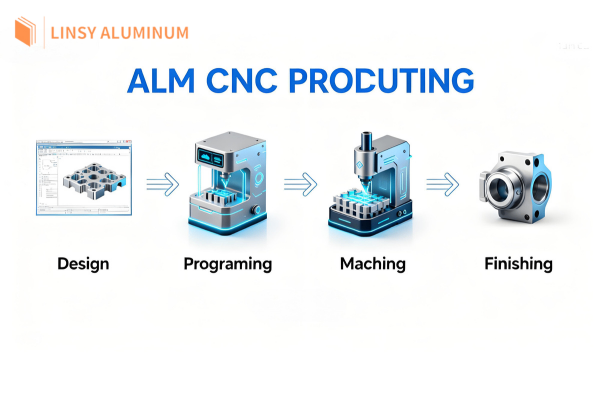
The workflow follows four standard steps, whether the part is a single prototype or a production run:
- 设计 — A 3D CAD model defines the part geometry, tolerances, and surface finish requirements.
- 编程 — CAM software translates the model into G-code, specifying tool paths, cutting speeds, feed rates, and coolant strategy.
- 机械加工 — A CNC mill or lathe executes the program. Multi-axis machines (3-axis, 4-axis, or 5-axis) handle increasingly complex geometries in fewer setups.
- 精加工 — The part is deburred, cleaned, and sent for surface treatment if specified — anodizing, bead blasting, chem film, or powder coating.

The process is fast and repeatable, but results depend on starting with consistent aluminum stock. Poor material quality produces unpredictable results even on the best machines.
Why Aluminum for CNC Projects
Aluminum is not just popular in CNC machining — it is the practical default for prototypes, functional parts, and production components across most industries. The material cuts roughly three to four times faster than stainless steel, requires less tooling force, and produces excellent surface finishes with the right alloy and post-processing.
Compared to common alternatives, the trade-offs break down as follows.
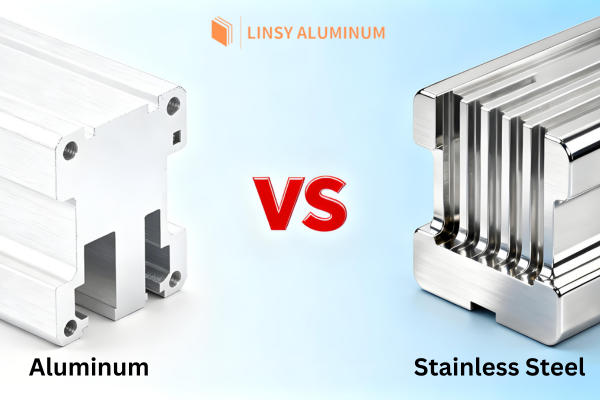
Aluminum vs Stainless Steel in CNC Machining
| 财产 | 铝质 | 不锈钢 |
|---|---|---|
| 机械加工性能 | Excellent — 3 to 4 times faster than steel | Good, but slower and requires more tooling force |
| 强度重量比 | Excellent — lightweight for its strength level | Good, but approximately 3 times heavier |
| 耐腐蚀性 | Good to excellent — alloy-dependent; 5052 and 6061 perform well in most environments | Excellent — especially in chloride-rich conditions |
| Material Cost | Generally lower than stainless steel | Typically higher |
| 表面处理 | Highly receptive to anodizing, chem film, bead blasting, and powder coating | Can be polished to a high sheen; fewer finish options overall |
Aluminum wins on speed and finish flexibility. Stainless steel wins on raw durability and extreme corrosion resistance. If weight, machining time, or surface finish variety matter most, aluminum is usually the better fit.

CNC-Ready Aluminum Alloys — Which Grade Fits Your Project
The biggest mistake beginners make is assuming all aluminum grades machine the same way. Each alloy behaves differently under the tool, and the wrong choice produces warping, poor surface finish, or failed surface treatments. The four alloys below cover the majority of CNC machining applications.
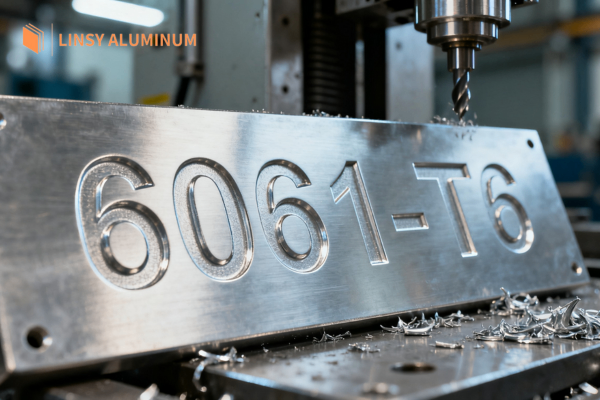
6061-T6 — General Purpose and Prototyping
6061-T6 is the most widely used CNC aluminum alloy — and for good reason. It balances machinability, strength, corrosion resistance, and anodizing response better than any other single grade. It cuts smoothly, produces clean chips, and holds tight tolerances with minimal distortion.
This makes it the standard for brackets, enclosures, automotive components, machine frames, and general engineering parts. If the project does not demand extreme strength or saltwater-grade corrosion resistance, 6061-T6 is usually the correct starting point.
One practical note: 6061-T6 welds well, but loses significant strength in the heat-affected zone. If post-machining welding is planned, factor this into the design. Refer to our guide on weldable aluminum alloys for a broader comparison.
| 财产 | 6061-T6 |
|---|---|
| 拉伸强度 | Approximately 310 MPa |
| 机械加工性能 | Excellent — smooth cutting, clean chip formation |
| 焊接性 | Good — TIG and MIG compatible; note HAZ strength loss |
| 耐腐蚀性 | Good — suitable for indoor and general outdoor use |
| 阳极氧化结果 | Uniform — accepts clear, black, and color anodizing well |
| 常见用途 | Brackets, enclosures, machine frames, automotive parts, prototypes |

7075-T6/T651 — High-Strength Applications
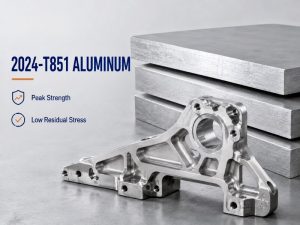
When strength-to-weight ratio is the primary requirement, 7075-T6/T651 is the alloy to reach for. Alloyed primarily with zinc, it delivers tensile strength comparable to many steels at roughly one-third the weight. Aerospace wing spars, fuselage fittings, drone frames, high-performance bicycle components, and defense hardware all rely on 7075 for this reason.
The trade-offs are real. 7075 is harder on tooling than 6061, is not weldable by standard methods, and has lower corrosion resistance — protective coatings like chem film or paint are usually required for outdoor or marine exposure. It also does not anodize cleanly; the high zinc content produces dark, blotchy results. Use 7075 when strength is non-negotiable. Otherwise, 6061 is the more practical and cost-effective choice.
| 财产 | 7075-T6/T651 |
|---|---|
| 拉伸强度 | Approximately 570 MPa — among the highest for aluminum alloys |
| 机械加工性能 | Fair — harder on tooling than 6061 |
| 焊接性 | Poor — not recommended by standard methods |
| 耐腐蚀性 | Low — typically requires chem film or paint protection |
| 阳极氧化结果 | Poor — tends to turn dark or blotchy due to zinc content |
| 常见用途 | Aircraft fittings, drone frames, defense components, climbing gear |

5052-H32 — Marine, Chemical, and Outdoor Environments
5052-H32 is the alloy to specify when the part will face saltwater, chemical exposure, or prolonged humidity. A non-heat-treatable grade strengthened by cold working, it offers the best corrosion resistance among commonly machined aluminum alloys, particularly in marine atmospheres.
The trade-off: 5052 machines less cleanly than 6061 — it is gummier and requires sharper tool geometry and more attention to chip evacuation. It also cannot match 6061 in strength or 7075 in peak tensile values. But for marine hardware, fuel tanks, chemical storage vessels, and outdoor enclosures where long-term environmental resistance matters more than ultimate strength, 5052-H32 is the right choice.
| 财产 | 5052-H32 |
|---|---|
| 拉伸强度 | Approximately 225 MPa — highest among non-heat-treatable grades |
| 机械加工性能 | Moderate — gummier than 6061; sharper tool geometry recommended |
| 焊接性 | Excellent — TIG and MIG compatible |
| 耐腐蚀性 | Excellent — especially in saltwater and chemical environments |
| 可热处理 | No — strength comes from cold working |
| 常见用途 | Marine hardware, fuel tanks, chemical vessels, outdoor enclosures |

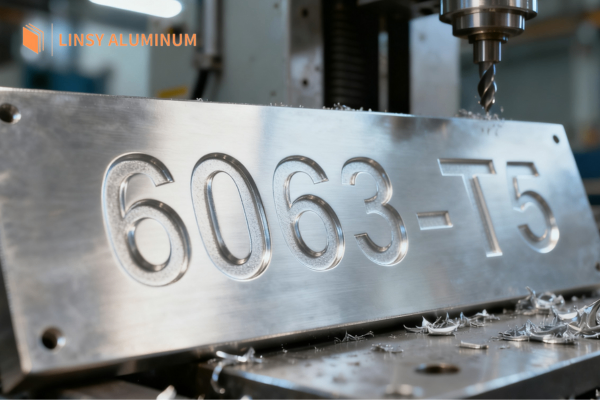
6063-T5/T6 — Aesthetic and Architectural Parts
When surface appearance drives the specification, 6063-T5/T6 is the best choice among machinable aluminum alloys. Often called architectural aluminum, 6063 produces an exceptionally smooth surface that anodizes to a deep, uniform finish — making it the standard for visible hardware, consumer electronics housings, lighting trims, window frames, and door systems.
Mechanical strength is lower than 6061 — roughly 170 to 210 MPa tensile — so 6063 is generally not the right choice for load-bearing structural parts. But for parts where visual quality, color consistency, and surface uniformity are the deciding factors, 6063 delivers results that 6061 and 7075 cannot match.
| 财产 | 6063-T5/T6 |
|---|---|
| 拉伸强度 | Approximately 170–210 MPa |
| 机械加工性能 | Good — cuts cleanly with consistent surface quality |
| 表面处理 | Exceptionally smooth — best base for anodizing among common CNC alloys |
| 阳极氧化结果 | Highly uniform — ideal for colored and clear anodized finishes |
| 结构强度 | Moderate — not suited for primary load-bearing parts |
| 常见用途 | Window frames, consumer electronics housings, lighting trims |

Surface Finishes and Alloy Compatibility
Aluminum’s advantage in CNC machining extends beyond machinability — the material works with a wide range of surface treatments. But not every alloy accepts every finish equally well. Selecting the wrong alloy and finish combination can produce uneven color, poor coating adhesion, or premature corrosion, even with a correctly executed finishing process.
机加工
The as-machined finish is the raw surface left after CNC cutting — no post-processing applied. Tool marks are visible, usually as fine spiral patterns, but the surface is smooth to the touch and dimensions are preserved with no risk of tolerance shift from coating build-up.
Best suited for internal components, functional prototypes, and high-volume parts where cost and speed are the priority over appearance.

Type II Anodizing — Standard and Color
Type II anodizing builds a thin, porous oxide layer on the aluminum surface. The layer enhances corrosion resistance and readily accepts dyes, producing colored finishes that do not chip or peel. This is the most common finish for consumer-facing parts, enclosures, and architectural hardware.
- 最佳选择: 6061-T6 and 6063-T5/T6 — uniform color, consistent results
- 避免: 7075-T6 — high zinc content produces dark, blotchy anodizing

Type III Hardcoat Anodizing
Hardcoat anodizing produces a much thicker, harder oxide layer — up to three times harder than Type II. The result is high wear resistance, making it the right choice for aerospace brackets, military housings, industrial fixtures, and any part exposed to abrasion or heavy use.
- 最佳选择: 6061-T6 — most reliable and predictable results
- 慎用: 7075 — internal stresses can cause cracking under thick hardcoat layers
While hardcoat can be dyed, colors appear darker due to the dense layer structure. Most applications specify clear or black for maximum durability.

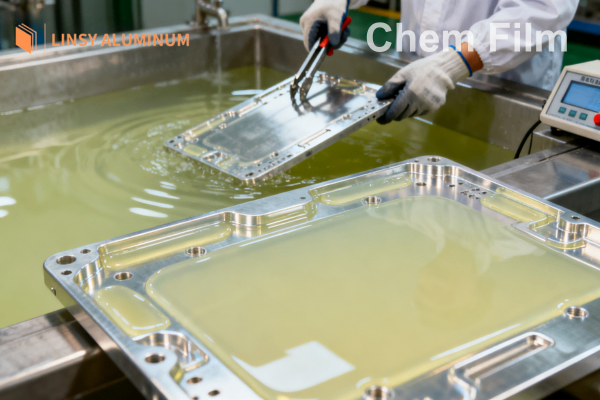
Chem Film — Alodine Conversion Coating
Unlike anodizing, chem film (Alodine) is a thin chemical conversion coating. It provides moderate corrosion resistance while preserving electrical conductivity — a key requirement for EMI/RFI shielding enclosures, electronic chassis, and parts that need paint or adhesive bonding afterward.
A practical advantage: chem film adds almost no measurable thickness, making it suitable for tight-tolerance assemblies where even the few microns from anodizing could cause fit issues. It works on all major aluminum alloys, including 7075-T6, which makes it the standard protective finish when anodizing is not viable.

Bead Blast and Clear Anodize
This two-step process produces the matte, satin-textured look common in premium consumer electronics and medical devices:
- Bead blasting removes visible machining marks and creates a uniform satin texture across the entire surface.
- Clear anodizing seals the blasted surface, locking in the texture while adding scratch and corrosion resistance.
- 最佳选择: 6061-T6 or 6063-T6 — consistent grain structure produces even texture and color
- 避免: Alloys with inconsistent grain — impurities or coarse grain show as visible blotches after blasting


结论
Getting the aluminum alloy right for CNC machining is a practical decision with measurable consequences. 6061-T6 covers most general-purpose work with the best all-around balance of machinability, finish compatibility, and cost. 7075-T6/T651 delivers the strength that aerospace and high-performance applications demand but trades away weldability and anodizing quality in the process. 5052-H32 is the answer when saltwater or chemical exposure is the primary risk — at the cost of slower machining. 6063-T5/T6 wins on surface finish and anodizing uniformity but should not be used where structural strength is the main requirement.
The common thread across all four alloys is that the quality of the aluminum stock matters as much as the grade itself. Inconsistent composition, internal stress, or lacking traceability can turn the right alloy choice into the wrong machining outcome.
Linsy Aluminum supplies CNC-grade 6061, 7075, 5052, and 6063 in plate, bar, and tube, with Mill Test Certificates (MTCs) for every order. Custom dimensions and low minimum order quantities are supported for non-stock items, with a typical lead time of 10 to 60 days depending on alloy, size, and processing requirements. SGS test reports — including chemical composition, mechanical properties, and dimensional inspection — are available on request at additional cost.
If you are still deciding between two grades, or need to confirm the temper, form, and document package before ordering, send the drawing or specification for a technical review.

常见问题
Can 7075 aluminum be anodized after CNC machining
7075-T6 can be anodized, but the results are usually poor for cosmetic applications. The alloy’s high zinc content causes the anodic layer to form unevenly, producing a dark, blotchy appearance rather than a clean, uniform finish. For parts that need a colored or clear anodized look, 6061 or 6063 are the better choices. If 7075 must be used for strength reasons, chem film (Alodine) is the standard protective coating — it preserves corrosion resistance without the cosmetic problems of anodizing.
What is the difference between 6061-T6 and 6061-T651
T651 is a sub-designation of T6. Both tempers are solution heat-treated and artificially aged to the same strength level. The difference is that T651 material has been stretched after heat treatment to relieve internal stress, followed by minor straightening. For CNC machining, T651 is generally preferred over plain T6 — the stress-relief step reduces the risk of warping or dimensional shift during material removal, especially on longer or thinner parts.
Does 6061-T6 need post-weld heat treatment after CNC machining
6061-T6 loses a significant portion of its strength in the heat-affected zone after welding — the area near the weld can drop to roughly the strength of annealed 6061-O. Whether post-weld heat treatment is necessary depends on the application. For non-structural parts where full T6 strength is not required, the as-welded condition may be acceptable. For load-bearing or fatigue-critical parts, post-weld solution heat treatment and artificial aging are recommended to restore strength across the entire component.
What minimum order quantity does Linsy Aluminum support for CNC-grade stock
Linsy Aluminum supports low minimum order quantities for non-stock custom items. Standard in-stock specifications are available without a high MOQ requirement. Custom dimensions, specific tempers, and non-standard sizes are produced to order with a typical lead time of 10 to 60 days, depending on alloy, dimensions, and processing requirements.
How should I choose between 6061 and 7075 for a prototype
Start with 6061-T6 unless the prototype has a specific requirement that can only be met by 7075. 6061 machines faster, costs less, anodizes predictably, and is widely available. Only switch to 7075 if the prototype must demonstrate ultimate tensile strength or fatigue performance comparable to the production part — for example, a functional aerospace bracket or a load-bearing drone component. For fit-check prototypes, form studies, or proof-of-concept builds, 6061 is almost always the practical answer.