At 6–8 µm the question is not how strong the foil is. It is whether there is a hole in it. A pinhole in a blister lidding or a retort pouch is not a defect anyone sorts out — it is a batch that gets rejected, and it turns up on the packing line weeks after the coil was accepted.
8079 exists to make that failure less likely, and it does it by rebalancing 8011 rather than by strengthening it: less silicon, more iron. It buys pinhole performance and elongation, and it pays for them with strength. The specifications, forms and sizes are on the 8079 aluminum page.
Why 8079 Exists
8011’s Ceiling
8011 is the workhorse of packaging foil, and its chemistry is why: silicon at 0.50–0.90% and manganese up to 0.20% raise strength and stiffness, which is exactly what a lidding or a container wall wants.
At micro gauge the same additions work against the barrier. Silicon does not sit quietly in solid solution — it forms coarse particles, and a 6–8 µm wall is only a few particle diameters thick. Where those particles cluster, the rolling pass tears instead of thinning. A stronger alloy is therefore not automatically the better barrier; at the thin end it is often the worse one.
That is the ceiling 8079 was designed to get around.
The Rebalance
8079 reverses the ratio. Silicon drops to 0.05–0.30% and iron rises to 0.70–1.30%. Iron still gives strength and puncture resistance, but through fine, evenly distributed iron-bearing phases rather than a coarse silicon phase, so the metal thins evenly at gauge instead of tearing.
What that buys is a lower pinhole rate and higher elongation. What it costs is strength: measured head to head, this grade sits below 8011 on tensile and above it on ductility. Neither reading is a fault. They are one trade seen from two sides, and the pack decides which side matters.
Pinholes, Not Strength, Decide the Grade
What a Pinhole Is
A foil is a barrier only where it is continuous. At 6 µm the wall is thinner than a human hair and only a handful of particle diameters thick, so a cluster of inclusions is not a cosmetic mark — it is a hole through the barrier, and it is a hole before the foil is ever laminated.
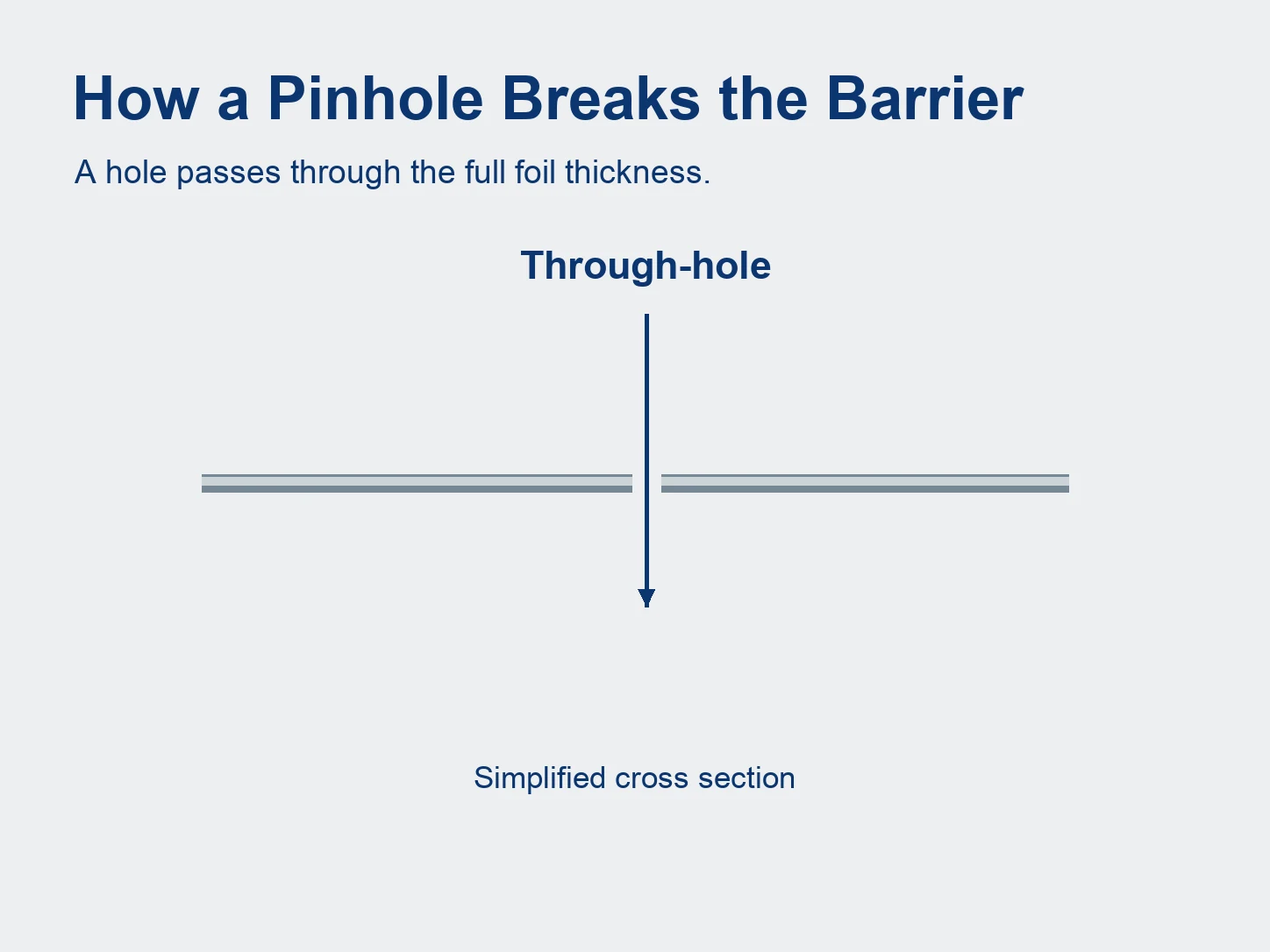
Nothing downstream closes it. A lacquer bridges a scratch; it does not bridge a perforation. That is why the grade is chosen on pinhole performance and elongation rather than on tensile strength, and why a foil that measures stronger can still fail a barrier test.
What It Costs Downstream
Goods-in inspection samples a coil; it does not test every square metre. A pinhole surfaces later — as a leak in a blister cavity, a failed dye test on a retort pouch, or a complaint from a brand owner whose product oxidised on the shelf.
By then the foil has been lacquered, printed, laminated and formed, and the cost of the failure includes all of that. A premium on the grade that pinholes less is usually cheaper than the reject rate it prevents, which is the commercial argument for 8079 in one line.
Choosing the Temper by Process Step
No T Temper Exists Here
8079 cannot be strengthened by heat treatment. It is a non-heat-treatable Al-Fe-Si alloy, so there is no solution treatment and no ageing step, and therefore no T temper for this alloy — an order for “8079-T6” is asking for something that does not exist.
Properties come from two levers only: how far the metal is cold rolled, and how it is annealed. That is why the choice is short, and why it should be made from the process rather than from a preference.
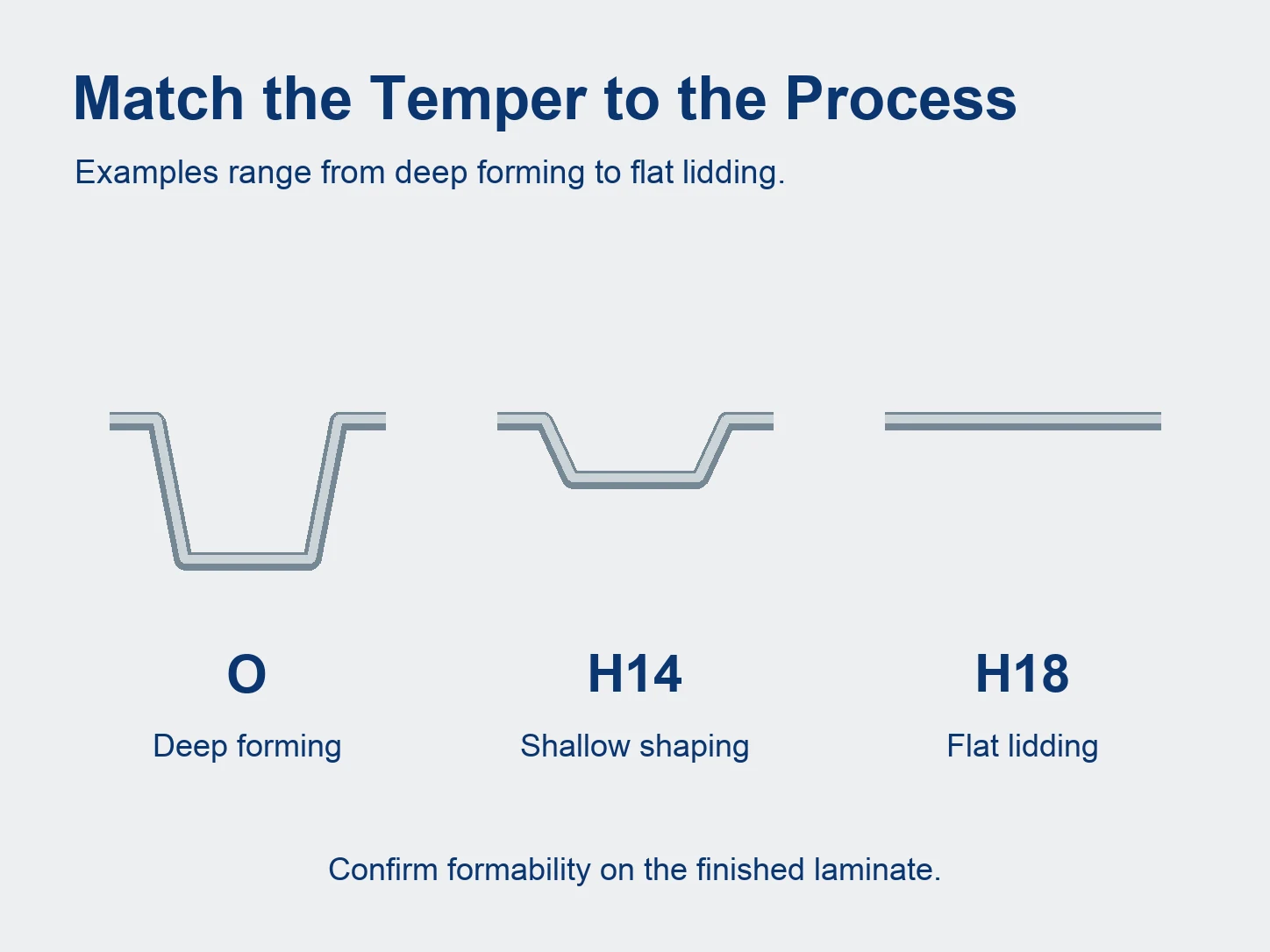
O, H14, H18
- O (geglüht) — the softest state and the default for this grade. It is the temper for deep drawing, lamination and printing, because the foil has to stretch and conform without cracking. Most 8079 volume ships in O.
- H14 (halbhart) — where the foil needs body but still has to form. Lidding stock and heat-seal substrates that are shaped rather than merely cut usually land here.
- H18 (full hard) — flat work. Blister lidding, bottle-cap seals and heat-seal membranes that are punched and sealed rather than drawn. Stiffness is the whole point, and forming is minimal by design.
The mistake to avoid is ordering H18 because it sounds stronger, then drawing it. Hard foil has very little elongation left, and a sharp radius will crack it.
8079 vs 8011
What the Extra Money Buys
Both are Al-Fe-Si packaging foils and both are bought on the same promises. The difference is where each spends its alloying budget.
8079 spends it on iron and keeps silicon low: pinhole performance and elongation go up, strength comes down. 8011 spends it on silicon and manganese: strength and stiffness go up, and the pinhole rate at thin gauge goes with them.
| 8079 | 8011 | |
|---|---|---|
| Silizium | 0.05–0.30% | 0.50–0.90% |
| Eisen | 0.70–1.30% | 0.60–1.00% |
| Was die Zusammensetzung bringt | pinhole performance, elongation, ductility at micro gauge | Festigkeit und Steifigkeit |
| Was es kostet | strength, and supply breadth | pinhole performance at thin gauge |
| Beste Eignung | blister and cold-formed pharma foil, thin laminates, deep-drawn work | lidding and container stock where strength and availability lead |
Table note: two Al-Fe-Si packaging foils compared in the same gauge band on the same laminate duty. Full specification tables are on each alloy’s own page.
8079 is bought where a pinhole is the failure mode; 8011 is bought where strength and supply security lead. The premium is real, and so is the narrower supply base — a grade that fewer mills roll is a grade with less price competition behind it.
Go/No-Go
8079 fits when:
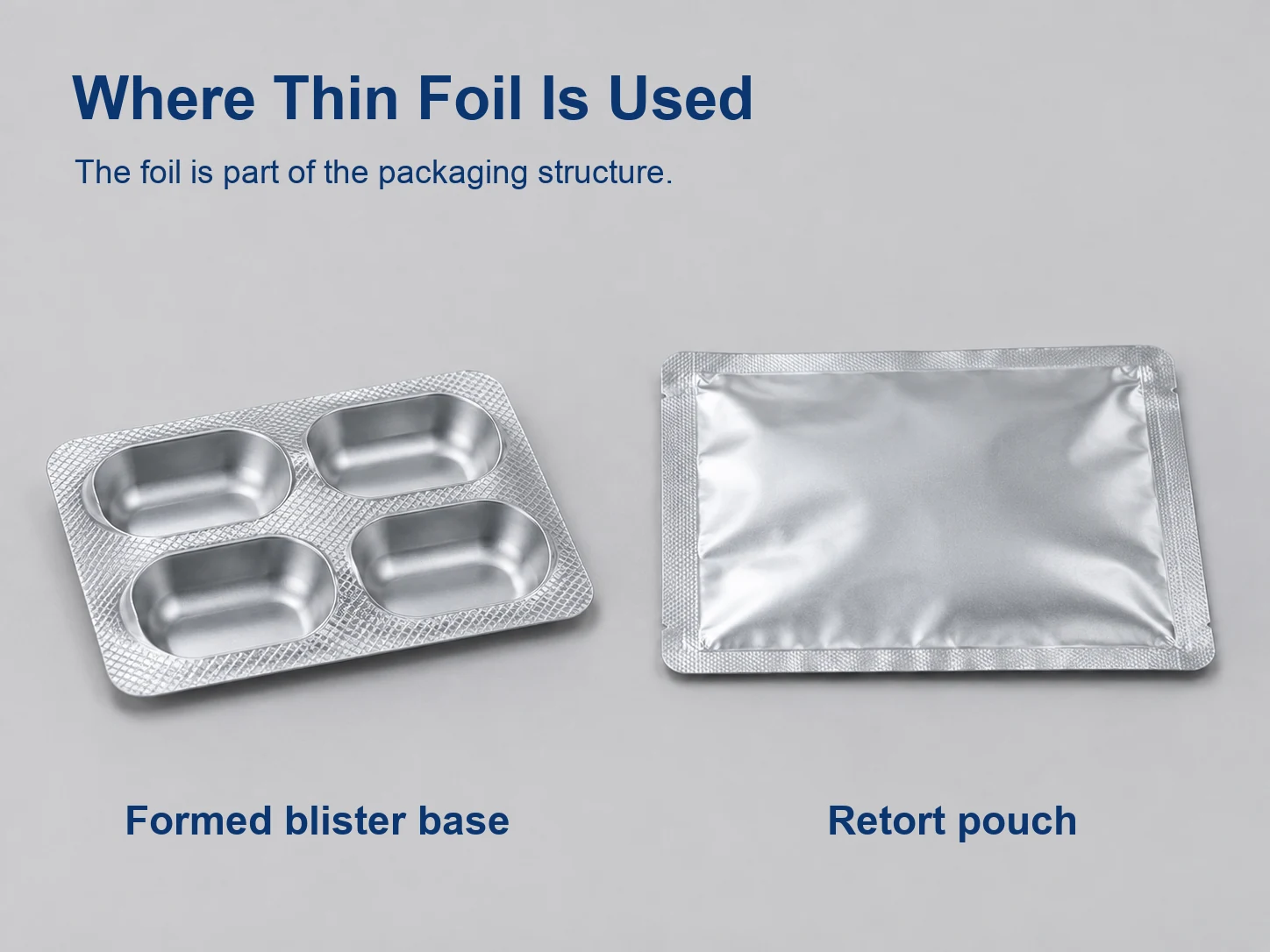
- A pinhole is the failure the pack cannot tolerate — PTP blister lidding, cold-formed pharma foil, retort and aseptic pouches, sachets, bottle-cap seals, or the aluminum layer in a label or decorative laminate.
- The process deep-draws or forms the foil, and elongation is what keeps yield up.
- The gauge is at the thin end, where particle size starts to decide the barrier.
- The qualification work is done, or the volume justifies doing it.
8079 does not fit when:
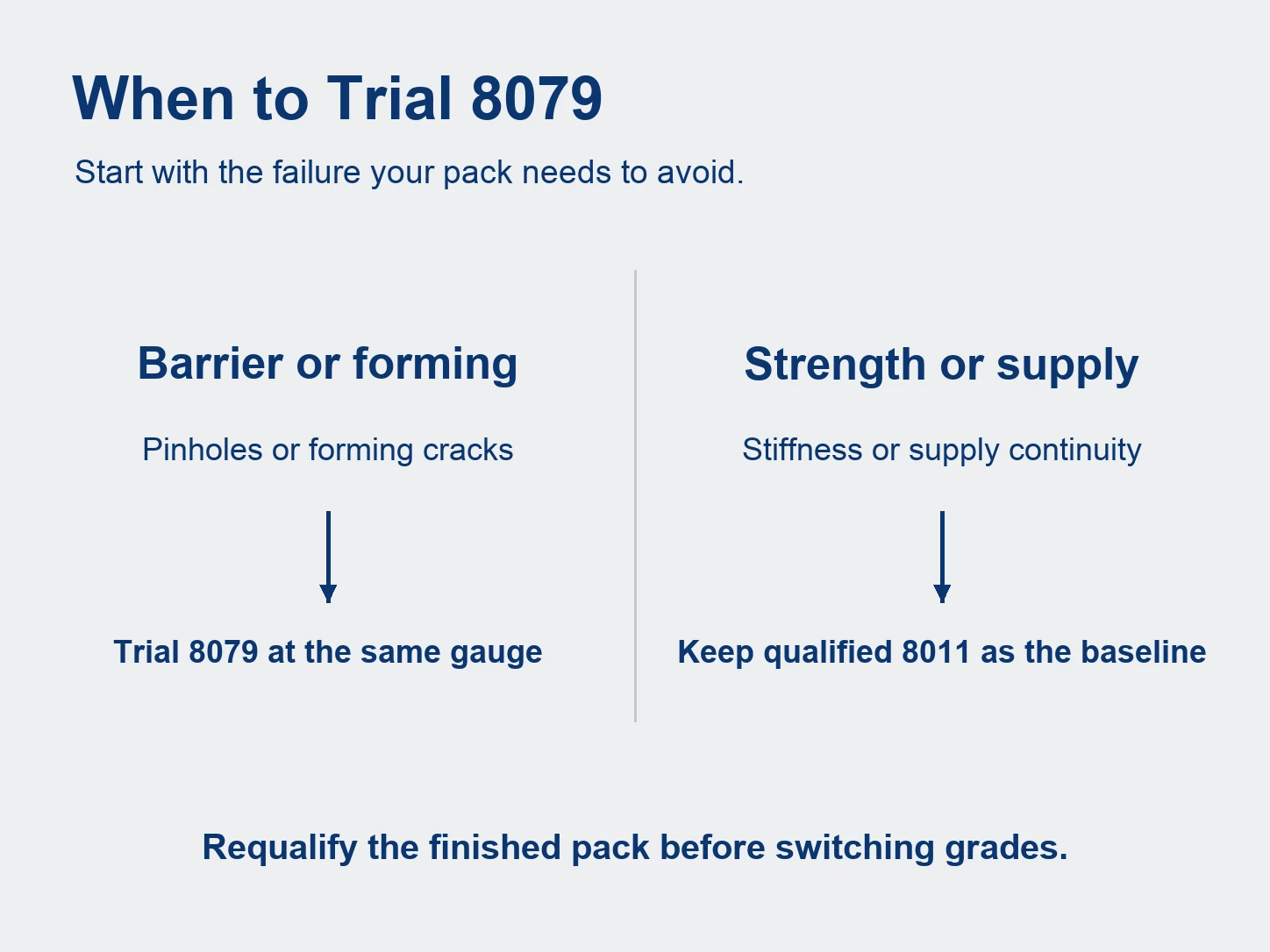
- The design is strength-driven rather than barrier-driven.
- The specification is already written around 8011 and requalifying would cost more than the yield gain.
- Supply continuity outweighs pinhole performance at high volume.
- The foil is a stiffener, where 8011 in H18 gives the stiffness for less money.
What to Put on the Order
An order carrying these lines keeps the grade decision intact:
- Legierung und Zustand — 8079 in O, H14 or H18, named rather than implied.
- Gauge and its tolerance — nominal thickness, plus the band the process can absorb.
- Pinhole requirement — written as an acceptance criterion, not a hope. If the pack cannot tolerate a hole, the number belongs on the order.
- Surface condition — clean, degreased and wettable, because that is what the lacquer and the ink adhere to.
- Slit width and join policy — the width the line takes, and whether joins are allowed in the coil.
- Dokumente — MTC as a minimum, with alloy and temper stated on it.
One point buyers miss: what we supply is bare foil. Lacquering, printing and laminating are the converter’s steps, so the thing to specify is the surface that has to accept them — not the printed result. We supply 8079 foil in O, H14 and H18, slit to width, with an MTC on every order.
Schlussfolgerung
8079 buys pinhole performance and elongation with strength and supply breadth, and at micro gauge that is usually the right way round: a foil with a hole in it has no barrier to offer, however strong it measures.
We supply 8079 foil in O, H14 and H18, slit to width, with an MTC on every order.
Send us the application, the gauge and the temper you run, and we will come back with the grade call, the slit width and the documents.
FAQ
Can 8079 replace 8011 without requalifying?
No. The two are not interchangeable at the same gauge: forming behaviour, seal window and barrier all shift with the alloy, so the laminate has to be requalified on your line. Budget that before the price comparison.
Can 8079 be heat treated to a T temper?
No. It is a non-heat-treatable Al-Fe-Si alloy, with no solution treatment or ageing step, so no T temper exists for it. Properties come from cold rolling and annealing, which is why the choice is O, H14 or H18.
Is 8079 foil suitable for food and pharmaceutical contact?
The alloy is used for both. Qualification sits with the finished laminate rather than the foil alone, because lacquer, adhesive and seal layer all take part. Confirm the coating system your converter runs before writing the specification.
What is the minimum quantity for a slit coil?
It is quoted from alloy, gauge, width and quantity together, so no single figure applies. Send those four with the application and we will confirm what is possible at that specification.