What Is 6101 Aluminum?
6101 is a 6xxx-series (Al-Mg-Si) aluminum alloy engineered for electrical conduction, not structural load. Its defining trait is a rare combination: high electrical conductivity (55–61% IACS) together with enough strength to serve as a self-supporting bus bar. It does this by keeping copper and iron very low (both ≤0.10%) to protect conductivity, while magnesium and silicon form Mg₂Si precipitates that give it heat-treatable strength. A small boron addition acts as a grain refiner that further optimizes conductivity.
That chemistry is why 6101 shows up wherever current must move efficiently and the conductor also has to hold its shape — bus bars, switchgear, transformer components, and EV powertrain bus links.
Chemical Composition of 6101 Aluminum
| Element | Weight % | Role in the alloy |
|---|---|---|
| Aluminum (Al) | Balance | Matrix metal |
| Silicon (Si) | 0.30–0.70% | With Mg forms Mg₂Si; precipitation hardening |
| Magnesium (Mg) | 0.35–0.80% | With Si forms Mg₂Si; primary strength source |
| Copper (Cu) | ≤0.10% | Kept very low to protect conductivity |
| Iron (Fe) | ≤0.50% | Kept low to protect conductivity and surface quality |
| Manganese (Mn) | ≤0.03% | Trace; minor dispersoid control |
| Chromium (Cr) | ≤0.03% | Trace; minor recrystallization control |
| Zinc (Zn) | ≤0.10% | Trace impurity |
| Boron (B) | ≤0.06% | Grain refiner that optimizes conductivity |
| Titanium (Ti) | ≤0.06% | Trace grain refiner |
Magnesium and silicon are the working elements: together they form Mg₂Si, which precipitates during aging to raise strength without dragging conductivity down. Copper and iron are deliberately capped because both scatter electrons and would otherwise lower the % IACS figure. Boron is the quiet contributor — a small addition that refines the grain structure and lifts conductivity a few points.
Mechanical and Physical Properties
Values below are typical for 6101 in the T6 temper (solution heat treated and artificially aged), the condition most often supplied for bus bars.
| Property | Value | Note |
|---|---|---|
| Density | 2.70 g/cm³ | About one-third the weight of copper |
| Ultimate Tensile Strength | ~200 MPa (min, T6); typical stock up to ~260 MPa | Moderate — enough to self-support a bus bar |
| Tensile Yield Strength (0.2% offset) | ~170 MPa (T6) | Design stress for supports |
| Elongation at Break | ~10% | Good for bending and forming |
| Electrical Conductivity | 55–61% IACS (T6 ~55–57) | The headline number |
| Thermal Conductivity | ~218 W/m·K (T6) | Efficient heat removal in enclosures |
| Coefficient of Thermal Expansion | 23.4 µm/m·K | Matches other 6xxx alloys |
| Melting Range | 620–655°C | Solidus to liquidus |
The conductivity figure is what separates 6101 from general-purpose 6xxx alloys. At 55–61% IACS it carries more than half the current of copper at roughly a third of the weight, which is exactly why it replaces copper in bus-bar runs where weight and cost matter.
6101 Tempers for Busbar Use
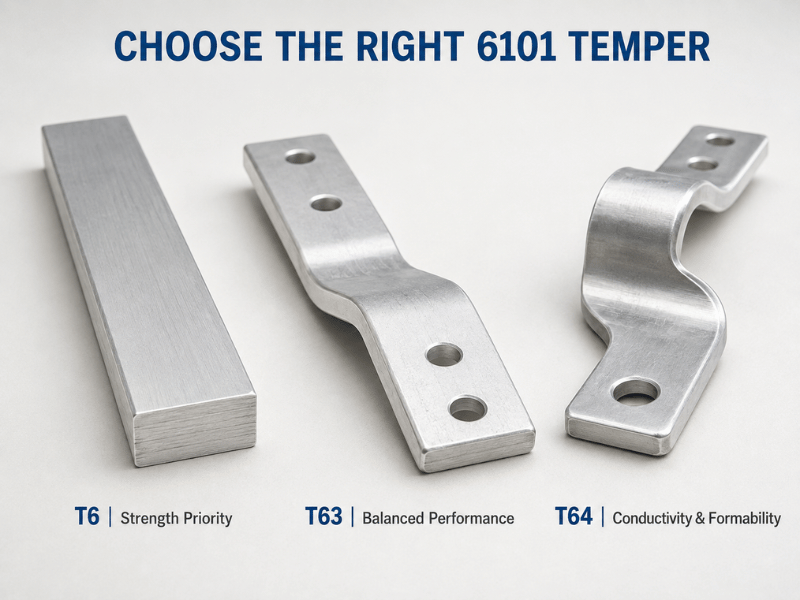
6101 is supplied in a family of electrical tempers that trade strength against conductivity:
| Temper | Treatment | Typical conductivity | Typical use |
|---|---|---|---|
| T6 | Solution + artificial age | ~55–57% IACS | Maximum-strength bus bars |
| T61 | Solution + stabilized | ~59% IACS | Maximum conductivity, good formability |
| T63 | Solution + controlled stabilization | ~56% IACS | Balanced strength and conductivity |
| T64 | Stabilized for efficiency | ~59.5% IACS | Extreme-efficiency bus links |
| T65 | Stabilized, bend-friendly | ~58% IACS | Bent or formed bus shapes |
For most bus-bar work T6 (strength) or T61 (conductivity) covers the need; T63/T64/T65 are specified when a project optimizes for a particular balance or for bending.
Why 6101 Performs the Way It Does
Conductivity with strength. Most aluminum alloys trade conductivity for strength. 6101 is tuned the other way: low Cu/Fe keeps resistivity down, while Mg₂Si precipitation hardening delivers the moderate strength a bus bar needs to span supports without sagging. The result is a bar that conducts like a near-copper grade but still holds its own shape.
Corrosion resistance. Like other Al-Mg-Si alloys, 6101 forms a stable oxide layer and resists atmospheric and mild aqueous corrosion well. It is suitable for indoor switchgear and many outdoor enclosures; in aggressive or marine exposures, anodizing or coating extends life.
Workability. 6101 extrudes, bends, machines, and welds cleanly (TIG, MIG, friction stir). Bus bars are routinely cut, punched, drilled, and bolted or welded into assemblies without losing meaningful conductivity.
Common Applications
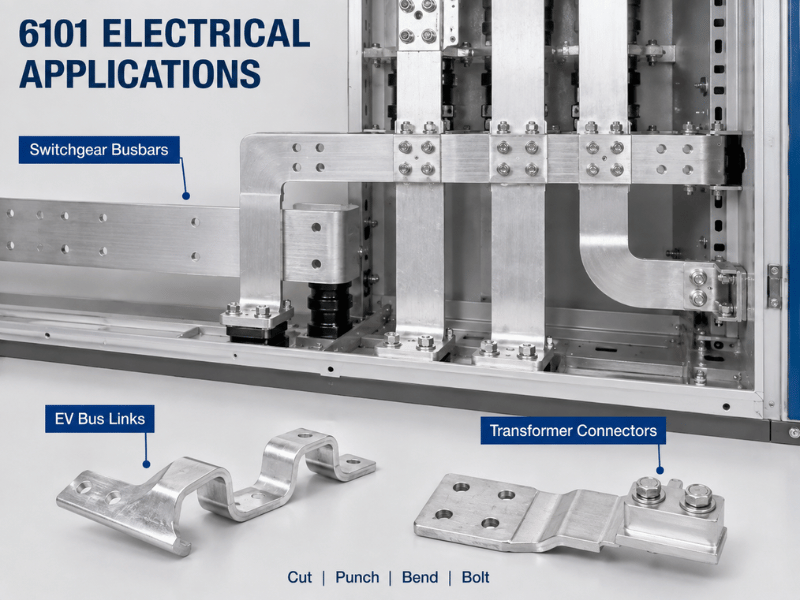
- 6101 is a conduction-grade alloy, so its uses cluster around moving current:
- Bus bars for switchgear, substations, and power-distribution panels
- Electrical conductors and connectors in transformers and switchgear
- EV and hybrid powertrain bus links where weight savings matter
- Heat sinks and thermal-management plates that also need to conduct
- Structural-electrical components such as rack frames that carry both load and current
In every case, the part is extruded, drawn, or machined — not cast — and runs in an environment where its conductivity, not its peak strength, is the selling point.
6101 vs 6061 vs 6063 vs 1350
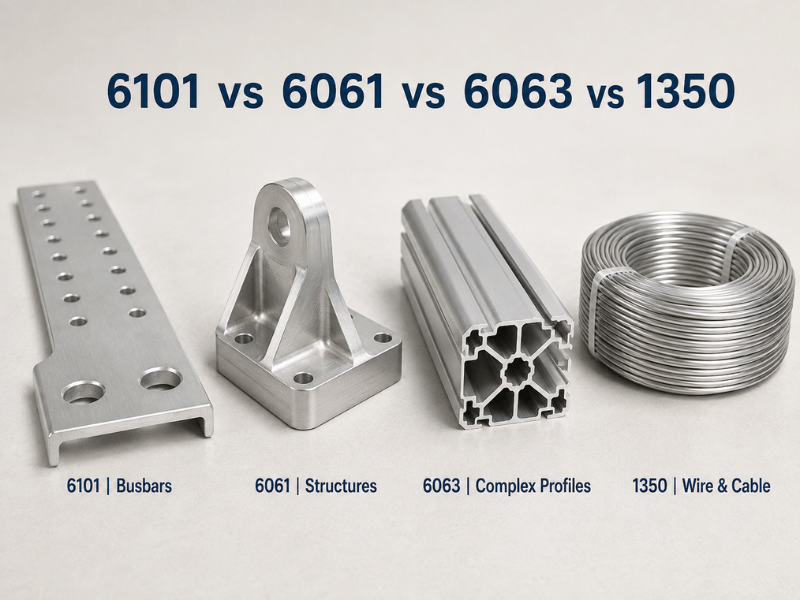
| Characteristic | 6101 | 6061 | 6063 | 1350 |
|---|---|---|---|---|
| Primary Alloying | Mg, Si (low Cu/Fe) | Mg, Si | Mg, Si | Pure Al |
| Electrical Conductivity | 55–61% IACS | 40–45% IACS | 50–55% IACS | ≥61% IACS |
| Tensile Strength (T6) | ~200 MPa (min) | ~310 MPa | ~240 MPa | Low (~90 MPa) |
| Corrosion Resistance | Excellent | Very Good | Excellent | Excellent |
| Weldability | Very Good | Excellent | Very Good | Excellent |
| Typical Use | Bus bars, conductors | Structural parts, frames | Architectural trim, heat sinks | Wire, cable |
Against 6061 and 6063, 6101 wins decisively on conductivity but gives up strength — it is the electrical specialist of the 6xxx family. Against 1350 (pure aluminum), 6101 sacrifices a little conductivity for far more strength, which is why bus bars use 6101 rather than EC wire grade.
Pros and Limitations at a Glance
| Dimension | Advantage | Limitation |
|---|---|---|
| Electrical conductivity | 55–61% IACS, near-copper | Below pure 1350 |
| Strength | Moderate, self-supporting bus bars | Not for high-stress structures |
| Weight | ~1/3 of copper | — |
| Corrosion resistance | Excellent in atmosphere | Coating needed in aggressive/marine |
| Workability | Extrudes, bends, welds well | Less formable than 6063 for complex profiles |
| Cost | Far cheaper than copper | More than 1350 |
Choose 6101 if…
- The part must carry current (bus bar, conductor, connector), and you want copper-like performance at lower weight and cost
- Moderate strength is enough — the bar spans supports without a heavy load
- You need it to be weldable, bendable, or extrudable into bus shapes
Skip 6101 if…
- You need high structural strength (use 6061 or 6082)
- The part is a complex architectural profile (6063 extrudes better)
- The exposure is harsh marine without coating (consider 5083 or protected 6061)
Conclusion
6101 aluminum earns its place by solving a specific problem: carrying current like copper, but at a third of the weight and a fraction of the cost, while still being strong enough to stand alone as a bus bar. It gives up top-end strength and complex-profile extrudability to get there — a fine trade for electrical infrastructure, a poor one for structural or decorative work.
Linsy Aluminum supplies 6101 in plate, bar, tube, wire, coil, profile, and block forms with tight tolerances and tempers matched to your bus-bar or conductor application. Stock standard sizes and low-MOQ custom production are typically delivered in 10–60 days, every order ships with an MTC, SGS test reports are available on request, and the plant holds ISO 9001, 14001, and 45001 certifications.
If your project needs 6101’s high conductivity and moderate strength, send the drawing or specification to Linsy Aluminum for a stock check and quote on 6101 aluminum products.
Frequently Asked Questions
What makes 6101 aluminum ideal for electrical applications?
Its high electrical conductivity (55–61% IACS) lets it carry more than half the current of copper at about a third of the weight. Low copper and iron keep resistivity down, while Mg₂Si precipitation hardening gives it enough strength to serve as a self-supporting bus bar. It also welds and bends cleanly, so bus assemblies are easy to fabricate.
How does 6101 compare to 6061 and 6063 on conductivity?
6101 leads the 6xxx family on conductivity: 55–61% IACS versus 40–45% for 6061 and 50–55% for 6063. The trade-off is strength — 6061 (~310 MPa) and 6063 (~240 MPa) are stronger, so 6101 is the pick when conduction is the priority and 6061/6063 when structure is.
Can 6101 aluminum be welded?
Yes. 6101 welds well with TIG, MIG, and friction-stir methods, and welding does not significantly drop its conductivity. Bus bars are commonly cut, drilled, and joined by bolting or welding into switchgear and transformer assemblies.
Which 6101 temper should I specify for a bus bar?
T6 for maximum strength and T61 for maximum conductivity are the common choices; T63, T64, and T65 are specified when a project optimizes for a particular strength-conductivity balance or for bending. Pick based on whether the bar must span a long distance (favor strength) or minimize resistive loss (favor conductivity).
Is 6101 suitable for marine or outdoor use?
In atmosphere it resists corrosion well thanks to its oxide layer, and it is used in many outdoor enclosures. In aggressive or salt-spray environments, anodizing or coating is recommended; for continuously immersed marine service a 5xxx alloy or a protected 6xxx grade is the safer call.