What Is 6063 Aluminum?
6063 aluminum is a 6xxx Al-Mg-Si alloy with deliberately little alloying content — silicon 0.20–0.60%, magnesium 0.45–0.90%, the rest impurity. That restraint is the point: it extrudes more easily than any other 6000-series grade and anodizes brighter, because there is little in the metal to disturb either process.
The metal then does very little itself: not enough alloying content to reach structural strength however it is treated, so the temper does almost all the work — on one profile from one die, the difference between 145 and 214 MPa yield. 6063 is bought as a temper, not an alloy.
Understanding T5, T52 and T6 — One Alloy, Three Routes
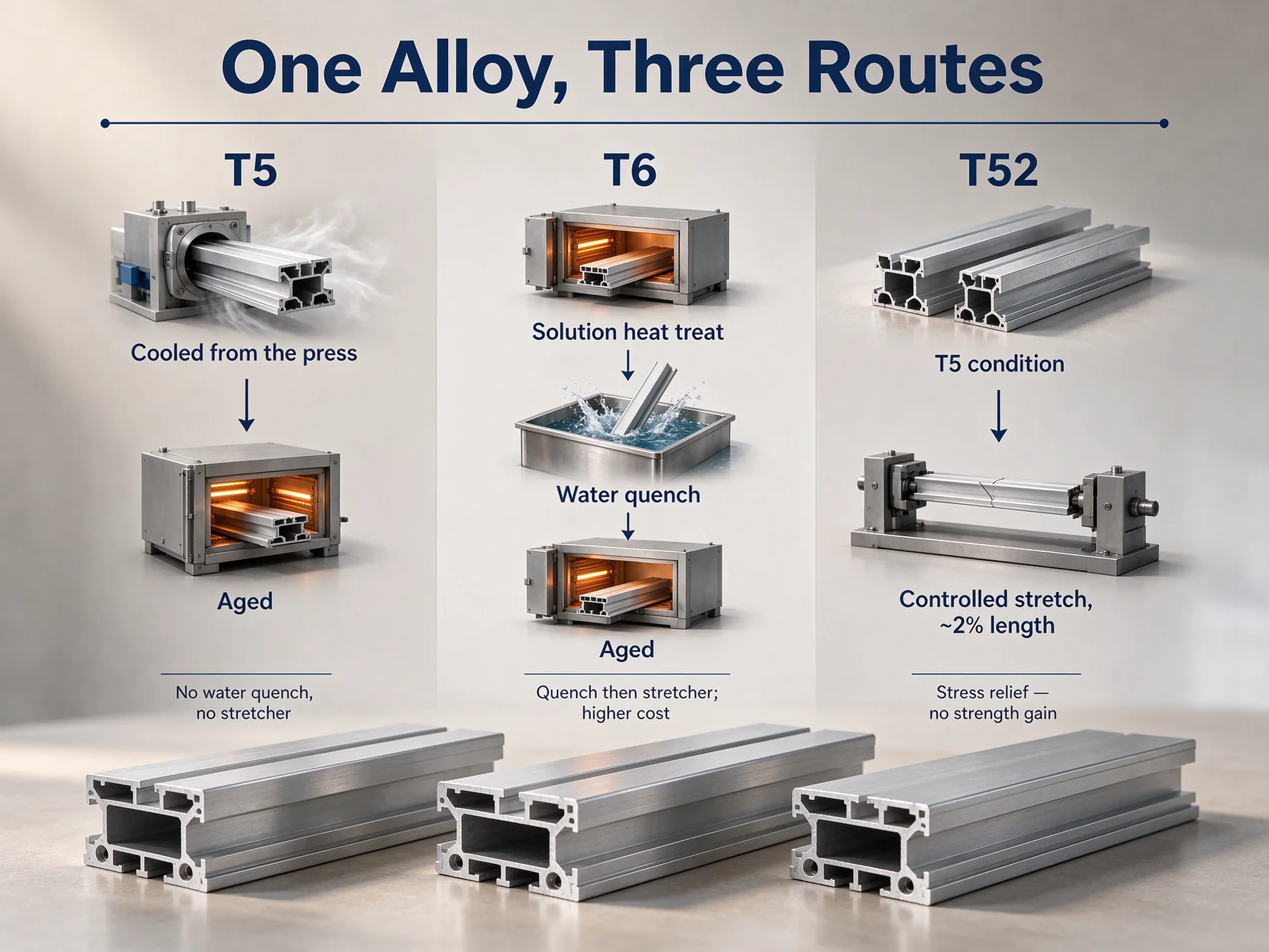
Not three grades: three ways of cooling and aging one extrusion, decided at the press within minutes of the profile leaving the die. The route sets how hard the metal ends up, and how much internal stress it carries.
T5 — Cooled From the Press, Then Aged
T5 is cooled from its extrusion temperature, in air or with a controlled press quench, then aged. No solution treatment, no water tank, no stretcher — a low-stress profile at the lowest cost per meter, straight off the line and staying straight — for a frame or trim section, that is the whole requirement. What it gives up is ceiling: there is no re-aging route to T6, only a fresh solution treatment and quench.
T6 — Quenched, Which Is Why It Costs More
T6 is solution heat treated, water quenched, then aged. The quench is fast and violent on purpose: it holds the alloying elements in solution so aging can precipitate them, lifting yield from 145 to 214 MPa.
It is also what distorts the profile: roughly 500 °C into water puts a thermal gradient through the section, so long profiles bow. T6 therefore usually needs a stretcher, and a higher quote on the same die pays for that furnace, quench, stretcher and scrap rate.
T52 — T5 With a Stretch, Not a Strength Upgrade
T52 is T5 plus a controlled stretch, about 2% of length, to relieve residual stress. The correction worth making: T52 has no separate strength. ASTM B221 lists T5 and T52 in one row — identical tensile, identical yield. What T52 buys is stability: a stressed profile moves as metal is machined away, so a long bracket comes off the mill bowed.
T52 also does not exist in EN 755-2, whose set is T4, T5, T6, T64 and T66. A drawing naming both is internally inconsistent.
6063-T5 and T6 Mechanical Properties — Under Two Standards
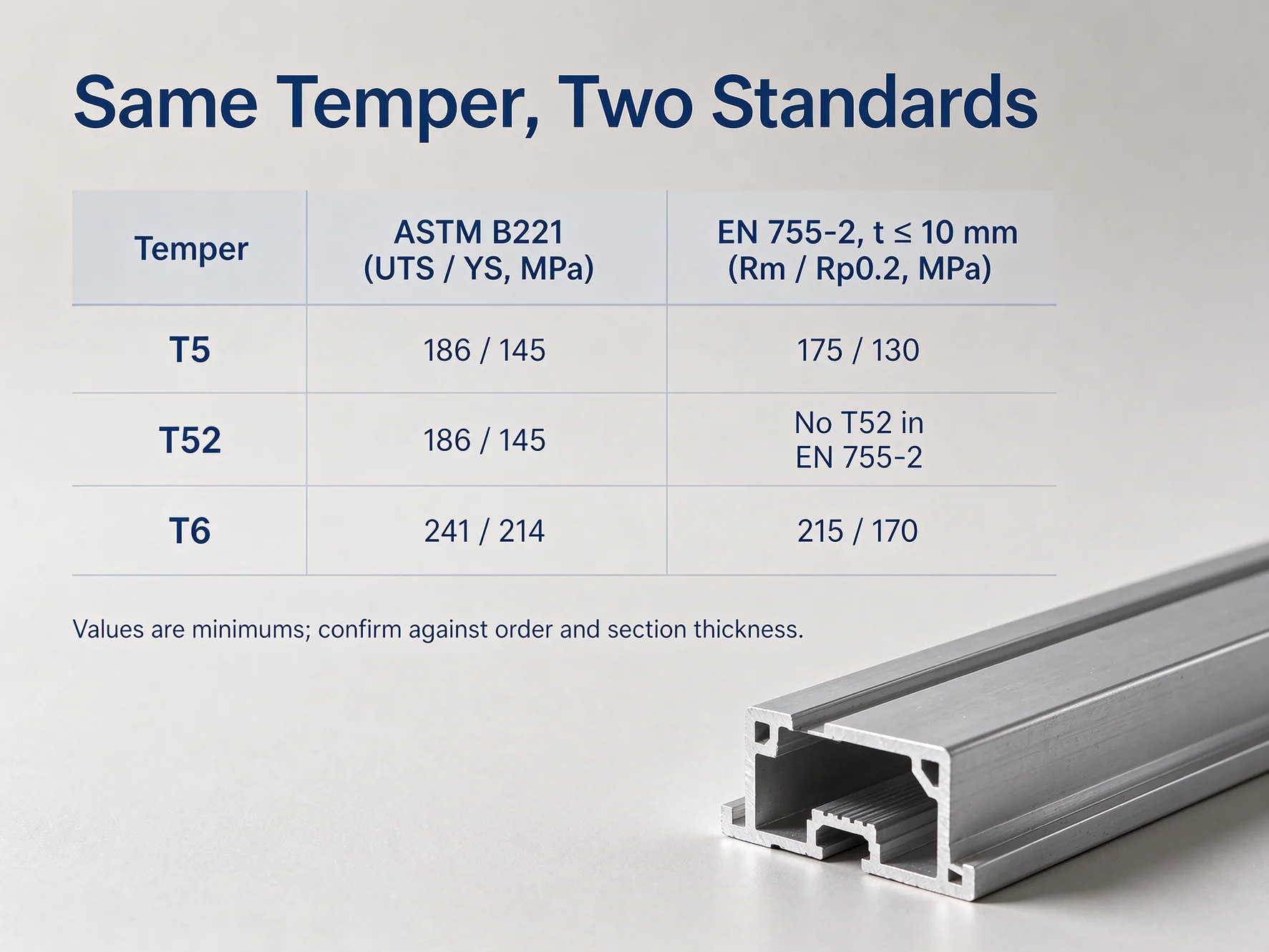
The same temper carries two different minimums depending on the standard. Both are correct; they apply to different orders.
| Temper | ASTM B221: UTS / YS / A | EN 755-2, t ≤ 10 mm: Rm / Rp0.2 / A |
|---|---|---|
| T4 | — | 130 / 65 MPa / 14% |
| T5 | 186 / 145 MPa / 12% | 175 / 130 MPa / 8% |
| T52 | 186 / 145 MPa / 12% | No T52 |
| T6 | 241 / 214 MPa / 12% | 215 / 170 MPa / 8% |
| T66 | — | 245 / 200 MPa / 8% |
ASTM B221 covers extruded bar, rod, shape and tube; EN 755-2 covers profiles, and above 10 mm it drops T5 to 160 / 110 and T6 to 195 / 160. No ASTM minimum is shown for T4 and T66 because neither is an ASTM temper for this alloy.
A 6063-T6 testing at 220 MPa therefore passes EN 755-2 and fails ASTM B221. Both true. Which applies depends on what the order says.
For a specifier the yield column decides. T6 lifts yield from 145 to 214 MPa, a 48% rise under ASTM; under EN the same pair runs 130 to 170, a 31% rise. Same comparison, two percentages — the uplift you quote depends on the standard the project uses.
Where Each Temper Is Used
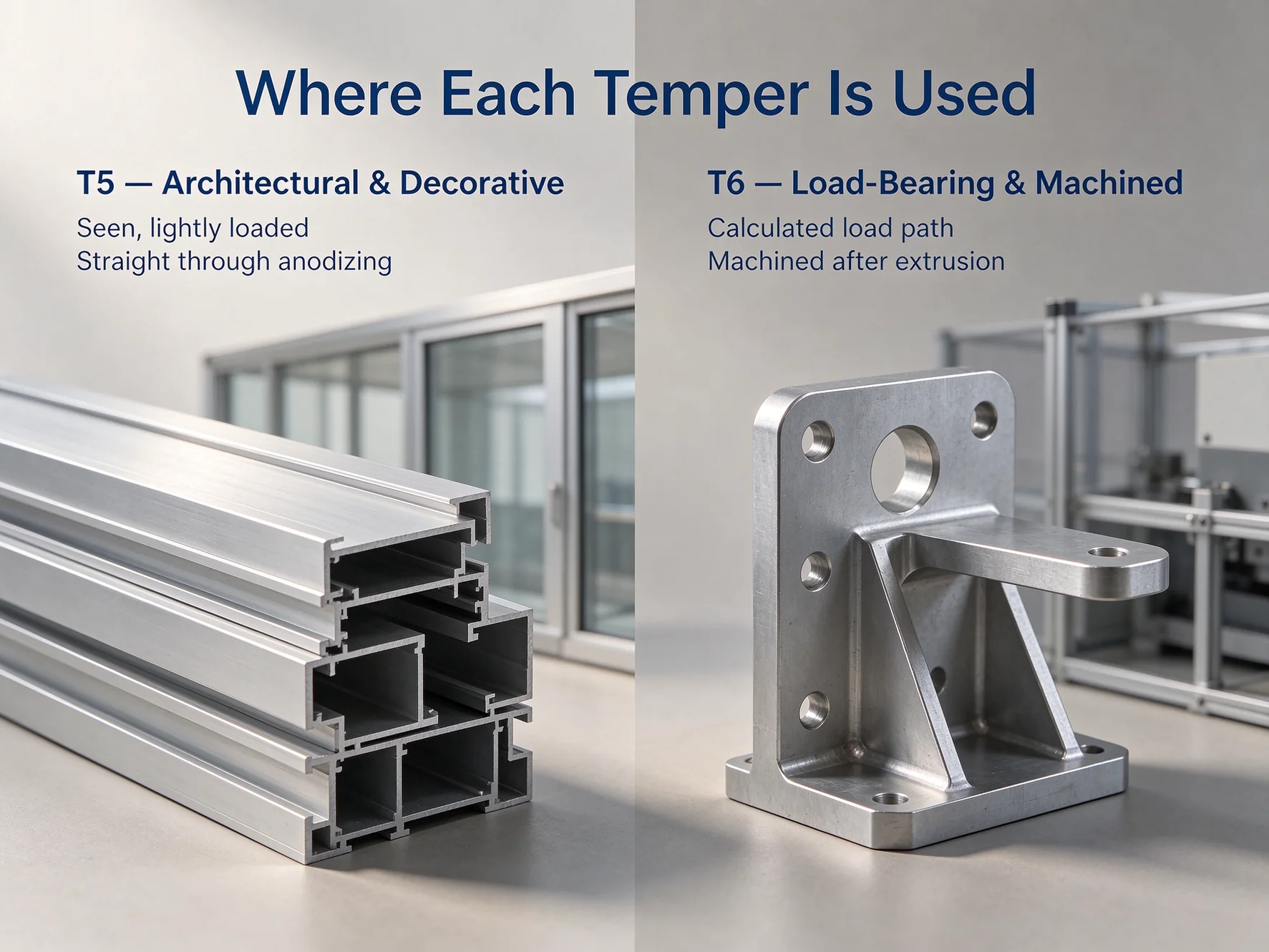
Architectural and Decorative Profiles — T5 Territory
Window and door profiles, curtain wall, railings, trim, heat sinks. The part is seen and lightly loaded; its value sits in the surface, not the load path. A six-meter mullion must arrive straight and stay straight through anodizing, and T5 does that without a stretcher.
Load-Bearing and Machined Parts — Where T6 Earns Its Price
Structural framing, machine guards, brackets with a calculated load path, anything machined after extrusion. Two reasons show up. T6 answers the part needing 214 MPa instead of 145. T52 answers the part needing only T5 strength but machined and kept flat. Choosing T52 where load requires T6 is a strength failure; choosing T6 to fix distortion is money spent on the wrong problem.
T5 vs T52 vs T6 — How to Choose
| Temper | Route | ASTM B221 (UTS / YS) | In EN 755-2 | Best for | Avoid when |
|---|---|---|---|---|---|
| O | Annealed | — | Yes (t ≤ 25 mm) | Forming before heat treatment | Used as delivered |
| T4 | Solution treated, naturally aged | — | Yes (130 / 65 MPa) | Forming, aging in service | Strength must be stable at delivery |
| T5 | Cooled from the press, aged | 186 / 145 MPa | Yes (175 / 130 MPa) | Architectural and decorative profiles | The part carries a calculated load |
| T52 | T5 plus a controlled stretch | 186 / 145 MPa | No | Machined parts that must stay flat | Higher strength is required |
| T6 | Solution treated, water quenched, aged | 241 / 214 MPa | Yes (215 / 170 MPa) | Load-bearing and structural parts | The part is only seen, not loaded |
ASTM values are minimums; EN values at t ≤ 10 mm. O is held to a maximum in ASTM B221, and T4 keeps aging after delivery, so neither offers a stable floor.
When T5 Is the Right Call
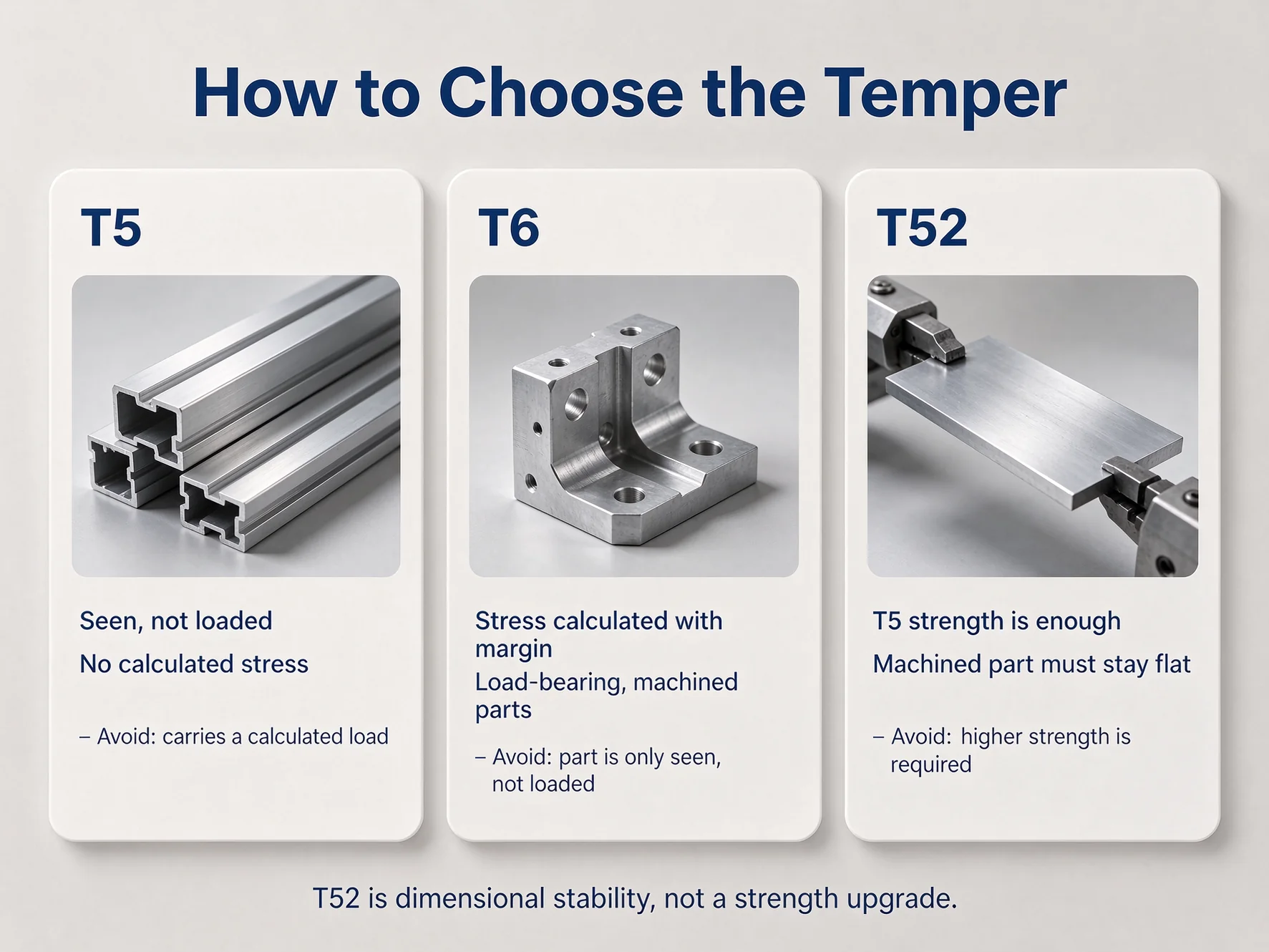
Two conditions, both easy to check. The part is seen rather than loaded, with no calculated stress in it. And it is not machined after extrusion, or only lightly at the ends, so residual stress has nothing to distort. If both hold, T5 is the cheapest correct answer.
When T6 or T52 Fits Better
T6 is right when a stress has been calculated and 145 MPa of yield does not clear it with margin; once you pay for a quench and a stretch, the part should use the extra strength. T52 is right when the load is fine on T5 but the part is machined and must stay flat — a dimensional decision, not a strength one.
Working With 6063-T5 and T6 — Extruding, Machining, Anodizing, Welding
- Extruding: die and cooling route are chosen together, so a profile designed for T5 may need a different quench arrangement, and tolerance, if it moves to T6.
- Machining: T6 cuts harder and, having been stretched, moves less after the cut. T5 cuts easily but releases stress as metal is removed, so a long part in T5 can bow where the same part in T52 stays flat.
- Anodizing: identical in both tempers and the best in the 6000 series — uniform, bright, reliable under color anodizing. It will not correct a profile already out of tolerance before it entered the tank.
- Welding: 4043 filler, or 5356 where the joint will be anodized. Heat-affected-zone properties drop substantially — published guidance puts the loss near half of parent strength — so keep welds out of the load path. T6 does not age back.
Pros and Limitations at a Glance
| Dimension | Advantage | What it costs |
|---|---|---|
| T5 cost | Lowest cost per meter — no furnace, quench or stretcher | Yield capped at 145 MPa (ASTM), ruling out calculated load paths |
| T6 strength | 214 MPa yield, a 48% rise over T5 under ASTM | Quench distortion, a stretching operation, higher scrap |
| T52 stability | Machined parts stay flat | An extra operation for no gain in strength |
| Anodized finish | Bright, uniform, reliable under color anodizing | Not a marine alloy; coastal service needs a specified coating |
| Extrudability | The best in the 6000 series; thin walls and hollows are routine | The same low alloy content is why the strength ceiling is low |
| Standard clarity | Both ASTM and EN values are published | The same temper carries two minimums, so an order without a standard is ambiguous |
Conclusion
On 6063 the temper, not the alloy, decides whether the part works — and the same temper carries two minimums depending on which standard the order names. A specification is incomplete until temper and standard appear together, and that is the most common reason a certificate and a drawing disagree.
We extrude, age, stretch and anodize 6063 in-house, and supply T5, T52 and T6. Every order ships with an MTC that names the standard.
Send us the profile drawing or bar size with the temper and the standard you are specifying, and we will confirm the temper and quote against it.
Frequently Asked Questions
Can I use 6063-T6 instead of 6061-T6?
No. 6063-T6 reaches 241 / 214 MPa under ASTM B221; 6061-T6 reaches 310 / 276. A part designed on 6061 values runs about 22% short.
Why does one 6063-T6 certificate say 215 MPa and another 241?
Different standards. ASTM B221 requires 241 MPa; EN 755-2 requires 215 at 10 mm and under. Name the standard on the order.
What does T52 give me that T5 does not?
Dimensional stability, not strength. ASTM B221 lists T5 and T52 with identical tensile and yield; the stretch relieves stress so a machined part stays flat. EN has no T52.
What is the minimum order and lead time?
Low MOQ, typically 10–60 days. The date depends on profile, temper and finishing, so it is confirmed with the quote. Send the drawing, temper and standard.