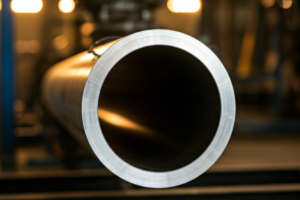
7075-T651 is the peak-strength, stress-relieved temper of 7075 — the aluminum grade engineers reach for when the part must carry steel-like load at a fraction of the weight. This guide covers what the T651 designation means, the real numbers, how it compares to T6 and the corrosion-resistant tempers, and where its strength pays off — so you can decide whether T651’s peak strength and machining stability are worth its corrosion and joining limits.
What Is 7075 Aluminum?
7075 is a 7xxx-series alloy built around zinc, magnesium, and copper, where the MgZn₂ precipitate is the main strengthening phase; it gains strength through precipitation hardening to a level no other common wrought aluminum matches, which puts it in a class of its own for high-load, weight-critical structures. That peak strength is the trade the alloy is built to win — but the same zinc-rich, copper-bearing chemistry that drives strength also makes 7075 less corrosion-resistant and effectively unweldable by fusion methods.
The cost of that strength is a narrow processing window: 7075 must be protected from corrosion and joined by fastening rather than welding, and the temper you choose decides how much residual stress the machined part carries. It is exactly that residual-stress question — and whether your part needs tight dimensional stability after heavy machining — that makes the T651 temper the default call for precision work, which the next section explains.
Understanding the T651 Temper
“T651” means the material is solution heat-treated, quenched, stress-relieved by stretching, then artificially aged. The alloy is heated to dissolve the Zn/Mg/Cu into solid solution, quenched to trap them supersaturated, stretched 1–3% to relieve the quenching stresses locked in the plate, then held at aging temperature so the MgZn₂ precipitates develop peak strength. The stretch is the step that separates T651 from plain T6.
That stretch does one job that matters to every machinist: it removes the residual stress that would otherwise spring the part out of tolerance the moment material is removed. In thick 7075 plate, quenching leaves internal stress high enough to warp a finished component during CNC machining; T651 relieves it up front, so the part holds its shape after the cut. Aerospace specifications for thick, machined plate call for T651 rather than T6 for this reason.
7075’s chemistry is why T651 lands at the top of the aluminum strength table — zinc (5.1–6.1%) is the primary strengthening element, magnesium enables the precipitation reaction, and copper adds hardness, while chromium (0.18–0.28%) improves resistance to stress-corrosion cracking. None of that comes free: the copper also lowers corrosion behavior relative to 6xxx alloys, which is the constraint every 7075 application has to design around.
| Element | Typical range (7075) |
|---|---|
| Zinc (Zn) | 5.1–6.1% |
| Magnesium (Mg) | 2.1–2.9% |
| Copper (Cu) | 1.2–2.0% |
| Chromium (Cr) | 0.18–0.28% |
| Silicon (Si) | 0.40% max |
| Iron (Fe) | 0.50% max |
| Manganese (Mn) | 0.30% max |
| Titanium (Ti) | 0.20% max |
| Aluminum (Al) | Balance |
How T651 Differs from T6
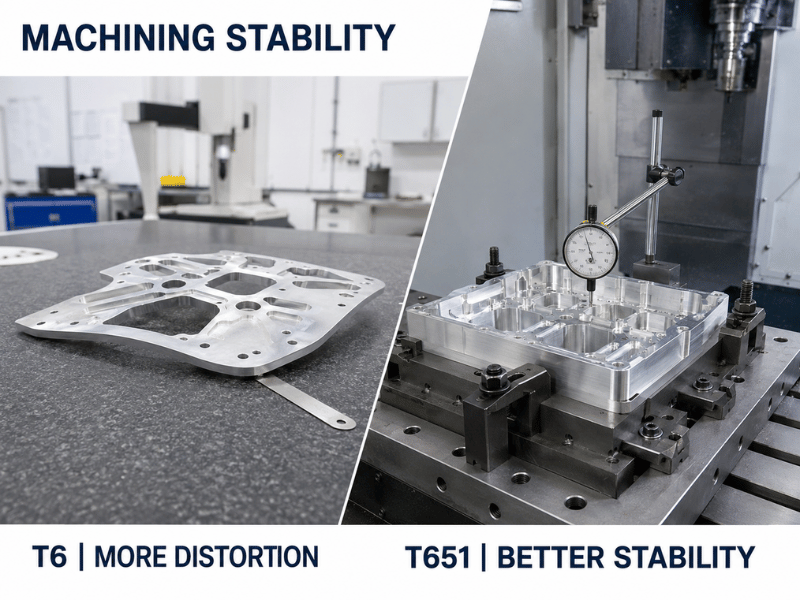
T6 and T651 reach essentially the same peak strength — the T651 stretch happens after quenching and before aging, so it does not change the final hardness or yield. What changes is residual stress: T651 carries far less, so a heavily machined plate stays flat and dimensionally stable, while T6 can distort as internal stress is released by material removal. For thin sections and parts with light machining, T6 is enough and slightly cheaper; for thick plate, fixtures, and any part held to tight tolerances after CNC work, T651 is the safer specification. The full T651-vs-T6 and vs-T73 breakdown is in the comparison table below, and the corrosion-focused alternative is covered in our 7075-T73 properties guide.
7075-T651 Mechanical Properties
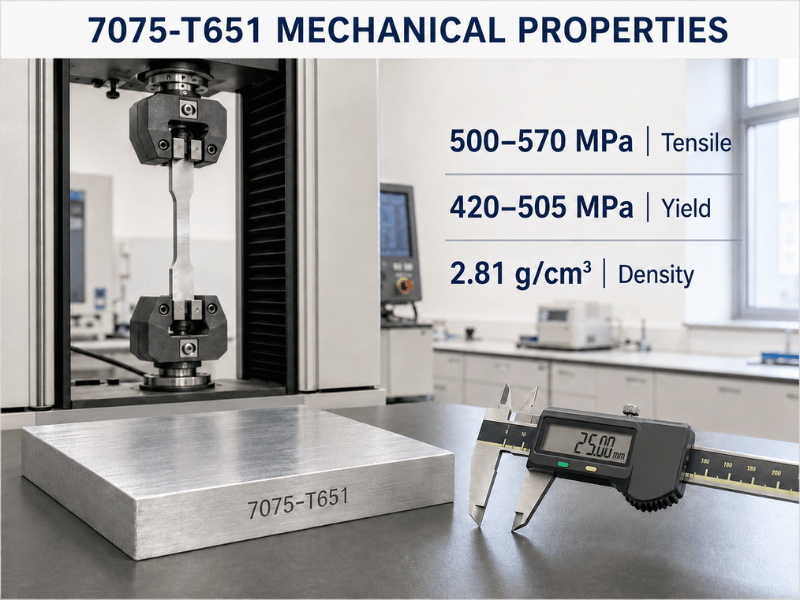
7075-T651 is the strongest commonly stocked aluminum temper — the numbers below are typical for plate, bar, and block.
| Property | Typical value (7075-T651) |
|---|---|
| Density | 2.81 g/cm³ |
| Ultimate tensile strength | ~572 MPa (83 ksi) |
| Yield strength (0.2% offset) | ~503 MPa (73 ksi) |
| Elongation at break | 11% |
| Fatigue strength | ~160 MPa |
| Brinell hardness | ~150 HB |
| Elastic (Young’s) modulus | ~71.7 GPa |
| Shear strength | ~331 MPa |
| Thermal conductivity | ~130 W/m·K |
| Electrical conductivity | ~33% IACS |
| Coefficient of thermal expansion | 23 µm/m·K |
The ~503 MPa yield is the number that matters most: roughly 1.8× the yield of 6061-T6 and about 55% above 2024-T3, which is why 7075 replaces steel in airframes and tooling. What that strength costs is corrosion and joining behavior — 7075 is not weldable by fusion and needs surface protection in any wet or chloride environment. The ~160 MPa fatigue strength still supports cyclic loading well, but the alloy is roughly as stiff as 6061 (modulus ~71.7 GPa), so 7075 wins on strength-to-weight, not on rigidity. For the cross-alloy picture, see our 6061 vs 7075 comparison guide.
Where 7075-T651 Is Used
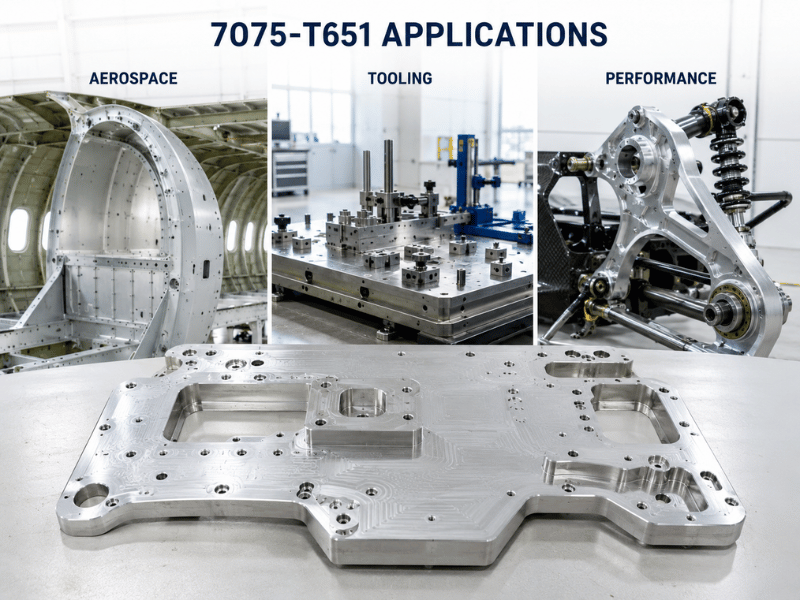
7075-T651 earns its place wherever peak strength and tight post-machining tolerances decide the build, and where the user can protect the part from corrosion and join it by fastening. It owns the high-load, precision-machined end of the aluminum range that 6061 and 6063 leave to versatility and cost.
Aerospace and Precision-Machined Structures
Wing spars, fuselage frames, bulkheads, landing-gear components, and machined fittings use T651 because the stress-relieved plate holds tolerance through deep pocket milling. Mold and tooling makers reach for T651 plate as well: it machines to a clean finish, polishes for short-run injection or blow molds, and stays dimensionally stable after material is removed. These are dry, protected, strength-critical environments — exactly where T651’s peak strength is the right tool and its corrosion sensitivity is managed by coating rather than by alloy choice.
High-Performance Automotive, Defense, and Tooling
Racing suspension arms, chassis plates, gearbox housings, and bicycle frames use T651 to cut mass at maximum load. Defense and armor applications exploit the same strength-to-weight edge. The common thread is a part that is machined, bolted, or bonded — not welded — and operated in air rather than salt spray. Avoid T651 for any component exposed to sustained humidity, marine service, or chloride environments; for those, step down to the overaged 7075-T73/T7351 tempers or a 5xxx/6xxx grade.
T651 vs Other 7075 Tempers — How to Choose
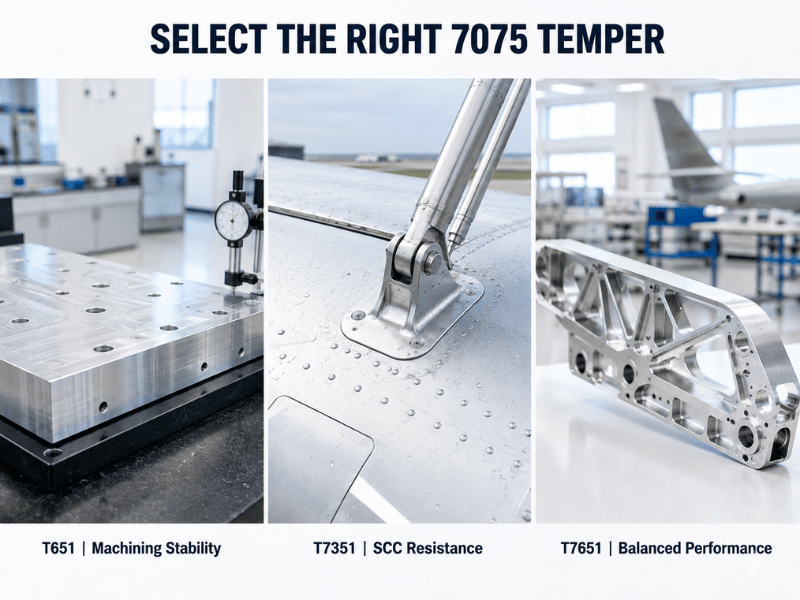
7075-T651 is the peak-strength, stress-relieved option; the other tempers trade strength for corrosion resistance or formability.
| Temper | Treatment | UTS (MPa) | YS (MPa) | SCC resistance | Best for | Avoid when |
|---|---|---|---|---|---|---|
| T651 | Solution + stretch + age | ~572 | ~503 | Moderate | Precision-machined plate, fixtures, dry-air structures | Humid, marine, or chloride exposure |
| T6 | Solution + age | ~572 | ~503 | Moderate | General high-strength, thin sections | Tight-tolerance machined thick plate |
| T73 / T7351 | Solution + stretch + overage | ~505 | ~435 | Excellent | Humid/saline aerospace, marine-adjacent parts | Peak strength is required |
| T76 / T7651 | Solution + stretch + balanced overage | ~510 | ~420 | Good | Semi-exposed skins, balanced load + corrosion | Maximum strength is required |
| O | Annealed | ~250 | ~110 | Good | Forming, blanking, severe bends | Any load-bearing use |
When T651 Is the Right Call
Choose T651 when the part is machined from thick plate or must hold tight tolerances after heavy material removal — the stretch step is what keeps it from warping. Choose T651 when the part lives in a dry, protected, strength-critical environment (airframe internal structures, tooling, race components) where corrosion is managed by coating, not by alloy substitution.
When Another Temper Fits Better
Step up to T73 or T7351 when the part sees sustained humidity, salt spray, or chloride and cannot be fully protected — you trade ~12–15% yield for SCC resistance that is orders of magnitude better. Reach for T76/T7651 when you need both decent strength and improved corrosion on semi-exposed structures. For any part that must be fusion-welded or formed with tight radii, leave 7075 entirely: 6061-T6 welds and forms far better (see our 6061-T6 complete guide), and O temper is the only 7075 state suited to severe forming.
Working with 7075-T651 — What You Need to Know
- Machining. T651 is excellent to machine — it cuts at high speed, forms short broken chips, and holds tolerance because the stretch step already removed residual stress. It is the reason 7075 is a favorite for CNC plate and mold work; use sharp carbide tooling and good coolant flow, and expect better surface finish than 6061 at higher feeds.
- Welding. 7075 is not recommended for fusion welding — arc processes cause hot cracking, soften the heat-affected zone by 40–50%, and leave residual stress that invites stress-corrosion cracking in service. For structural joints, design for riveting, bolting, or adhesive bonding; where welding is unavoidable, friction stir welding (FSW) retains over 90% of base strength, but fusion repair of a 7075 load path should not return to service.
- Corrosion protection. T651 has only moderate corrosion resistance and is SCC-sensitive in the peak-aged condition, so protect exposed surfaces: anodizing (Type II or III), chromate conversion coating (Alodine), cladding, or paint. For anything in marine or chloride service, specify T73/T7351 instead of relying on coating alone.
- Formability. T651 has poor formability and cracks under tight-radius bends; use large bend radii and plan for springback. Real forming belongs in the O temper, with the part then heat-treated to T6 or T73 after shaping — do not expect to form T651 directly.
Pros and Limitations at a Glance
| Dimension | Advantage | Limitation |
|---|---|---|
| Strength-to-weight | Highest of any common aluminum (~503 MPa yield) | Cost well above 6xxx grades |
| Machining stability | T651 stress-relieved, stays flat after CNC | T651 carries a stretch/processing premium over T6 |
| Fatigue | ~160 MPa supports cyclic aerospace loads | SCC risk if stressed in corrosive environments |
| Corrosion | Manageable with coating in dry service | Moderate at best; needs protection, unlike 5xxx/6xxx |
| Weldability | FSW feasible for non-critical joints | Fusion welding not recommended |
| Availability | Stocked as plate, bar, and block | Thin-wall and specialty extrusions less common |
| SCC resistance | Good in T651 for dry, protected parts | Peak-aged tempers need T73/T7351 in wet service |
Conclusion
The trade-off is clear: 7075-T651 gives you the highest strength any stock aluminum offers plus the machining stability that keeps precision parts in tolerance — but it demands corrosion protection and fastened (not welded) joints, and it is the wrong call in any wet or chloride environment. Choose it when the part is machined, load-critical, and protected; choose T73/T7351 when corrosion is in the picture, and 6061 when welding or forming decides the build.
At Linsy Aluminum, we stock 7075-T651 in plate, bar, block, and tube, with other 7075 tempers (T6, T73/T7351) available across forms. Every order ships with a Mill Test Certificate, and SGS composition, mechanical, and ultrasonic (thick-plate) reports are available on request. Our team reviews your drawing, recommends the right temper and size, and flags SCC risk before you over-specify. Send the drawing and requirements, and we will return a grade-fit review and quote.
Frequently Asked Questions
Is 7075-T651 stronger than 7075-T6?
Essentially the same. Both reach ~572 MPa tensile and ~503 MPa yield; the T651 stretch happens before aging and does not change final strength. The real difference is residual stress — T651 stays dimensionally stable through heavy machining, while T6 can warp as stress is released, so T651 is the specification for precision-machined plate.
Can 7075-T651 be welded?
Not by fusion welding. Arc processes cause hot cracking, soften the weld zone by 40–50%, and leave SCC risk in service, so structural 7075 joints are riveted, bolted, or bonded. Friction stir welding can work for non-critical seams and retains most base strength, but a fusion-welded 7075 load path should not return to service.
Should I choose T651 or T73?
Choose T651 for dry, protected, strength-critical parts where corrosion is managed by coating. Choose T73 or T7351 when the part faces sustained humidity, salt spray, or chloride — you give up ~12–15% yield for SCC resistance that is orders of magnitude better, which is why aerospace exterior and marine-adjacent parts spec the overaged tempers.
Is 7075-T651 suitable for marine or outdoor use?
Only with strong protection, and even then T651 is a poor default for marine service because peak-aged 7075 is SCC-sensitive in chloride. For genuine marine or coastal exposure, specify T73/T7351 or move to a 5xxx grade; T651 belongs in dry, coated, airframe-internal or tooling roles.
Does Linsy stock 7075-T651, and what is the lead time?
Yes. Stock plate, bar, block, and tube ship from inventory; non-stock sizes and tempers run on custom production with a typical lead time of 10–60 days depending on alloy, dimensions, and processing. Linsy supports low-MOQ custom production, so mixed-spec or harder-to-find 7075 orders rarely block a project.