Wat is 2024-Aluminium?
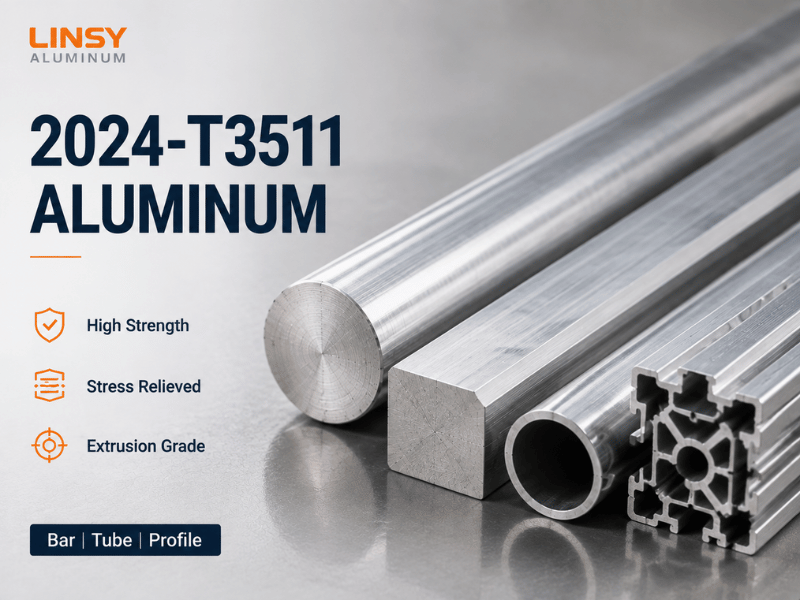
2024 is een aluminiumlegering uit de 2000-serie met koper als voornaamste legeringselement (3,8–4,9% Cu). Het verkrijgt sterkte door precipitatieharding na een oplossingswarmtebehandeling, niet door koudvervorming, wat het plaatst onder de sterkste vervormbare aluminiumlegeringen.
Dat kopergehalte maakt 2024 ook de minst corrosiebestendige van de gangbare luchtvaartlegeringen en over het algemeen ongeschikt voor smeltlassen — onbeklede delen zijn gevoelig voor interkristallijne en exfoliatiecorrosie en vereisen bekleding, anodiseren of verf ter bescherming. Het is deze sterkte-gewichtsverhouding, gecombineerd met betrouwbare bewerkbaarheid, die 2024 de standaardkeuze maakt voor vliegtuigconstructies en hoogwaardige constructiedelen — en precies de reden waarom de gespecificeerde temperatuurstoestand en productvorm, vooral voor geëxtrudeerde profielen, belangrijker zijn dan alleen de legeringsnaam.
Inzicht in de T3511-temperatuurstoestand
De aanduiding “T3511” beschrijft een drietraps thermisch-mechanische behandeling die wordt toegepast op geëxtrudeerde 2024-producten:
- Oplossingsgloeien. Het extrusieprofiel wordt verwarmd tot ongeveer 493°C (920°F) om koperrijke precipitaten op te lossen in een uniforme vaste oplossing, en vervolgens snel afgeschrikt — doorgaans in koud water.
- Spanningontlasting door rekken. Binnen een kort tijdsvenster na het afschrikken wordt het materiaal 1–3% van zijn lengte gerekt. Deze gecontroleerde plastische vervorming ontspant de restspanningen die door het snelle afschrikken zijn vastgezet.
- Richten. Omdat T3511 wordt toegewezen aan extrusies (staaf, buis, vorm, buisprofiel, profiel), wordt het profiel bovendien gericht door lichte koudvervorming, zodat het voldoet aan de rechtheidstoleranties bij levering.
Het praktische resultaat is een geëxtrudeerd 2024-profiel dat hoge sterkte combineert met lage restspanning en goede rechtheid in de geleverde toestand. Het voordeel wordt zichtbaar tijdens het bewerken: een T3511-staaf of -profiel heeft veel minder kans om te vervormen of buiten tolerantie te veren dan een niet-ontspannen extrusieprofiel wanneer materiaal aan één zijde wordt verwijderd.
Hoe T3511 verschilt van T351
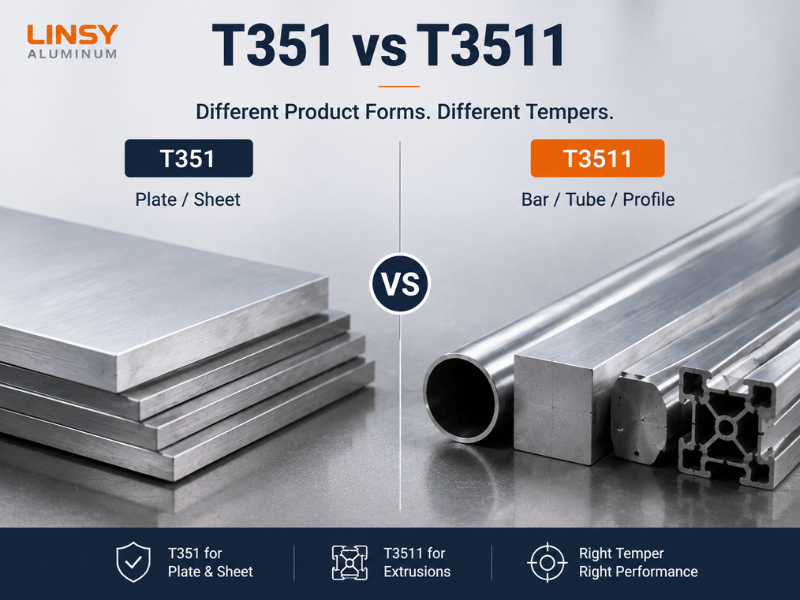
T351 en T3511 delen dezelfde oplossingswarmtebehandeling en rekoverspanningsontlasting. De extra “1” in T3511 is productspecifiek: deze geldt uitsluitend voor extrusies en voegt een richtstap toe. T351 is de equivalente temperatuurstoestand voor plaat en band, waarbij alleen rekken de restspanning beheerst en de rechtheid wordt bepaald door het walsen. Het onderscheid is productvormgedreven — T351 geldt voor vlakgewalste plaat en band, T3511 voor geëxtrudeerde staaf, buis, vorm of profiel.
Mechanische eigenschappen van 2024-T3511
De vloeigrens van 310 MPa is het getal dat de meeste constructieberekeningen bepaalt. Dit plaatst 2024-T3511 ruim boven algemeen toepasbaar 6061 (ongeveer 276 MPa) qua sterkte, terwijl de vermoeiingswaarde van ongeveer 125 MPa cyclisch belaste onderdelen zoals liggers en beslag ondersteunt. Het compromis is corrosie en lasbaarheid, hieronder behandeld.
| Eigendom | Waarde | Opmerking |
| Dichtheid | 2,78 g/cm³ | Typisch voor 2xxx-serie |
| Uiteindelijke treksterkte | 425 MPa (62 ksi) | Geëxtrudeerd product, kamertemperatuur |
| Trekvloeigrens (0,2%-offset) | 310 MPa (45 ksi) | Belangrijk voor constructief ontwerp |
| Rek bij breuk | ~10% | Afhankelijk van productvorm |
| Vermoeiingssterkte (5×10⁸ cycli) | ~125 MPa (18 ksi) | Glad proefstuk, R = −1 |
| Afschuifsterkte | 270 MPa (39 ksi) | Relevant voor bevestigingsverbindingen |
| Elasticiteitsmodulus | 73 GPa (10,6×10³ ksi) | ~Een derde van staal |
| Thermische geleidbaarheid | 121 W/m·K | Goede warmteafvoer |
| Thermische uitzettingscoëfficiënt | 23 µm/m·K | - |
| Specifieke warmtecapaciteit | 880 J/kg-K | - |
Waar 2024-T3511 wordt toegepast
De combinatie van sterkte, vermoeiingsweerstand en dimensionale stabiliteit na bewerking maakt T3511 de voorkeurstemperatuurstoestand voor geëxtrudeerde profielen in cyclisch belaste of precisieconstructies.
Luchtvaart- en defensiestructuren
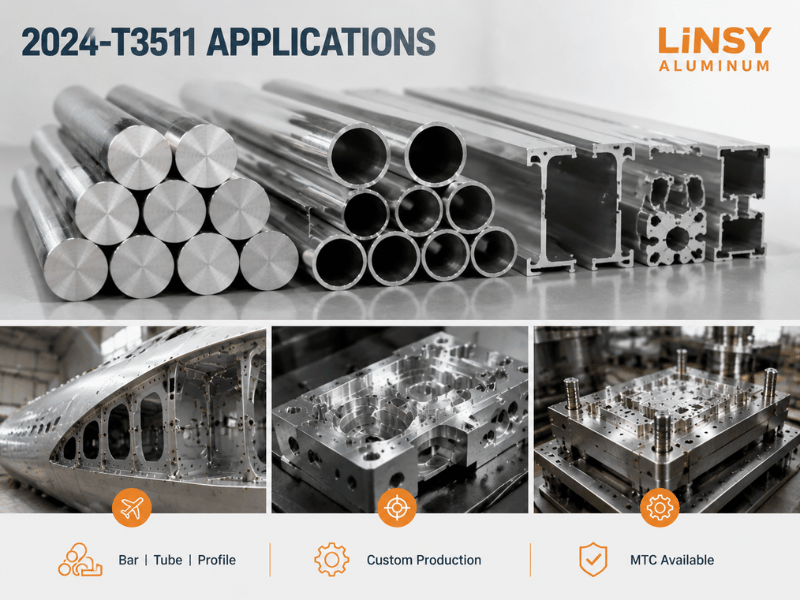
Vleugelliggers, rompstringers en constructiebeslag worden vaak bewerkt uit 2024-T3511-extrusies omdat de ontspannen toestand dunne of asymmetrische profielen stabiel houdt tijdens het frezen. Raketvinnen, munitiebehuizingen en elektronische structuren aan boord gebruiken dezelfde temperatuurstoestand waar sterkte-gewichtsverhouding en voorspelbaar bewerkingsgedrag primaire vereisten zijn. In deze toepassingen wordt het profiel doorgaans alclad-bekleed of met een afwerklaag beschermd, aangezien onbekleed 2024 agressieve omgevingen niet onbeschermd overleeft.
Hoogwaardige machines en gereedschappen
Motorsport-ophangingsarmen, bell-cranks en versnellingsbakhuizen bewerkt uit T3511-staaf leveren gewichtsbesparing op ten opzichte van staal zonder stijfheid op te geven. Precisiemallen, inspectiefixtures en constructieframes voor automatisering gebruiken T3511-profiel omdat het vlak blijft bij temperatuurschommelingen en herhaalde belastingscycli. Waar het onderdeel wordt gelast in plaats van bevestigd, is 6061 meestal het betere uitgangspunt — zie de werkaantekeningen hieronder.
T3511 versus andere 2024-temperatuurstoestanden — hoe te kiezen
Wanneer T3511 specificeren
Twee voorwaarden wijzen op T3511: het onderdeel is een geëxtrudeerde staaf, buis, vorm of profiel, en het zal precisiebewerkt worden of cyclische belasting dragen waarbij vervorming niet getolereerd kan worden. Als beide gelden, vermindert de rek-en-richtbehandeling vervorming en uitvalrisico tijdens precisiebewerking van geëxtrudeerde profielen.
Wanneer een andere toestand beter past
Wanneer de geometrie vlakgewalst is, biedt T351-plaat of -band dezelfde spanningsontlasting zonder te betalen voor extrusiegereedschap. Wanneer pieksterkte belangrijker is dan bewerkbaarheid of vervormbaarheid, levert T851 ongeveer 20% hogere vloeigrens. Wanneer lassen of gebruik in zoutwateromgeving deel uitmaakt van de vereisten, stap dan volledig af van 2024 — 6061 of een 5xxx-legering verwijdert de corrosie- en lasbaarheidsbeperkingen ten koste van lagere sterkte.
| Temper | Behandeling | UTS | YS | Geschikt voor | Vermijd wanneer |
| T3511 | Oplossing + rek + richten (extrusie) | 425 MPa (62 ksi) | 310 MPa (45 ksi) | Bewerkte geëxtrudeerde constructies, dimensionale stabiliteit | Lassen vereist, zoutwaterblootstelling |
| T3 | Oplossingsgloeien + koudvervorming + natuurlijke veroudering | 483 MPa (70 ksi) | 345 MPa (50 ksi) | Plaathuiden, gevormde onderdelen | Dikke secties die stabiliteit vereisen |
| T4 | Oplossing + natuurlijke veroudering | 469 MPa (68 ksi) | 324 MPa (47 ksi) | Hoogductiele onderdelen | Corrosieblootstelling zonder bekleding |
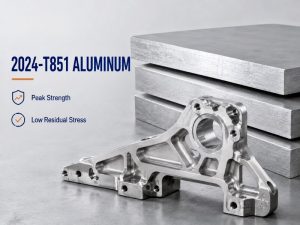
| T851 | Oplossingsbehandeling + spanningsontlasting (rek) + kunstmatige veroudering | 510 MPa (75 ksi) | 450 MPa (66 ksi) | Onderdelen met maximale sterkte | Vervormbaarheid of vormbaarheid vereist |
Werken met 2024-T3511 — wat u moet weten
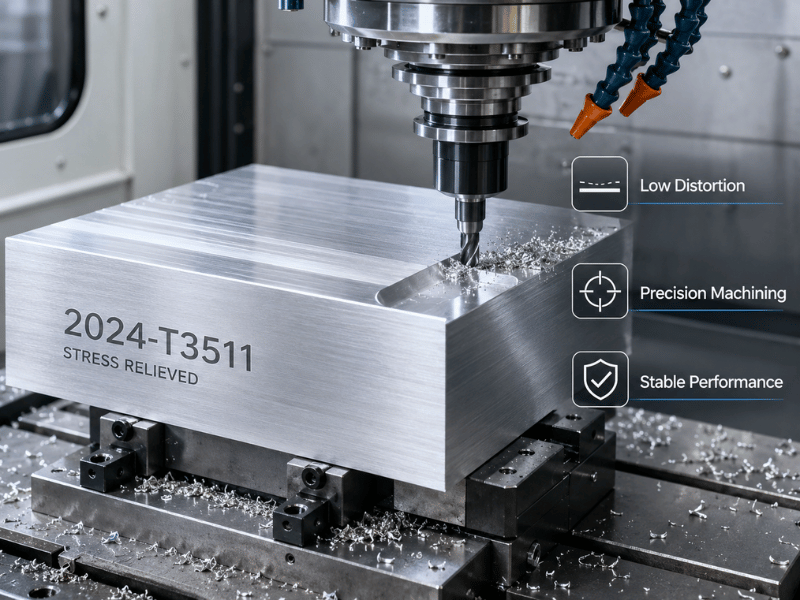
Bewerking. 2024-T3511 laat zich schoon bewerken met goede spaanderbeheersing en ondersteunt hoge snijsnelheden, wat het een basisproduct maakt voor automatische draaimachines en precisie-CNC-onderdelen. Gereedschapsslijtage blijft beheersbaar omdat de legering niet kleveriger is dan 6000-serie materiaal, maar scherpe gereedschapsgeometrie en consistente koelmiddelstroom houden de oppervlaktekwaliteit strak op dunne profielen.
Lassen en verbinden. Smeltlassen wordt niet aanbevolen voor 2024. De koperrijke samenstelling maakt de las en de warmte-beïnvloede zone gevoelig voor hete scheurvorming, en de sterkte na het lassen kan ver onder het basismateriaal dalen. Gebruik voor samenstellingen klinknagels, bouten of lijmverbindingen; indien een gelaste constructie onvermijdelijk is, wijzig het ontwerp dan naar 6061-T6 en accepteer de lagere sterkte.
Corrosiebescherming. Blank 2024 heeft een slechte corrosiebestendigheid en is kwetsbaar voor interkristallijne en exfoliatie-aantasting, vooral in chloride-omgevingen. Specificeer alclad (een metallurgisch gebonden zuivere aluminium oppervlaktelaag) voor vliegtuighuiden, of combineer anodiseren en verf voor gesloten constructies. Bij directe onderdompeling in zout water of maritieme omgevingen is 2024 de verkeerde keuze, ongeacht de tempering.
Vervormbaarheid. T3511 wordt geleverd als een gericht extrusieprofiel, dus het is niet bedoeld voor zware koudvervorming na behandeling — buigen riskeert scheuren omdat de temperatuurstoestand al nabij de pieksterkte ligt. Vorm of buig het profiel waar mogelijk vóór de uiteindelijke veroudering, of specificeer de geometrie als extrusieprofiel in plaats van buigen uit voorraad.
Voor- en nadelen in één oogopslag
| Afmeting | Voordeel | Beperking |
| Sterkte-gewichtsverhouding | Onder de hoogste van vervormbare aluminiumlegeringen | - |
| Weerstand tegen vermoeiing | Sterk voor constructies met cyclische belasting | Lager dan 7075 bij piektoepassingen |
| Bewerkingsstabiliteit | Spanningsontlast en gericht, lage vervorming | - |
| Corrosiebestendigheid | - | Slecht; vereist bekleding of coating |
| Lasbaarheid | - | Smeltlassen niet aanbevolen |
| Beschikbaarheid | Standaard en op maat gemaakte extrusies beschikbaar | Geen algemene plaatvervanger |
| Kosten | - | Hoger dan 6061 |
Conclusie
2024-T3511 biedt hoge sterkte, goede vermoeiingsweerstand en lage bewerkingsvervorming voor geëxtrudeerde constructieprofielen, maar ruilt corrosiebestendigheid en lasbaarheid in voor die prestaties — alleen beheersbaar met het juiste beschermings- en verbindingsplan. Het verkrijgen van het juiste geëxtrudeerde profiel met volledige documentatie blijft een veelvoorkomende inkoopuitdaging; Linsy Aluminum levert 2024-legering in staaf, buis, profiel en draad — inclusief T3511-extrusies — met standaardmaten op voorraad, maatwerkproductie met lage minimale bestelhoeveelheid (10–60 dagen), MTC voor elke bestelling, SGS-rapporten op verzoek, en ISO 9001/14001/45001-certificeringen. Raadpleeg de 2024-T3511-specificatie voor mechanische eigenschapsgrenzen, temperatuurstoestand-vergelijkingsgegevens en beschikbare extrusieprofielen, of neem contact op met Linsy Aluminum om voorraadbeschikbaarheid en maatwerkproductieopties voor uw project te bevestigen.
Veelgestelde vragen
Kan 2024-T3511 worden gelast?
Smeltlassen wordt niet aanbevolen. De koperrijke legering scheurt in de las en de warmtebeïnvloede zone en verliest een groot deel van zijn sterkte. Gebruik mechanische bevestiging of lijmverbindingen, of kies 6061-T6 als lassen vereist is.
Is 2024-T3511 geschikt voor maritiem gebruik of zoutwateromgevingen?
Nee. Blank 2024 heeft een slechte corrosiebestendigheid en zal putcorrosie of exfoliatie vertonen in chloride-omgevingen. Voor zoutwater- of maritieme onderdompeling is een 5xxx- of 6xxx-legering de veiligere keuze; 2024 hoort thuis in gesloten of goed gecoate constructies.
Wat is het verschil tussen 2024-T3511 en 2024-T351?
Ze delen de oplossingswarmtebehandeling en rekoverspanningsontlasting. T3511 voegt een richtstap toe en wordt toegewezen aan extrusies (staaf, buis, vorm, profiel); T351 is de equivalente temperatuurstoestand voor plaat en band.
Kan 2024-T3511 worden geanodiseerd?
Ja. Anodiseren verbetert de oppervlaktehardheid en slijtvastheid en geeft een schone afwerking, maar vervangt geen corrosiebescherming in agressieve omgevingen. Combineer anodiseren met verf, of gebruik alclad-materiaal, waar de blootstelling ernstig is.
Welke doorlooptijd kan ik verwachten voor maatwerk 2024-T3511-extrusies?
Maatwerk-extrusies buiten het standaardassortiment duren doorgaans 10–60 dagen, afhankelijk van legering, afmetingen en verwerkingsvereisten, met lage minimale bestelhoeveelheden. Standaardmaten uit voorraad zijn beschikbaar voor snellere respons, en elke bestelling wordt geleverd met een MTC.