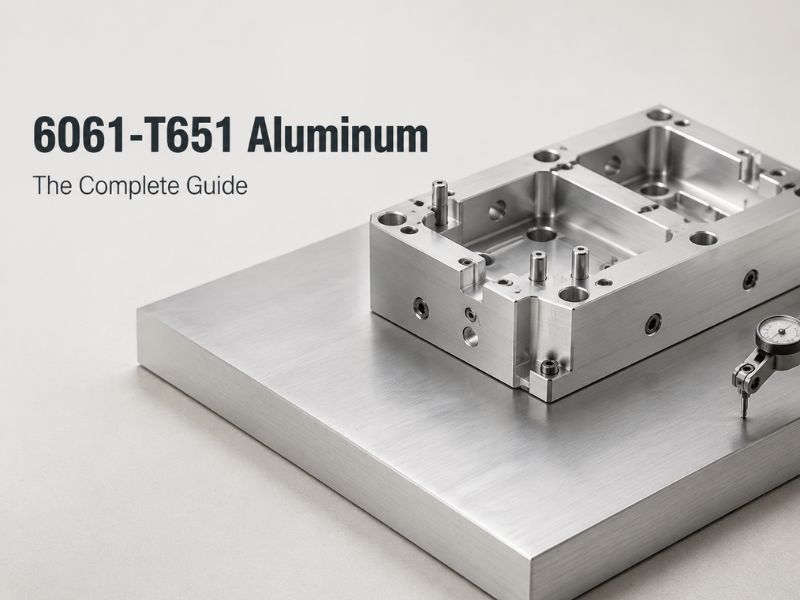
6061-T651 is one of the most-used heat-treatable aluminum tempers in structural, marine, and precision-machined components. This guide covers what the T651 designation means, its real properties, how it compares to 6061-T6, and where it earns its place — so you can specify the right temper instead of over- or under-buying.
What 6061-T651 Means
In “6061-T651”, the digits name the alloy family and the suffix names the temper. 6061 is a magnesium-silicon alloy (Mg₂Si is the main strengthening precipitate); T651 means the material is solution heat-treated, artificially aged, and then stress-relieved by stretching 1–3% before or after aging. That stretch is the whole point of the “51”: it permanently deforms the part enough to relax the internal stress locked in by quenching, so the bar or plate stays flat and dimensionally stable when you cut or weld it.
For extrusions, the equivalent stress-relieved temper is T6511 (stretch or compress, depending on shape). The underlying 6061 alloy and its strength are unchanged — only the residual-stress state differs.
Composition and Physical Properties
6061 is a balanced Mg-Si alloy with small copper, chromium, and manganese additions for strength and corrosion behavior.
| Element | Typical range (6061) |
|---|---|
| Silicon (Si) | 0.40–0.80% |
| Magnesium (Mg) | 0.80–1.20% |
| Copper (Cu) | 0.15–0.40% |
| Chromium (Cr) | 0.04–0.35% |
| Manganese (Mn) | 0.15% max |
| Iron (Fe) | 0.70% max |
| Zinc (Zn) | 0.25% max |
| Aluminum (Al) | Balance |
| Property | Typical value (T6 / T651) |
|---|---|
| Density | 2.70 g/cm³ |
| Melting range | 580–650 °C |
| Thermal conductivity | ~170 W/m·K |
| Electrical conductivity | ~40–43% IACS |
| Coefficient of expansion | 23.6 µm/m·K |
| Modulus of elasticity | 68.9 GPa |
Mechanical Properties
T651 and T6 share essentially the same strength — the stress-relief stretch does not meaningfully change peak strength. Values below are typical for plate and bar; minimum specified values step down as section thickness increases, so always read the numbers for your exact form and thickness.
| Property | Typical (T6 / T651) |
|---|---|
| Tensile strength | ~310 MPa |
| Yield strength | ~276 MPa |
| Elongation | ~12% |
| Hardness (Brinell) | ~95 HB |
Common Applications of 6061-T651
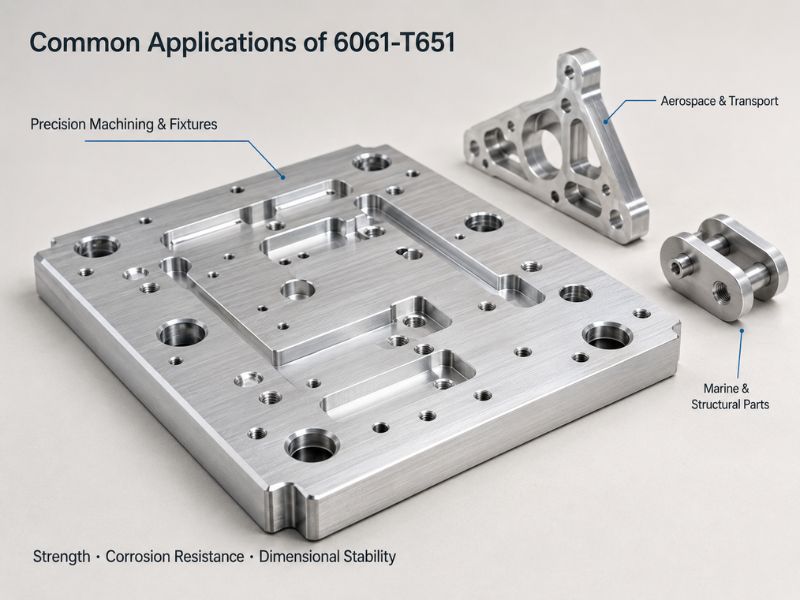
6061-T651 is chosen where strength, corrosion resistance, and weldability all matter but the part also has to hold a tight tolerance:
- Aerospace and transport — aircraft structures, brackets, and fittings where weight and stability count.
- Marine hardware — boat components and frames; 6061’s corrosion resistance in water is sound, though it is not a substitute for 5xxx in continuously submerged service.
- Precision machining — mold bases, jig and fixture plates, CNC-machined parts, and automation frames, where residual-stress distortion would scrap the work.
- Structural and welded assemblies — frames, supports, and tubing that are cut to size and welded on site.
6061-T651 vs 6061-T6
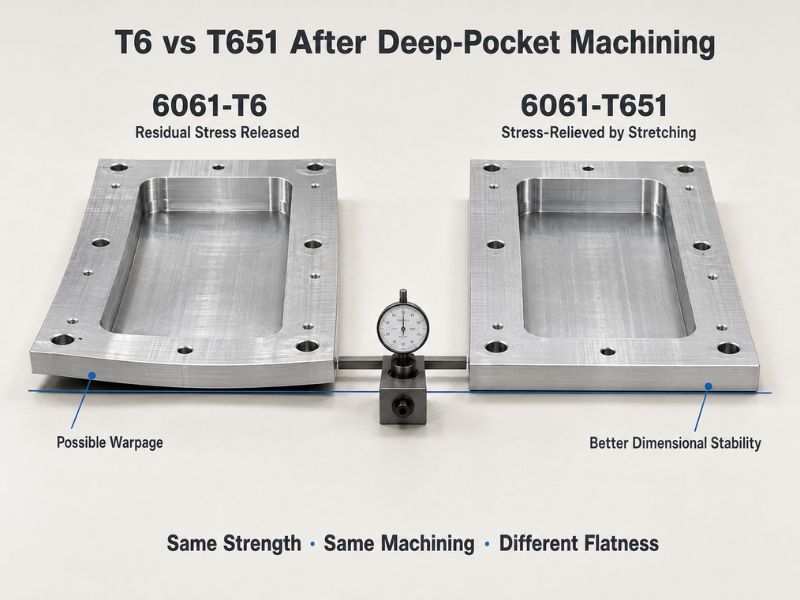
6061-T651 and 6061-T6 are the same alloy at nearly the same strength. The real difference is residual stress and what happens to the part during machining and welding.
Short answer. 6061-T651 is 6061-T6 with a controlled stretch (1–3%) that relieves quench-induced internal stress. Tensile and yield strength are essentially identical. T651’s advantage is dimensional stability: it warps far less when material is removed, so it holds tight tolerances. T6 is the lower-cost default for general structural work; T651 is worth the premium when precision machining, flatness, or post-machining stability decide whether the part passes.
| Feature | 6061-T6 | 6061-T651 |
|---|---|---|
| Heat treatment | Solution + age | Solution + stretch 1–3% + age |
| Tensile strength | ~310 MPa | ~310 MPa |
| Yield strength | ~276 MPa | ~276 MPa |
| Residual stress | Higher (from quench) | Significantly lower (relieved >70%) |
| Dimensional stability | Good | Excellent |
| Machining distortion | Can warp/spring | Minimal; holds ±0.05 mm class tolerances |
| Weldability | Good | Good (same as T6) |
| Typical forms | Sheet, plate, bar, tube, extrusion | Primarily plate, bar, rod |
| Relative cost | Standard | ~15–20% higher |
Choosing between them. Pick T6 for standard structural parts, cost-sensitive builds, and general fabrication where tight tolerances are not critical — bike frames, brackets, automotive and marine structures. Pick T651 when your shop does heavy machining, the part is thin-walled or close-tolerance, or flatness must survive cutting and welding — mold bases, fixture plates, aerospace details, and precision automation components. Both are weldable, so welding alone does not decide the temper; stability under subsequent machining does.
How 6061-T651 Compares to Other Tempers and Alloys
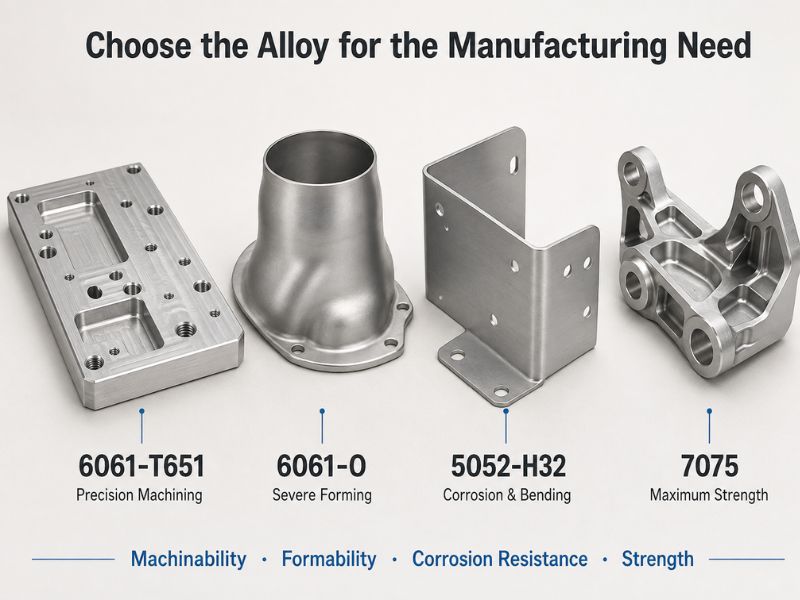
Next to other 6061 tempers and a common alternative, the trade-offs are formability, strength, and cost.
| Temper / alloy | Formability | Strength | Machinability | Corrosion resistance |
|---|---|---|---|---|
| 6061-T651 | Moderate | High | Good (stable) | Excellent |
| 6061-O | Excellent | Low | Excellent | Good |
| 5052-H32 | Good | Medium | Good | Very good |
If the part needs tight bends or deep draws, 6061-O forms far better despite lower strength. If you need maximum strength, 7075 is stronger but costs more and machines less freely. For most structural and machined jobs, 6061-T651’s balance is the reason it shows up across aerospace, automotive, and general fabrication.
Working With 6061-T651
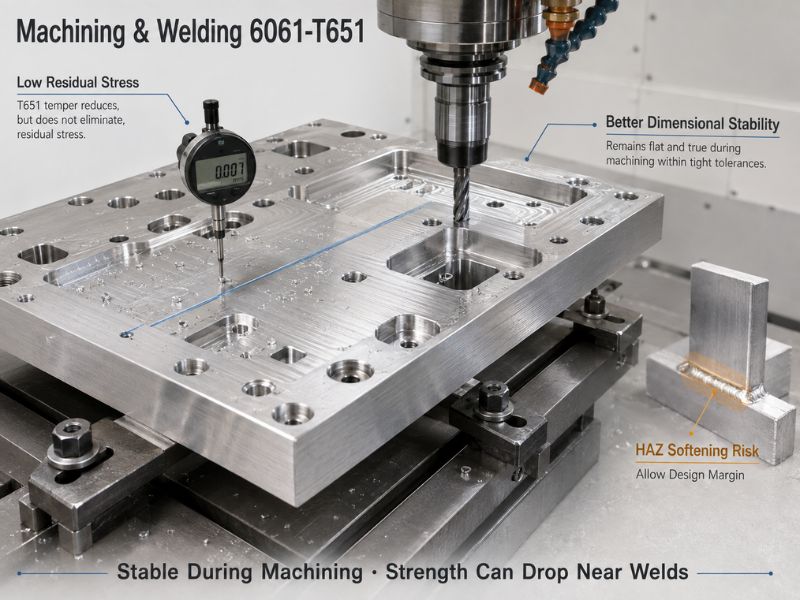
- Machining. T651 machines cleanly with standard tooling. Its low residual stress is why it is preferred for precision CNC work — the part stays put as you cut it.
- Welding. 6061-T6 and T651 weld similarly well (both Good). Note that the heat-affected zone softens toward the O condition, so design around post-weld strength loss rather than the temper’s as-received numbers.
- Forming. Moderate formability. Heavy bends work-harden the material; anneal before severe forming if the geometry demands it. Track elongation so you do not exceed the bend limit.
- Finishing. Anodizes to a clear, even coating; 6061 is a common anodized structural alloy.
Conclusion
The trade-off is straightforward: 6061-T651 gives you high strength, good corrosion resistance, and clean machinability, but only moderate formability and a small cost premium over T6. Choose it for structural, marine, and machined parts where stability under load and during cutting matters more than deep bending or the lowest price.
At Linsy Aluminum, we supply 6061-T651 in sheet, bar, tube, and profile, with other 6061 tempers (T4, T6, T6511) available across wire, square and round bar, tube, and flat bar. Mill Test Certificates come standard, and SGS or third-party composition and mechanical reports are available on request. Our team reviews your drawing, recommends the right temper and size, and helps you avoid over-specifying. Send the drawing and requirements, and we will return a stock check and quote.
Frequently Asked Questions
Is 6061-T651 stronger than 6061-T6?
No — they are essentially the same strength. Typical tensile is ~310 MPa and yield ~276 MPa for both. T651’s stretch relieves residual stress but does not raise peak strength; its edge is dimensional stability, not load capacity.
When should I choose T651 over T6?
Choose T651 when the part will be heavily machined, thin-walled, or held to close tolerances, or when flatness must survive cutting and welding. Choose T6 for general structural work where cost matters more than ultra-tight tolerances.
Can 6061-T651 and T6 be welded?
Yes. Both weld similarly well (Good). Welding does not decide the temper — what differs is stability during later machining, where T651 distorts far less.
How does 6061-T651 compare to 6061-O?
6061-O is fully annealed: much lower strength but excellent formability, used when the part must be bent or drawn before being heat-treated to T6/T651. T651 is the high-strength, moderate-formability service temper.
What applications is 6061-T651 best suited for?
Precision-machined parts, mold and fixture plates, aerospace structures, marine hardware, and welded structural assemblies — anywhere strength, corrosion resistance, and dimensional stability all matter.