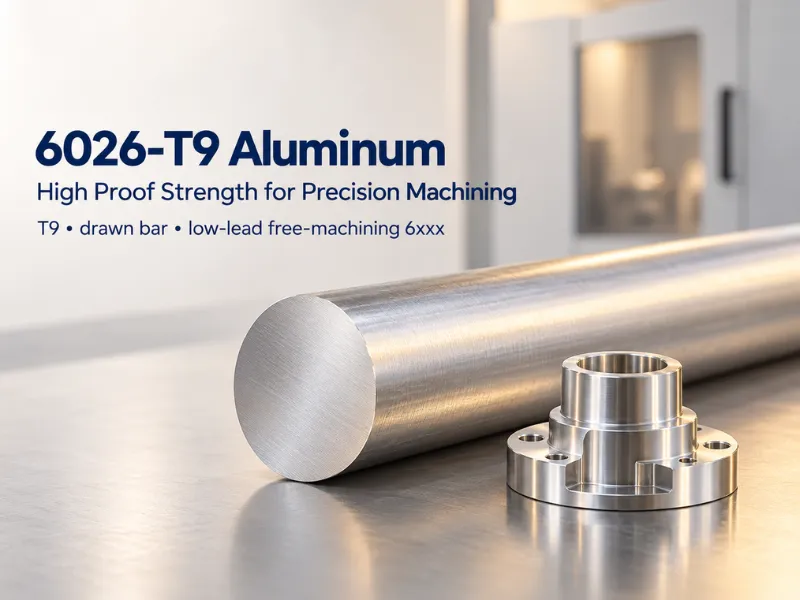
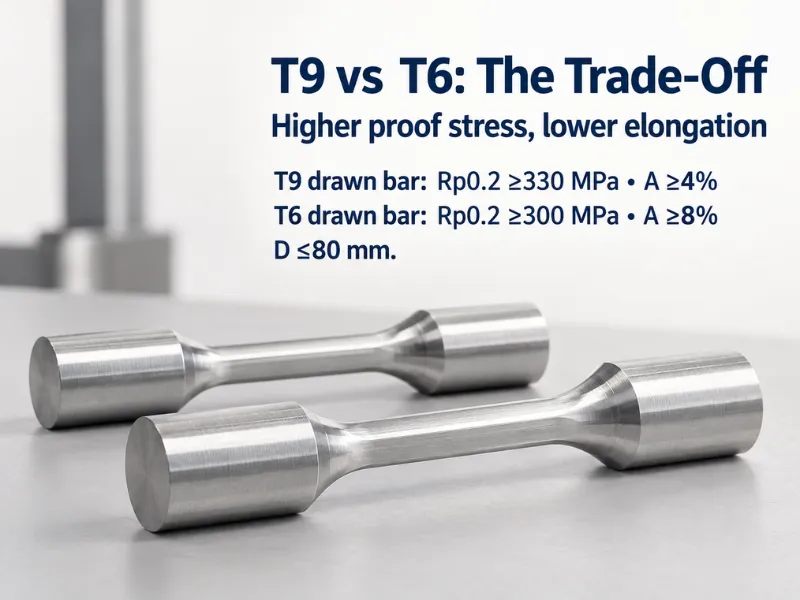
6026-T9 is the temper to specify when a machined part has to resist permanent set as far as this alloy allows, and will never be bent afterwards. Cold working the bar after aging takes the 0.2% proof stress to 330 MPa, 30 MPa above T6, and leaves 4% elongation to work with instead of 8%.
Strength is only half the decision. The production sequence also fixes which form each temper is available in, and a temper on a form we cannot run is not a specification you can place.
What 6026 Is
6026 is a 6xxx Al–Mg–Si alloy that gains strength from Mg₂Si precipitating during artificial aging. Its defining feature is the free-machining addition: bismuth at 0.50–1.50% breaks the chip, while lead is capped at 0.40% rather than being the mechanism. That keeps the corrosion resistance and anodizing response of an ordinary 6xxx while adding the chip control of a free-cutting grade — the role 6262 and 6012 filled, with bismuth doing the chip breaking.
The trade-off is where the alloy sits, not what it can do. Bismuth does not raise strength, so 6026 is a machining grade first and a structural grade second; where maximum strength is the driver, 6082 or 7075 do that job better. What decides a 6026 part in practice is the temper, because the spread across T6, T8, T9 and T6510/T6511 runs from 300 to 330 MPa in proof stress and from 8% to 4% in elongation — wide enough to decide whether the part can be formed at all.
Chemical Composition (EN 573-3)
Bismuth is the deliberate addition; tin and lead sit at impurity ceilings. That distinction matters when you read a mill certificate, because a high tin figure is a contamination signal, not a free-machining benefit.
| Element | 6026 (EN 573-3, wt%) | What it does |
|---|---|---|
| Si | 0.60–1.40 | Forms Mg₂Si with Mg — the strength source |
| Fe | 0.70 max | Impurity; affects surface finish and toughness |
| Cu | 0.20–0.50 | Raises strength and hardens the precipitate |
| Mn | 0.20–1.00 | Controls grain structure and recrystallization |
| Mg | 0.60–1.20 | Balances with Si into Mg₂Si |
| Cr | 0.30 max | Impurity in this grade |
| Zn | 0.30 max | Impurity |
| Ti | 0.20 max | Grain refiner |
| Bi | 0.50–1.50 | Free-machining addition — breaks the chip |
| Pb | 0.40 max | Residual; the ceiling the ELV and RoHS exemptions allow |
| Sn | 0.05 max | Impurity ceiling, not an addition |
| Others | 0.05 max each, 0.15 max total | — |
| Al | Balance | — |
Check three lines on the certificate before you accept a heat: Bi inside 0.50–1.50%, Sn at or under 0.05%, and Pb at or under 0.40%. A heat with Bi below 0.50% machines long and stringy; one with Sn above 0.05% signals scrap contamination rather than a design change.
How the T Tempers Are Produced
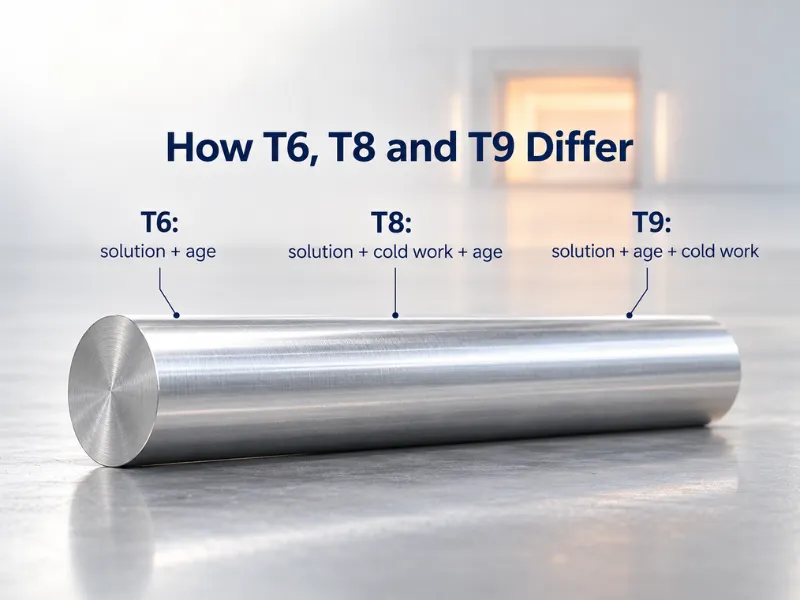
Every age-hardened 6xxx temper starts the same way: the billet is solution heat treated to dissolve the alloying elements, quenched to trap them in supersaturated solution, then aged so they precipitate as fine particles. The suffix after T records what happens around that core sequence — and the order of cold work against aging is what separates T8 from T9.
- T6 — solution heat treated, then artificially aged. No cold work.
- T8 — solution heat treated, cold worked, then artificially aged. Cold work comes before aging.
- T9 — solution heat treated, artificially aged, then cold worked. Cold work is the final operation.
- T6510 — T6 followed by stress relief by stretching, permanent set 1–3% on rounds, bars, profiles and tubes (0.5–3% on drawn tube), with no further straightening after the stretch.
- T6511 — the same as T6510, except light straightening after stretching is permitted to meet dimensional tolerances.
T9 is the only one of the five that cold works the bar after aging. Aging has already set the precipitate; the cold draw then adds dislocation strengthening on top of it and fixes the diameter in the same pass. A T9 bar arrives with its dimensions and its residual stress already settled, which is why precision turned parts are usually specified in T9 — the diameter you machine to is the diameter the bar holds.
T8 reverses that order. Cold work goes in before aging, so the bar is aged at its drawn size rather than drawn after aging. A T8 bar reaches 315 MPa proof stress and 345 MPa tensile at 4% elongation — more proof stress than T6, 15 MPa less than T9.
6026-T9 in Numbers
The minimums below are from EN 754-2 for cold-drawn bar and EN 755-2 for extruded product. T9 exists only as a drawn product; T6510 and T6511 exist only as extruded product, and they carry the same strength line as T6 at each size band.
| Temper | Form and standard | Size range | Rm min (MPa) | Rp0.2 min (MPa) | A min (%) | HB (typ.) |
|---|---|---|---|---|---|---|
| T6 | Drawn bar, EN 754-2 | D ≤ 80 mm | 370 | 300 | 8 | 95 |
| T8 | Drawn bar, EN 754-2 | D ≤ 80 mm | 345 | 315 | 4 | 95 |
| T9 | Drawn bar, EN 754-2 | D ≤ 80 mm | 360 | 330 | 4 | 95 |
| T6 / T6510 / T6511 | Extruded, EN 755-2 | D ≤ 140 mm | 370 | 300 | 8 | 95 |
| T6 / T6510 / T6511 | Extruded, EN 755-2 | 140 < D ≤ 200 mm | 340 | 250 | 8 | 90 |
| T6 / T6510 / T6511 | Extruded, EN 755-2 | 200 < D ≤ 250 mm | 300 | 200 | 8 | 90 |
Choose on the proof-stress column, not the tensile column. T9 holds the highest yield at 330 MPa, 30 MPa above T6, while its tensile minimum of 360 MPa actually sits 10 MPa below T6’s 370 — cold work on an aged structure buys resistance to permanent set and gives up tensile and elongation to get it.
Physical properties sit where a 6xxx normally sits; these are typical values, not minimums: density 2.72 g/cm³, modulus of elasticity about 69–70 GPa, thermal conductivity 172 W/(m·K), electrical conductivity around 26 MS/m (roughly 44% IACS), and a coefficient of thermal expansion of 23.4 × 10⁻⁶/K between 20 and 100 °C. Solidification runs approximately 575–650 °C.
T9 vs T6 vs T8 vs T6510/T6511
| Temper | Sequence | Rm min | Rp0.2 min | A min | Specify it when |
|---|---|---|---|---|---|
| T6 | Solution + age | 370 | 300 | 8% | You need the best tensile-elongation balance, or the part is extruded rather than drawn |
| T8 | Solution + cold work + age | 345 | 315 | 4% | The bar is already cold drawn and the part needs more proof stress than T6 at the same 4% elongation |
| T9 | Solution + age + cold work | 360 | 330 | 4% | The finished part is cut, not formed, and must hold its set under the highest load the grade allows |
| T6510 | T6 + stretch, no re-straightening | 370 | 300 | 8% | A large extruded section is machined flat or square and residual stress would move it |
| T6511 | T6510 + light straightening | 370 | 300 | 8% | Same as T6510, but the section needs straightening inside standard tolerance after the stretch |
T9 is the right call when the part is produced entirely by machining and the design load is carried below the yield point. The 330 MPa proof stress is the highest the alloy offers, and the cold-finished diameter means the bar is already where the tolerance wants it. The cost is 4% elongation: T9 leaves almost no room for a bend, a swage, or a crimp after delivery.
T6 covers the widest range of work. Its 370 MPa tensile and 8% elongation give room to form or straighten after heat treatment, and it is the temper extruded tube and profile come in. If the part needs any deformation after aging, T6 or one of its stress-relieved versions is the one that can still take it.
T8 sits between them and is easy to overlook. It is a drawn-bar temper like T9, but with cold work ahead of aging: 315 MPa proof stress and 345 MPa tensile, still at 4% elongation. Specify T8 when the drawing calls for more proof stress than T6 and the part will not be formed — but T9 is available, it gives 15 MPa more proof stress at the same elongation, so T8 usually loses that comparison on a like-for-like drawing.
T6510 and T6511 are the stress-relieved versions of T6 and exist only for extruded product. They change residual stress, not the strength line, so the choice between them and T6 is about distortion after machining rather than load capacity. T6510 forbids straightening after the stretch; T6511 allows light straightening to hold tolerance, which is why it appears more often on standard extruded sections.
Shapes and Sizes
The temper usually decides the form. T9 and T8 are drawn-bar tempers; T6510 and T6511 are extruded; T6 exists in both. Where a drawing needs a temper the standard form does not carry, the route changes — the order does not get refused.
- Bar and rod — round 6–400 mm, hex and square 6–200 mm, length 1000–6000 mm. T9 is normally a cold-drawn round bar.
- Sheet and plate — 0.5–120 mm thick, 1000–2600 mm wide, length 1000–6000 mm.
- Tube — outer diameter 10–300 mm, wall 0.5–30 mm.
- Coil — supplied on enquiry. Tell us the required temper, width and coil weight and we confirm what the mill can run; coil is not a standing stock form for this grade.
- Custom profiles — extruded to your section drawing (how custom extrusion profiles are produced covers the route from drawing to die).
Non-standard sections and sizes are produced to order. Low-MOQ custom runs typically take 10–60 days depending on size and processing; what a size outside the standard range changes is the production route and the lead time, not whether we will quote it.
Go / No-Go
- Go when the part is turned or milled in volume, the enquiry has to clear RoHS or ELV, and 6061-T6 is short on strength while a 2xxx or 7xxx grade would be more than the design needs. The bismuth chip control is what pays for the alloy, and it pays most on automatic lathes running long batches.
- Go when the part needs an anodized finish and free-machining behavior at the same time; a leaded free-machining grade dulls that finish and carries its own compliance burden. Note the qualification: 6026 meets ELV and RoHS under the lead exemption for aluminum alloys, which permits up to 0.40% Pb. It is a low-lead grade, not a zero-lead grade, and the distinction matters if your compliance file treats exemptions differently from substance bans.
- No-go when the drawing fixes T9 or T8 on a part that still has to be formed. That is a temper mismatch rather than an alloy limitation — 6026 forms in O and T4, and the drawing changes temper, not grade.
- No-go when the service environment needs the seawater performance of a 5xxx alloy, or when 6061 or 6063 already meets the drawing. 6026 costs more than either, and the premium only returns where the free-machining behavior and the compliance position are both being used.
Specifying and Sourcing 6026
Four lines on the enquiry prevent most wrong deliveries:
- Name the standard, not only the alloy.
6026-T9 to EN 754-2fixes the product form, the size band and the property table;6026-T9on its own leaves all three open. - Pair the temper with a form the standard carries. T9 and T8 belong to drawn bar under EN 754-2; T6, T6510 and T6511 belong to extruded product under EN 755-2. Asking for
T9 extruded profilesends the enquiry back for clarification. - Give the size band, not just the nominal. The EN 755-2 minimums step down at 140 mm and again at 200 mm, so a 210 mm bar is specified against 300 MPa tensile, not 370.
- Require EN 10204 3.1. That certificate carries the heat’s actual chemistry and mechanical results, signed at the producing mill, and it is the only document that lets you check Bi, Sn and Pb against the limits above.
Our 6026 aluminum alloy page lists the forms and tempers we run, so the size and temper can be checked before you write the enquiry.
Conclusion
T9 gives 6026 its highest proof stress at 330 MPa and its lowest elongation at 4%, so it suits a part that is machined to final form and loaded below yield, and rules out anything that still has to bend. T6, T8 and T6510/T6511 trade that yield back for formability or for lower residual stress in large sections.
We draw and supply 6026 in T6, T8, T9, T6510 and T6511 across bar, sheet, tube and custom profiles, with MTC on every order and coil quoted on enquiry.
Send your drawing with the standard, temper and size band, and we will confirm the production route and lead time before you commit.
Frequently Asked Questions
What is 6026 T9 aluminum?
6026 is a low-lead free-machining 6xxx alloy, and T9 is the temper produced by aging the bar and then cold working it. Because the cold draw is the last step, the bar arrives strengthened and dimensionally finished — which is why T9 suits precision turned parts.
Is 6026 T9 stronger than T6?
It depends which strength you mean. T9 reaches a higher 0.2% proof stress, 330 MPa against T6’s 300, so it resists permanent set better. Its tensile minimum is 360 MPa against T6’s 370 — 10 MPa lower — and its elongation drops from 8% to 4%.
Can 6026 T9 be welded?
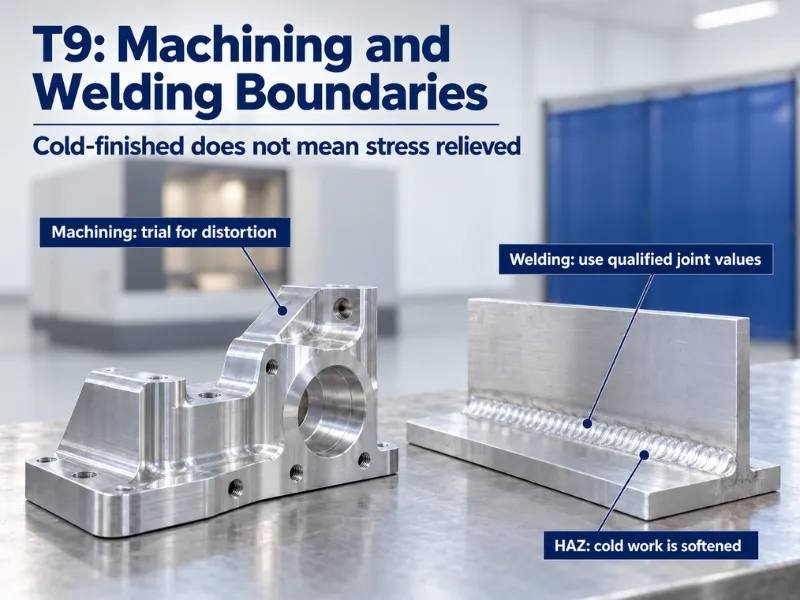
Yes, by TIG or MIG, but the joint will not hold T9 properties. The heat-affected zone reverts toward the annealed condition, and no post-weld aging treatment restores the T9 structure in this grade. If the finished assembly must carry T9 strength across a weld, change the design to a mechanical joint or pick a temper you can accept losing.
Which tempers do you supply, and what is the minimum order?
We supply bar, sheet, tube and custom profiles in T6, T8, T9, T6510 and T6511. Coil is quoted on enquiry. Round bar runs 6–400 mm and sheet 0.5–120 mm thick.
Non-standard sizes go to low-MOQ custom production, typically 10–60 days. Send the drawing, temper and size band for a route and a price.