Introduction
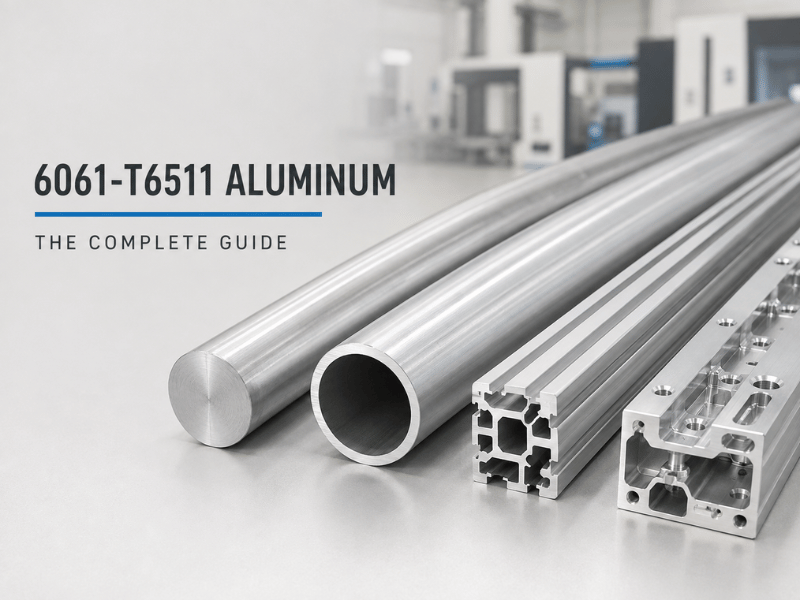
6061 aluminum is the most widely used aluminum alloy in the world, and T6511 is its extruded, stress-relieved, straightened form. The temper adds two controlled steps to a standard T6 treatment — stretching to relieve residual stress, then straightening to hold straightness tolerances on long bars, tubes, and profiles.
That combination is what makes 6061-T6511 the default choice for extruded structural and machined parts: it keeps all of 6061’s weldability, corrosion resistance, and strength while removing the two failure modes that show up in machining — distortion from internal stress and bowed long sections. The practical question is when that extra processing earns its cost over plain 6061-T6 or plate-form 6061-T651, and what to check when ordering.
The Basics of 6061 T6511 Aluminum
6061 gains its strength through precipitation hardening. The alloy is solution heat treated — heated, then quenched — and then artificially aged at elevated temperature, which precipitates the magnesium-silicide phase that gives 6061 its mechanical properties. The T6511 designation adds detail to that route: the “T6” part is the solution treatment and artificial aging, the “51” means the material has been stress relieved by stretching (typically 1–3% permanent set), and the final “1” indicates the extrusion was straightened after stretching to meet straightness tolerances.
Definition and Composition
6061 is an aluminum-magnesium-silicon alloy (Al-Mg-Si) whose strength comes from Mg₂Si precipitation. Its composition, per the Aluminum Association and ASTM B221 / AMS QQ-A-200/8, is controlled within these limits:
| Element | Content (%) | Role |
|---|---|---|
| Aluminum | Balance | Base metal |
| Magnesium (Mg) | 0.8 – 1.2 | Main hardening element (Mg₂Si) |
| Silicon (Si) | 0.4 – 0.8 | Main hardening element (Mg₂Si) |
| Copper (Cu) | 0.15 – 0.40 | Adds strength |
| Chromium (Cr) | 0.04 – 0.35 | Grain-structure control |
| Iron (Fe) | 0.70 max | Impurity control |
| Zinc (Zn) | 0.25 max | Impurity control |
| Manganese (Mn) | 0.15 max | Grain refinement |
| Titanium (Ti) | 0.15 max | Grain refinement |
The magnesium and silicon are the working pair: magnesium makes the alloy age-harden over time, silicon allows the Mg₂Si phase to form, and the small copper addition lifts strength without wrecking weldability or corrosion resistance.
Key Characteristics and Physical Properties
6061-T6511 mechanical and physical values (extruded bar, rod, and profile, room temperature):
| Property | Value | Note |
|---|---|---|
| Density | 2.70 g/cm³ | Standard for 6xxx alloys |
| Ultimate Tensile Strength | 290 MPa (42 ksi) min | Typical ~310 MPa (45 ksi) |
| Yield Strength (0.2%) | 270 MPa (40 ksi) min | Typical ~276 MPa (40 ksi) |
| Elongation at Break | ~9% (50 mm gauge) | Extruded bar/rod |
| Fatigue Strength | ~100 MPa (15 ksi) | 5×10⁸ cycles |
| Shear Strength | ~170 MPa (25 ksi) | |
| Elastic Modulus | 69 GPa (10,000 ksi) | Stiff for a 6xxx alloy |
| Shear Modulus | 26 GPa | |
| Brinell Hardness | ~95 HB | |
| Thermal Conductivity | ~170 W/m·K | Good for heat removal |
| Electrical Conductivity | ~43% IACS | |
| Thermal Expansion | ~24 µm/m·K | |
| Melting Range | ~580–650 °C |
Two numbers matter most for design. The 270 MPa yield minimum is what structural calculations use, and it is identical to 6061-T6 — the stress relief does not cost strength. The ~100 MPa fatigue strength at 5×10⁸ cycles is why repeated-load parts (brackets, frames, couplings) stay in this alloy rather than moving to a lower-grade extrusion.
Common Applications of 6061 T6511
Because 6061-T6511 welds, machines, and anodizes cleanly, it shows up across the same industries that use 6061 generally, with one addition: the stress-relieved, straightened condition is what makes long machined extrusions practical.
Aerospace. Aircraft interiors, seat tracks, and secondary structural brackets are machined from 6061-T6511 bar and profile — the stress relief keeps thin machined sections from distorting after material removal.
Automotive. Truck frames, roof rails, and suspension and chassis components use the extruded form because it combines weldability with dimensional stability in long sections.
Marine. Boat rails, masts, and hardware take advantage of 6061’s corrosion resistance; the straightened condition keeps long rail and tube sections true.
Industrial and electrical. Machine frames, conveyor rails, heat sinks, and enclosures use the alloy’s stiffness, conductivity, and machinability where a straight, stable extrusion saves fabrication time.
Advantages of Using 6061 T6511 Aluminum
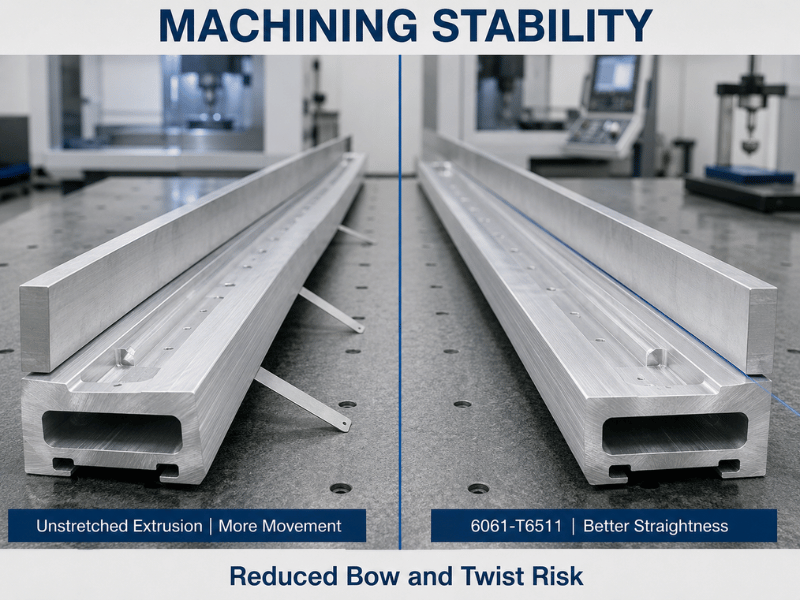
The T6511 value is not higher strength — it is controlled residual stress and straightness. That changes three things in practice:
Machining stability. A T6511 bar machined with deep pockets or asymmetric cuts stays within tolerance, because the stretching step removed the locked-in stresses that make plain T6 twist during machining.
Straightness on long sections. Extruded bars and tubes that run 6 meters or more stay straight as delivered, so downstream cutting and assembly do not inherit bow.
All the standard 6061 benefits. Good weldability with MIG/TIG, a protective oxide film that resists atmospheric corrosion, clean machining, and a good anodized finish. The alloy is heat-treatable in principle, but in the T6511 condition it is already at its working strength.
6061-T6511 vs T6 vs T651: How to Choose
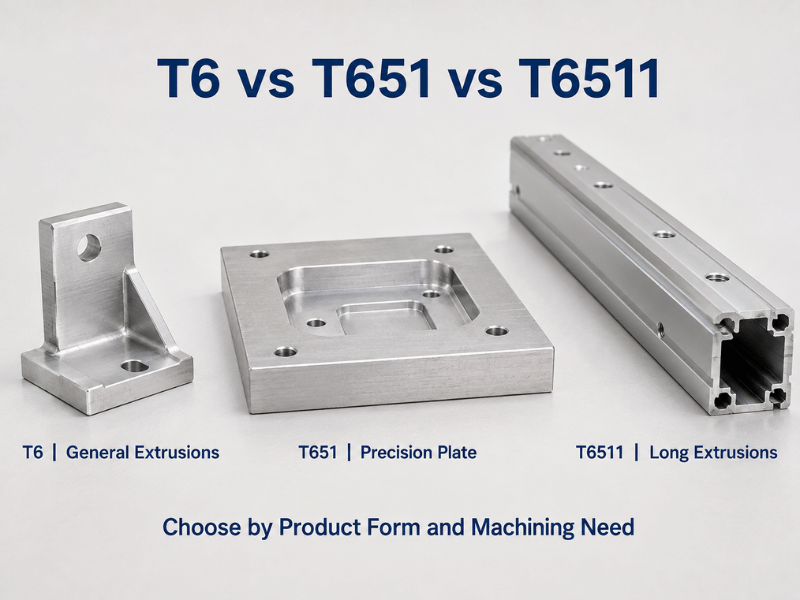
All three tempers share the same solution treatment and artificial aging, so their mechanical minimums are identical. The difference is entirely in how residual stress is handled:
| Temper | UTS (MPa) | YS (MPa) | Stress Relief | Product Form |
|---|---|---|---|---|
| 6061-T6 | 290 min | 270 min | None | Extrusions, sheet, plate |
| 6061-T651 | 290 min | 270 min | Stretched (plate) | Plate, bar, rolled forms |
| 6061-T6511 | 290 min | 270 min | Stretched + straightened (extrusion) | Extruded bar, rod, tube, profile |
When T6511 Is the Right Call
The part is an extruded bar, tube, or profile that will be precision-machined or must hold straightness in a long section. If either holds, T6511 is the temper to specify — the stretch and straighten steps are exactly what prevent machining distortion and bow. The same logic applies to T651 on plate: stress relief, applied to a different product form. The 6061-T651 vs T6 comparison covers the plate side in detail.
When T6 or T651 Fits Better
When the part is a short, lightly machined extrusion where distortion is not a risk, plain 6061-T6 is the lower-cost route — you are not paying for a stress-relief step you will not use. When the starting form is plate rather than extrusion, specify T651, which is the plate/bar equivalent of T6511; the 6061-T651 complete guide walks through that temper in depth.
Working with 6061-T6511 — What You Need to Know
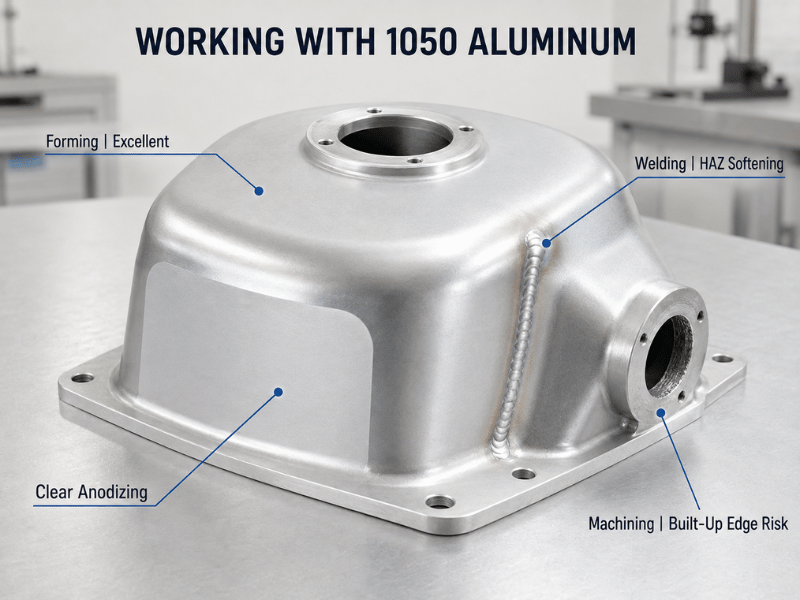
Machining. 6061-T6511 machines cleanly with sharp carbide tooling at high speeds and moderate feeds. The stress-relieved condition is the reason it is a staple for screw-machine products and precision CNC parts — deep pockets and one-sided cuts hold tolerance instead of springing.
Welding. MIG and TIG welding work well on 6061-T6511. The heat-affected zone next to the weld loses part of the aged strength (standard for 6xxx tempers), so welded joints that must carry full rated load should be designed with that margin and a qualified filler and procedure.
Anodizing and finishing. 6061-T6511 anodizes to clear, black, and color finishes. The copper content (0.15–0.40%) makes the anodized color slightly less bright than 6063’s, but the alloy accepts standard anodizing and powder coating without issue.
Corrosion protection. The natural oxide film resists atmospheric and industrial corrosion well, which is why 6061 is used outdoors without coating. For coastal or marine service, anodizing or a protective coating is the standard safeguard.
Pros and Limitations at a Glance
| Factor | Advantage | Limitation |
|---|---|---|
| Machining stability | Stress-relieved — minimal distortion | Not needed for short, lightly machined parts |
| Straightness | Straightened long bars and tubes | Adds a processing step vs plain T6 |
| Weldability | Excellent with MIG/TIG | HAZ strength loss needs design margin |
| Corrosion resistance | Good atmospheric and industrial | Marine service needs coating |
| Anodizing | Clear/black/color finishes | Slightly less bright than 6063 |
| Strength | 270 MPa yield min, same as T6 | Not as high as 7075 or 2024 |
| Availability | Standard extruded mill product | Extrusion route only — not for sheet |
Conclusion
6061-T6511 delivers everything 6061 is known for — weldability, corrosion resistance, and strength-to-weight — in a stress-relieved, straightened extrusion that machines true and stays straight. The trade-off is that the value only shows when the processing matters: temper control and straightness tolerances decide whether it performs to spec, so material certification matters as much as price.
Linsy Aluminum is a Shenzhen-based aluminum factory supplying 6061-T6511 bars, rods, and profiles with an MTC for every order, low-MOQ custom sizes, and SGS test reports on request, with a typical lead time of 10–60 days for non-stock dimensions.
If the part is a machined or structural extrusion, send the drawing or specification to Linsy Aluminum to confirm the temper, dimensions, and straightness requirements before ordering.
Frequently Asked Questions
How does 6061-T6511 compare to other aluminum alloys?
6061-T6511 sits in the versatile middle of the aluminum family: stronger and stiffer than 6063 and 6005, weldable and corrosion-resistant where 2024 and 7075 are not. Against 6061 vs 7075, 6061 wins on weldability and corrosion; 7075 wins on strength. For extruded parts that will be machined or welded, 6061-T6511 is usually the more practical starting point.
What is the difference between 6061-T6511 and 6061-T651?
The processing logic is the same — both are solution treated, stress relieved by stretching, and artificially aged. T6511 is the designation for extruded products (bar, rod, tube, profile) and adds a straightening step to hold straightness; T651 is the equivalent temper for plate and flat-rolled products, where straightness is governed by the rolling process rather than straightening.
What is the difference between 6061-T6511 and 6061-T6?
Both share the same solution treatment, artificial aging, and identical mechanical minimums (290 MPa UTS / 270 MPa yield). T6 is the plain heat-treated temper with no stress relief; T6511 adds the stretch stress relief and straightening. The practical difference appears during machining — a T6511 bar resists distortion from material removal, while plain T6 can bow or twist when stresses are released.
Does 6061-T6511 weld well?
Yes — 6061 is one of the most weldable heat-treatable aluminum alloys, and T6511 welds the same with MIG or TIG. The heat-affected zone loses part of its aged strength after welding, which is normal for 6xxx tempers, so welded joints carrying full rated load need a design margin and a qualified filler and procedure.
Can 6061-T6511 be anodized?
Yes. 6061-T6511 takes clear, black, and color anodizing and accepts powder coating well. The small copper content makes the anodized color slightly less bright than 6063’s, but for structural and industrial parts the difference is rarely a factor.