What Is 2024 Aluminum?
2024 is a 2xxx-series alloy whose primary alloying element is copper (3.8–4.9%), supported by magnesium and manganese. It gains strength through precipitation hardening rather than cold work, which puts it among the strongest aluminum alloys available in wrought form.
That copper content is also why 2024 corrodes more readily than 5xxx or 6xxx alloys and is normally supplied alclad or protected by anodizing or paint. The strength-to-weight profile is what makes 2024 the default for airframes and high-performance machinery — and exactly why the temper decision matters more than the alloy itself. For parts that must be formed before heat treatment, that decision starts with the annealed O temper.
Understanding the O Temper
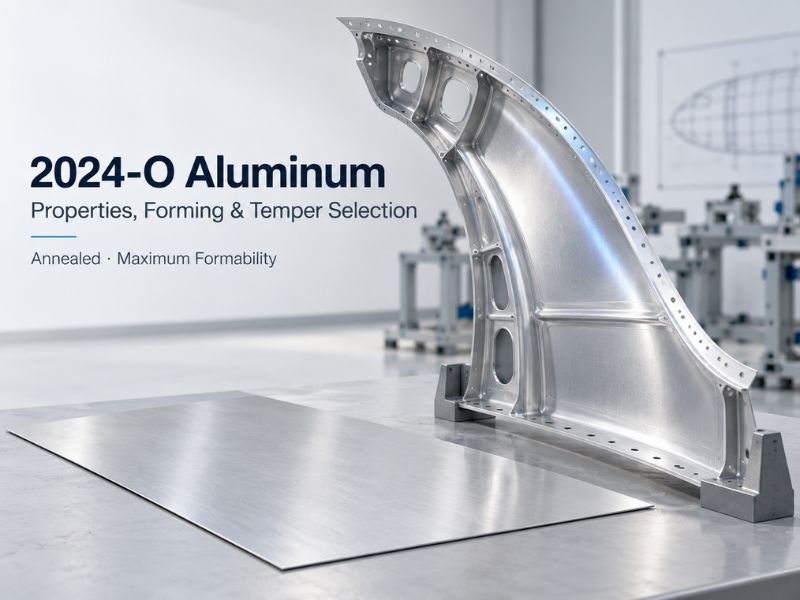
The O temper is the fully annealed condition — the softest, most ductile state in the entire 2024 family. It is produced by heating the material to roughly 413 °C, holding it long enough for the worked structure to recrystallize, then cooling it slowly. The result: no residual cold work, no precipitation hardening, and internal stress reduced to a minimum.
What that means in practice is that 2024-O bends, draws, and stretch-forms with far less springback and cracking risk than any aged temper. The trade-off is strength — the O condition carries no precipitation hardening at all, so it tests at a fraction of the T3 or T4 levels.
How O Differs from T3 and T4
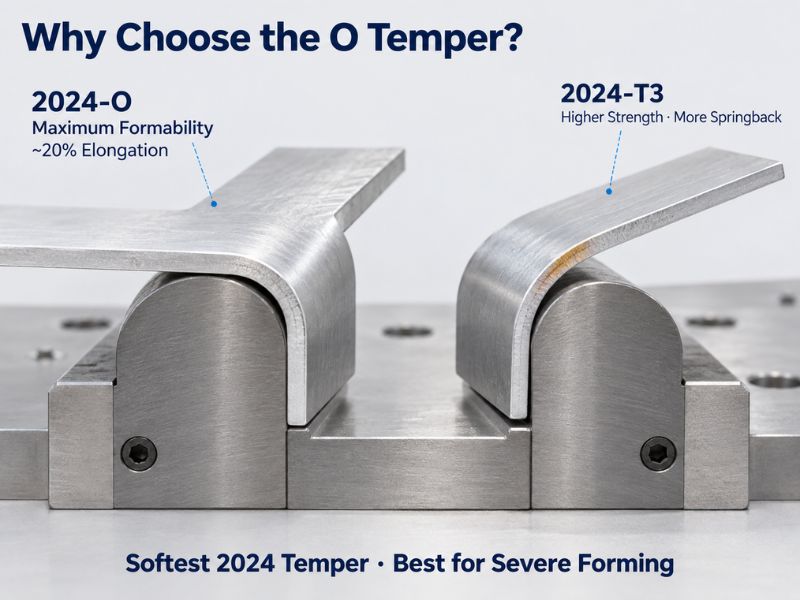
T3 and T4 both start from the same solution heat treatment and end in natural aging. The O temper skips both steps entirely — it is the annealed baseline those tempers are built from. Where T3 adds controlled cold work after quenching and T4 relies on natural aging alone, O has neither. That is why O sits at the bottom of the family strength curve and the top of its formability curve.
2024-O Mechanical Properties
| Property | Value (Typical) | Note |
|---|---|---|
| Density | 2.78 g/cm³ | About one-third of steel |
| Ultimate Tensile Strength | 186 MPa (27 ksi) | Annealed condition |
| Yield Strength (0.2% offset) | 76–97 MPa (11–14 ksi) | Lowest of the 2024 family; gauge- and clad-dependent |
| Elongation at Break | ~20% (up to ~22% in thicker gauge) | Highest of the 2024 family |
| Fatigue Strength | ~90 MPa | Cycle-ratio dependent |
| Shear Strength | ~124 MPa | Fastener-joint reference |
| Modulus of Elasticity | 73.1 GPa | Constant across tempers |
| Hardness (Brinell) | ~47 HB | Soft, easily worked |
| Thermal Conductivity | ~121 W/m·K | |
| Electrical Conductivity | ~30% IACS | |
| Melting Range | 502–638 °C |
The yield strength of 76–97 MPa is the number that defines this temper. It is the softest state 2024 can be bought in — roughly one-fifth to one-quarter of the T3 yield — and that softness is precisely the point: the material can be formed aggressively and then solution treated and aged to a structural temper (T42, T4, or T6) in a later step. Elongation above 20% is what makes deep drawing and complex bending practical.
Where 2024-O Is Used
Form-First Aerospace and Structural Parts
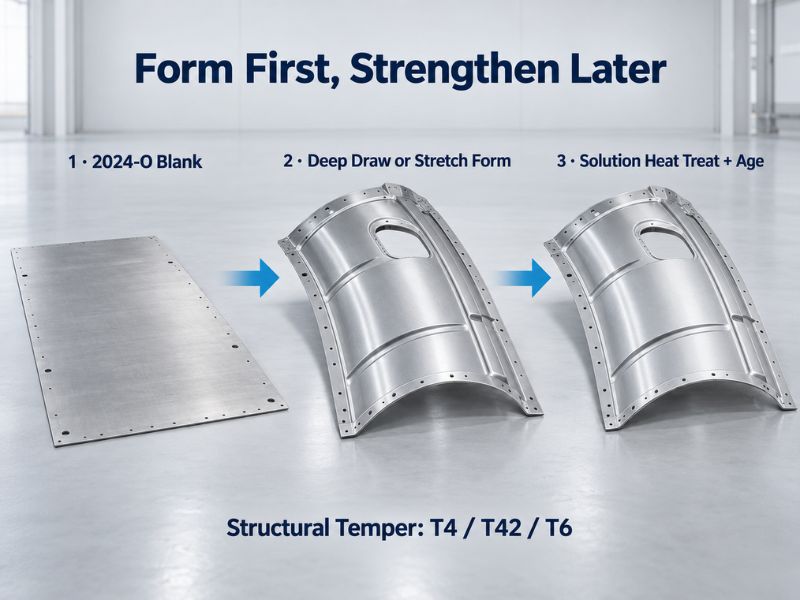
The classic use of 2024-O is as a forming blank: sheet, plate, and bar are bought annealed, then stamped, deep-drawn, stretch-formed, or bent into shape before being solution heat treated and aged to restore strength. Wing-skin panels, fuselage frames, and rib sections that are too complex to form in the hard temper are routinely made this way. The annealed state allows tight radii and severe draws without the cracking risk of T3 or T4.
Prototyping, Tooling, and Machined Blanks
For one-off parts, prototype validation, and low-volume fabrication where the part is not later heat-treated, 2024-O behaves like a strong, easy-to-work material in any form. It is also a common starting point for machined blanks — bar, plate, and tube — that need a soft, stable condition before final processing. Where the finished part will never see the strength of an aged temper, alclad 2024-O is a practical, corrosion-protected choice.
O vs Other 2024 Tempers — How to Choose
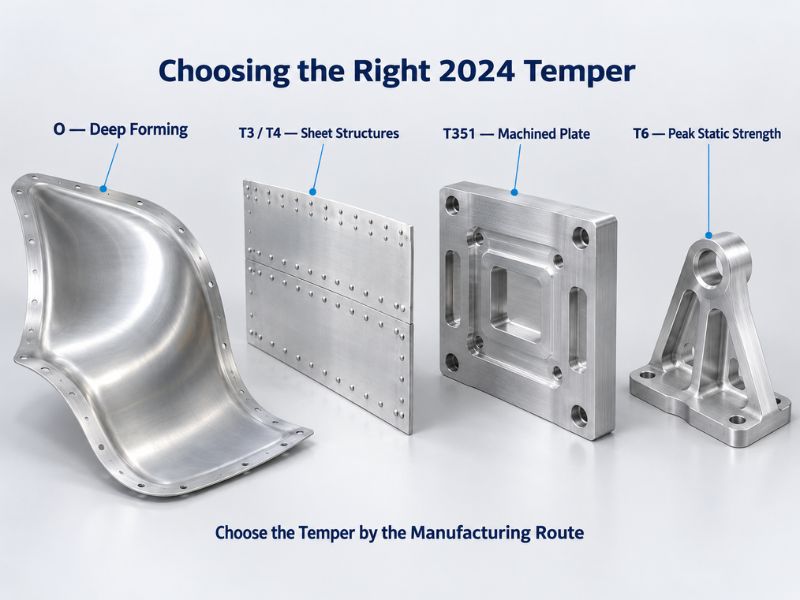
| Temper | Treatment | UTS (MPa) | Yield (MPa) | Elongation | Best for | Avoid when |
|---|---|---|---|---|---|---|
| O | Annealed | 186 | 76 | ~20% | Forming blanks, deep draws, soft machining | Load-bearing structure as-supplied |
| T3 | Solution + cold work + natural age | 483 | 345 | 18% | Sheet skins, formed and riveted parts | Deep forming, tight bends |
| T4 | Solution + natural age | 469 | 324 | ~19% | High-ductility formed parts | Thick-section machining |
| T351 | Solution + stretch + natural age | 470 | 325 | 10–20% | Machined plate, fatigue structures | Thin sheet forming |
| T6 | Solution + artificial age | 476 | 393 | ~10% | Peak static strength, lightly machined | Fatigue-critical or heavily machined parts |
When O Is the Right Call
Two conditions point to O. The part will be formed — bent, drawn, or stretch-formed — before it is heat-treated, or the material must be worked extensively in the soft condition. If either holds, O is the only 2024 temper that forms without cracking risk and without paying a strength premium that cannot be used yet.
When Another Temper Fits Better
When the part is used as-formed and must carry structural load immediately, T3 or T4 supplies the strength O cannot — T3 tests at roughly 2.6 times the yield of O. When the part is machined from thick plate, the T351 temper’s stretch stress relief prevents distortion. When peak static strength is the only target and the part is lightly machined, T6 or T851 fits better. O is a starting condition, not a finish condition.
Working with 2024-O — What You Need to Know
Machining. 2024-O machines easily with sharp tooling. Cutting forces are low and surface finish is easy to hold, but the soft condition produces long, stringy chips that need good chip-breaking control.
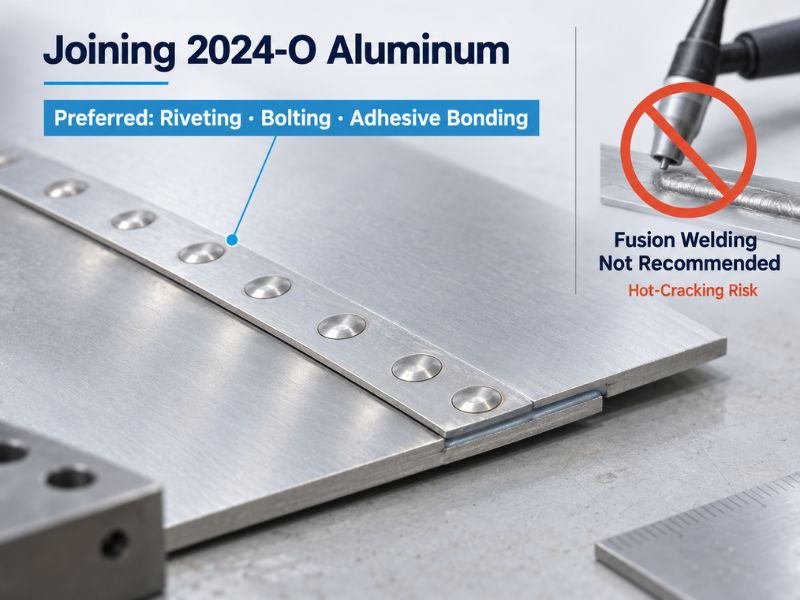
Welding and joining. Fusion welding of 2024 is not recommended in any temper, O included — the alloy is susceptible to hot cracking in the weld zone, and the heat-affected zone loses strength. Riveting, bolting, and adhesive bonding are the standard joining routes.
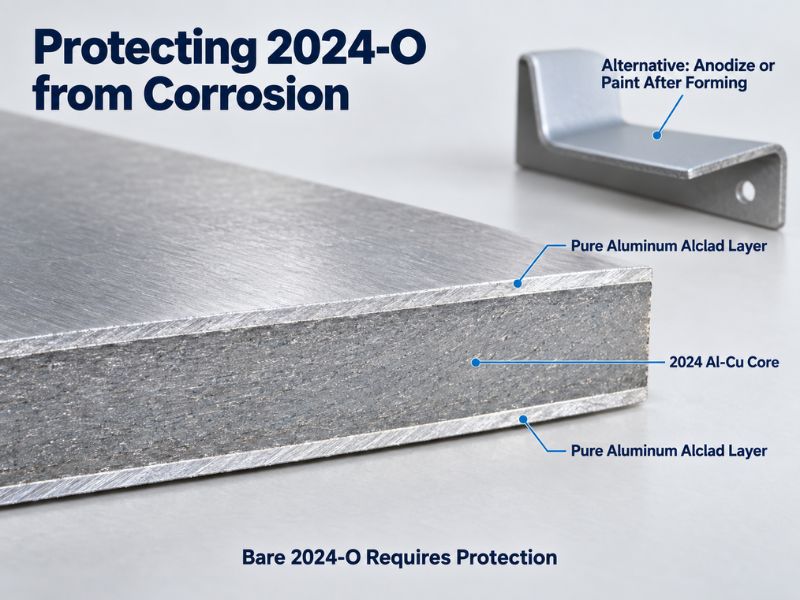
Corrosion protection. Bare 2024-O is still a copper-rich alloy and corrodes in service, so O-temper material is commonly supplied alclad — a thin pure-aluminum layer roll-bonded to the surface — or protected after forming by anodizing or paint. Alclad is an option specified at order time, not a default.
Formability. This is where O earns its place: minimum bend radii drop, springback decreases, and deep draws become practical across sheet, plate, and tube. Machined blanks and extruded sections in O also hold dimension through roughing cuts, since the soft state carries little residual stress. Form or machine the part in O, then solution treat and age to T42, T4, or T6 if the design needs the strength.
Pros and Limitations at a Glance
| Factor | Advantage | Limitation |
|---|---|---|
| Formability | Best of the 2024 family — tight bends, deep draws | No structural strength as-supplied |
| Strength-to-weight | Retains 2024’s low density | Roughly one-fifth of T3 yield strength |
| Machining | Low cutting forces, easy surface finish | Gummy chips need chip-breaking control |
| Corrosion resistance | Alclad and coated variants protect well | Bare material still copper-rich, corrodes in service |
| Weldability | — | Not fusion-weldable — hot cracking risk |
| Post-treatment | Forms first, then heat-treats to T42/T4/T6 | Requires a heat-treatment step for strength |
| Availability | Standard aerospace mill product, O temper stocked | Often bought as a forming blank, not a finished part |
Conclusion
The defining trade-off of 2024-O: it gives up almost all of 2024’s strength so the material can be formed, then heat-treated back up to a structural temper. Buying O and expecting finished-part strength, or buying T3 and trying to deep-form it, are the two failure modes this temper exists to prevent.
Linsy Aluminum supplies 2024-O across sheet, plate, bar, and tube alongside the T3, T4, T351, and T851 tempers, with MTC documentation on every order and SGS test reports available on request. The Shenzhen factory supports low-MOQ custom dimensions with a typical lead time of 10–60 days, and in-house laser cutting and CNC machining cover the processing most 2024-O jobs need — so the annealed starting point rarely blocks a project.
If the part will be formed before it is heat-treated, send the 2024-O drawing or specification to Linsy Aluminum for a stock check and quote.
Frequently Asked Questions
What is the difference between 2024-O and 2024-T3?
O is the annealed baseline: no solution treatment, no cold work, no aging — about 186 MPa UTS and 76–97 MPa yield with elongation above 20%. T3 adds solution treatment, 1–3% cold work, and natural aging to reach 483/345 MPa at the cost of ductility. O is for forming first; T3 is for as-supplied strength.
Can 2024-O be heat treated to T4 or T6 strength?
Yes — that is the standard route. A 2024-O blank formed into a part can be solution heat treated and aged to a T42 or T4 condition (and in some sections T6), restoring the family’s structural strength. That heat-treatment step belongs to the fabricator or a heat-treatment shop, not to the mill supply.
Is 2024-O easy to weld?
No. Like every 2024 temper, O is not fusion-weldable — the alloy is susceptible to hot cracking, and the heat-affected zone loses strength. Rivets, bolts, or adhesive bonding are the standard joining methods.
Is 2024-O corrosion resistant?
Bare 2024-O is a copper-rich alloy and will corrode in service; it should not be treated as corrosion-resistant on its own. O-temper material is often ordered alclad, with pure aluminum roll-bonded to the surfaces, or protected after forming by anodizing or paint.
What lead time should I expect for custom 2024-O material?
Stock standard sizes ship quickly. Non-stock dimensions run through low-MOQ custom production with a typical lead time of 10–60 days, depending on form, size, and any processing such as laser cutting or machining. Every order ships with an MTC, and SGS test reports are available on request.