What Is 2024 Aluminum?
2024 is the copper-based workhorse of the 2xxx series. Copper at 3.8–4.9%, with magnesium at 1.2–1.8% and manganese at 0.3–0.9%, makes the alloy heat-treatable: fine precipitates form inside the metal and pin dislocations, and that is where the strength comes from. In its stronger tempers 2024 carries loads that would otherwise call for steel, at roughly one third of the density.
The copper content also imposes specific trade-offs. 2024 is among the least corrosion-resistant aluminum alloys in common use, because copper-rich phases set up galvanic cells along the grain boundaries, so bare material needs cladding, anodizing, or paint in any humid or marine service. It also joins poorly by fusion welding, since the heat-affected zone is crack-prone, which is why 2024 structures are riveted or bolted instead. Those limits belong to the alloy and do not change with heat treatment. What does change — strength, ductility, and how much forming the material tolerates before it cracks — is set entirely by the temper, and for sheet work that temper is almost always T3.
Understanding the T3 Temper
The T3 designation defines a three-step sequence: solution heat-treated, cold worked, then naturally aged to a substantially stable condition.
| Step | Process | Purpose and result |
| Solution heat treatment | Held near 493 °C (920 °F), then quenched | Copper and magnesium dissolve into the aluminum matrix and are trapped in supersaturated solution |
| Cold work | Controlled deformation — for sheet, a rolling or flattening pass | Raises dislocation density on top of the quenched structure; this step separates T3 from T4 |
| Natural aging | Room-temperature precipitation of fine clusters from trapped solute | Most strength develops within the first 24 hours; substantially stable after roughly four days |
The practical result is a sheet that arrives with nearly all of its strength already developed while still holding about 18% elongation. That is enough ductility for the brake bends, joggles, and stretch forming that airframe sheet metal work demands. No shop-floor heat treatment is required, and no refrigerated storage: the material can be formed and riveted in the as-delivered condition.
T3, T4, and T351: Key Distinctions
These three tempers are closely related and are frequently confused in specifications and procurement documentation within the 2024 family.
T4 skips the cold-work step — solution treated and naturally aged only. Marginally lower strength, marginally more ductility, and the usual condition for bar, rod, and 2024 wire. See the 2024-T4 guide for the full data set.
T3 adds the cold work, which is why it is the default sheet temper for formed and riveted structure.
T351 applies the same logic to plate, except the cold work is a controlled 1.5–3% stretch whose purpose is stress relief, not strengthening. For thick plate intended for machining rather than sheet for forming, the 2024-T351 guide is the relevant one.
Mechanical Properties of 2024-T3
The figures below are typical values for bare 2024-T3 sheet. Thickness and product form move them, so design decisions should reference the certified values on the mill test certificate rather than a published average.
| Property | Typical value | Notes |
| Density | 2.78 g/cm³ | Roughly one third of steel |
| Ultimate tensile strength | 483 MPa (70 ksi) | Bare sheet; Alclad runs lower |
| Yield strength (0.2%) | 345 MPa (50 ksi) | The number most design allowables key off |
| Elongation at break | ~18% | 1.6 mm sheet; drops as gauge increases |
| Fatigue strength | 138 MPa | At 5×10⁸ cycles, rotating beam |
| Shear strength | 283 MPa | Relevant for riveted joint sizing |
| Modulus of elasticity | 73.1 GPa | Effectively constant across 2024 tempers |
| Hardness | 120 HB | 500 kg load, 10 mm ball |
| Thermal conductivity | 121 W/m·K | Lower than 6061, a copper effect |
| Electrical conductivity | ~30% IACS | Moderate to low; not a conductor alloy |
| Melting range | 502–638 °C | Solidus to liquidus |
Two numbers do most of the work here. The 483/345 MPa pairing is what lets a 2024-T3 skin panel replace a much heavier steel one, and the 138 MPa fatigue strength is why the alloy holds a position in pressurized fuselage structure that newer, stronger alloys have not taken from it. A fuselage skin sees a pressurization cycle every flight; resistance to crack initiation over hundreds of thousands of those cycles matters more than peak tensile strength.
One sourcing detail worth confirming before ordering: Alclad 2024-T3 is not as strong as bare. The pure-aluminum cladding layers carry little load, so typical Alclad values fall to around 448 MPa tensile and 310 MPa yield — a debit of roughly 8–10%. Thin gauges lose proportionally more. If allowables were calculated on bare properties, clad material should not be substituted without rechecking the margin.
Where 2024-T3 Is Used
Aerospace dominates, and not by a small margin. The fatigue behavior and the strength-to-weight ratio are worth the corrosion protection and the riveted joining the alloy requires.
Aircraft skins. Alclad 2024-T3 sheet is the classic fuselage and lower-wing skin material, formed to contour and riveted to the substructure.
Fuselage frames, stringers, and ribs. Formed sheet components where the part is bent to shape before assembly rather than machined from solid.
Lower wing surfaces. The lower wing is a tension structure, and 2024 outperforms 7075 in fatigue crack growth under tension. Upper surfaces, loaded in compression, more often use 7075. The 2024 vs 7075 comparison covers that split in detail.
Fittings, brackets, and hardware. Machined or formed parts where strength per unit mass drives the design.
Truck wheels and hydraulic manifolds. The main non-aerospace uses, both of them high-stress parts that justify the extra finishing cost.
Motorsport and defense structures. Weight-critical assemblies operating in controlled or protected environments.
Where 2024-T3 does not belong: general chassis work, marine hardware, welded frames, architectural panels, or anything carrying current. 5052 and 6061 handle those cases better and cost less to finish.
2024-T3 vs Other 2024 Tempers
All 2024 tempers share the same chemistry. Only the thermal and mechanical history differs, and that history is what determines the material’s properties and suitability for a given application.
| Temper | UTS (MPa) | Yield (MPa) | Elongation | Typical form |
| O (annealed) | 186 | 76 | ~20% | Sheet for severe forming |
| T3 | 483 | 345 | ~18% | Sheet, formed and riveted |
| T4 | 469 | 324 | ~19% | Bar, rod, wire |
| T351 | ~470 | ~325 | ~19% | Plate for machining |
| T6 | ~475 | ~393 | ~10% | Rarely stocked as sheet |
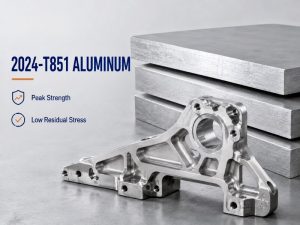
| T851 | ≥455 | ≥400 | ~5% | Machined plate, maximum stability |
Note what the table does not show: a large tensile spread. Between T3, T4, T351, and T6 the ultimate strength moves by only a few percent. The meaningful differences are in yield strength, ductility, and dimensional behavior, and those are what should drive the choice.
Choosing the Temper
T3 is the standard choice when the part starts as sheet, gets formed, and gets riveted — strength is required on delivery with enough elongation left to bend.
T4 applies to bar, rod, or wire, or when the forming is severe enough that the extra point of ductility matters.
T351 is specified for machining thick plate where residual stress would pull the part out of tolerance as material comes off.
T851 is selected when a machined plate part needs the highest yield strength and stability available in 2024 and 5% elongation is acceptable.
O is used when the forming is severe enough to crack any T temper — form annealed, then solution treat and age. The 2024-O sheet guidecovers that route.
A different alloy is required if the assembly must be fusion welded, will sit unprotected outdoors or at sea, or has to carry meaningful current. None of the 2024 tempers resolves those limitations.
Working With 2024-T3
Forming
T3 forms, but it is not 5052. Plan on a minimum bend radius in the range of 3t to 5t depending on gauge and orientation, several times what a 5xxx sheet tolerates at the same thickness. Bending transverse to the rolling direction is more forgiving than bending along it, and thicker gauges need proportionally larger radii. Where a design genuinely needs a tight radius, the usual answers are to form in the O condition and heat treat afterwards, or to move to a formed-then-riveted assembly rather than a single bent part.
Joining
Fusion welding 2024 is not a practical production route: the heat-affected zone is hot-crack prone and the temper is destroyed locally in any case. Riveting is the default, with bolting and structural adhesive bonding as the other two accepted paths. Friction stir welding does work on 2024 and avoids the melting problem, though it needs fixturing and joint access that many assemblies cannot give it. Note that 2024 rivets themselves (the DD designations) ship in a fresh solution-treated condition and must be kept refrigerated and driven within a limited window — that constraint applies to the rivet, not to the T3 sheet it goes into.
Machining
2024-T3 machines cleanly. Sharp carbide tooling, high surface speed, and moderate feed give good chip control and a bright finish, and the alloy holds tight tolerances well. For thick sections where a lot of stock comes off, T351 plate is the better starting point because the stretched stress relief keeps the part flat.
Corrosion Protection and Finishing
Protection is not optional on this alloy. Alclad sheet, with high-purity aluminum roll-bonded to both faces, is the standard aerospace answer because the cladding corrodes sacrificially and shields the copper-rich core. Anodizing and primer or paint systems are the alternatives for bare stock. One point specific to fatigue-critical parts: conventional sulfuric acid anodizing carries a measurable fatigue debit, which is why thin chromic acid anodize was traditionally specified for 2024 airframe parts, and why boric-sulfuric and thin-film sulfuric processes have taken over as chromate use is restricted. Also watch galvanic pairing — 2024 in contact with steel fasteners or carbon fiber needs an isolating layer.
Advantages and Limitations
| Advantage | Limitation |
| 483 MPa tensile at 2.78 g/cm³, one of the best strength-to-weight ratios in commercial aluminum | Poor corrosion resistance; cladding, anodizing, or paint is mandatory in service |
| 138 MPa fatigue strength, well suited to cyclically loaded structure | Not weldable by fusion methods; assemblies must be riveted, bolted, or bonded |
| ~18% elongation, enough for the forming that riveted sheet structure needs | Bend radii of 3t to 5t; tighter geometry needs O-temper forming and post-heat-treatment |
| Machines cleanly and holds tolerance | ~30% IACS conductivity rules it out for current-carrying parts |
| Widely specified and well characterized, so design data is easy to source | Costs more than 5052 or 6061, and the finishing adds to that |
Conclusion
2024-T3 combines high delivered strength, fatigue resistance, and sufficient ductility for formed and riveted sheet structure, but the trade-offs are equally defined: corrosion protection is mandatory, fusion welding is not a practical production route, and bend radii of 3t to 5t constrain geometry — where those constraints fit the part, few alloys compete, and where they do not, 6061 or 5052 is the more practical choice at lower total cost. Sourcing the correct temper and gauge with full documentation remains a common procurement challenge.
Linsy supplies 2024 in T3 and other standard tempers across sheet, plate, bar, tube, and wire, with mill test certificates on every order, low-MOQ custom production, and ISO 9001, ISO 14001, and ISO 45001 certification, with SGS test reports available on request and typical lead times of 10 to 60 days depending on form and quantity. Review the 2024-T3 specification for certified property data by gauge and temper, or contact Linsy to confirm stock availability and custom production options for the target application.
Frequently Asked Questions
Is 2024-T3 the same as 2024-T351?
They are close but not interchangeable. Both are solution treated, cold worked, and naturally aged. In T351 the cold work is a controlled 1.5–3% stretch applied specifically to relieve residual stress, and the designation is normally applied to plate. T3 is the sheet temper, where the cold work is a rolling or flattening pass aimed at strength. Typical strengths sit within a few percent of each other; the reason to specify T351 is dimensional stability during machining, not extra strength.
Can 2024-T3 be welded?
Not by fusion methods in any practical production sense. The heat-affected zone is prone to hot cracking, and the T3 condition is destroyed locally by the weld heat regardless. Riveting, bolting, and structural adhesive bonding are the accepted routes. Friction stir welding is technically viable because it stays below melting, but it requires fixturing and joint access that most sheet assemblies cannot provide.
How much does 2024-T351 cost compared to T3?
The price premium for T351 over T3 is generally 5–15%, driven by the additional stretching operation. For thick plate (above 25 mm), the premium narrows because T3 is rarely specified at those gauges — T351 is the default aerospace temper. The real cost comparison is not T351 vs T3, but T351 vs the cost of scrapping a distorted T3 part after machining.
What minimum bend radius should I design for in 2024-T3 sheet?
Roughly 3t to 5t, varying with gauge and bend orientation, with transverse bends more forgiving than longitudinal ones. Confirm against the supplier’s data for the specific thickness before releasing tooling. If the design needs something tighter, form the part in the O condition and heat treat it to T after forming.
Does 2024-T3 need refrigerated storage or re-aging after delivery?
No. T3 material is naturally aged to a substantially stable condition before shipment, so it can be stored and worked at room temperature without a strength penalty. The refrigeration requirement people associate with 2024 applies to freshly solution-treated rivets, which are a different product condition entirely.