Key Highlights
-
The 7050-T7451 aluminum alloy is known for its high strength, toughness, and resistance to corrosion. It outperforms many standard high-strength alloys in demanding environments.
-
This high-strength alloy is widely used in the aerospace industry. It plays a critical role in structural components such as bulkheads, fuselage frames, and wing skins.
-
Thanks to its strong resistance to stress corrosion cracking, 7050-T7451 delivers long-term durability and reliability in harsh aerospace operating conditions.
-
The versatility of this alloy extends beyond aerospace to other industries where high strength, lightweight construction, and corrosion resistance are required.
-
Understanding the chemical composition, mechanical properties, and temper designations of 7050-T7451 is essential for selecting and processing this alloy correctly.
Introduction
In high-performance materials, 7050 T7451 aluminum alloy is a leading choice, especially valued in the demanding aerospace industry. This aluminum alloy is known for its high strength, toughness, and resistance to corrosion. These qualities make it well-suited for critical aerospace applications with stringent specifications.
Understanding 7050 T7451 Aluminum Alloy
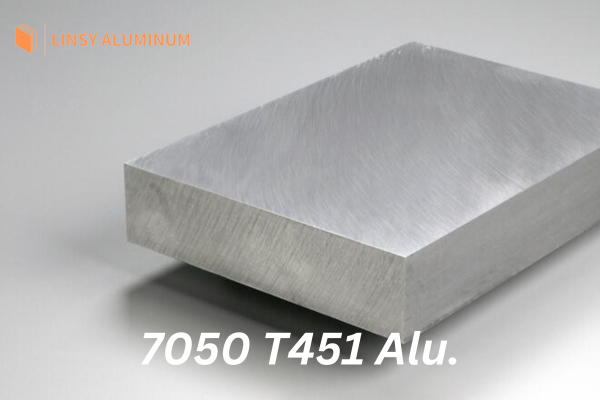
The 7050 T7451 aluminum alloy belongs to the 7000 series. It is heat-treatable and contains zinc as its primary alloying element. This composition produces several outstanding mechanical properties. With high strength, low weight, and good resistance to fatigue and stress corrosion, 7050 T7451 is widely adopted in demanding industries. It offers measurable advantages over many alternative aluminum alloys.
This alloy undergoes a specific heat treatment designated T7451. The process enhances the alloy’s strength, toughness, and resistance to stress corrosion cracking. This makes it suitable for applications where both strength and long service life are critical.
The Basics of 7050 T7451
7050 T7451 is a high-strength aluminum alloy that retains its mechanical properties even in thick sections. This characteristic makes it ideal for large structures and load-bearing components.
This alloy is notable for its low quench sensitivity. It maintains consistent mechanical properties across varying cooling rates during heat treatment, particularly in thicker cross-sections.
7050 T7451 exhibits uniform strength and toughness throughout its thickness. This makes it a reliable material for critical applications where consistency is essential.
Benefits of 7050 T7451
The advantages of 7050 T7451 aluminum alloy extend beyond its high strength and toughness. It provides good corrosion resistance, making it well-suited for applications where exposure to harsh environments is a concern. This reduces maintenance requirements and helps ensure long service life.
Its strong resistance to corrosion, including exfoliation corrosion and stress corrosion cracking, makes it an excellent choice for aircraft components such as fuselage frames, wing skins, and bulkheads.
7050 T7451 maintains its strength at low temperatures, making it a dependable choice for cryogenic applications.
The key benefits of 7050 T7451 include:
-
Good corrosion resistance
-
High toughness
-
Very high strength
Applications of 7050 T7451 in Aerospace and Beyond
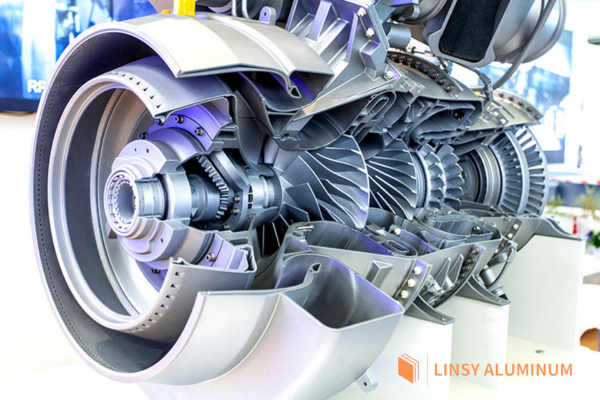
7050 T7451 is widely used in the aerospace industry for manufacturing critical structural components. This material is ideal for aircraft fuselage frames, bulkheads, wing skins, and landing gear components. These applications require high strength, low weight, and good corrosion resistance.
This high-strength alloy finds use outside aerospace as well. It is applied in transportation, sporting goods, and other demanding fields where the combination of strength, lightweight construction, and corrosion resistance is needed.
Chemical Composition and Properties of 7050 T7451 Aluminum
Below is the chemical composition for 7050-T7451 aluminum alloy:
|
Element |
7050-T7451 Aluminum (%) |
|
Aluminum |
Balance |
|
Zinc |
5.7 – 6.7 |
|
Copper |
2.0 – 2.6 |
|
Magnesium |
1.9 – 2.6 |
|
Zirconium |
0.08 – 0.15 |
|
Manganese |
0.10 max |
|
Silicon |
0.12 max |
|
Iron |
0.15 max |
|
Chromium |
0.04 max |
|
Titanium |
0.06 max |
|
Vanadium |
0.05 max |
|
Other, each |
0.05 max |
|
Other, total |
0.15 max |
The chemical composition of 7050-T7451 aluminum alloy features high zinc, copper, and magnesium content, with aluminum as the base metal. Zinc is the primary alloying element, significantly increasing the alloy’s strength. Copper and magnesium further enhance strength and contribute to heat treatability. Zirconium is added to control grain structure and improve fracture toughness and fatigue resistance. The tight limits on elements such as silicon and iron are essential for maintaining the alloy’s high performance, especially in demanding applications where strength and toughness are critical.
7050 Aluminum Temper Comparisons
Understanding the different tempers of 7050 aluminum is important for selecting the right material for a given application. Each temper designation indicates how the alloy has been heat-treated, resulting in distinct mechanical properties. For a deeper comparison between 7050 and its closest competing alloy, see our guide on the differences between 7050 vs 7075 aluminum alloys.
T7451 is noted for its balanced combination of strength, toughness, and resistance to stress corrosion cracking. Other common tempers such as T7651 and T351 offer their own advantages depending on specific application requirements.
T7651 Vs. T351 Vs. T7451
When selecting the optimal temper for 7050 aluminum, you need to evaluate your application requirements. T7651, T351, and T7451 are among the most common tempers, each with distinct characteristics.
The main differences between 7050-T351, T7451, and T7651 aluminum result from their heat treatment processes. This treatment affects their resistance to corrosion and stress cracking, while their strength levels remain broadly comparable.
T351 is the baseline condition and has the lowest resistance to corrosion and stress cracking. T7451 is heat-treated to provide significantly better resistance to stress cracking with minimal strength loss. T7651 is treated further to deliver the highest resistance to corrosion and stress cracking, though it may be slightly lower in strength than T7451 and T351. For applications prioritizing strength, any of these tempers will perform well. For environments where corrosion and stress cracking resistance are critical, T7451 or T7651 are the better choices.
|
Temper |
Exfoliation Corrosion Resistance |
Stress Corrosion Cracking Resistance |
|---|---|---|
|
T7651 |
Highest |
Highest |
|
T351 |
Lowest |
Lowest |
|
T7451 |
Moderate |
Moderate |
Conclusion
7050 T7451 aluminum alloy delivers an excellent balance of high strength, toughness, and corrosion resistance, making it a leading material for aerospace structural components. The trade-off is that its corrosion resistance, while good, is not the highest within the 7000 series. For environments where maximum corrosion resistance matters more than peak strength, tempers like T7651 may be worth evaluating.
As a trusted aluminum supplier, Linsy Aluminum emphasizes quality and reliability in all its products. Our advanced manufacturing facilities produce high-performance aluminum alloys that meet the toughest industry requirements. With a focus on precision, durability, and tailored solutions, we serve as a reliable partner for businesses worldwide seeking quality aluminum solutions.
If your project requires 7050 aluminum alloy, contact us for a quote and material specifications.
Frequently Asked Questions
What is temper T7451?
Temper T7451 is a specific heat treatment process applied to the 7050 aluminum alloy. This process gives the alloy an optimal balance of strength and toughness. It follows strict guidelines set by USI (Aerospace Material Specifications) and AMS (SAE Aerospace Material Specifications), making it well-suited for demanding aerospace applications.
What is 7050-T7451 material?
7050-T7451 is a high-strength aluminum alloy known for its good corrosion resistance and toughness. It is widely used in aerospace for critical components such as wing skins, fuselage frames, and bulkheads, where strength and durability are essential.
What is the difference between 7050 and 7040 aluminum?
7050 and 7040 are both high-strength aluminum alloys. The 7050 alloy contains zinc as its primary alloying element, providing better corrosion resistance and toughness, especially in thicker sections. This makes it a preferred choice for demanding aerospace applications.
What is the difference between T7351 and T7451?
Both T7351 and T7451 are tempers of the 7050 aluminum alloy. However, T7451 offers higher strength and better resistance to stress corrosion, particularly in thicker sections over one inch. This quality makes it the preferred choice for critical aerospace components such as fuselage frames that require exceptional durability and reliability.