7050 and 7075 are the two high-strength 7xxx-series alloys most aerospace and defense buyers weigh against each other — often on the same drawing. Getting the call wrong is expensive either way: 7075-T6 specified into a thick, corrosion-exposed section can crack under sustained load, while 7050 chosen for a thin, strength-critical part pays a toughness premium it never uses.
This comparison works through the data that actually separates them — composition, peak strength versus fracture toughness, stress-corrosion behavior, the tempers each is produced in, fabrication limits, and price — so you can match the alloy to your section thickness, loading, and environment rather than to a headline strength number.
7050 vs 7075 at a Glance
| Factor | 7050 | 7075 |
|---|---|---|
| Series / type | 7xxx Al-Zn-Mg-Cu, zirconium-grained | 7xxx Al-Zn-Mg-Cu, chromium-grained |
| Peak UTS (common temper) | 524 MPa (T7451); 552 MPa (T7651) | 572 MPa (T6 / T651) |
| Peak yield strength | 469–490 MPa | 503 MPa (T6) |
| Fracture toughness (K_Ic, L-T) | 32–38 MPa√m (high) | 26–30 MPa√m (moderate) |
| SCC resistance (short-transverse) | Excellent (T7451) | Poor at T6; good at T73 / T7351 |
| Grain refiner | Zirconium (Zr) 0.08–0.15% | Chromium (Cr) 0.18–0.28% |
| Best for | Thick-plate critical structure | Thin / medium high-strength parts |
Chemical Composition
| Element | 7050 (wt%) | 7075 (wt%) | What the difference changes |
|---|---|---|---|
| Zinc (Zn) | 5.7–6.7 | 5.1–6.1 | Both high; primary strengthening element |
| Magnesium (Mg) | 1.9–2.6 | 2.1–2.9 | 7075 slightly higher |
| Copper (Cu) | 2.0–2.6 | 1.2–2.0 | 7050 higher — supports toughness and heat-treat response |
| Zirconium (Zr) | 0.08–0.15 | — (none specified) | 7050 grain control |
| Chromium (Cr) | ≤0.04 | 0.18–0.28 | 7075 grain control |
| Silicon (Si) | ≤0.12 | ≤0.40 | 7050 held tighter |
| Iron (Fe) | ≤0.15 | ≤0.50 | 7050 held tighter |
| Manganese (Mn) | ≤0.10 | ≤0.30 | 7075 range wider |
| Titanium (Ti) | ≤0.06 | ≤0.20 | — |
| Aluminum (Al) | Balance | Balance | — |
The single most important compositional split is the grain refiner. 7050 uses zirconium; 7075 uses chromium. Zirconium dispersoids let 7050 keep its toughness and resist recrystallization in thick sections — the root of its stress-corrosion advantage.
Mechanical Properties
| Property | 7075-T6 / T651 | 7050-T7451 | 7050-T7651 |
|---|---|---|---|
| Ultimate tensile strength | 572 MPa | 524 MPa | 552 MPa |
| Yield strength (0.2%) | 503 MPa | 469 MPa | 490 MPa |
| Elongation | 10–13% | 11% | 11% |
| Brinell hardness | ~150 HB | ~135 HB | ~135 HB |
| Density | 2.81 g/cm³ | 2.83 g/cm³ | 2.83 g/cm³ |
| Thermal conductivity | ~130 W/m·K | ~150–190 W/m·K | ~150–190 W/m·K |
| Fracture toughness K_Ic (L-T) | 26–30 MPa√m | 32–38 MPa√m | — |
Note the common misconception this article previously repeated: 7075-T6 is the higher-strength alloy in thin and medium sections (572 MPa UTS vs 524 MPa for 7050-T7451). 7050 only approaches 7075’s peak with the T7651 temper (552 MPa). What 7050 gives up in peak strength it returns as toughness and environmental resistance.
Strength and Toughness: Where They Diverge
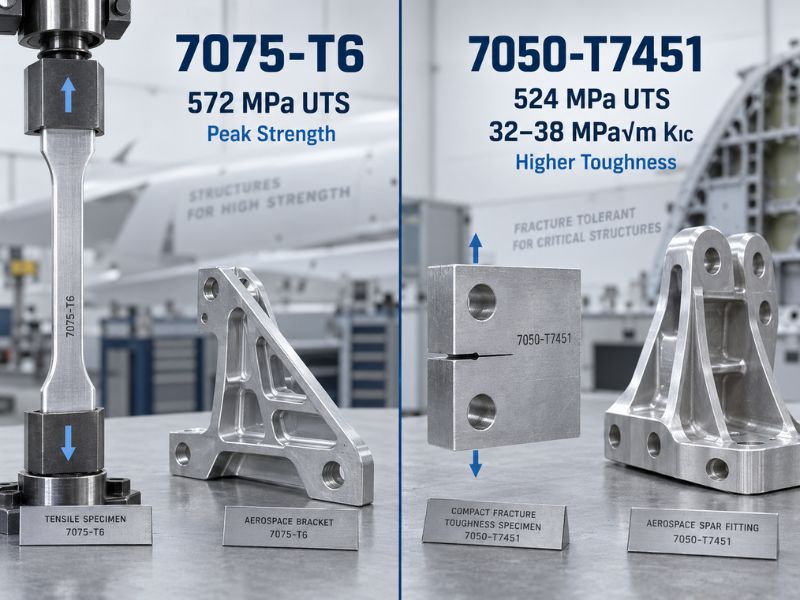
7075-T6 delivers the highest ultimate tensile strength of the two in thin and medium sections — about 572 MPa UTS and 503 MPa yield. That makes it the default when absolute static strength per kilogram is the priority and the section is modest.
7050 is deliberately overaged (T74 / T7451 / T7651). Overaging trades roughly 10–15% of peak strength for a large gain in fracture toughness and stress-corrosion resistance. In thick plate, 7050-T7451 stays tough and crack-resistant while 7075-T6 loses both as thickness grows — which is why wing spars, bulkheads, and thick fittings lean on 7050.
Corrosion and Stress-Corrosion Resistance
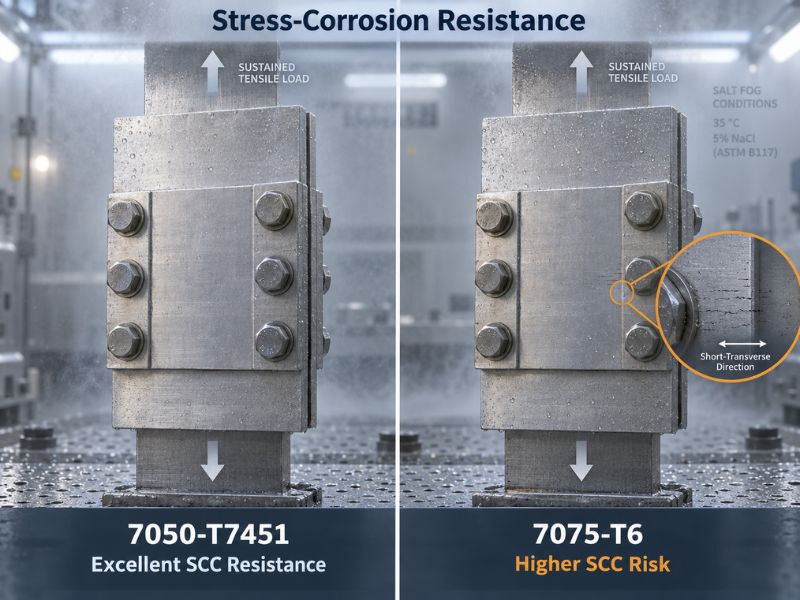
This is the clearest functional split. 7075-T6 is prone to stress-corrosion cracking (SCC), especially in the short-transverse direction of thick plate and in marine or chemically exposed service. The usual mitigation is an overaged T73 / T7351 temper or alclad cladding plus protective coatings.
7050 was designed around this weakness. Its zirconium grain structure and overaged T7451 temper give it excellent SCC resistance even in thick, highly stressed sections. For any part that lives in humidity, salt, or sustained load, 7050 is the safer pick.
Tempers and Heat Treatment
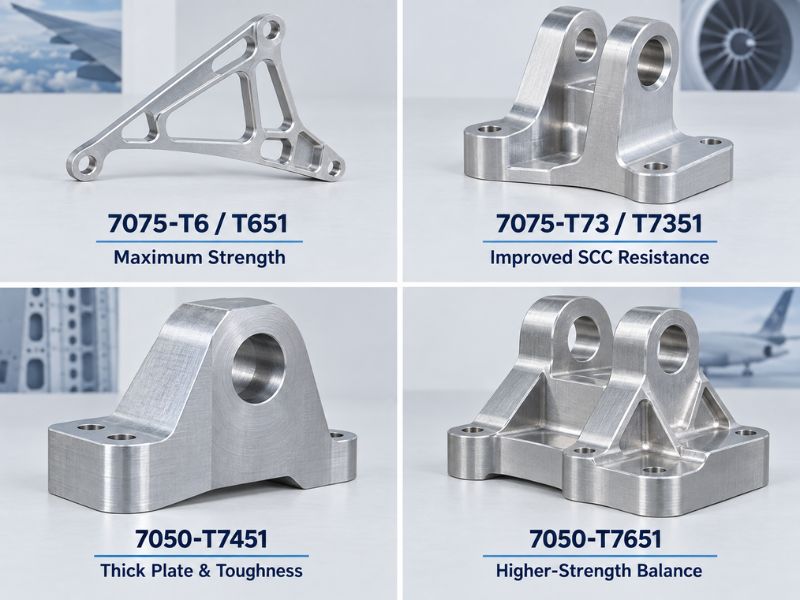
Both follow solution treatment, quenching, and aging; the temper sets the strength-toughness-corrosion balance.
- 7075: O (annealed), T6 / T651 (peak strength), T73 / T7351 (overaged for SCC), T76.
- 7050: T6, T74, T7451, T7351, T7651 — most production runs in the overaged T7xx range because that is where its advantage lives.
Fabrication: Machining, Welding, Forming
Both machine well in the T6 / T7 tempers, with 7075 marginally easier to cut. Neither is a good fusion-welding candidate: both are prone to hot cracking and severe post-weld strength loss, so welded 7xxx structures are rare and normally require post-weld heat treatment. Forming is limited compared with 5xxx or 6xxx alloys; 7050’s higher strength and quench sensitivity make it less formable than 7075 in the same temper.
Applications: Where Each Wins
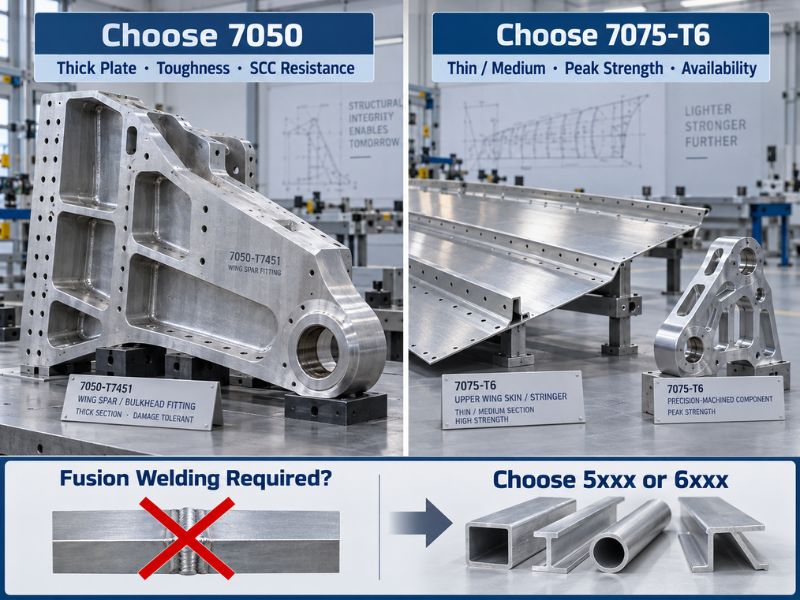
- 7050: thick wing spars and ribs, fuselage frames, bulkheads, landing-gear lugs, pressure vessels, and heavy structural plate where crack tolerance matters more than peak strength.
- 7075: wing skins (especially upper compression skins), fuselage stringers, landing-gear components, high-performance bicycle and automotive frames, and precision tooling or mold plates where T6 strength and machinability dominate.
Price and Availability
Both are premium alloys priced well above commodity 6xxx and 5xxx grades. 7075 is usually the lower-cost option and is more widely stocked in bar, plate, and extruded forms. 7050 typically carries a small premium tied to its zirconium chemistry, tighter impurity control, and thick-plate production difficulty. Confirm current mill quotes per temper and section — the gap is usually modest but real.
How to Choose: Go / No-Go
Choose 7050 when:
- Section thickness is large (25 mm plate and up) and crack tolerance is critical.
- The part sees sustained load in humid, marine, or chemical environments.
- SCC resistance in the short-transverse direction is a design requirement.
- You need thick-plate fracture toughness that 7075-T6 cannot deliver.
Choose 7075-T6 when:
- Peak static strength per weight is the priority and the section is thin to medium.
- The part is machined from plate or bar and weldability is not required.
- Cost and broad stock availability outweigh the SCC limitation.
Avoid both when:
- The design requires fusion welding as the primary joint — pick a 5xxx or 6xxx weldable grade instead.
- Corrosion exposure is severe and neither overaged temper fits the budget — consider 5083 or 6061 for that environment.
Conclusion
7050 and 7075 are close-chemistry cousins, but the choice is rarely about raw strength: 7075-T6 is the stronger alloy in thin sections, while 7050-T7451 wins on fracture toughness, stress-corrosion resistance, and thick-plate behavior.
Linsy Aluminum supplies both 7050 and 7075 in plate, bar, tube, and custom forms across standard tempers, with dimension and finish customization and MTC for every order. Typical custom lead times run 10–60 days depending on alloy, temper, size, and processing. Send your drawing and service conditions to Linsy Aluminum for a grade-fit review and a current quote.
Frequently Asked Questions
Which is stronger, 7050 or 7075?
7075-T6 is stronger in thin and medium sections — about 572 MPa UTS and 503 MPa yield, versus 524 MPa UTS for 7050-T7451. 7050 only approaches that peak with the T7651 temper (552 MPa). 7050’s real edge is toughness and SCC resistance, not peak strength.
Which resists corrosion better?
7050 resists stress-corrosion cracking far better, especially in thick sections and marine or chemical exposure. 7075-T6 is SCC-prone and usually needs cladding or overaging (T73 / T7351) to manage it.
Can 7050 or 7075 be welded?
Both are poor fusion-welding candidates — they crack easily and lose much of their strength at the weld. Use mechanical fastening or bonding, or pick a 5xxx / 6xxx alloy if welding is required.
Which should I choose for a thick plate?
7050-T7451. Its zirconium grain control and overaged temper keep toughness and SCC resistance high in heavy sections, whereas 7075-T6 loses both as thickness grows.
Is 7050 more expensive than 7075?
Usually a little. 7075 is more widely stocked and lower cost; 7050 carries a modest premium from its zirconium chemistry, tighter impurity limits, and thick-plate production. The gap is typically small but real — confirm per temper and section.