Czym jest aluminium 8009?
Aluminium 8009 należy do gatunków serii 8xxx — serii, w której głównym dodatkiem jest żelazo, a nie miedź, magnez czy cynk — i istnieje w jednym celu: dla części, które muszą przenosić obciążenie podczas pracy w podwyższonej temperaturze, zwykle między 150 °C a 300 °C. To zakres, w którym 6061 i 2024 utraciły już większość wytrzymałości nadanej im przez obróbkę cieplną.
Jego wytrzymałość nie pochodzi wcale z obróbki cieplnej. Pochodzi z bardzo dużej liczby drobnych cząstek — żelaza, krzemu i wanadu — wprowadzonych do metalu podczas jego wytwarzania. Na tym polega cała różnica między 8009 a stopami, które zna większość nabywców. Metal jest wytwarzany z proszku chłodzonego niezwykle szybko, zamiast być odlewanego w blok w zwykły sposób, i to szybkie chłodzenie utrzymuje cząstki wystarczająco drobne, by spełniały swoją funkcję.
Koszt tej zalety leży po stronie kupującego, nie po stronie konstrukcyjnej. Niewiele zakładów potrafi wytworzyć ten proszek, więc materiał nie jest pozycją katalogową. Dostępny jest w dwóch stanach, a nie w drabinie stanów obróbki. A specyfikacja lotnicza napisana dla niego obejmuje wyłącznie blachę, co oznacza, że wszystko grubsze lub o innym kształcie musi być zamawiane według rysunku, a nie według standardu. Gdy stop pasuje do Twojej temperatury, pozostaje ustalić stan, w jakim zostanie dostarczony.
Dlaczego 8009 zachowuje wytrzymałość tam, gdzie 6061 i 2024 miękną
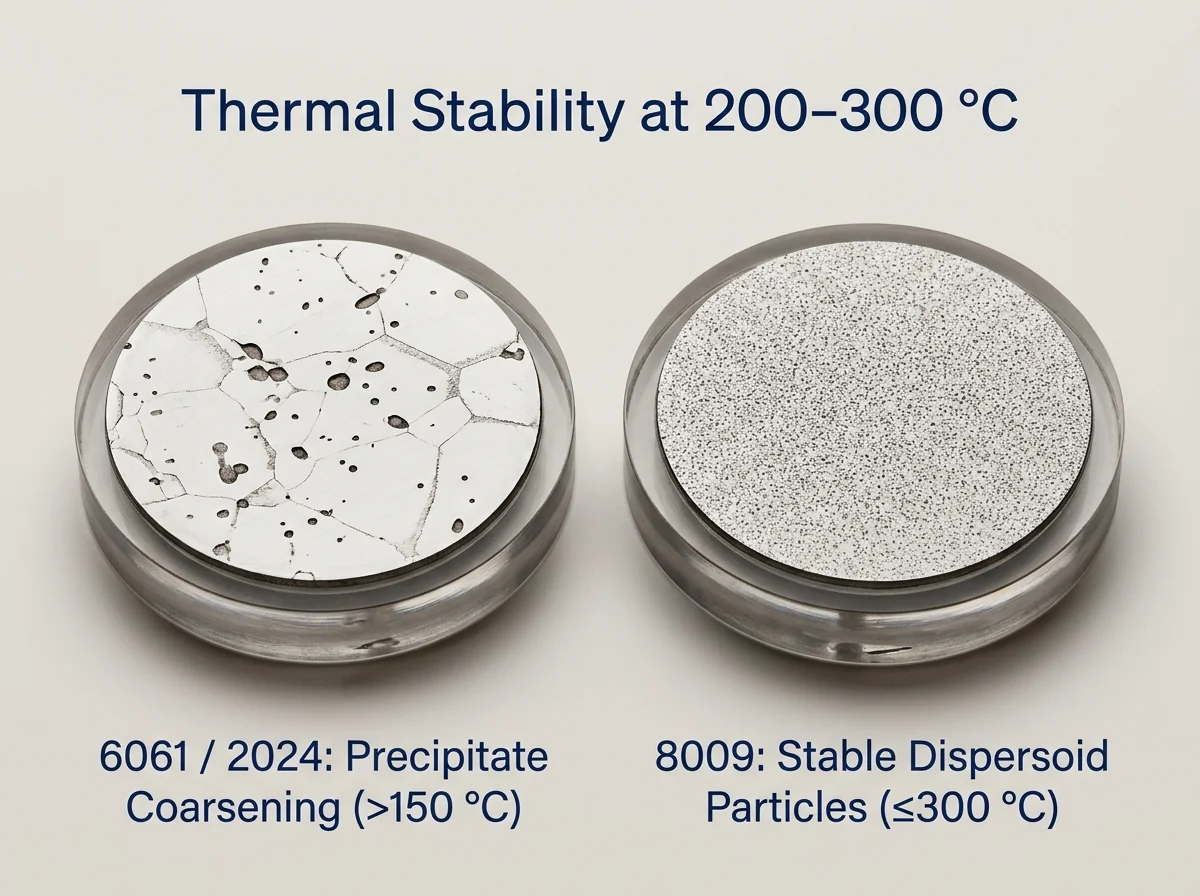
6061 i 2024 czerpią wytrzymałość z obróbki cieplnej, a obróbka cieplna jest niweczona przez ciepło. Od około 150 °C w górę struktura, która czyniła je twardymi, stopniowo się rozpada, a wytrzymałość odchodzi wraz z nią. Wspornik z 6061-T6, który na stole warsztatowym z zapasem mieści się w limitach, przy 200 °C może być poważnie przeciążony, a nic w karcie danych dla temperatury pokojowej Cię o tym nie ostrzeże.
8009 działa inaczej. Cząstki, które dają mu wytrzymałość, są już w metalu i są stabilne w temperaturze: nie rosną i nie rozpuszczają się z powrotem w aluminium. Ogrzej część, a te cząstki nadal powstrzymują metal przed rozciąganiem, tak samo jak wtedy, gdy był zimny.
Dlatego wytrzymałość spada stopniowo, a nie gwałtownie. Ile jej pozostaje i na jak długo, pokazuje poniższa tabela.
Właściwości aluminium 8009 w temperaturze pokojowej i podwyższonej
| Nieruchomość | Wartość | Podstawa |
|---|---|---|
| Gęstość | 2,92 g/cm³ | Typowa |
| Wytrzymałość na rozciąganie, temperatura pokojowa | 450 MPa | Typowa |
| Granica plastyczności, temperatura pokojowa | 385 MPa | Typowa |
| Wydłużenie | ~15% | Typowa |
| Moduł sprężystości przy rozciąganiu | 90 GPa | Typowa |
| Twardość | ~140 HB | Typowa |
| Przewodność cieplna | ~115 W/m·K | Typowa |
| Rozszerzalność cieplna | ~19,0 µm/m·°C | Typowa |
W temperaturze pokojowej 8009 wytrzymuje około 450 MPa przed pęknięciem i 385 MPa, zanim przestaje wracać do pierwotnego kształtu. Dla porównania 6061-T6 — stop najlepiej znany większości warsztatów — osiąga 310 MPa i 276 MPa w tych samych dwóch miarach, a 7075-T6 osiąga 572 MPa i 503 MPa. Zatem 8009 jest mocniejszy niż 6061 na zimno i słabszy niż 7075, co oznacza, że temperatura pokojowa nie jest powodem, by go kupować. W praktyce większe znaczenie mają dwie inne liczby. Gęstość wynosi 2,92 g/cm³, około 8% większa niż 6061 z powodu żelaza, ale wciąż znacznie poniżej połowy ciężaru stali. Twardość około 140 HB jest bliska 7075, więc warsztat, który już obrabia 7075, nie będzie zaskoczony sposobem jego skrawania.
Liczby w temperaturze są powodem, dla którego ten stop istnieje.
| Temperatura | Wytrzymałość na rozciąganie po 1 000 h | Granica plastyczności po 1 000 h |
|---|---|---|
| 100 °C | 410 MPa | 370 MPa |
| 150 °C | 380 MPa | 350 MPa |
| 200 °C | 350 MPa | 310 MPa |
| 250 °C | 310 MPa | 275 MPa |
| 300 °C | 270 MPa | 240 MPa |
Przy 200 °C stop nadal przenosi 350 MPa po tysiącu godzin w temperaturze — około 78% tego, co osiąga na zimno. Przy 250 °C utrzymuje 310 MPa, a przy 300 °C wciąż utrzymuje 270 MPa, czyli nieco poniżej poziomu wyjściowego 6061-T6 w temperaturze pokojowej. Spadek od 200 °C do 300 °C jest stromszy niż spadek od temperatury pokojowej do 200 °C, i to jest praktyczny wniosek: 200–300 °C to okno robocze, a jego górna połowa wymaga większego marginesu bezpieczeństwa niż dolna.
Są to publikowane wartości typowe, a nie minima gwarantowane przez specyfikację. Poproś dostawcę o wartości obowiązujące dla dostarczanego materiału i wpisz liczbę, na którą projektowałeś, do zamówienia zakupu, zamiast pozostawiać ją domyślną.
Stany obróbki i formy wyrobów — co faktycznie obejmuje AMS 4308
AMS 4308 to specyfikacja materiału lotniczego dla tego stopu, publikowana przez SAE International. Ustala skład chemiczny, stan i wartości wytrzymałości, które materiał musi spełniać, i jest dokumentem, według którego pracuje inspektor przy odbiorze materiału. Gdy rysunek mówi "AMS 4308", to właśnie obiecuje dostawca.
Skład chemiczny sprowadza się do sześciu wierszy i to one są warte sprawdzenia na certyfikacie.
| Element | Zakres (% mas.) | Co robi |
|---|---|---|
| Żelazo (Fe) | 8.4 – 8.9 | Główny dodatek; tworzy cząstki utrzymujące wytrzymałość w temperaturze |
| Krzem (Si) | 1.7 – 1.9 | Współdziała z żelazem i wanadem przy tworzeniu tych cząstek |
| Wanad (V) | 1.1 – 1.5 | Utrzymuje te cząstki stabilnymi, gdy część pracuje w wysokiej temperaturze |
| Cynk (Zn) | 0,25 maks | Zanieczyszczenie — to jest wiersz, który wychwytuje błędny certyfikat |
| Tlen (O) | maks. 0,30 | Charakterystyczny ślad technologii proszkowej; stop odlewany z wlewka nie miałby takiego limitu |
| Aluminium | Równowaga | Pozostała część |
Są to publikowane typowe limity, zgodne ze składem 8,6Fe – 1,8Si – 1,3V podanym w AMS 4308B. Poproś o wartości certyfikowane dla partii, którą wyceniasz.
O (wyżarzony)
O to stan zmiękczony. Metal jest celowo nagrzewany i powoli chłodzony, aby można go było formować — giąć, walcować lub prasować do kształtu — i w zamian oddaje wytrzymałość. Kupuj O, gdy część musi być jeszcze kształtowana po dostarczeniu, i planuj akceptację niższych wartości wytrzymałości, dopóki formowanie nie zostanie zakończone.
H112 / F (stan po wytworzeniu)
H112 — często zapisywany jako F, oznaczający stan po wytworzeniu — to stan, w jakim materiał opuszcza hutę po obróbce na gorąco, bez dalszej obróbki. Jest to domyślny stan konstrukcyjny i ten, który wymienia tytuł AMS 4308, ponieważ nie ma etapu starzenia, który można dodać lub pominąć: wytrzymałość, jaką ma stop, jest wytrzymałością wytworzoną przez proces.
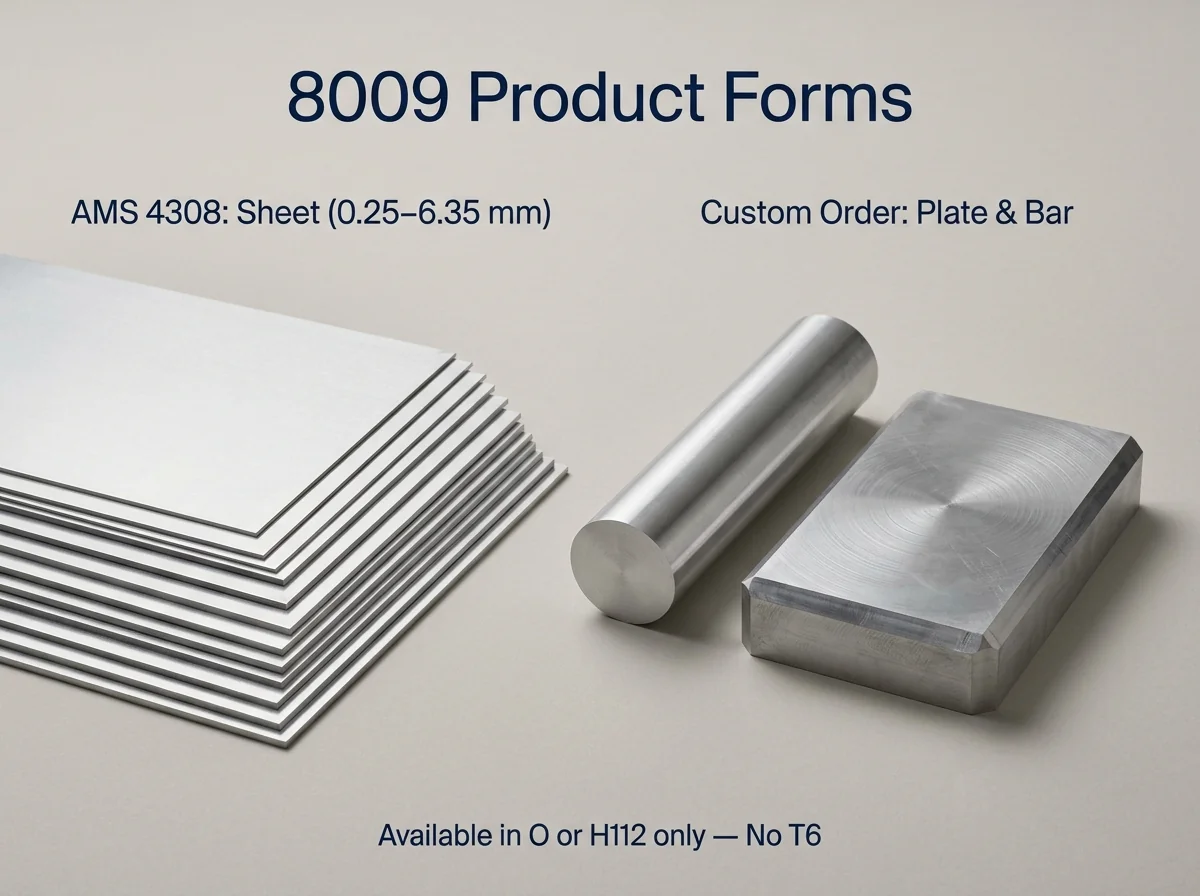
Kwestia formy wyrobu to miejsce, w którym większość zamówień zakupu popełnia błąd.
| Formularz | Covered by | What has to be on the order |
|---|---|---|
| Sheet, 0.25–6.35 mm | AMS 4308B | Standard product — chemistry, state and mechanical values are fixed by the specification |
| Plate over 6.35 mm | No AMS coverage | Chemistry limits and mechanical values stated on the order |
| Pręty i wałki | No AMS coverage | Chemistry limits and mechanical values stated on the order |
| Extrusion profile | No AMS coverage | Chemistry, values and section agreed per drawing |
| Rura | No AMS coverage | Chemistry, values and dimensions agreed per drawing |
| Foil and strip below 0.25 mm | No AMS coverage | Chemistry and values stated on the order |
Only the first row has a specification standing behind it. Everything below that line is exactly as good as what the purchase order says, which is why the chemistry and the mechanical values have to be written down instead of referenced.
One more thing to settle before the RFQ goes out: 8009 has no T6 or T8 temper. A T6 or T8 designation means the alloy is hardened by a heat treatment cycle after forming, and this alloy does not harden that way — the particles are already in it and will not re-form. If an offer names T6 or T8 for 8009, the offer is describing a different material.
Two lines on the certificate catch most of the confusion. A zinc figure of 5–6% describes 7075, not 8009, which carries almost no zinc. And a strength figure far above the table above usually means the numbers were carried over from another grade rather than measured on that batch.
We buy 8009 billet, plate and bar from producers that run the powder route, then cut, machine and finish to drawing. For forms outside the AMS range, we quote against the chemistry and the properties your drawing names.
Where 8009 Is Used
Aerospace and Engine-Adjacent Structures
The reason 8009 appears in aerospace work is a weight comparison, not a strength comparison. Above 150 °C the usual alternatives are titanium, steel, and the few heat-resistant aluminiums such as 2618. Titanium is about 50% heavier for the same volume and steel close to three times. A part that can stay aluminium up to 300 °C removes that penalty for anything whose service temperature lands in the band — supersonic airframe skins that heat up in flight, rocket structure, thermal-protection hardware, and brackets and housings close to an engine where the metal soaks up radiant heat without seeing combustion.
The fit is specific rather than general. If the part runs below 150 °C, 7075 or 2024 gives more strength per kilogram and is easier to buy. If it runs above 350 °C, aluminium stops competing and the titanium or steel argument takes over. 8009 earns its place in the band where neither of those answers works.
High-Performance Automotive and Specialty Heat Exchangers
Turbocharger and exhaust-adjacent parts see the same problem in a smaller package: cyclic heating and cooling, with load on the part the whole time. A piston or a housing that softens a little more with every heat cycle loses its clearances before it loses its shape, which is why slow stretching under load at temperature — creep — decides the material here rather than peak strength.
Specialty heat exchangers and high-temperature tooling follow the same logic from the other direction — the part is hot by design, and the question is whether the wall keeps its dimensions over a long campaign. The limiting factor for cost here is usually the size of the part rather than the material: 8009 is expensive relative to 6061, and that premium is easiest to justify on small, highly loaded components.
8009 vs 6061, 2024, 2618 and 7075 — Choosing by Service Temperature
| Stop i stan (temper) | Tensile, room temp | Yield, room temp | Practical service ceiling | What it is for |
|---|---|---|---|---|
| 7075-T6 | 572 MPa | 503 MPa | ~120 °C | Strongest at room temperature; wrong choice for a hot part |
| 2024-T3 | 483 MPa | 345 MPa | ~150 °C | Airframe skins and fatigue-critical structure |
| 6061-T6 | 310 MPa | 276 MPa | ~150 °C | The default general-purpose structural alloy |
| 2618-T61 | ~440 MPa | ~370 MPa | ~200 °C | Forged pistons and compressor parts |
| 8009 (H112) | 450 MPa | 385 MPa | 200–300 °C | Parts that must stay aluminium while running hot |
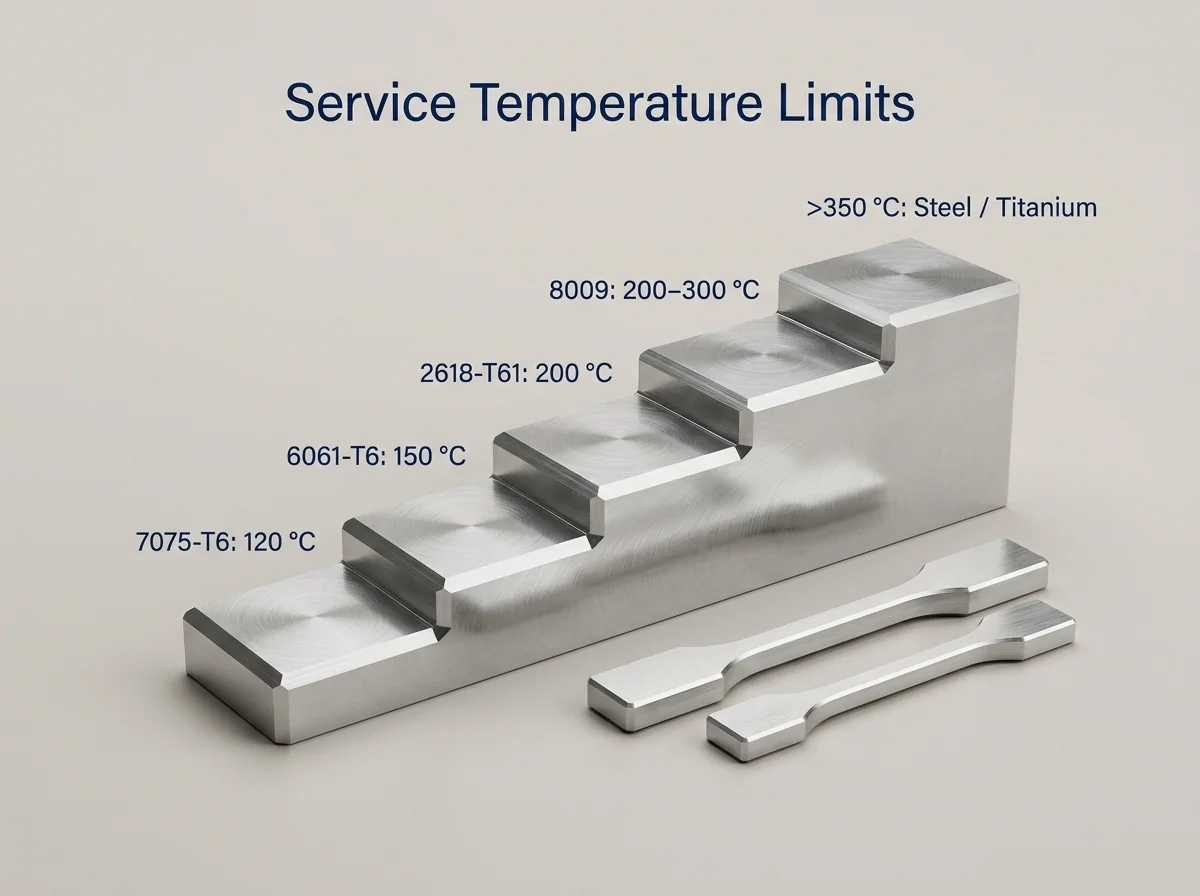
Room-temperature values above are the minimums published in ASTM B209 for sheet, except 2618, where they are typical forging values to AMS 4132. Service ceilings are practical design limits rather than values printed in any specification, and a specific duty cycle can justify going beyond them with the right testing.
Read that table by the fourth column, not the second. 7075 wins the room-temperature column and is the wrong material for a 250 °C part. 2618 is the right answer for a piston crown at 200 °C and stops being one above it. 8009 is the only grade here with a service ceiling above 200 °C.
That is also why the two alloys are easy to compare the wrong way round. Put the datasheets side by side and 7075 shows 572 MPa against 8009’s 450 MPa, which reads like 8009 is the weaker alloy. It is weaker — at room temperature, on a bench, which is not where the part works.
Working With 8009 — Machining, Joining and Finishing
Obróbka skrawaniem: it cuts like a hard aluminium, not like 6061. At around 140 HB it behaves much closer to 7075, which means a shop that already runs 7075 will be comfortable and a shop that only runs 6061 should expect faster tool wear and lighter cuts. There is no free-machining version of this alloy, so how the chips break comes down to how the machine is set rather than to the metal.
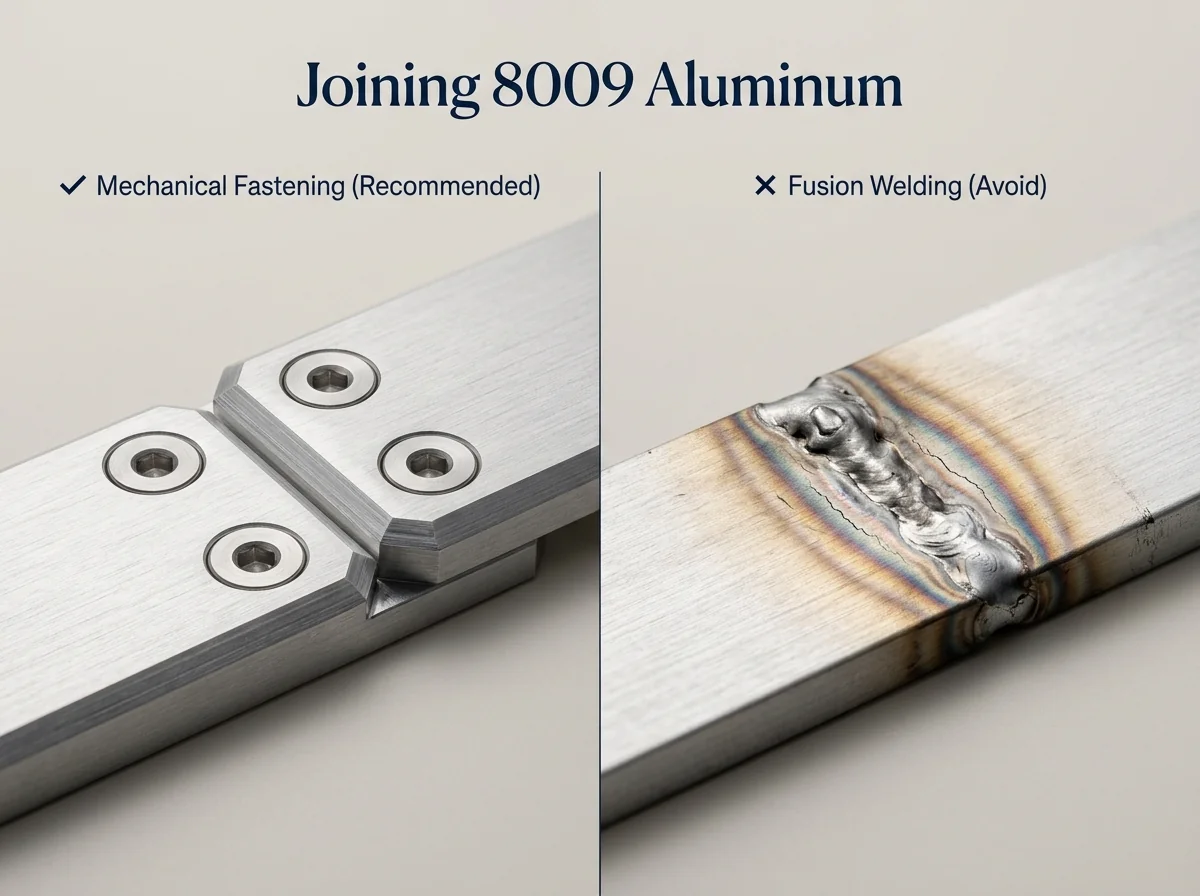
Łączenie: welding costs you the property you bought the alloy for. A fusion weld destroys the particle structure in the weld zone, and the joint loses the high-temperature strength that justified the material in the first place. For a load-bearing joint, plan on mechanical fastening, or on a joining method that does not melt the metal and has been qualified for this alloy; treat a fusion-welded joint as non-structural unless it has been tested and accepted on its own.
Ochrona antykorozyjna: it holds up well in normal workshop and atmospheric service but it is not a marine alloy. Anodizing works, and so do chemical conversion coatings — a chemical surface treatment that leaves a protective layer on the metal. For a part that will see salt air or chemical exposure, specify the finish on the drawing rather than deciding it after the part is made.
Formowanie: shape it in O, and accept that you cannot heat-treat the strength back afterwards. This is the biggest practical difference from the 2xxx and 7xxx grades, where forming in a soft state and then aging to full strength is routine. In 8009 the H112 values are set when the material is worked hot, not by a treatment you can repeat in your own shop — so a part that needs heavy forming either starts in O and stays softer, or is formed near-final and machined from H112.
Zalety i Ograniczenia w Skrócie
| Wymiar | Przewaga | Co kosztuje |
|---|---|---|
| Strength above 200 °C | Holds 350 MPa at 200 °C and 270 MPa at 300 °C after 1,000 hours | Nothing comparable in the 6xxx or 7xxx families at that temperature |
| Room-temperature strength | 450 MPa tensile, comparable to 2618 | Below 7075 and 2024; not a reason to choose it |
| Waga | 2.92 g/cm³ — under half of steel, so it replaces hot steel parts directly | About 8% heavier than 6061 for the same volume |
| Fatigue at temperature | 160 MPa at 250 °C — published typical value — supports cyclic hot service | Cost per kilogram is several times 6061 |
| Obróbka skrawaniem | Cuts predictably, close to 7075 | ~140 HB wears tooling faster than 6061 |
| Łączenie | Mechanical fastening and methods that do not melt the metal both work | Fusion welding removes the strength advantage locally |
| Supply | Available as billet, plate and bar from powder-route producers | Narrow producer base; lead time follows billet availability; sheet only under AMS 4308 |
| Formowanie | O temper forms well | Formed parts cannot be re-hardened to H112 |
Wnioski
8009 solves a real problem — carrying load at 200 to 300 °C without moving to titanium or steel — but nothing about it is standard. One producer tier, a specification that covers sheet only, and just two usable states mean the buying problem replaces the engineering problem as soon as the alloy is chosen.
We buy 8009 billet, plate and bar from powder-route producers, then cut and machine to your drawing. Every order ships with an MTC, and SGS reports are available if your project needs them.
Send us the drawing with the form, state and quantity for a supply check and a cutting quote.
Często zadawane pytania
Can 8009 aluminum be used at 400 °C?
No — there is no published basis for 400 °C. Published 1,000-hour test values, rather than specification minimums, support 200–300 °C; above 350 °C the particle structure needs assessment against your duty cycle.
Does 8009 have a T6 temper?
No. 8009 is strengthened by particles already in the metal, so there is no solution-treat-and-age step to make T6 or T8. It ships in O or H112 only, and an offer naming T6 describes another alloy.
Can you supply 8009 in bar or tube when AMS 4308 covers sheet only?
Yes, as a drawing-controlled item. Outside the AMS thickness range there is no specification to point at, so chemistry and mechanical values travel on the purchase order, and the MTC reports what was tested.
What is the minimum order and lead time for 8009?
Low MOQ, typically 10–60 days. The date depends on billet availability and the cutting or machining you need, so it is confirmed with the quote rather than quoted in advance. Send the drawing, form, state and quantity.