Wat is 8009-aluminium?
8009-aluminium is een van de 8xxx-graden — de serie die ijzer draagt in plaats van koper, magnesium of zink als belangrijkste toevoeging — en het bestaat voor één taak: onderdelen die belasting moeten dragen terwijl ze heet draaien, meestal tussen 150 °C en 300 °C. Dat is het bereik waarin 6061 en 2024 al het grootste deel van de sterkte hebben verloren die hun warmtebehandeling hun gaf.
De sterkte komt helemaal niet uit warmtebehandeling. Die komt uit een zeer groot aantal fijne deeltjes — ijzer, silicium en vanadium, in het metaal gemengd terwijl het wordt gemaakt. Dat is het hele verschil tussen 8009 en de legeringen die de meeste kopers kennen. Het metaal wordt gemaakt van poeder dat extreem snel wordt afgekoeld in plaats van op de gebruikelijke manier tot een massief blok te worden gegoten, en die snelle afkoeling is wat de deeltjes fijn genoeg houdt om hun werk te doen.
De kosten van dat voordeel liggen aan de inkoopkant, niet aan de technische kant. Zeer weinig fabrieken kunnen het poeder maken, dus het materiaal is geen catalogusartikel. Het komt in twee toestanden in plaats van een ladder van tempers. En de luchtvaartspecificatie die ervoor is geschreven, dekt alleen plaat, wat betekent dat alles wat dikker is of een andere vorm heeft, op tekening moet worden besteld in plaats van volgens een standaard. Zodra de legering bij uw temperatuur past, blijft alleen nog het bepalen van de toestand waarin het aankomt.
Waarom 8009 zijn sterkte behoudt waar 6061 en 2024 zachter worden
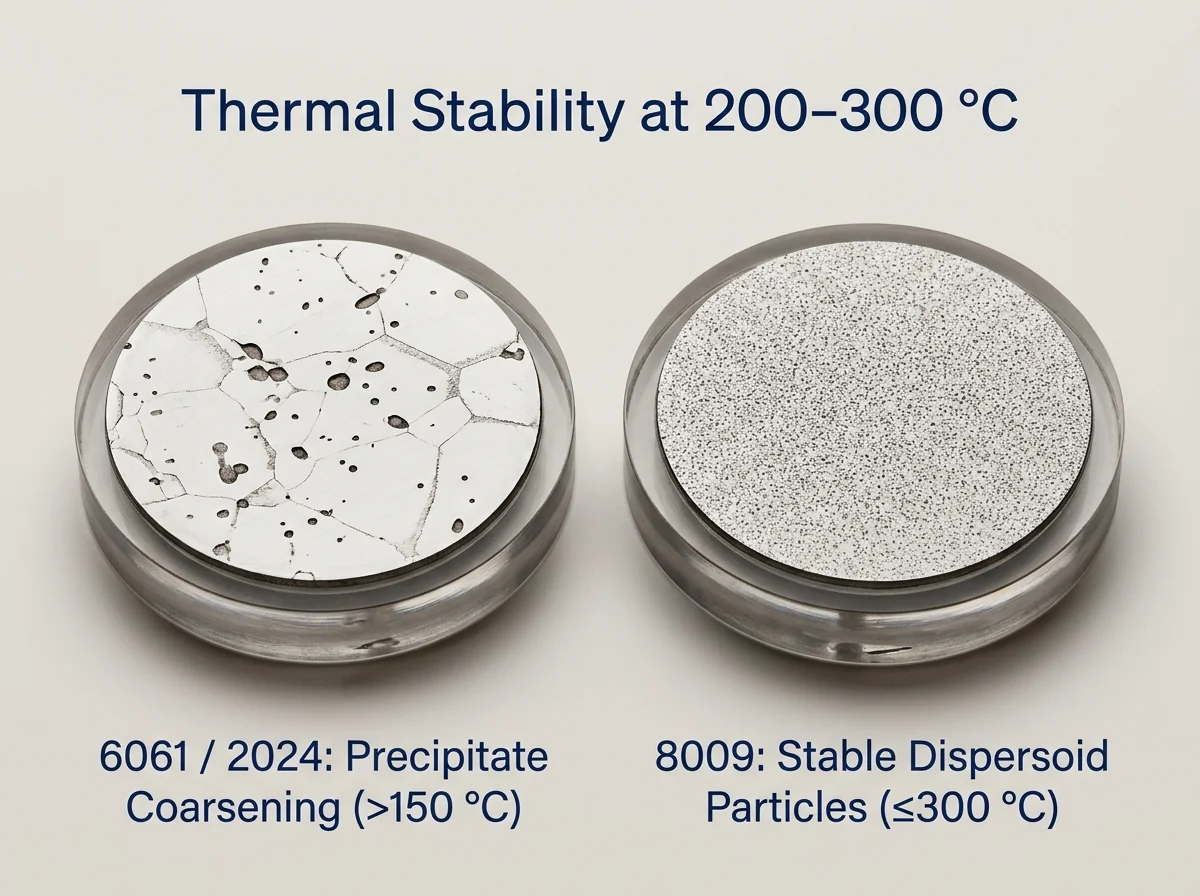
6061 en 2024 halen hun sterkte uit warmtebehandeling, en warmtebehandeling wordt tenietgedaan door warmte. Vanaf ongeveer 150 °C valt de structuur die hen hard maakte geleidelijk uiteen en verdwijnt de sterkte mee. Een 6061-T6 beugel die op de werkbank ruim binnen de grenzen valt, kan bij 200 °C ernstig overbelast zijn, en niets in het datasheet bij kamertemperatuur waarschuwt u daarvoor.
8009 werkt anders. De deeltjes die het zijn sterkte geven, zitten al in het metaal en zijn stabiel bij temperatuur: ze groeien niet en lossen niet weer op in het aluminium. Verhit het onderdeel en die deeltjes blijven het metaal ervan weerhouden uit te rekken, op dezelfde manier als toen het koud was.
Daarom neemt de sterkte geleidelijk af in plaats van van een klif te vallen. Hoeveel ervan overblijft, en hoe lang, laat de onderstaande tabel zien.
Eigenschappen van 8009-aluminium bij kamertemperatuur en verhoogde temperatuur
| Eigendom | Waarde | Basis |
|---|---|---|
| Dichtheid | 2,92 g/cm³ | Typisch |
| Treksterkte, kamertemperatuur | 450 MPa | Typisch |
| Vloeigrens, kamertemperatuur | 385 MPa | Typisch |
| Rek | ~15% | Typisch |
| Trekmodulus | 90 GPa | Typisch |
| Hardheid | ~140 HB | Typisch |
| Thermische geleidbaarheid | ~115 W/m·K | Typisch |
| Thermische uitzetting | ~19,0 µm/m·°C | Typisch |
Bij kamertemperatuur verdraagt 8009 ongeveer 450 MPa voordat het breekt en 385 MPa voordat het niet meer terugveert. Ter vergelijking: 6061-T6 — de legering die de meeste werkplaatsen het best kennen — verdraagt 310 MPa en 276 MPa op dezelfde twee maten, en 7075-T6 verdraagt 572 MPa en 503 MPa. Dus 8009 is koud sterker dan 6061 en zwakker dan 7075, wat betekent dat kamertemperatuur niet de reden is om het te kopen. Twee andere getallen zijn in de praktijk belangrijker. De dichtheid is 2,92 g/cm³, ongeveer 8% zwaarder dan 6061 vanwege het ijzer, maar nog steeds ruim onder de helft van het gewicht van staal. Een hardheid van rond 140 HB ligt dicht bij 7075, dus een werkplaats die al 7075 bewerkt, zal niet verrast zijn door hoe het snijdt.
De getallen bij temperatuur zijn de reden dat de legering bestaat.
| Temperatuur | Treksterkte na 1.000 h | Vloeigrens na 1.000 h |
|---|---|---|
| 100 °C | 410 MPa | 370 MPa |
| 150 °C | 380 MPa | 350 MPa |
| 200 °C | 350 MPa | 310 MPa |
| 250 °C | 310 MPa | 275 MPa |
| 300 °C | 270 MPa | 240 MPa |
Bij 200 °C draagt de legering na duizend uur op temperatuur nog steeds 350 MPa — ongeveer 78% van wat het koud doet. Bij 250 °C houdt het 310 MPa vast, en bij 300 °C houdt het nog 270 MPa vast, wat iets onder het niveau ligt waarop 6061-T6 bij kamertemperatuur begint. De daling van 200 °C naar 300 °C is steiler dan de daling van kamertemperatuur naar 200 °C, en dat is de praktische lezing: 200–300 °C is het werkvenster, en de bovenste helft ervan vereist meer veiligheidsmarge dan de onderste helft.
Dit zijn gepubliceerde typische waarden, niet de minimumwaarden die een specificatie garandeert. Vraag de leverancier om de waarden die gelden voor de warmtebehandeling die u daadwerkelijk wordt aangeboden, en schrijf het getal waarvoor u hebt ontworpen in de inkooporder in plaats van het impliciet te laten.
Tempers en productvormen — wat AMS 4308 feitelijk dekt
AMS 4308 is de luchtvaartmateriaalspecificatie voor deze legering, uitgegeven door SAE International. Deze legt de chemie, de toestand en de sterktecijfers vast waaraan het materiaal moet voldoen, en het is het document waarmee een inspecteur werkt wanneer het materiaal aankomt. Wanneer een tekening "AMS 4308" vermeldt, is dat wat de leverancier belooft.
De chemie komt neer op zes regels, en dat zijn de regels die het waard zijn om op een certificaat te controleren.
| Element | Bereik (gew.%) | Wat het doet |
|---|---|---|
| IJzer (Fe) | 8.4 – 8.9 | De belangrijkste toevoeging; vormt de deeltjes die de sterkte bij temperatuur behouden |
| Silicium (Si) | 1.7 – 1.9 | Werkt samen met het ijzer en vanadium om die deeltjes te vormen |
| Vanadium (V) | 1.1 – 1.5 | Houdt die deeltjes stabiel wanneer het onderdeel heet draait |
| Zink (Zn) | 0,25 max | Onzuiverheid — dit is de regel die een verkeerd certificaat betrapt |
| Zuurstof (O) | 0,30 max | De vingerafdruk van de poederroute; een blokgegoten legering zou een dergelijke limiet niet hebben |
| Aluminium | Saldo | De rest |
Dit zijn gepubliceerde typische limieten, consistent met de chemie 8,6Fe – 1,8Si – 1,3V zoals vermeld in AMS 4308B. Vraag om de gecertificeerde waarden voor de batch waarvoor u offreert.
O (gegloeid)
O is de zachte toestand. Het metaal wordt opzettelijk verwarmd en langzaam afgekoeld zodat het kan worden gevormd — gebogen, gewalst of geperst — en het levert sterkte in om dat te doen. Koop O wanneer het onderdeel na ontvangst nog moet worden gevormd, en reken erop lagere sterktecijfers te accepteren totdat het vormen is voltooid.
H112 / F (As-Fabricated)
H112 — vaak geschreven als F, voor as-fabricated — is de toestand waarin het materiaal verkeert wanneer het de walserij verlaat na heet te zijn bewerkt, zonder verdere behandeling. Het is de standaard structurele toestand en degene die de titel van AMS 4308 noemt, omdat er geen verouderingsstap is om toe te voegen of over te slaan: de sterkte die de legering heeft, is de sterkte die het proces heeft geproduceerd.
De vormkwestie is waar de meeste inkooporders fout gaan.
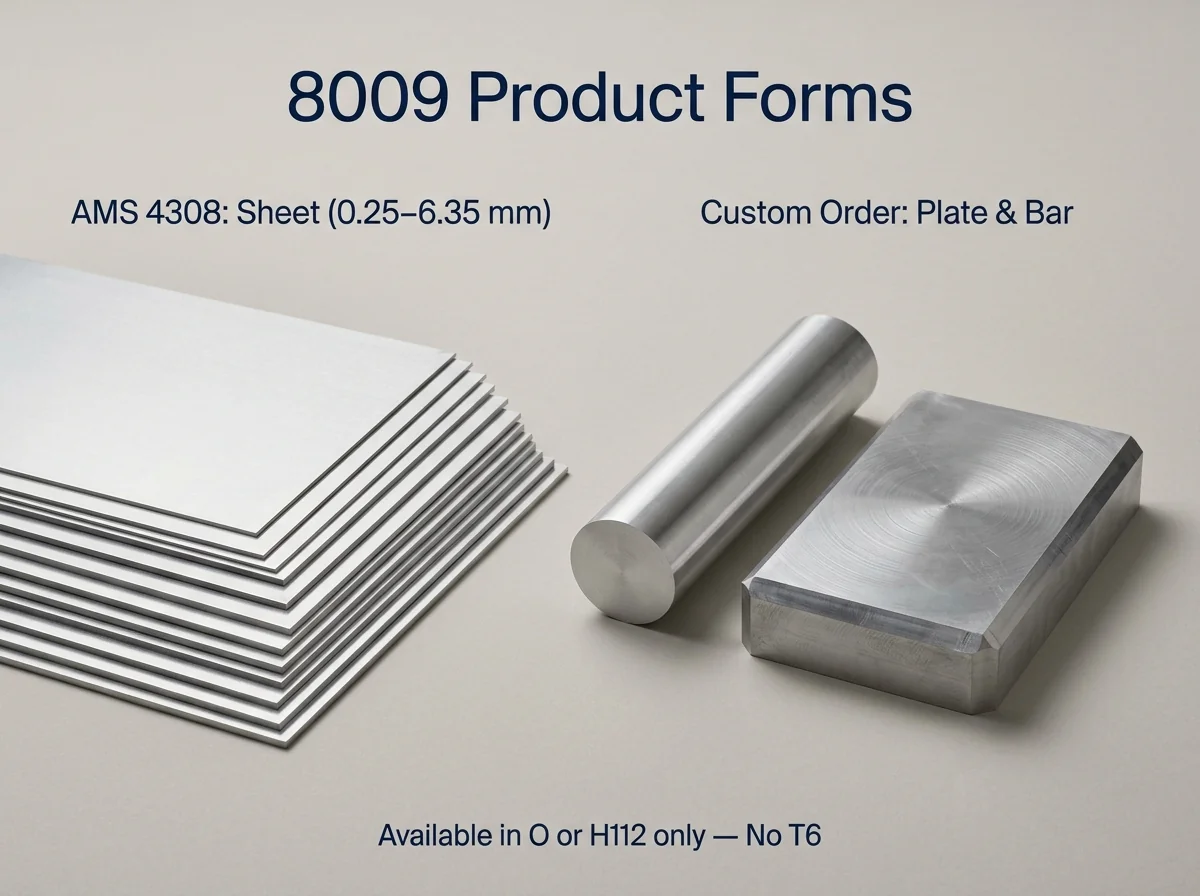
| Formulier | Covered by | What has to be on the order |
|---|---|---|
| Sheet, 0.25–6.35 mm | AMS 4308B | Standard product — chemistry, state and mechanical values are fixed by the specification |
| Plate over 6.35 mm | No AMS coverage | Chemistry limits and mechanical values stated on the order |
| Staaf en staf | No AMS coverage | Chemistry limits and mechanical values stated on the order |
| Extrusion profile | No AMS coverage | Chemistry, values and section agreed per drawing |
| Buis | No AMS coverage | Chemistry, values and dimensions agreed per drawing |
| Foil and strip below 0.25 mm | No AMS coverage | Chemistry and values stated on the order |
Only the first row has a specification standing behind it. Everything below that line is exactly as good as what the purchase order says, which is why the chemistry and the mechanical values have to be written down instead of referenced.
One more thing to settle before the RFQ goes out: 8009 has no T6 or T8 temper. A T6 or T8 designation means the alloy is hardened by a heat treatment cycle after forming, and this alloy does not harden that way — the particles are already in it and will not re-form. If an offer names T6 or T8 for 8009, the offer is describing a different material.
Two lines on the certificate catch most of the confusion. A zinc figure of 5–6% describes 7075, not 8009, which carries almost no zinc. And a strength figure far above the table above usually means the numbers were carried over from another grade rather than measured on that batch.
We buy 8009 billet, plate and bar from producers that run the powder route, then cut, machine and finish to drawing. For forms outside the AMS range, we quote against the chemistry and the properties your drawing names.
Where 8009 Is Used
Aerospace and Engine-Adjacent Structures
The reason 8009 appears in aerospace work is a weight comparison, not a strength comparison. Above 150 °C the usual alternatives are titanium, steel, and the few heat-resistant aluminiums such as 2618. Titanium is about 50% heavier for the same volume and steel close to three times. A part that can stay aluminium up to 300 °C removes that penalty for anything whose service temperature lands in the band — supersonic airframe skins that heat up in flight, rocket structure, thermal-protection hardware, and brackets and housings close to an engine where the metal soaks up radiant heat without seeing combustion.
The fit is specific rather than general. If the part runs below 150 °C, 7075 or 2024 gives more strength per kilogram and is easier to buy. If it runs above 350 °C, aluminium stops competing and the titanium or steel argument takes over. 8009 earns its place in the band where neither of those answers works.
High-Performance Automotive and Specialty Heat Exchangers
Turbocharger and exhaust-adjacent parts see the same problem in a smaller package: cyclic heating and cooling, with load on the part the whole time. A piston or a housing that softens a little more with every heat cycle loses its clearances before it loses its shape, which is why slow stretching under load at temperature — creep — decides the material here rather than peak strength.
Specialty heat exchangers and high-temperature tooling follow the same logic from the other direction — the part is hot by design, and the question is whether the wall keeps its dimensions over a long campaign. The limiting factor for cost here is usually the size of the part rather than the material: 8009 is expensive relative to 6061, and that premium is easiest to justify on small, highly loaded components.
8009 vs 6061, 2024, 2618 and 7075 — Choosing by Service Temperature
| Legering en tempering | Tensile, room temp | Yield, room temp | Practical service ceiling | What it is for |
|---|---|---|---|---|
| 7075-T6 | 572 MPa | 503 MPa | ~120 °C | Strongest at room temperature; wrong choice for a hot part |
| 2024-T3 | 483 MPa | 345 MPa | ~150 °C | Airframe skins and fatigue-critical structure |
| 6061-T6 | 310 MPa | 276 MPa | ~150 °C | The default general-purpose structural alloy |
| 2618-T61 | ~440 MPa | ~370 MPa | ~200 °C | Forged pistons and compressor parts |
| 8009 (H112) | 450 MPa | 385 MPa | 200–300 °C | Parts that must stay aluminium while running hot |
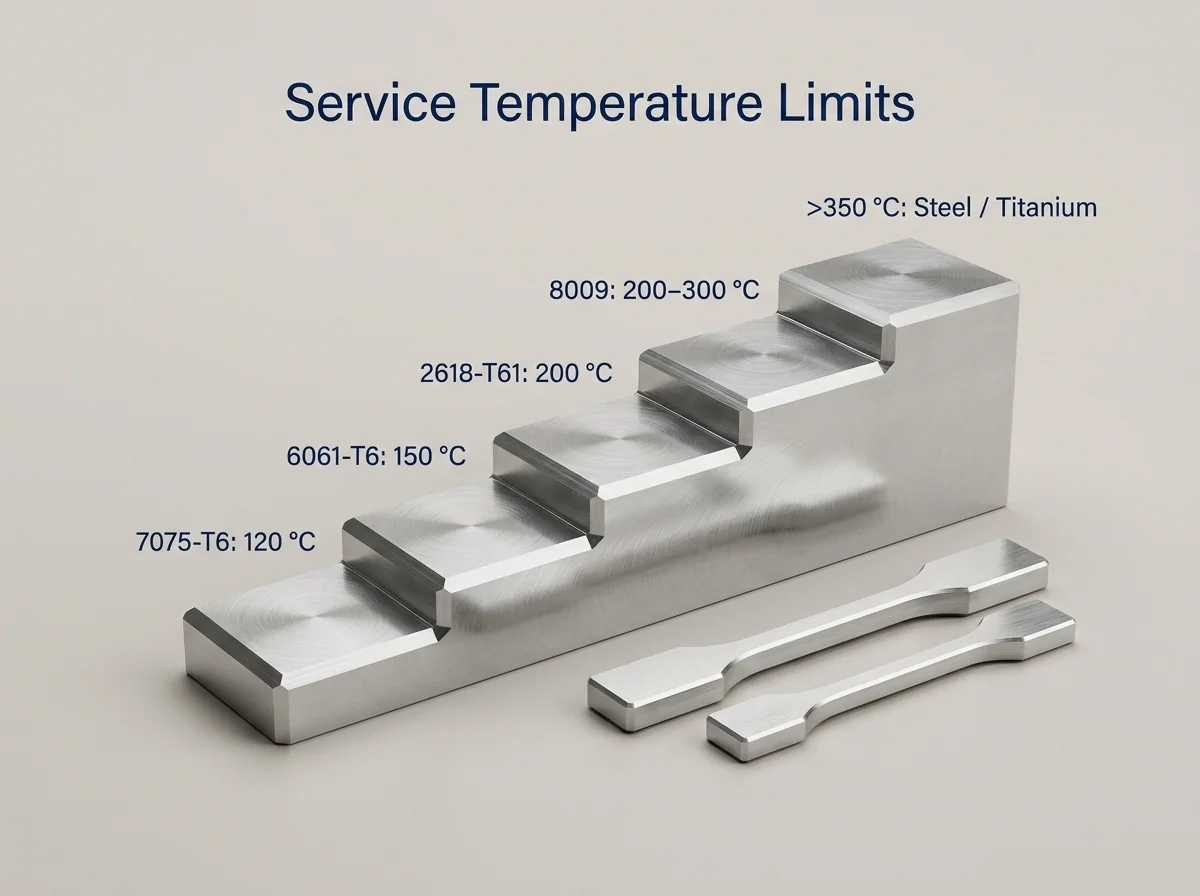
Room-temperature values above are the minimums published in ASTM B209 for sheet, except 2618, where they are typical forging values to AMS 4132. Service ceilings are practical design limits rather than values printed in any specification, and a specific duty cycle can justify going beyond them with the right testing.
Read that table by the fourth column, not the second. 7075 wins the room-temperature column and is the wrong material for a 250 °C part. 2618 is the right answer for a piston crown at 200 °C and stops being one above it. 8009 is the only grade here with a service ceiling above 200 °C.
That is also why the two alloys are easy to compare the wrong way round. Put the datasheets side by side and 7075 shows 572 MPa against 8009’s 450 MPa, which reads like 8009 is the weaker alloy. It is weaker — at room temperature, on a bench, which is not where the part works.
Working With 8009 — Machining, Joining and Finishing
Verspaning: it cuts like a hard aluminium, not like 6061. At around 140 HB it behaves much closer to 7075, which means a shop that already runs 7075 will be comfortable and a shop that only runs 6061 should expect faster tool wear and lighter cuts. There is no free-machining version of this alloy, so how the chips break comes down to how the machine is set rather than to the metal.
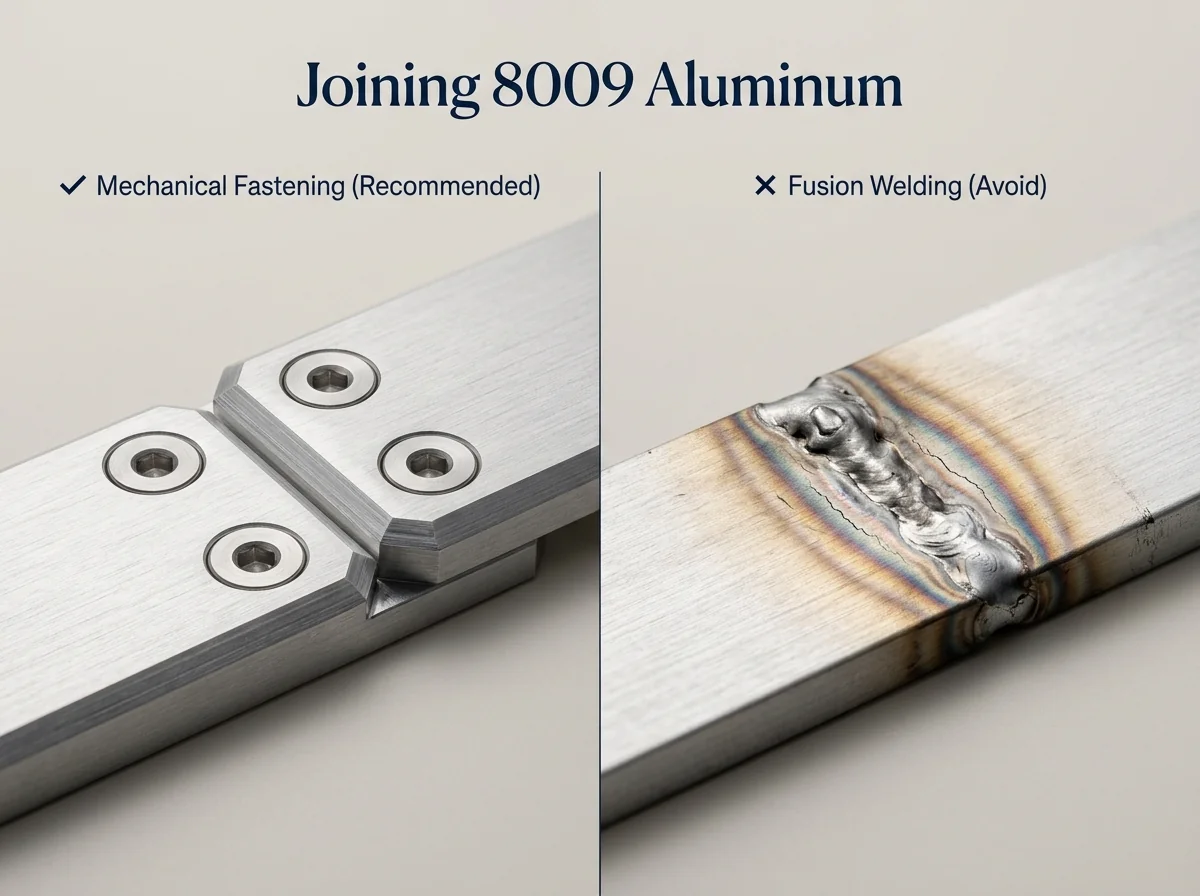
Verbinden: welding costs you the property you bought the alloy for. A fusion weld destroys the particle structure in the weld zone, and the joint loses the high-temperature strength that justified the material in the first place. For a load-bearing joint, plan on mechanical fastening, or on a joining method that does not melt the metal and has been qualified for this alloy; treat a fusion-welded joint as non-structural unless it has been tested and accepted on its own.
Corrosiebescherming: it holds up well in normal workshop and atmospheric service but it is not a marine alloy. Anodizing works, and so do chemical conversion coatings — a chemical surface treatment that leaves a protective layer on the metal. For a part that will see salt air or chemical exposure, specify the finish on the drawing rather than deciding it after the part is made.
Vormen: shape it in O, and accept that you cannot heat-treat the strength back afterwards. This is the biggest practical difference from the 2xxx and 7xxx grades, where forming in a soft state and then aging to full strength is routine. In 8009 the H112 values are set when the material is worked hot, not by a treatment you can repeat in your own shop — so a part that needs heavy forming either starts in O and stays softer, or is formed near-final and machined from H112.
Voor- en nadelen in één oogopslag
| Afmeting | Voordeel | Wat het kost |
|---|---|---|
| Strength above 200 °C | Holds 350 MPa at 200 °C and 270 MPa at 300 °C after 1,000 hours | Nothing comparable in the 6xxx or 7xxx families at that temperature |
| Room-temperature strength | 450 MPa tensile, comparable to 2618 | Below 7075 and 2024; not a reason to choose it |
| Gewicht | 2.92 g/cm³ — under half of steel, so it replaces hot steel parts directly | About 8% heavier than 6061 for the same volume |
| Fatigue at temperature | 160 MPa at 250 °C — published typical value — supports cyclic hot service | Cost per kilogram is several times 6061 |
| Bewerking | Cuts predictably, close to 7075 | ~140 HB wears tooling faster than 6061 |
| Verbinden | Mechanical fastening and methods that do not melt the metal both work | Fusion welding removes the strength advantage locally |
| Supply | Available as billet, plate and bar from powder-route producers | Narrow producer base; lead time follows billet availability; sheet only under AMS 4308 |
| Vormgeving | O temper forms well | Formed parts cannot be re-hardened to H112 |
Conclusie
8009 solves a real problem — carrying load at 200 to 300 °C without moving to titanium or steel — but nothing about it is standard. One producer tier, a specification that covers sheet only, and just two usable states mean the buying problem replaces the engineering problem as soon as the alloy is chosen.
We buy 8009 billet, plate and bar from powder-route producers, then cut and machine to your drawing. Every order ships with an MTC, and SGS reports are available if your project needs them.
Send us the drawing with the form, state and quantity for a supply check and a cutting quote.
Veelgestelde vragen
Can 8009 aluminum be used at 400 °C?
No — there is no published basis for 400 °C. Published 1,000-hour test values, rather than specification minimums, support 200–300 °C; above 350 °C the particle structure needs assessment against your duty cycle.
Does 8009 have a T6 temper?
No. 8009 is strengthened by particles already in the metal, so there is no solution-treat-and-age step to make T6 or T8. It ships in O or H112 only, and an offer naming T6 describes another alloy.
Can you supply 8009 in bar or tube when AMS 4308 covers sheet only?
Yes, as a drawing-controlled item. Outside the AMS thickness range there is no specification to point at, so chemistry and mechanical values travel on the purchase order, and the MTC reports what was tested.
What is the minimum order and lead time for 8009?
Low MOQ, typically 10–60 days. The date depends on billet availability and the cutting or machining you need, so it is confirmed with the quote rather than quoted in advance. Send the drawing, form, state and quantity.