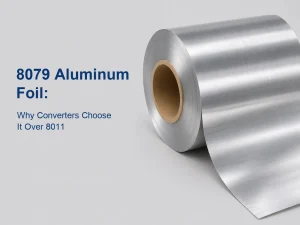
At 6–7 µm the reel gives nothing away. A roll of 1235 and a roll of 8011 look the same, weigh the same and print the same; the alloy is printed on the carton, not on the metal. The difference appears on the packing line, where one foil folds and stays folded and the other opens back up between the folding arms.
1235 is an alloy designation in the 1xxx commercially pure family, and what it fixes is a purity floor rather than a level of performance: aluminum at 99.35% minimum, with silicon and iron together capped at 0.65%. The specifications, forms and sizes are on the 1235 aluminum page. What that purity does at liner gauge, and when another 1xxx foil serves you better, is what follows.
Why Foil Folds and Stays Folded
The Crease Is a Yield-Strength Effect
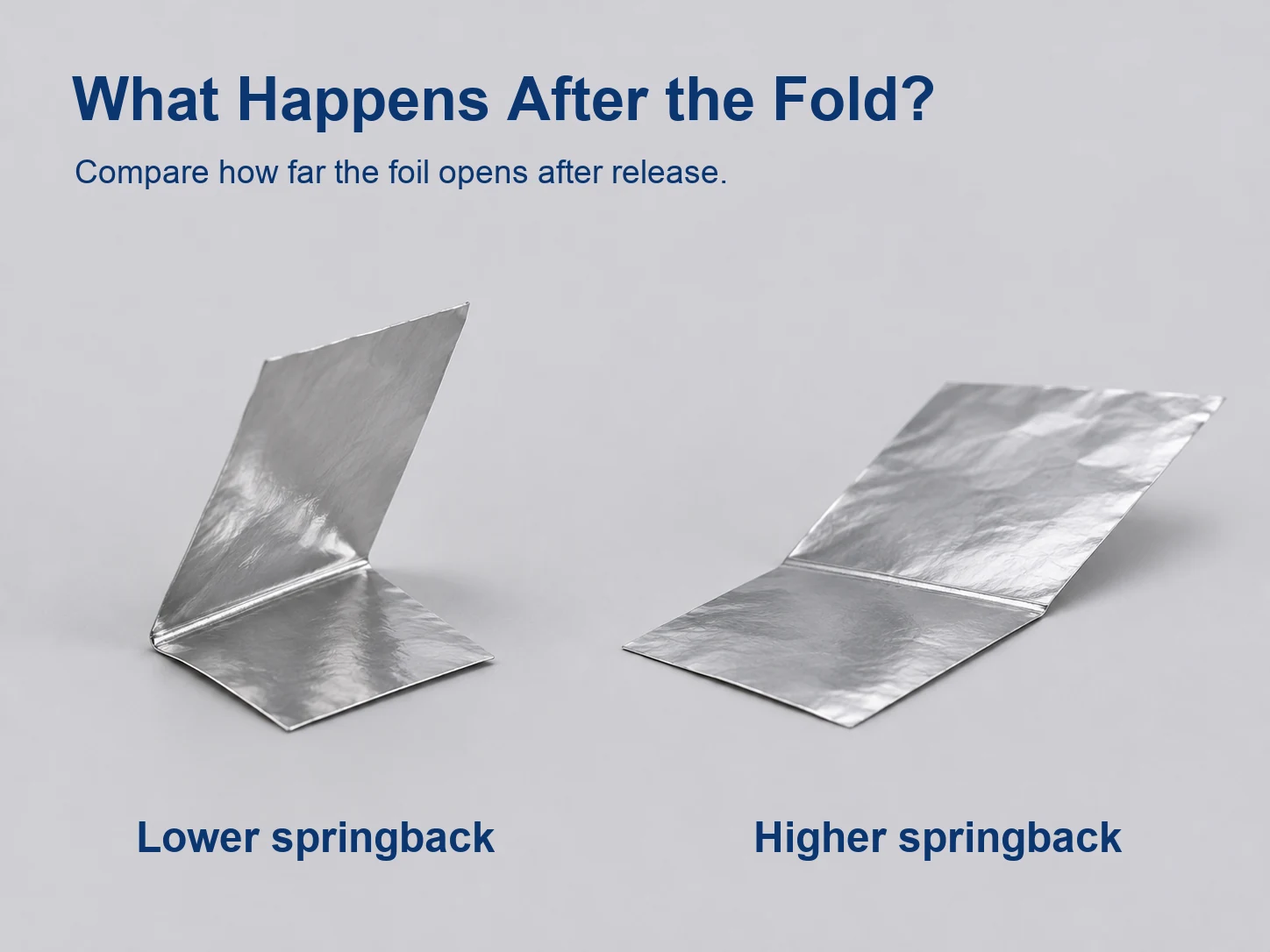
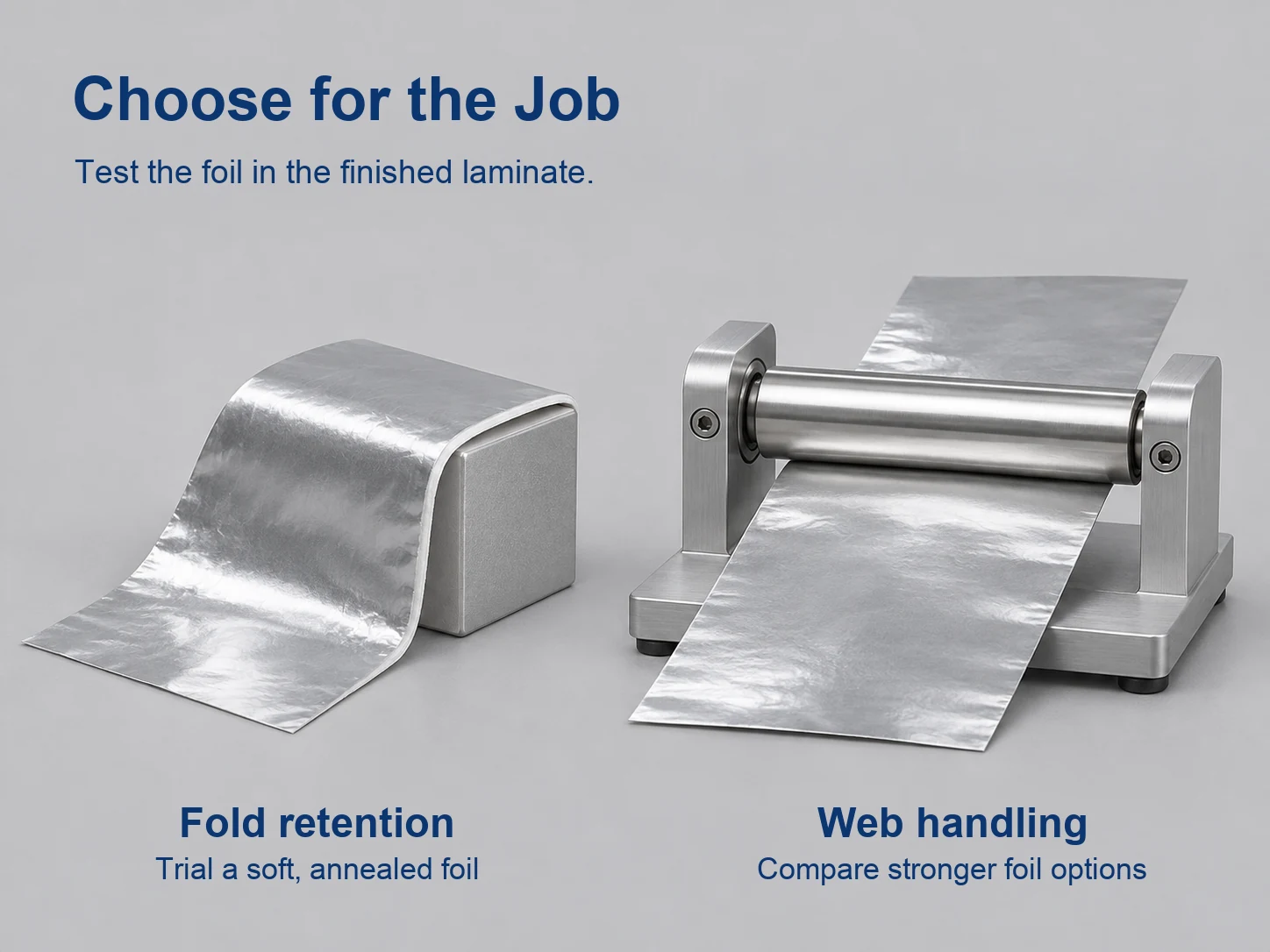
Foil holds a fold because bending yields the metal through its full thickness, and the elastic recovery left over afterwards is too small to open it again. That balance moves with temper. In the annealed condition — O temper, the one foil is normally ordered in — the yield strength is low enough that a fold is almost entirely permanent set.
Raise the yield strength and the balance moves the other way. An H-temper foil resists the fold while it is being made and stores more recoverable strain across the bend, so it springs back once the folding force is released. The crease looks acceptable on the bench and opens in the machine.
What That Buys at Machine Speed
A cigarette liner is folded around the pack at a few hundred packs a minute, closed, and then opened again by the smoker. A foil that springs back fails all three: it will not hold a tight wrap, the pack edge loses its sharp line, and the soft pack cannot be re-closed after the first cigarette.
Each of those is a reject or a complaint, and none of them appears in a delivery inspection. That is why the temper belongs on the order as explicitly as the alloy does — dead fold is a property of the annealed condition, not of the number 1235 by itself.
What Purity Does at Six Microns
Fewer Particles, Fewer Pinholes
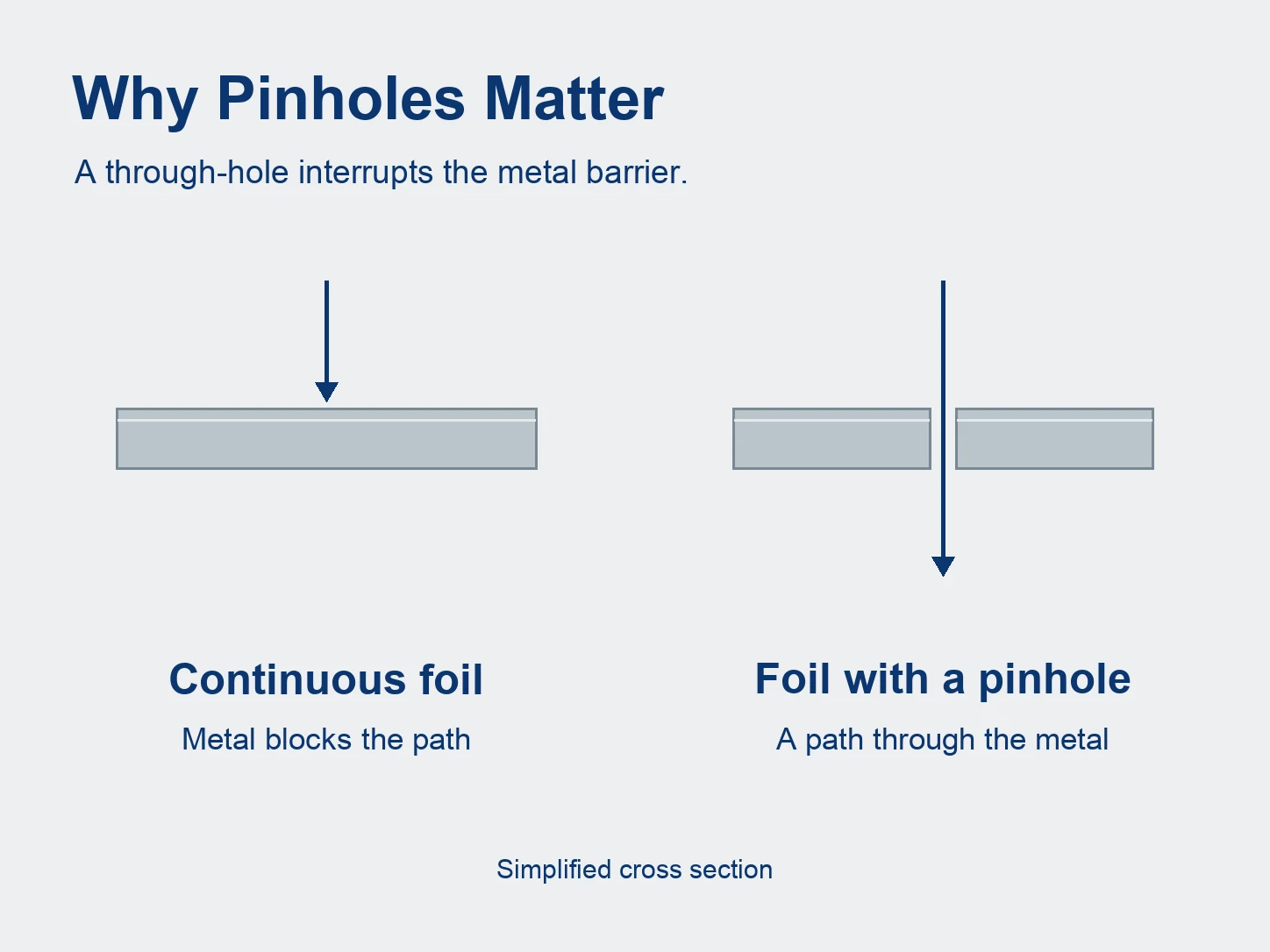
Iron and silicon do not dissolve fully in aluminum. They form coarse intermetallic particles, and at 6–7 µm a particle a few micrometres across occupies a large share of the wall. Where several sit close together the rolling pass tears rather than thins, and what comes out is a pinhole.
Capping silicon plus iron is therefore not purity for its own sake. It is what allows this alloy to be rolled to liner gauge and still be a barrier. A stronger 1xxx foil carries more of those particles, and it buys its strength at the cost of the thinnest gauges.
A Surface That Takes Print and Leaves No Taste
The same low alloy content gives a cleaner, brighter surface off the mill, which is what lamination, printing and embossing need in order to read as a premium pack rather than a printed film. And with little in the metal besides aluminum, there is little that can react with the tobacco it wraps.
Hold the two effects together: they are one cause seen twice, once as a barrier and once as a surface.
Inside a Cigarette Liner
The Structure Is Foil Plus Paper
Cigarette packing is the application that made 1235 a standard, and it runs on a laminate rather than on foil. Foil at 6–7 µm — a typical commercial gauge for this application, and not a figure any standard fixes — is bonded to liner base paper, usually in the 20–25 g/m² band, then printed or embossed and slit to the width the packing machine takes.
The two materials do different jobs. Paper supplies stiffness, opacity and the friction the folding arms need to control the sheet; the foil supplies the barrier. Neither works alone: foil at this gauge is too floppy to feed by itself, and paper without foil passes moisture straight through.
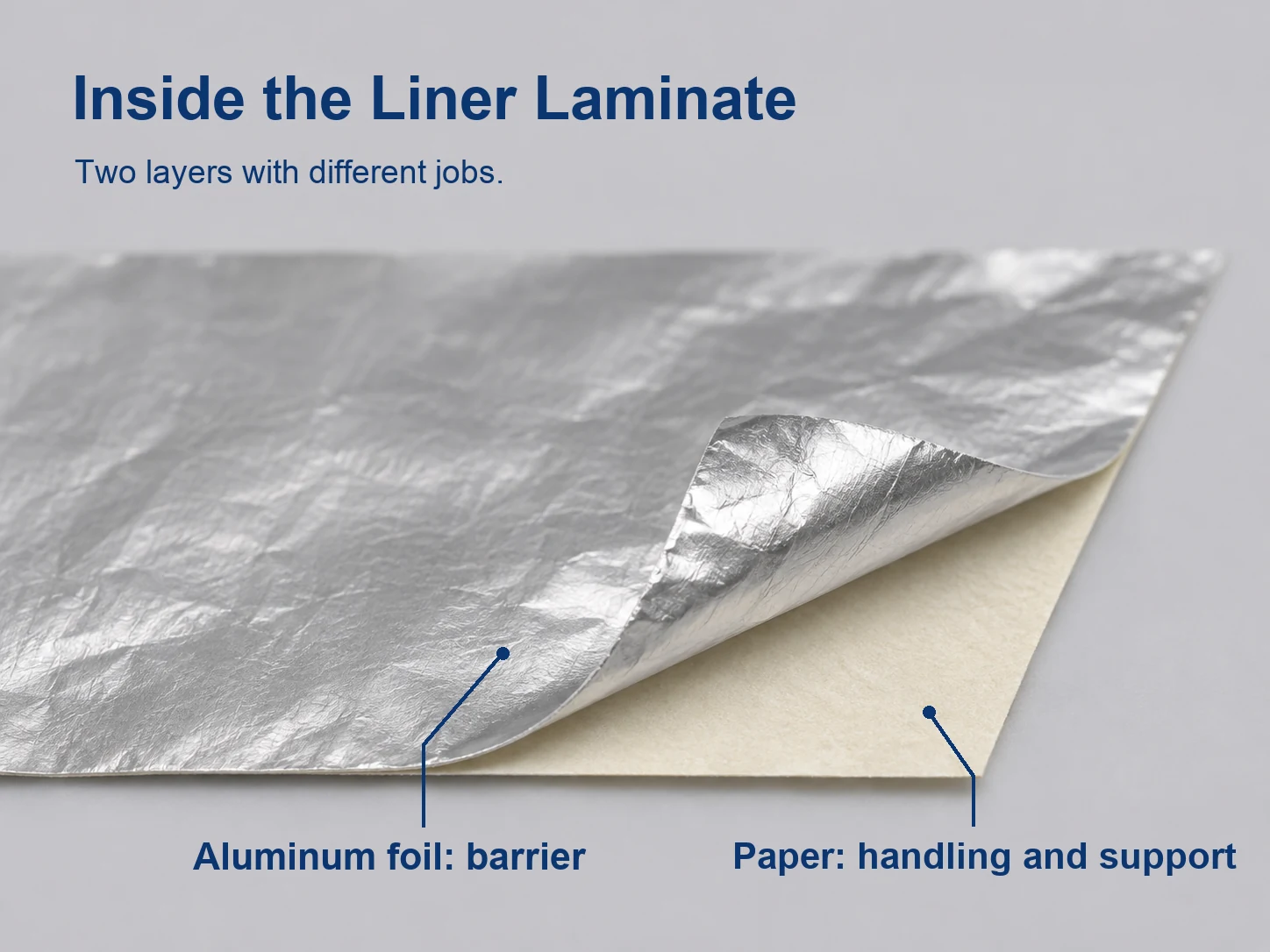
One detail that catches buyers: double rolling leaves one bright face and one matte face, and which face goes outward is an order decision. It is normally the bright face, but a design that wants a satin look has to say so.
The Four Jobs the Foil Does
- Aroma retention. Volatile compounds leave tobacco through anything porous, and a continuous metal layer is not porous.
- Moisture control. The pack has to hold its internal humidity in both directions — not drying out in a dry market, not taking on water in a humid one.
- Light blocking. Ultraviolet light degrades the oils in tobacco; an opaque layer stops it at the surface.
- Brand surface. The foil is the first thing a buyer sees when the pack opens, so it carries the print, the embossing and the metallic finish.
Beyond Cigarettes
The same combination — thin, soft, clean, barrier — carries into other laminates. Sachets and blister lidding use it as the barrier layer, cable wrap as the electromagnetic shield, tape as the backing. The requirement changes with the product; the reason for choosing a 1xxx foil does not.
Choosing Between 1235, 8011 and 1145
What Each Composition Buys
1235 is the soft one. Its purity is what lets it fold, hold and roll thin without pinholes, and it is why it became the default liner foil.
8011 is the deliberate opposite. Iron and silicon are added on purpose, which raises strength and stiffness — useful when the foil is a stiffener, when line speed punishes a soft web, or when the laminate needs more body. The price is softness and surface brightness.
1145 is the older high-purity grade, purer than 1235 and the liner foil before 1235 displaced it. Narrower supply and higher cost are why it largely did not come back.
| 1235 | 8011 | 1145 | |
|---|---|---|---|
| Содержание алюминия | 99.35% minimum | lower — iron and silicon added deliberately | higher than 1235 |
| Что даёт состав | softness, dead fold, thin-gauge rolling | прочность и жёсткость | purity above 1235 |
| Чем это обходится | прочность | dead fold and surface brightness | price and availability |
| Наилучшее применение | a liner or wrap that must fold and hold | a stiffener, a fast line, a heavier laminate | a legacy specification already written around it |
Table note: three 1xxx foils compared at the annealed temper and in the same gauge band, on the same laminate duty. Composition and properties for each grade sit on their own alloy pages.
The choice is dead fold against stiffness — not purity against purity — and only the pack tells you which one it needs.
Годен/Не годен
1235 fits when:
- The foil has to fold and stay folded — a liner, a wrap, a re-closable pack.
- The gauge is at the thin end, where a pinhole decides the barrier.
- The surface must stay bright for print or a metallic finish.
- The laminate needs softness more than body.
1235 does not fit when:
- The foil works as a stiffener rather than a wrap.
- Line speed is the constraint and a soft web is the problem.
- The gauge is heavy enough that a stronger alloy does the same job with less metal.
- The specification was written around 1145 and requalifying costs more than the foil.
What the Standard Leaves to You
ASTM B479 Covers Annealed Foil Only
ASTM B479 governs annealed packaging foil, and its scope is narrower than the phrase “packaging foil to B479” suggests: it covers annealed foil from 0.0064 mm up to but not including 0.15 mm. An order for H-temper foil that cites B479 is citing a document that does not govern what it is buying.
That is not a technicality when the application depends on stiffness. Change the temper and the standard, the mechanical expectation and the dead-fold behaviour all change together — and only the first of the three is visible on the paper.
European orders more often name an EN 546 grade. The clauses below are quoted from B479 because they are the ones that decide whether a substitute can be shipped, and that question does not change with the letterhead on the standard.
The Clause That Lets a Producer Choose the Alloy
B479 lists the alloys it covers — 1100, 1145, 1235, 8011, 8079 and 8111 — and then states that unless the purchaser specifies otherwise, the alloy to be supplied is left to the producer.
So an order reading “0.0065 mm foil to ASTM B479” has specified a thickness and a tolerance system. It has not specified a material. It can be filled with 8011, 8079 or 8111, and the delivery will conform to everything the order said.
The remedy is three lines: name the alloy, name the temper, and name the standard the certificate will be read against. The substitution route closes as soon as the first of those is written down.
What to Send With the Enquiry
An enquiry carrying these six lines leaves little room for interpretation:
- Сплав и состояние — 1235 in O temper, unless the design has a reason for H18.
- Gauge and its tolerance — the nominal thickness, and how much deviation the process can absorb.
- Width and slit requirement — the width the packing machine takes, and whether joins are allowed in the roll.
- Which face goes out — bright or matte.
- The laminate it joins — paper weight, film or coating, because the bond is decided at lamination, not at rolling.
- Документы — MTC as a minimum, and a third-party report where the brand owner’s specification asks for one.
The certificate is the line that matters most and the one that gets dropped when a price is under pressure. By the time the foil has been laminated, printed and packed, the only record of what was rolled is the paperwork. We supply 1235 foil in O and H18, slit or laminated, with an MTC on every order.
Заключение
1235 is chosen for what its purity takes away — strength and stiffness — and at liner gauge that is the right trade, because the pack needs the foil to fold and hold rather than to carry load. The risk is not picking the wrong alloy; it is ordering a standard without an alloy, which ASTM B479 explicitly allows.
We supply 1235 foil in O and H18, slit or laminated, with an MTC on every order.
Send us the application, the gauge and the slit width, and we will come back with the alloy call, the temper and the documents that go with it.
ЧАСТО ЗАДАВАЕМЫЕ ВОПРОСЫ
Why does my 1235 foil spring back when I fold it?
Because it is not fully annealed. Dead fold depends on low yield strength, so a partially hardened or H-temper roll resists the fold and recovers when the force is released. Check the temper on the certificate before blaming the alloy.
Can I get 1235 foil in H18 instead of O?
Yes, and it is the right call when the foil works as a stiffener. Expect to give up dead fold, and note that ASTM B479 covers annealed foil only — so the mechanical requirement has to be written into the order itself.
What is the minimum order for a slit roll?
It is quoted from alloy, gauge, width and quantity together, so no single figure applies. Send those four with the application and we will confirm what is possible at that specification.
How do I compare 1235 aluminum foil manufacturers?
Read the certificate first: alloy, temper and heat or batch number belong on it. Then look at the surface — 1235 takes a bright, even finish, while a stronger 1xxx foil with iron and silicon reads slightly duller. Compare on those two before you compare on price.