Bei 6–7 µm verrät die Rolle nichts. Eine Rolle 1235 und eine Rolle 8011 sehen gleich aus, wiegen gleich viel und drucken sich gleich; die Legierung steht auf dem Karton, nicht auf dem Metall. Der Unterschied zeigt sich an der Verpackungslinie, wo die eine Folie faltet und gefaltet bleibt und die andere sich zwischen den Falzarmen wieder öffnet.
1235 ist eine Legierungsbezeichnung aus der kommerziell reinen 1xxx-Familie, und was sie festlegt, ist eine Reinheitsuntergrenze und kein Leistungsniveau: Aluminium mit mindestens 99,35%, wobei Silizium und Eisen zusammen auf 0,65% begrenzt sind. Die Spezifikationen, Formen und Größen finden sich auf der 1235-Aluminiumseite. Was diese Reinheit bei Liner-Dicke bewirkt und wann eine andere 1xxx-Folie besser für Sie geeignet ist, folgt im Weiteren.
Warum Folie faltet und gefaltet bleibt
Die Falte ist ein Streckgrenzeneffekt
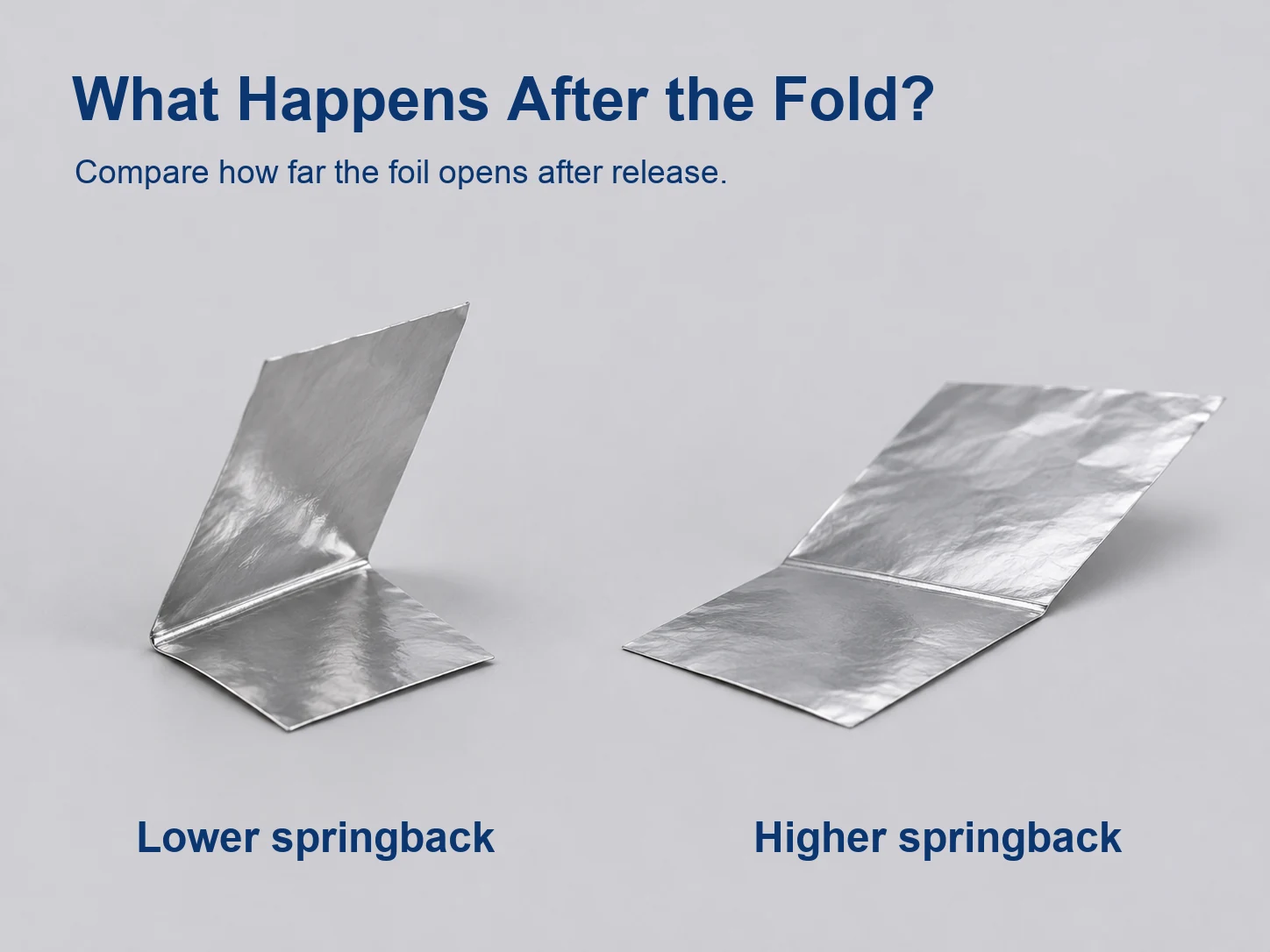
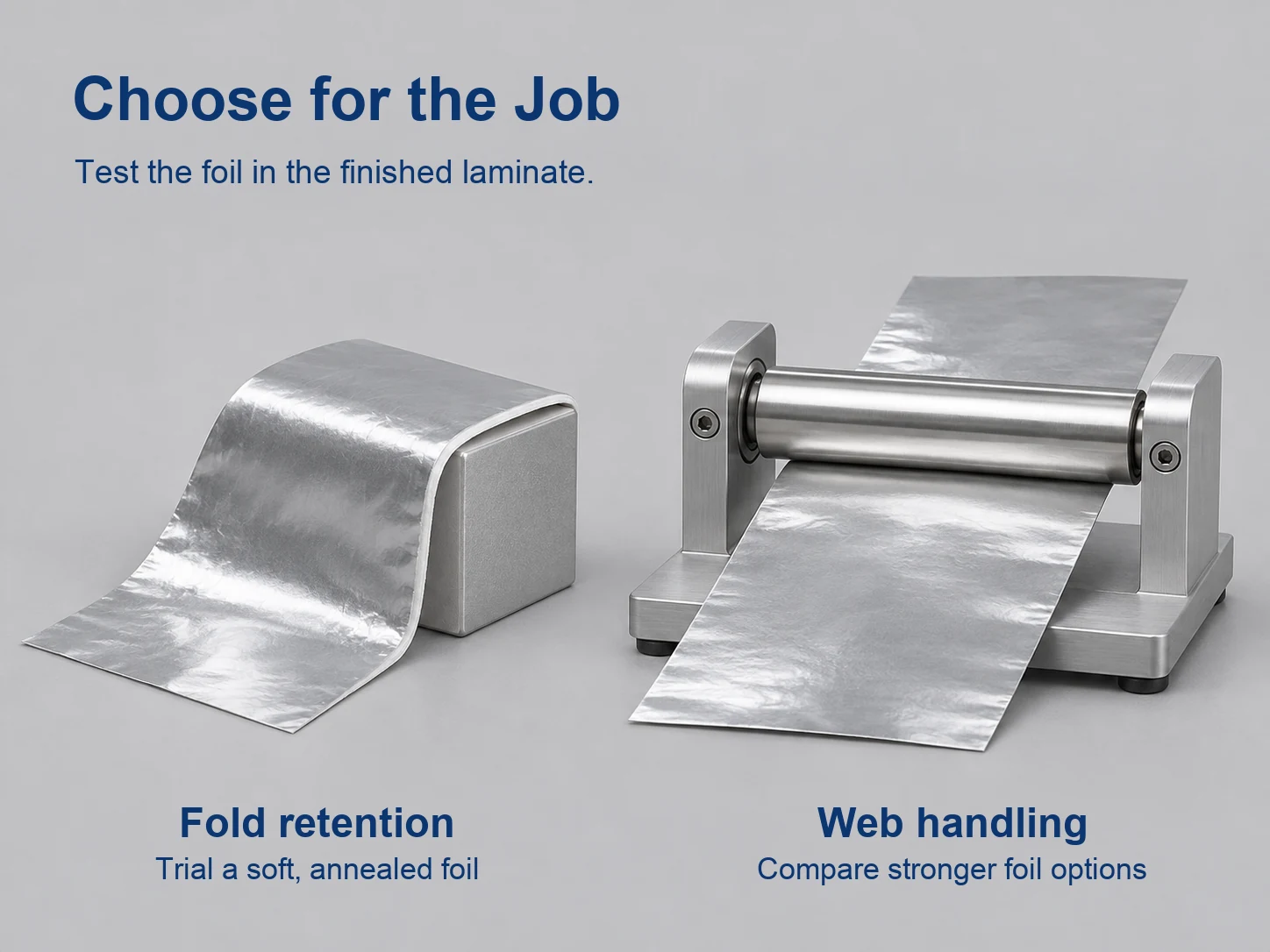
Folie hält eine Falte, weil das Biegen das Metall über seine volle Dicke fließen lässt und die danach verbleibende elastische Rückfederung zu gering ist, um sie wieder zu öffnen. Dieses Gleichgewicht verschiebt sich mit dem Härtezustand. Im geglühten Zustand — O-Zustand, in dem die Folie normalerweise bestellt wird — ist die Streckgrenze niedrig genug, dass eine Falte nahezu vollständig eine bleibende Verformung ist.
Erhöht man die Streckgrenze, verschiebt sich das Gleichgewicht in die andere Richtung. Eine Folie im H-Zustand widersteht der Falte während ihrer Herstellung und speichert mehr rückgewinnbare Dehnung über die Biegung, sodass sie nach dem Loslassen der Faltkraft zurückfedert. Die Falte sieht auf dem Prüftisch akzeptabel aus und öffnet sich in der Maschine.
Was das bei Maschinengeschwindigkeit bringt
Ein Zigarettenliner wird mit einigen hundert Packungen pro Minute um die Packung gefaltet, verschlossen und dann vom Raucher wieder geöffnet. Eine Folie, die zurückfedert, versagt bei allen drei Aspekten: Sie hält keine straffe Umhüllung, die Packungskante verliert ihre scharfe Linie, und die Softpackung lässt sich nach der ersten Zigarette nicht wieder verschließen.
Jedes davon ist eine Ausschussware oder eine Reklamation, und keines davon erscheint bei einer Lieferprüfung. Deshalb gehört der Härtezustand ebenso ausdrücklich auf die Bestellung wie die Legierung — der Dead Fold ist eine Eigenschaft des geglühten Zustands, nicht der Zahl 1235 an sich.
Was die Reinheit bei sechs Mikrometern bewirkt
Weniger Partikel, weniger Nadelstiche
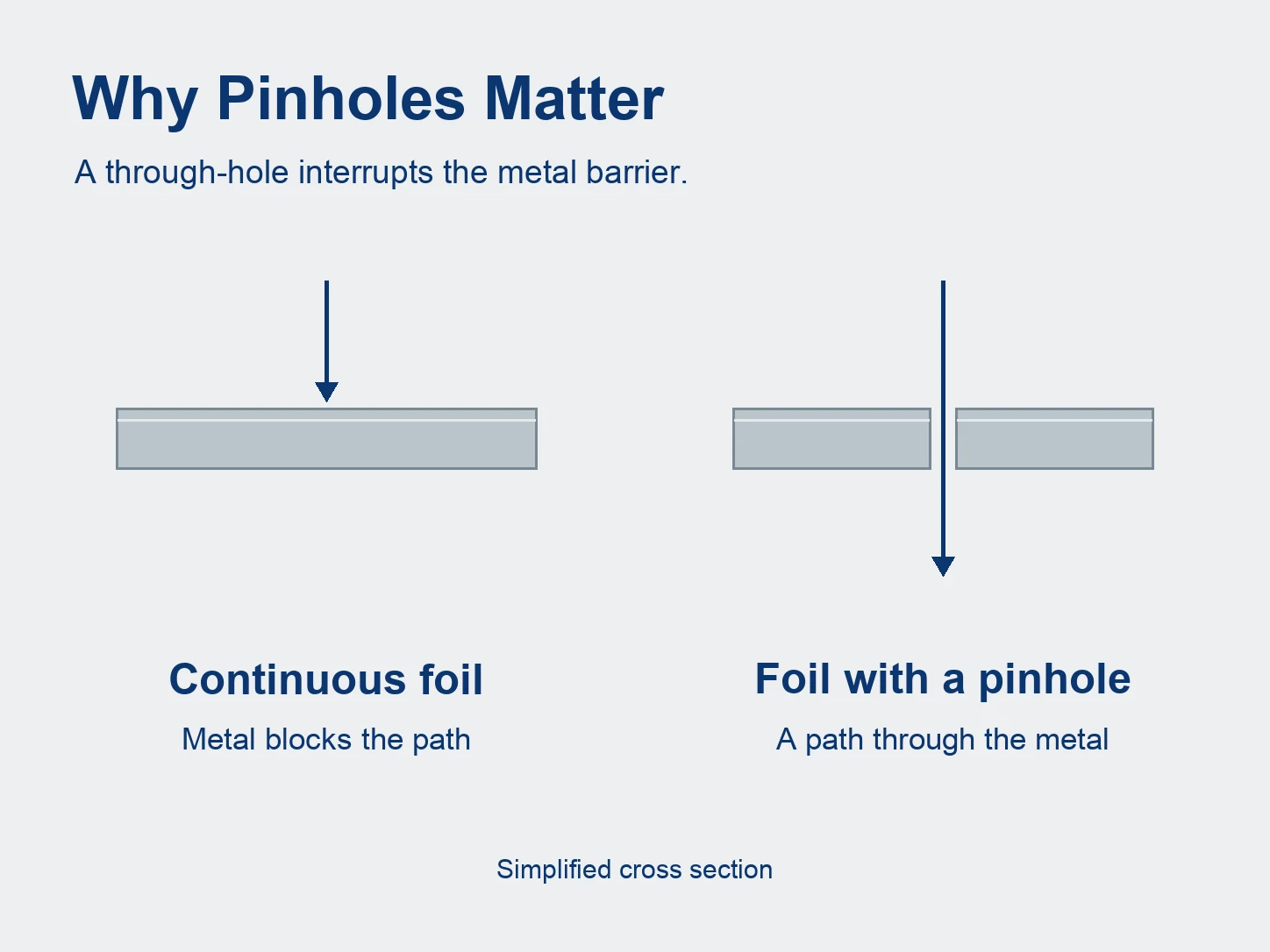
Eisen und Silizium lösen sich nicht vollständig in Aluminium. Sie bilden grobe intermetallische Partikel, und bei 6–7 µm nimmt ein einige Mikrometer großes Partikel einen großen Anteil der Wandstärke ein. Wo mehrere eng beieinander liegen, reißt der Walzdurchgang, anstatt zu dünnen, und was herauskommt, ist ein Nadelstich.
Die Begrenzung von Silizium plus Eisen ist daher keine Reinheit um ihrer selbst willen. Sie ist es, was es dieser Legierung ermöglicht, auf Liner-Dicke gewalzt zu werden und dennoch eine Barriere zu sein. Eine stärkere 1xxx-Folie trägt mehr dieser Partikel und erkauft ihre Festigkeit auf Kosten der dünnsten Dicken.
Eine Oberfläche, die Druck annimmt und keinen Geschmack hinterlässt
Derselbe niedrige Legierungsgehalt ergibt eine sauberere, glänzendere Oberfläche ab Walzwerk, was Laminierung, Druck und Prägung benötigen, damit es als Premium-Packung und nicht als bedruckte Folie wirkt. Und da im Metall außer Aluminium wenig enthalten ist, gibt es wenig, das mit dem umhüllten Tabak reagieren kann.
Halten Sie die beiden Effekte zusammen: Sie sind eine Ursache, zweimal gesehen, einmal als Barriere und einmal als Oberfläche.
Im Inneren eines Zigarettenliners
Die Struktur ist Folie plus Papier
Die Zigarettenverpackung ist die Anwendung, die 1235 zum Standard gemacht hat, und sie läuft auf einem Laminat statt auf Folie. Folie mit 6–7 µm — eine typische kommerzielle Dicke für diese Anwendung und kein Wert, den eine Norm festlegt — wird auf Liner-Basispapier, üblicherweise im Bereich von 20–25 g/m², kaschiert, dann bedruckt oder geprägt und auf die Breite geschnitten, die die Verpackungsmaschine aufnimmt.
Die beiden Materialien erfüllen unterschiedliche Aufgaben. Papier liefert Steifigkeit, Opazität und die Reibung, die die Falzarme zur Kontrolle des Bogens benötigen; die Folie liefert die Barriere. Keines funktioniert allein: Folie in dieser Dicke ist zu schlaff, um von selbst zugeführt zu werden, und Papier ohne Folie lässt Feuchtigkeit direkt durch.
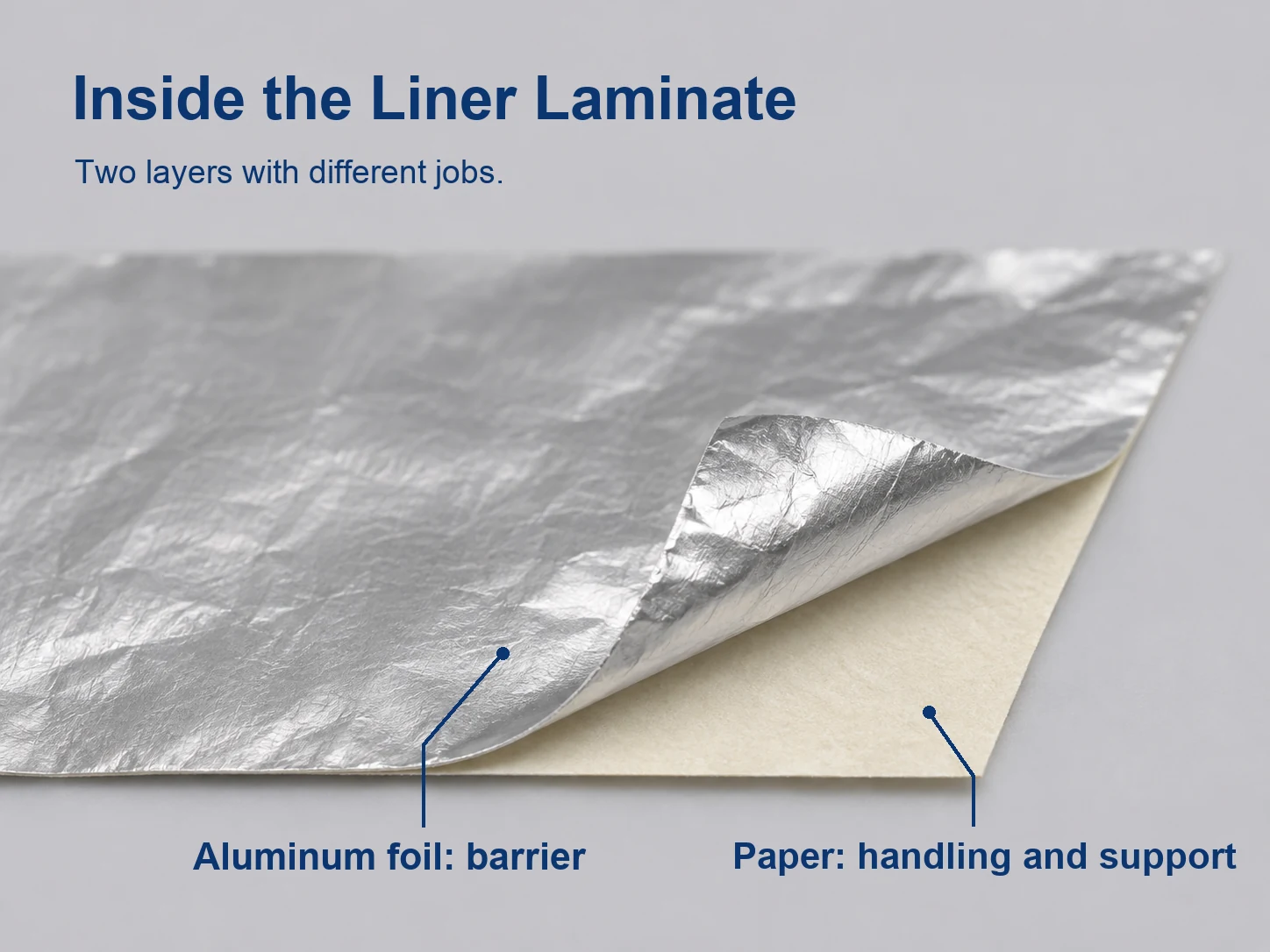
Ein Detail, das Einkäufer aufhorchen lässt: Doppelwalzen hinterlässt eine glänzende und eine matte Seite, und welche Seite nach außen zeigt, ist eine Bestellentscheidung. Normalerweise ist es die glänzende Seite, aber ein Design, das einen satinierten Look wünscht, muss das angeben.
Die vier Aufgaben der Folie
- Aromarückhaltung. Flüchtige Verbindungen verlassen den Tabak durch alles Poröse, und eine durchgehende Metallschicht ist nicht porös.
- Feuchtigkeitskontrolle. Die Packung muss ihre interne Feuchtigkeit in beide Richtungen halten — nicht austrocknen in einem trockenen Markt, nicht Wasser aufnehmen in einem feuchten.
- Lichtblockierung. Ultraviolettes Licht zersetzt die Öle im Tabak; eine opake Schicht stoppt es an der Oberfläche.
- Markenoberfläche. Die Folie ist das Erste, was ein Käufer beim Öffnen der Packung sieht, daher trägt sie den Druck, die Prägung und die metallische Veredelung.
Jenseits von Zigaretten
Dieselbe Kombination — dünn, weich, sauber, Barriere — setzt sich in anderen Laminaten fort. Sachets und Blisterdeckel verwenden sie als Barriereschicht, Kabelwicklung als elektromagnetische Abschirmung, Klebeband als Träger. Die Anforderung ändert sich mit dem Produkt; der Grund für die Wahl einer 1xxx-Folie nicht.
Die Wahl zwischen 1235, 8011 und 1145
Was jede Zusammensetzung bringt
1235 ist die weiche. Ihre Reinheit ist es, die sie falten, halten und dünn walzen lässt ohne Nadelstiche, und deshalb wurde sie zur Standard-Linerfolie.
8011 ist das bewusste Gegenteil. Eisen und Silizium werden absichtlich zugesetzt, was Festigkeit und Steifigkeit erhöht — nützlich, wenn die Folie ein Versteifungsmittel ist, wenn die Liniengeschwindigkeit eine weiche Bahn bestraft oder wenn das Laminat mehr Körper benötigt. Der Preis ist Weichheit und Oberflächenglanz.
1145 ist die ältere hochreine Sorte, reiner als 1235 und die Linerfolie, bevor 1235 sie verdrängte. Engere Versorgung und höhere Kosten sind der Grund, warum sie weitgehend nicht zurückkam.
| 1235 | 8011 | 1145 | |
|---|---|---|---|
| Aluminiumgehalt | mindestens 99,35% | niedriger — Eisen und Silizium absichtlich zugesetzt | höher als 1235 |
| Was die Zusammensetzung bringt | Weichheit, Dead Fold, Dünndickenwalzen | Festigkeit und Steifigkeit | Reinheit über 1235 |
| Was es kostet | Stärke | Dead Fold und Oberflächenglanz | Preis und Verfügbarkeit |
| Beste Eignung | ein Liner oder eine Umhüllung, die falten und halten muss | ein Versteifungsmittel, eine schnelle Linie, ein schwereres Laminat | a legacy specification already written around it |
Table note: three 1xxx foils compared at the annealed temper and in the same gauge band, on the same laminate duty. Composition and properties for each grade sit on their own alloy pages.
The choice is dead fold against stiffness — not purity against purity — and only the pack tells you which one it needs.
Go/No-Go
1235 fits when:
- The foil has to fold and stay folded — a liner, a wrap, a re-closable pack.
- The gauge is at the thin end, where a pinhole decides the barrier.
- The surface must stay bright for print or a metallic finish.
- The laminate needs softness more than body.
1235 does not fit when:
- The foil works as a stiffener rather than a wrap.
- Line speed is the constraint and a soft web is the problem.
- The gauge is heavy enough that a stronger alloy does the same job with less metal.
- The specification was written around 1145 and requalifying costs more than the foil.
What the Standard Leaves to You
ASTM B479 Covers Annealed Foil Only
ASTM B479 governs annealed packaging foil, and its scope is narrower than the phrase “packaging foil to B479” suggests: it covers annealed foil from 0.0064 mm up to but not including 0.15 mm. An order for H-temper foil that cites B479 is citing a document that does not govern what it is buying.
That is not a technicality when the application depends on stiffness. Change the temper and the standard, the mechanical expectation and the dead-fold behaviour all change together — and only the first of the three is visible on the paper.
European orders more often name an EN 546 grade. The clauses below are quoted from B479 because they are the ones that decide whether a substitute can be shipped, and that question does not change with the letterhead on the standard.
The Clause That Lets a Producer Choose the Alloy
B479 lists the alloys it covers — 1100, 1145, 1235, 8011, 8079 and 8111 — and then states that unless the purchaser specifies otherwise, the alloy to be supplied is left to the producer.
So an order reading “0.0065 mm foil to ASTM B479” has specified a thickness and a tolerance system. It has not specified a material. It can be filled with 8011, 8079 or 8111, and the delivery will conform to everything the order said.
The remedy is three lines: name the alloy, name the temper, and name the standard the certificate will be read against. The substitution route closes as soon as the first of those is written down.
What to Send With the Enquiry
An enquiry carrying these six lines leaves little room for interpretation:
- Legierung und Zustand — 1235 in O temper, unless the design has a reason for H18.
- Gauge and its tolerance — the nominal thickness, and how much deviation the process can absorb.
- Width and slit requirement — the width the packing machine takes, and whether joins are allowed in the roll.
- Which face goes out — bright or matte.
- The laminate it joins — paper weight, film or coating, because the bond is decided at lamination, not at rolling.
- Dokumente — MTC as a minimum, and a third-party report where the brand owner’s specification asks for one.
The certificate is the line that matters most and the one that gets dropped when a price is under pressure. By the time the foil has been laminated, printed and packed, the only record of what was rolled is the paperwork. We supply 1235 foil in O and H18, slit or laminated, with an MTC on every order.
Schlussfolgerung
1235 is chosen for what its purity takes away — strength and stiffness — and at liner gauge that is the right trade, because the pack needs the foil to fold and hold rather than to carry load. The risk is not picking the wrong alloy; it is ordering a standard without an alloy, which ASTM B479 explicitly allows.
We supply 1235 foil in O and H18, slit or laminated, with an MTC on every order.
Send us the application, the gauge and the slit width, and we will come back with the alloy call, the temper and the documents that go with it.
FAQ
Why does my 1235 foil spring back when I fold it?
Because it is not fully annealed. Dead fold depends on low yield strength, so a partially hardened or H-temper roll resists the fold and recovers when the force is released. Check the temper on the certificate before blaming the alloy.
Can I get 1235 foil in H18 instead of O?
Yes, and it is the right call when the foil works as a stiffener. Expect to give up dead fold, and note that ASTM B479 covers annealed foil only — so the mechanical requirement has to be written into the order itself.
What is the minimum order for a slit roll?
It is quoted from alloy, gauge, width and quantity together, so no single figure applies. Send those four with the application and we will confirm what is possible at that specification.
How do I compare 1235 aluminum foil manufacturers?
Read the certificate first: alloy, temper and heat or batch number belong on it. Then look at the surface — 1235 takes a bright, even finish, while a stronger 1xxx foil with iron and silicon reads slightly duller. Compare on those two before you compare on price.