What Is 6005 Aluminum?
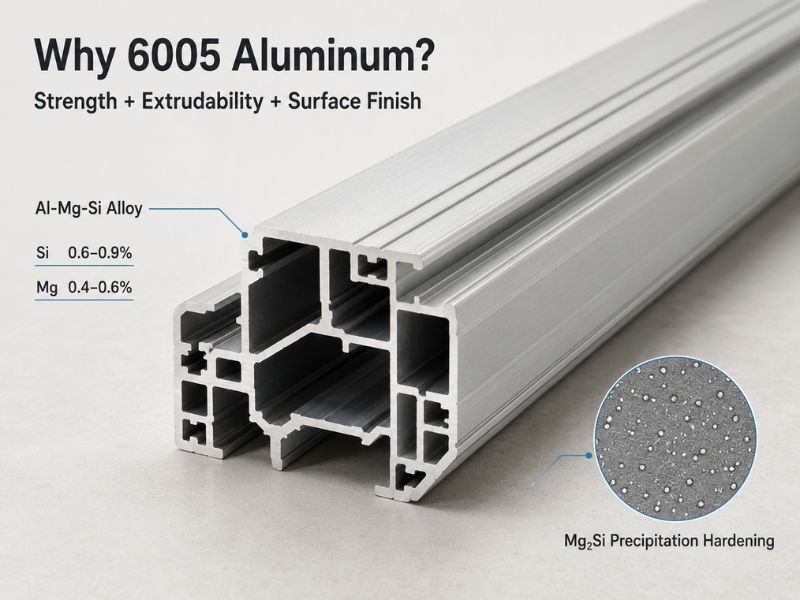
6005 aluminum alloy is a heat-treatable 6xxx-series alloy built on the aluminum-magnesium-silicon system (Al-Mg-Si). Its strength comes from magnesium-silicide (Mg₂Si) precipitation during aging, which lets the alloy be extruded first and hardened afterward — the same family logic as 6063 and 6061, but tuned for a different balance.
That balance is the useful part: 6005 delivers noticeably higher strength than 6063 or 6060 while extruding more easily and finishing with a better surface than 6061. The trade-off is that it does not reach 6061’s peak tensile values. The practical question is whether the strength-to-extrudability position fits the profile, the loads, and the finish the project needs.
Chemical Composition
The composition of 6005 (AA 6005, per ASTM B221 and EN 573-3) is controlled within tight limits:
| Element | Content (%) | Role |
|---|---|---|
| Aluminum | Balance | Base metal |
| Silicon (Si) | 0.6 – 0.9 | Forms Mg₂Si hardening phase |
| Magnesium (Mg) | 0.4 – 0.6 | Forms Mg₂Si hardening phase |
| Manganese (Mn) | 0.10 max | Grain refinement |
| Iron (Fe) | 0.35 max | Impurity control |
| Copper (Cu) | 0.10 max | Impurity control |
| Chromium (Cr) | 0.10 max | Grain structure control |
| Zinc (Zn) | 0.10 max | Impurity control |
| Titanium (Ti) | 0.10 max | Grain refinement |
The silicon and magnesium levels are what separate 6005 from its neighbors: they keep extrudability and surface finish closer to 6063 while raising aged strength toward 6061.
6005 Mechanical and Physical Properties
| Property | Value | Note |
|---|---|---|
| Density | 2.70 g/cm³ | Standard for 6xxx alloys |
| Ultimate Tensile Strength (T5) | ~260 MPa (min 190) | Cooled from extrusion + artificially aged |
| Yield Strength (T5) | ~215 MPa (min 145) | |
| Ultimate Tensile Strength (T6) | ~310 MPa (min 260) | Solution treated + artificially aged |
| Yield Strength (T6) | ~275 MPa (min 240) | |
| Elongation at Break | ~8–10% | T6 slightly lower than T5 |
| Brinell Hardness | ~80 HB (T5) / ~90 HB (T6) | |
| Fatigue Strength | ~115 MPa (T5) / ~130 MPa (T6) | 5×10⁸ cycles |
| Elastic Modulus | ~70 GPa | Same across tempers |
| Thermal Conductivity | ~170–180 W/m·K | |
| Electrical Conductivity | ~45–50% IACS | |
| Melting Range | ~580–650 °C |
The yield strength of ~240 MPa minimum in T6 is the number that drives most structural calculations — it is the reason 6005 replaced many heavier steel sections in transport and bridge applications. The T5 temper trades some of that strength for a lower-cost route: it is aged straight from extrusion heat, skipping a separate solution furnace, which matters when the profile is long and the budget is tight. A companion overview of 6005 key properties covers the alloy in summary form.
The T5 and T6 Tempers
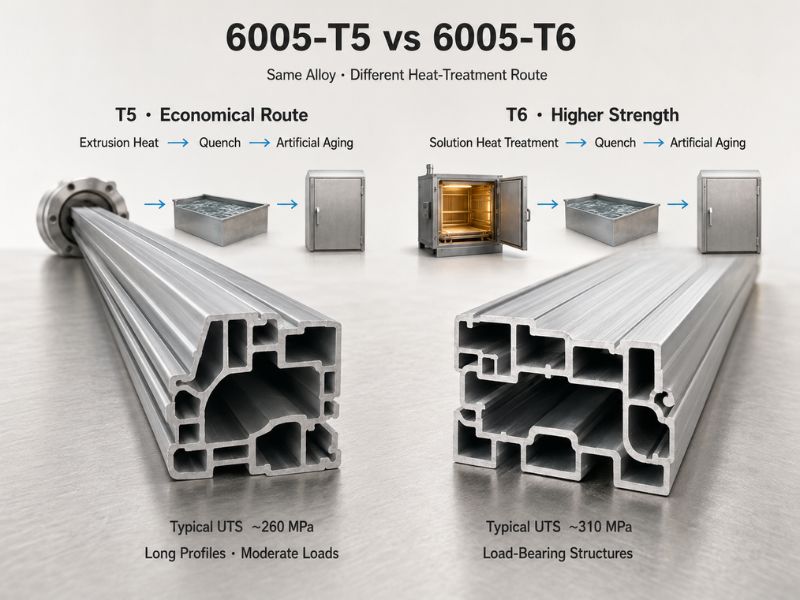
6005 is most often supplied in two tempers, and the difference is in the heat-treatment route, not the alloy:
T5 — cooled from extrusion and artificially aged. The profile leaves the press, is quenched, and is aged at elevated temperature without a separate solution step. It is the economical choice for long architectural and structural runs where ~260 MPa tensile is enough.
T6 — solution heat treated and artificially aged. The profile is re-solutionized, quenched, and aged, which dissolves and re-precipitates the hardening phase more completely. This adds roughly 50 MPa of tensile and 30–60 MPa of yield over T5, at the cost of an extra furnace pass and slightly lower ductility.
The selection is usually driven by load: T5 covers railings, frames, and architectural sections; T6 covers bridge members, truck and trailer structures, and load-bearing components where the extra strength pays for the extra process step.
Where 6005 Is Used
Construction and Architectural Structures
6005 profiles carry structural loads while keeping the clean surface that architectural work demands. Handrails, stair stringers, curtain-wall framing, window and door frames, and bridge railings are standard uses — the alloy extrudes into the complex hollow sections these designs need, and the T5/T6 choice tunes strength to the span.
Transportation, Industrial, and Electrical
Truck and trailer frames, roof rails, railcar components, and lift equipment use 6005 where weight matters and welds are part of the build — the alloy welds reliably with MIG or TIG, and the heat-affected zone loss is manageable with proper procedure. On the industrial side, ladders, scaffolding, and solar-panel frames exploit the same strength-to-weight balance, while electrical enclosures, heat sinks, and busbars use its good conductivity.
6005 vs 6061 vs 6063 vs 6060
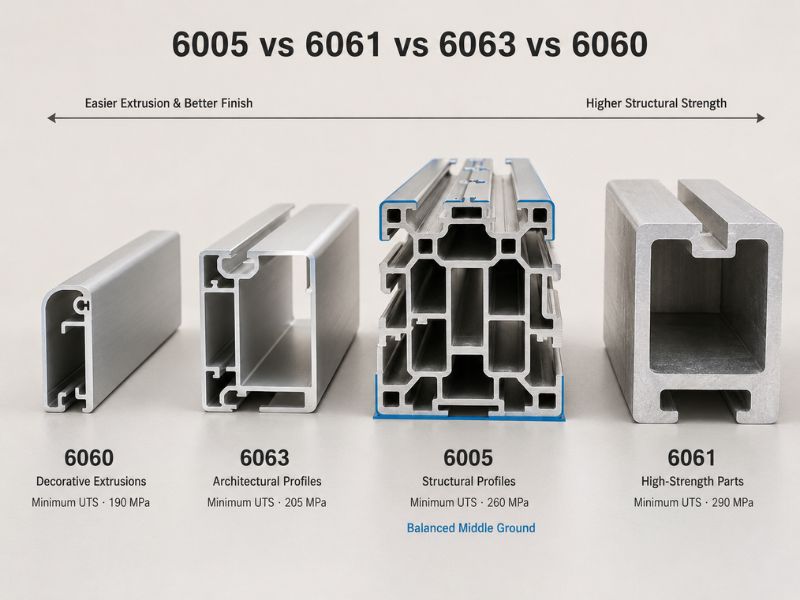
| Alloy | UTS (MPa, min) | YS (MPa, min) | Extrudability | Surface / Anodizing | Best for |
|---|---|---|---|---|---|
| 6060 | 190 (T6) | 150 (T6) | Excellent | Very good | Trim, tubing, decorative extrusions |
| 6063 | 205 (T6) | 170 (T6) | Excellent (reference) | Very good | Architectural frames, window/door systems |
| 6005 | 260 (T6) | 240 (T6) | Good | Good | Structural profiles, transport, railings |
| 6061 | 290 (T6) | 240 (T6) | Moderate | Moderate (Cu affects finish) | High-strength machined parts, welded structures |
Values are minimum guaranteed per ASTM B221 / EN 755. 6005-T5 minimums are 190 MPa tensile and 145 MPa yield — the T5 route sits below T6 but costs less to produce.
When 6005 Is the Right Call
Two conditions point to 6005. The part is an extruded profile that must carry structural load — railing, frame, bridge member, or vehicle component — and the surface needs to finish cleanly. If the profile is long, the section is complex, and the design sits between 6063’s strength and 6061’s cost, 6005 is the middle ground that usually wins.
When Another Alloy Fits Better
When the requirement is maximum strength from a machined or thick-section part, 6061-T6 delivers higher minimum tensile strength, and its copper content is acceptable in that role. When extrudability, surface finish, and anodizing response matter more than strength — window systems, trim, decorative profiles — 6063 or 6060 is the better starting point. When the section is thin and purely decorative, 6060 is cheaper and easier to extrude.
Working with 6005 — What You Need to Know
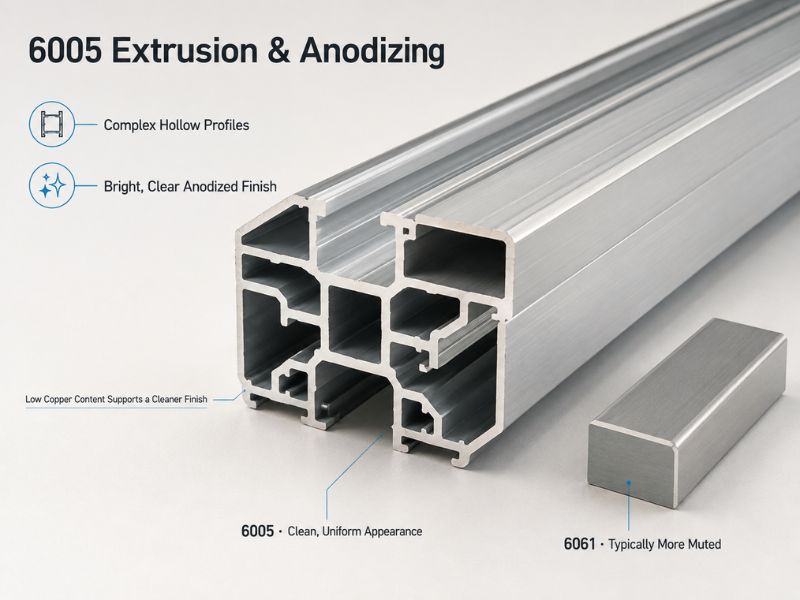
Extrusion. 6005 is designed for the press: it extrudes into complex hollow and thin-wall sections at good speeds, and the aged surface takes a bright, clear anodized finish — one of the alloy’s practical advantages over 6061, whose copper content dulls anodizing.
Welding. MIG, TIG, and resistance welding all work on 6005. The weld zone and heat-affected area lose some strength after welding, so the T6 base strength is the design margin — for welded joints that must carry full rated load, the filler and procedure should be qualified against the application.
Anodizing and finishing. 6005 anodizes to a bright, clear finish and accepts powder coating well. For exterior or marine-adjacent service, anodizing or coating is the standard protection, since bare 6005, like 6061, is corrosion-resistant but not seawater-immune.
Machining. 6005 machines with standard tooling and holds tolerances well; chip control is easier than in softer 6063, and the alloy is a common choice for extruded profiles that are then drilled, tapped, or cut to length.
Pros and Limitations at a Glance
| Factor | Advantage | Limitation |
|---|---|---|
| Strength | Well above 6063/6060, near 6061 in T6 | Below 6061 peak tensile |
| Extrudability | Complex hollow sections at good speed | Not as fast as 6063 |
| Surface / anodizing | Bright clear anodized finish | Cu-free helps finish, but not the brightest of the family |
| Weldability | Excellent with MIG/TIG/resistance | HAZ strength loss needs design margin |
| Corrosion resistance | Good for outdoor/industrial | Marine service needs anodizing or coating |
| Cost | Lower process cost than 6061 for profiles | T6 adds a solution-treatment pass |
Conclusion
6005 is the practical middle of the 6xxx extrusion family: stronger than 6063 and 6060, easier to extrude and finish than 6061, and weldable in both T5 and T6. The trade-off is that peak strength still belongs to 6061 — so 6005 earns its place on extruded structural profiles where surface quality and section complexity matter as much as the load.
Linsy Aluminum supplies 6005 aluminum alloy across standard product forms with MTC documentation on every order and SGS test reports available on request. The Shenzhen factory supports low-MOQ custom dimensions with a typical lead time of 10–60 days, and in-house processing such as CNC machining, laser cutting, and surface finishing covers the steps most 6005 projects need.
If the part is an extruded 6005 profile between tempers or between alloys, send the drawing or specification to Linsy Aluminum for a stock check and quote.
Frequently Asked Questions
How does 6005 compare to 6061 in strength?
6005-T6 guarantees 260 MPa tensile and 240 MPa yield minimum, while 6061-T6 guarantees 290 MPa tensile and 240 MPa yield minimum. 6061 holds the edge at the top of the range; 6005 gives back a little strength in exchange for better extrudability and a cleaner anodized surface.
What is the difference between 6005 and 6063?
6063 is optimized for extrudability and surface finish — it is the reference alloy for architectural frames and window systems, at roughly 205 MPa tensile in T6. 6005 trades some of that ease for about 50–100 MPa more strength, which is why it is chosen for structural profiles, railings, and transport components where the section has to carry load as well as look good.
Does welding reduce 6005 strength?
Yes. The heat-affected zone next to the weld loses part of the age-hardened strength, which is normal for all 6xxx tempers. For welded joints carrying full rated load, the T6 base strength provides the margin, and the filler and procedure should be qualified against the application.
Does 6005 anodize well?
Yes — this is one of its advantages over 6061. Because 6005 contains no copper beyond trace levels, it takes a bright, clear anodized finish without the dulling that copper causes. Clear or colored anodizing and powder coating are both standard.
Is 6005 suitable for marine environments?
6005 has good general and atmospheric corrosion resistance, but like 6061 it is not seawater-immune. For coastal or marine service, anodizing or powder coating is the standard protection; for constant seawater immersion, a 5xxx-series alloy such as 5083 is the safer choice.