Qu'est-ce que l'aluminium 2219 ?
Le 2219 est un alliage de la série 2xxx basé sur un système aluminium-cuivre-manganèse, avec du cuivre à 5,8–6,8% assurant le durcissement structural primaire et de petites additions de titane, de vanadium et de zirconium contrôlant la taille des grains et la stabilité à haute température. Son avantage déterminant est qu'il reste résistant sur une très large plage de températures — depuis les applications cryogéniques jusqu'à environ 260 °C — tout en demeurant l'une des rares nuances 2xxx à haute résistance qui se soude de manière fiable.
Ce compromis soudabilité-température explique pourquoi le 2219 est utilisé pour les réservoirs de carburant aérospatiaux, les récipients cryogéniques et les structures sous pression soudées, et c'est précisément pourquoi le traitement thermique (T62, T851 ou T87) et la décision de placage importent plus que le seul nom de l'alliage.
Composition chimique
| Élément | Contenu (%) | Rôle |
|---|---|---|
| Cuivre (Cu) | 5.8–6.8 | Durcisseur primaire par précipitation (Al₂Cu) |
| Manganèse (Mn) | 0.20–0.40 | Améliore la soudabilité et le contrôle de la recristallisation |
| Magnésium (Mg) | ≤0,02 | Maintenu à l'état de trace — évite les eutectiques à bas point de fusion qui provoquent la fissuration au soudage |
| Silicium (Si) | ≤0,20 | Contrôle des impuretés |
| Fer (Fe) | ≤0,30 | Contrôle des impuretés |
| Zinc (Zn) | ≤0,10 | Contrôle des impuretés |
| Titane (Ti) | 0.02–0.10 | Affinage du grain |
| Vanadium (V) | 0.05–0.15 | Inhibe la recristallisation, favorise la stabilité à chaud |
| Zirconium (Zr) | 0.10–0.25 | Dispersoïdes stables (Al₃Zr) résistant à la croissance des grains à chaud |
| Chrome (Cr) | — (non spécifié) | Pas un ajout contrôlé dans le 2219 |
| Aluminium (Al) | Équilibre | Base |
Propriétés mécaniques selon le traitement thermique
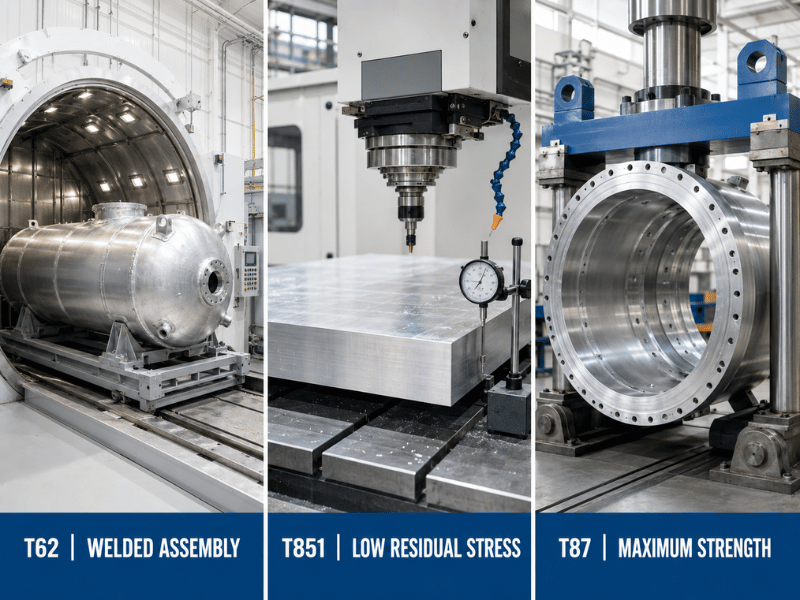
Les valeurs sont typiques en sens longitudinal ; les minimums de l'ASTM B209 sont inférieurs (par exemple, le minimum T62 est de 414 MPa UTS / 290 MPa YS).
| Tempérer | UTS (MPa) | Limite d'élasticité (MPa) | Élongation (%) | Dureté (HB) |
|---|---|---|---|---|
| O (recuit) | 170 | 76 | 18 | 45 |
| T62 | 415 | 290 | 10 | 120 |
| T81 | 455 | 350 | 10 | 135 |
| T851 | 455 | 350 | 10 | 135 |
| T87 | 475 | 395 | 10 | 140 |
L'écart entre O et T87 résume tout l'enjeu : à l'état mou, le 2219 se forme et se soude facilement, puis le traitement thermique fait passer la limite d'élasticité d'environ 76 MPa à près de 400 MPa. Pour la plupart des structures soudées, le T62 ou le T851 est le traitement de référence ; le T87 est réservé aux pièces à paroi épaisse et haute pression qui ont besoin de chaque MPa.
Propriétés physiques et complémentaires
| Propriété | Valeur |
|---|---|
| Densité | 2,84 g/cm³ (supérieure au 6xxx en raison du cuivre) |
| Elastic modulus | ~73 GPa |
| Conductivité thermique | ~120 W/m·K |
| Coefficient de dilatation thermique | ~22,5 µm/m·°C |
| Intervalle de fusion | 510–640 °C |
| Limite de fatigue (10⁷ cycles, T87) | ~160 MPa |
| Résistance au cisaillement (T87) | ~275 MPa |
| Ténacité à la rupture en déformation plane KIC (T87/T851) | ~35–40 MPa√m |
Cette valeur de KIC est le héros discret de l'alliage : à résistance équivalente, elle se situe bien au-dessus du 7075-T6 (environ 25–29 MPa√m), ce qui explique pourquoi les conceptions tolérantes aux dommages se tournent vers le 2219 lorsqu'un réservoir ou un récipient sous pression ne peut pas se permettre une propagation rapide des fissures.
Performance en température
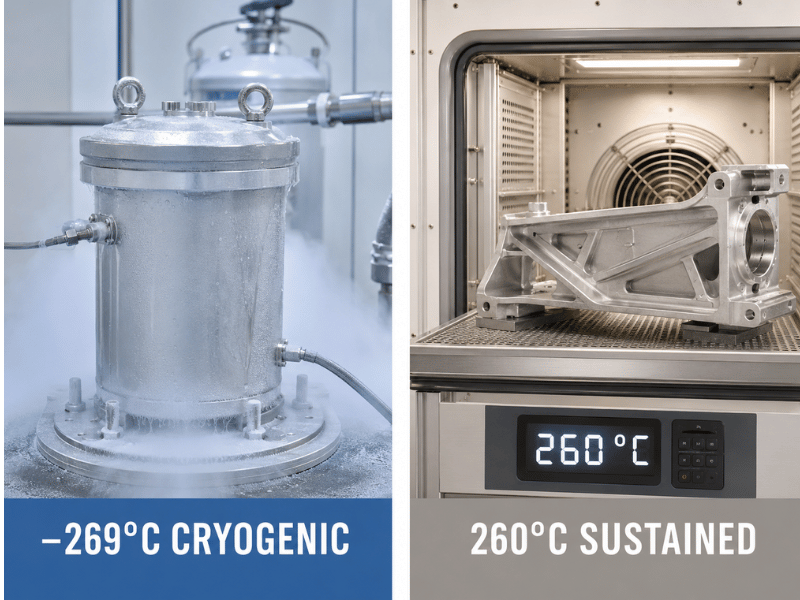
Le 2219 est inhabituel en ce qu'il gagne en résistance à mesure que la température baisse. À −196 °C, la résistance à la traction et la limite d'élasticité atteignent environ 110% des valeurs à température ambiante tandis que l'allongement s'améliore de 15–20% ; à −269 °C, le gain atteint environ 115%, sans transition ductile-fragile. C'est le mécanisme qui sous-tend sa sélection pour les réservoirs d'oxygène liquide, d'azote liquide et d'hydrogène liquide.
Du côté chaud, le tableau nécessite de la précision, car le chiffre dépend du temps d'exposition :
| Température | Résistance retenue (% de TA) | Signification pratique |
|---|---|---|
| 150 °C | 85–90% | Charge de service élevée normale OK |
| 205 °C | 70–75% | Composants à court terme |
| 260 °C | 55–60% | Limite de service continu — réduire la conception |
| 315 °C | 45–50% | Maximum à court terme uniquement, conception spéciale |
À titre de comparaison, le 2024 ne conserve qu'environ 30% de la résistance à température ambiante à 260 °C et le 6061 perd rapidement de la résistance au-dessus de 150 °C. La limite de service continu de 260 °C est le plafond de travail honnête ; 315 °C apparaît dans les fiches techniques mais s'applique à de brèves excursions, non à une charge continue.
Soudabilité et mise en œuvre
Soudage. Le 2219 est soudable par GTAW (TIG) et GMAW (MIG), avec le métal d'apport ER2319 (AWS A5.10) correspondant à la chimie de base. Un joint soudé qualifié atteint environ 85 à 90 % de la résistance du métal de base, et le traitement thermique après soudage (mise en solution plus vieillissement) restaure la zone soudée à des propriétés proches de l'optimal. Le soudage par friction-malaxage est également courant pour les longues soudures de réservoirs. La faible teneur en magnésium maintient la tendance à la fissuration à chaud bien en dessous du 2024 ou du 2017.
Usinage. Dans les états T6 et T8, le 2219 s'usine comme les autres nuances Al-Cu à haute résistance — un outillage en carbure affûté et une charge de copeau contrôlée permettent de gérer l'arête rapportée (les copeaux soudés qui se forment sur l'arête de coupe).
Protection contre la corrosion. Le 2219 nu a une résistance à la corrosion limitée en raison de sa teneur en cuivre. Le placage (Alclad) ou un système de revêtement est standard pour les applications extérieures ou corrosives ; les états T851 et T87 ajoutent une meilleure résistance à l'exfoliation et à la corrosion sous contrainte grâce à une structure de grains contrôlée.
Formage. Former les enveloppes épaisses ou complexes en O ou T62, puis traiter thermiquement l'ensemble soudé fini — c'est la voie pour les grands réservoirs cryogéniques. Les états T8 sont moins formables et sont normalement usinés ou utilisés près de la forme finale.
2219 vs 2024, 7075 et 6061
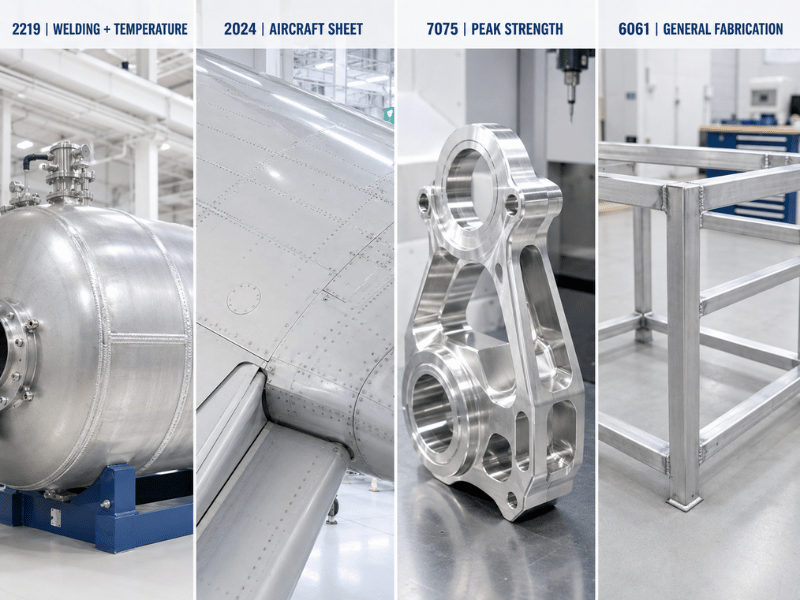
| Alliage (état) | Rm / Re (MPa) | Soudable ? | Rétention à haute température | Corrosion (nu) |
|---|---|---|---|---|
| 2219-T87 | 475 / 395 | Oui (2319 + TTAS) | Bon jusqu'à 260 °C | Faible — nécessite un placage |
| 2024-T3 | 483 / 345 | Non | Moyen, plafond ~150 °C | Pauvre |
| 7075-T6 | 572 / 503 | Non | Pauvre | Faible–modéré |
| 6061-T6 | 310 / 276 | Oui | Limité, chute >150 °C | Bon |
La décision porte rarement sur la résistance maximale à température ambiante. Choisissez le 2219 lorsque la pièce doit être soudée, doit subir des températures cryogéniques ou élevées prolongées, ou doit présenter une ténacité à la rupture élevée à une résistance supérieure à 400 MPa. Choisissez le 2024-T3 ou le 7075-T6 lorsque le rapport résistance/poids à température ambiante est le seul critère et qu'aucun soudage n'est impliqué. Choisissez le 6061-T6 pour la fabrication générale, exposée à la corrosion et sensible aux coûts.
États courants et comment choisir
- T62 — mis en solution et vieilli artificiellement. L'état aérospatial polyvalent et celui utilisé pour les assemblages soudés qui sont traités thermiquement après fabrication.
- T6 — même voie sans l'étape de traitement à froid ; comportement légèrement meilleur à l'état soudé pour les composants traités thermiquement après soudage.
- T81 — mise en solution, écrouissage et vieillissement ; résistance supérieure au T62.
- T851 — mise en solution, détente par traction et vieillissement. La faible contrainte résiduelle en fait le choix pour les pièces usinées de précision et les récipients sous pression où la déformation au soudage doit rester faible.
- T87 — mise en solution, ~7 % d'écrouissage et vieillissement. Résistance la plus élevée et ductilité légèrement inférieure ; utilisé pour les corps de réservoirs à paroi épaisse et haute pression.
Logique de sélection en une ligne : soudage requis → T62 ou T6 ; résistance maximale → T87 ; contrôle des contraintes et résistance à la CSC → T851.
Où le 2219 est utilisé
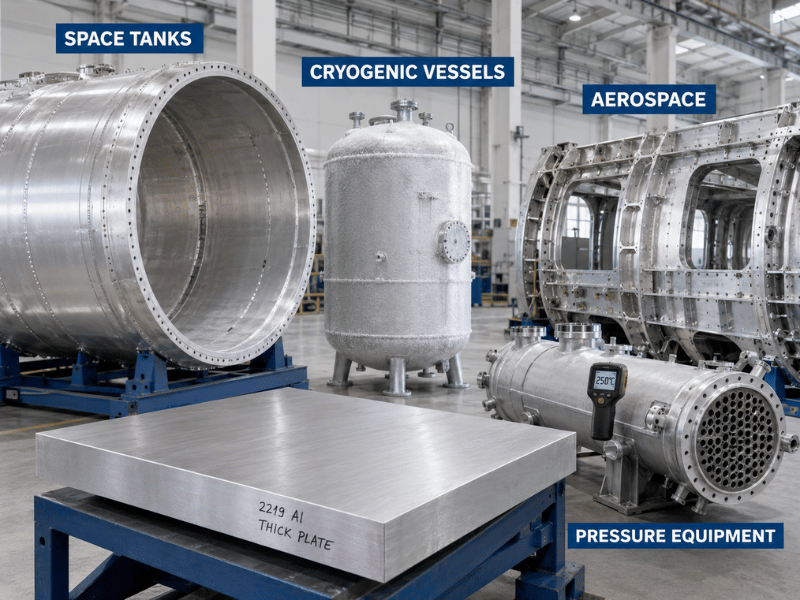
Structures aérospatiales et spatiales. Les réservoirs de carburant, les récipients de stockage cryogénique, les panneaux de voilure et les cadres de fuselage reposent sur le 2219 parce que le même matériau peut être soudé, puis traité thermiquement, et absorber encore les charges de choc cryogéniques sans perdre sa ténacité. Le réservoir externe de la navette spatiale et les étages centraux actuels des lanceurs sont construits à partir de celui-ci.
Équipements de défense et industriels sous pression. Les récipients sous pression soudés, l'outillage à haute température et les composants d'échangeurs de chaleur utilisent le 2219 lorsque le cahier des charges exige une température prolongée proche de 260 °C ou une ténacité à la rupture élevée à une résistance supérieure à 400 MPa.
Limites Go / No-Go
Utilisez cette référence pour décider si le 2219 convient avant de le spécifier.
Aller — utilisez le 2219 lorsque :
- La plage de service s'étend du cryogénique à environ 260 °C et vous avez besoin d'une résistance conservée aux deux extrémités, pas seulement à température ambiante.
- Le soudage par fusion est requis et vous avez encore besoin d'une limite d'élasticité supérieure à 400 MPa — le 2219 se soude avec le 2319, contrairement au 2024 ou au 7075.
- Une spécification exige une ténacité à la rupture élevée à une résistance supérieure à 400 MPa, comme un réservoir ou un récipient sous pression où la propagation des fissures doit rester lente.
Non-aller — n'utilisez pas le 2219 lorsque :
- La résistance maximale à température ambiante est le seul critère — le 2024-T3 ou le 7075-T6 offrent des valeurs plus élevées à moindre coût et avec un stock plus large.
- La résistance à la corrosion à l'état nu est requise — le placage ou le revêtement est obligatoire pour le 2219 en service corrosif.
- Le travail est de la fabrication générale à budget limité — le 6061-T6 couvre la plupart des travaux structurels et extérieurs à moindre coût.
- Vous avez besoin d'une production à grand volume avec des délais rapides — le 2219 est un alliage spécialisé avec un stock plus restreint ; confirmez le délai avant de vous engager.
Avantages et limites en un coup d'œil
| Dimension | La force | Points d'attention |
|---|---|---|
| Résistance (chaud et froid) | Fort au cryogénique et jusqu'à 260 °C | Pic à température ambiante inférieur au 7075 |
| Soudabilité | Excellent parmi les nuances 2xxx | Nécessite un TTAS ; la forme nue nécessite un placage |
| Plage de température | −269 °C à 260 °C en continu | 315 °C uniquement à court terme |
| Corrosion | Le placage prolonge bien le service | Faible à l'état nu ; dû au cuivre |
| Solidité | KIC élevé vs série 7000 | — |
| Disponibilité | Nuances spécialisées prises en charge | Stock plus étroit que les 6xxx |
| Coût | Qualité supérieure, justifiée par la fonction | Supérieure au 6061 |
Conclusion
Le 2219 échange une partie de sa résistance maximale à température ambiante contre la soudabilité et une plage de températures qu'aucune autre nuance courante à haute résistance n'égale — mais il s'agit d'un alliage spécialisé avec un stock plus étroit et une étape obligatoire de protection contre la corrosion.
Linsy Aluminum fournit Tôles et barres en 2219, prend en charge les fabrications soudées en interne par soudage TIG et MIG, et ajoute l'usinage CNC, la découpe laser et le finissage de surface afin qu'un réservoir ou une structure puisse passer de la matière première à la pièce finie sous un même toit. Chaque commande est livrée avec un MTC, des tests SGS sont disponibles sur demande, et la production personnalisée à faible MOQ s'effectue en 10 à 60 jours. Envoyez le dessin pour une évaluation de l'adéquation de la nuance et des délais.
Questions fréquemment posées
Comment le 2219 se comporte-t-il aux températures cryogéniques ?
La résistance augmente à mesure que la température diminue — à −196 °C, la résistance à la traction et la limite d'élasticité atteignent environ 110 % des valeurs à température ambiante et l'allongement s'améliore de 15 à 20 %, sans transition ductile-fragile. C'est pourquoi il est standard pour les réservoirs d'oxygène liquide, d'azote liquide et d'hydrogène liquide.
Le 2219 peut-il être soudé, et quel métal d'apport est utilisé ?
Oui. Le GTAW (TIG) et le GMAW (MIG) fonctionnent tous deux, avec le métal d'apport ER2319 correspondant au métal de base. Un joint qualifié atteint environ 85 à 90 % de la résistance du métal de base, et le traitement thermique après soudage restaure la zone soudée ; le soudage par friction-malaxage est également courant pour les longues soudures.
Quelle est la principale différence entre le 2219 et le 2024 ?
La soudabilité et la plage de températures. Le 2024-T3 a une résistance à température ambiante similaire ou supérieure mais est essentiellement non soudable et se ramollit au-dessus d'environ 150 °C. Le 2219 se soude avec le 2319 et conserve une résistance utile jusqu'à 260 °C, au prix d'un léger sacrifice de résistance maximale et d'un placage obligatoire.
Quel revenu dois-je choisir — T62, T851 ou T87 ?
Soudage requis → T62 ou T6 (traité thermiquement après fabrication). Résistance maximale → T87 pour les pièces sous pression à paroi épaisse. Besoin d'une faible contrainte résiduelle et d'une résistance à la corrosion sous contrainte pour les récipients usinés ou soudés → T851.
Le 2219 est-il disponible en tôle, plaque et barre ?
Principalement en plaque et barre, ainsi qu'en profilés extrudés et en stock de forgeage. Les tôles minces sont moins courantes que les plaques ; confirmez l'épaisseur, le revenu et la quantité minimale de commande auprès du fournisseur avant de spécifier.
Le 2219 nécessite-t-il un placage pour la protection contre la corrosion ?
À l'état nu, oui pour un service corrosif ou en extérieur — sa teneur en cuivre lui confère une résistance limitée. Les versions Alclad ou un système de revêtement sont standard ; les revenus T851 et T87 ajoutent une meilleure résistance à l'exfoliation et à la corrosion sous contrainte en plus de cela.