What Is 2219 Aluminum?
2219 is a 2xxx-series alloy built on an aluminum-copper-manganese system, with copper at 5.8–6.8% doing the primary precipitation-hardening work and small additions of titanium, vanadium, and zirconium holding grain size and high-temperature stability. Its defining edge is that it stays strong across a very wide temperature band — from cryogenic service up to roughly 260°C — while remaining one of the few high-strength 2xxx grades that welds reliably.
That weldability-plus-temperature envelope is why 2219 anchors aerospace fuel tanks, cryogenic vessels, and welded pressure structures, and exactly why the temper (T62, T851, or T87) and the cladding decision matter more than the alloy name alone.
Chemical Composition
| Element | Content (%) | Role |
|---|---|---|
| Copper (Cu) | 5.8–6.8 | Primary precipitate strengthener (Al₂Cu) |
| Manganese (Mn) | 0.20–0.40 | Improves weldability and recrystallization control |
| Magnesium (Mg) | ≤0.02 | Kept trace — avoids low-melting eutectics that cause weld cracking |
| Silicon (Si) | ≤0.20 | Impurity control |
| Iron (Fe) | ≤0.30 | Impurity control |
| Zinc (Zn) | ≤0.10 | Impurity control |
| Titanium (Ti) | 0.02–0.10 | Grain refinement |
| Vanadium (V) | 0.05–0.15 | Inhibits recrystallization, supports hot stability |
| Zirconium (Zr) | 0.10–0.25 | Stable dispersoids (Al₃Zr) resist grain growth at heat |
| Chromium (Cr) | — (not specified) | Not a controlled addition in 2219 |
| Aluminum (Al) | Balance | Base |
Mechanical Properties by Temper
Values are typical longitudinal; ASTM B209 minimums sit lower (for example, T62 minimum is 414 MPa UTS / 290 MPa YS).
| Temper | UTS (MPa) | YS (MPa) | Elongation (%) | Hardness (HB) |
|---|---|---|---|---|
| O (annealed) | 170 | 76 | 18 | 45 |
| T62 | 415 | 290 | 10 | 120 |
| T81 | 455 | 350 | 10 | 135 |
| T851 | 455 | 350 | 10 | 135 |
| T87 | 475 | 395 | 10 | 140 |
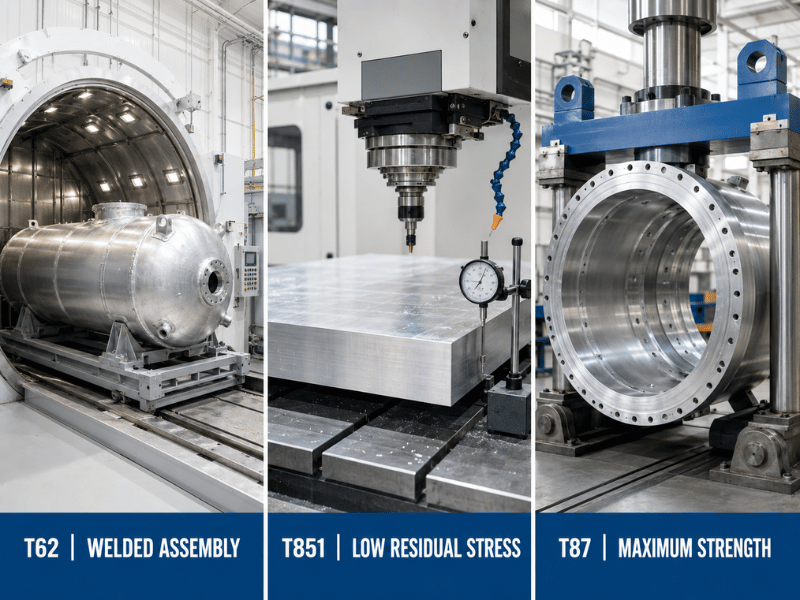
The spread between O and T87 shows the whole game: in the soft condition 2219 forms and welds easily, then heat treatment lifts yield from about 76 MPa to nearly 400 MPa. For most welded structures T62 or T851 is the workhorse; T87 is reserved for thick-wall, high-pressure parts that need every MPa.
Physical & Supporting Properties
| Property | Value |
|---|---|
| Density | 2.84 g/cm³ (higher than 6xxx due to copper) |
| Elastic modulus | ~73 GPa |
| Thermal conductivity | ~120 W/m·K |
| Coefficient of thermal expansion | ~22.5 µm/m·°C |
| Melting range | 510–640°C |
| Fatigue limit (10⁷ cycles, T87) | ~160 MPa |
| Shear strength (T87) | ~275 MPa |
| Plane-strain fracture toughness KIC (T87/T851) | ~35–40 MPa√m |
That KIC figure is the quiet hero of the alloy: at equivalent strength it runs well above 7075-T6 (about 25–29 MPa√m), which is why damage-tolerance designs reach for 2219 when a tank or pressure vessel cannot afford fast crack growth.
Temperature Performance
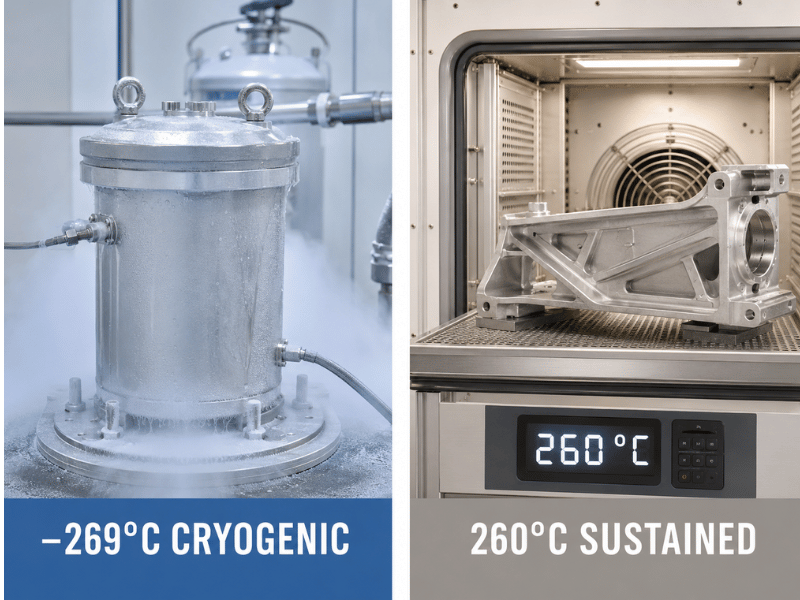
2219 is unusual in gaining strength as it gets colder. At −196°C tensile and yield rise to roughly 110% of room-temperature values while elongation improves 15–20%; at −269°C the gain reaches about 115%, with no ductile-to-brittle transition. That is the mechanism behind its selection for liquid-oxygen, liquid-nitrogen, and liquid-hydrogen tanks.
On the hot end the picture needs precision, because the number depends on exposure time:
| Temperature | Strength retained (% of RT) | Practical meaning |
|---|---|---|
| 150°C | 85–90% | Normal elevated-service load OK |
| 205°C | 70–75% | Short-term components |
| 260°C | 55–60% | Sustained-service limit — derate the design |
| 315°C | 45–50% | Short-term maximum only, special design |
For comparison, 2024 holds only about 30% of room-temperature strength at 260°C and 6061 loses strength rapidly above 150°C. The 260°C sustained limit is the honest working ceiling; 315°C appears in datasheets but applies to brief excursions, not continuous load.
Weldability & Working With
Welding. 2219 is weldable by GTAW (TIG) and GMAW (MIG), with filler metal ER2319 (AWS A5.10) matching the base chemistry. A qualified weld joint reaches about 85–90% of base-metal strength, and post-weld heat treatment (solution plus aging) restores the weld zone close to full properties. Friction stir welding is also common for long tank seams. The low magnesium content keeps hot-cracking tendency far below 2024 or 2017.
Machining. In T6 and T8 tempers 2219 machines like other high-strength Al-Cu grades — sharp carbide tooling and controlled chip load keep built-up edge (the welded-on swarf that forms on the cutting edge) manageable.
Corrosion protection. Bare 2219 has limited corrosion resistance because of its copper content. Cladding (Alclad) or a coating system is standard for outdoor or corrosive service; T851 and T87 tempers add better exfoliation and stress-corrosion resistance through controlled grain structure.
Forming. Form thick or complex shells in O or T62, then heat-treat the finished weldment — this is the route for large cryogenic tanks. The T8 tempers are less formable and are normally machined or used near final shape.
2219 vs 2024, 7075, and 6061
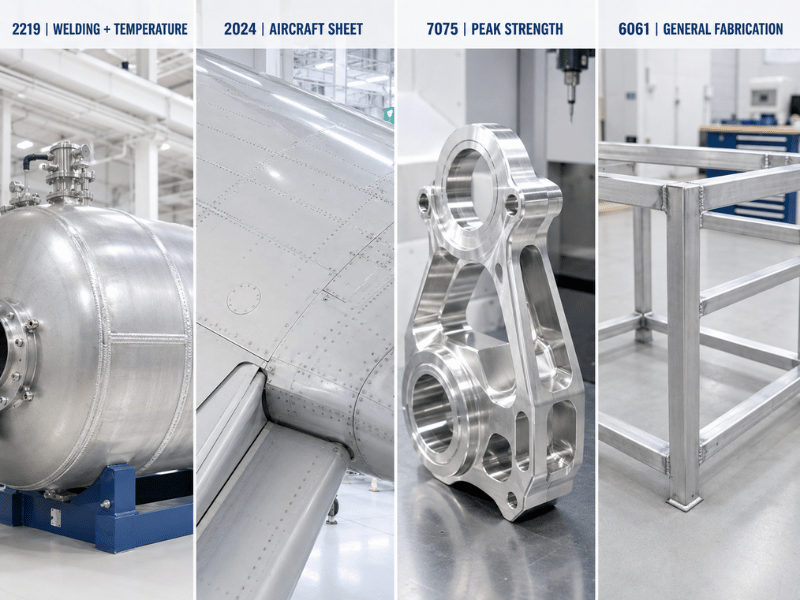
| Alloy (temper) | UTS / YS (MPa) | Weldable? | Elevated-temp retention | Corrosion (bare) |
|---|---|---|---|---|
| 2219-T87 | 475 / 395 | Yes (2319 + PWHT) | Good to 260°C | Poor — needs cladding |
| 2024-T3 | 483 / 345 | No | Fair, ~150°C ceiling | Poor |
| 7075-T6 | 572 / 503 | No | Poor | Poor–moderate |
| 6061-T6 | 310 / 276 | Yes | Limited, >150°C drops | Good |
The decision is rarely about peak room-temperature strength. Pick 2219 when the part must be welded, must see cryogenic or sustained high temperature, or must carry high fracture toughness at strength above 400 MPa. Pick 2024-T3 or 7075-T6 when room-temperature strength-to-weight is the only driver and welding is not involved. Pick 6061-T6 for general, corrosion-exposed, cost-sensitive fabrication.
Common Tempers & How to Choose
- T62 — solution heat-treated and artificially aged. The general-purpose aerospace temper and the one used for welded assemblies that are heat-treated after fabrication.
- T6 — same route without the cold-treatment step; slightly better as-welded behavior for post-weld heat-treated components.
- T81 — solution, cold work, and age; higher strength than T62.
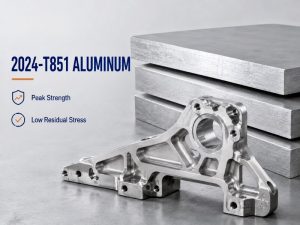
- T851 — solution, stretch stress-relief, and age. Low residual stress makes it the choice for precision-machined parts and pressure vessels where weld distortion must stay small.
- T87 — solution, ~7% cold work, and age. Highest strength and slightly lower ductility; used for thick-wall, high-pressure tank bodies.
Selection logic in one line: welding required → T62 or T6; maximum strength → T87; stress control and SCC resistance → T851.
Where 2219 Is Used
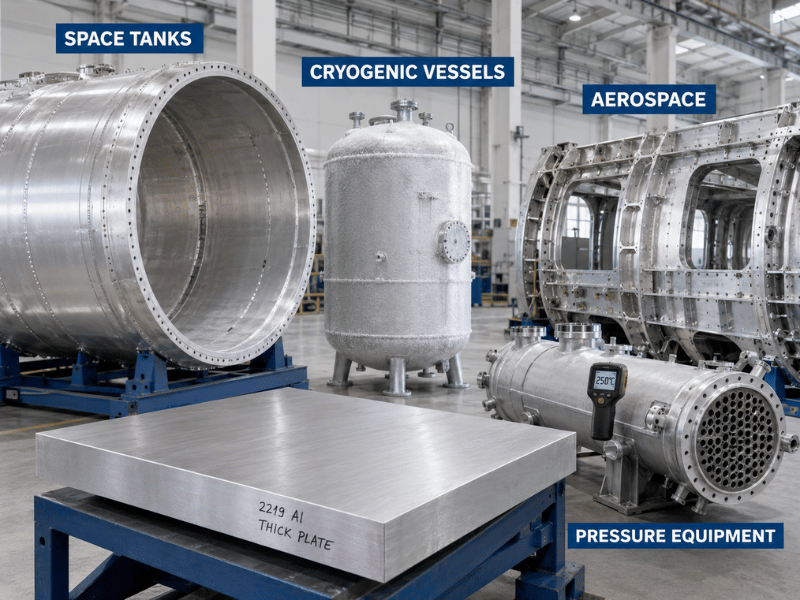
Aerospace and space structures. Fuel tanks, cryogenic storage vessels, wing panels, and fuselage frames rely on 2219 because the same material can be welded, then heat-treated, and still absorb cryogenic shock loads without losing toughness. The Space Shuttle external tank and current launch-vehicle core stages are built from it.
Defense and industrial pressure equipment. Welded pressure vessels, high-temperature tooling, and heat-exchanger components use 2219 where sustained temperature near 260°C or high fracture toughness at strength above 400 MPa is part of the specification.
Go / No-Go Limits
Use this reference to decide whether 2219 fits before you spec it.
Go — use 2219 when:
- The service span runs from cryogenic to about 260°C and you need retained strength at both ends, not just at room temperature.
- Fusion welding is required and you still need yield above 400 MPa — 2219 welds with 2319, unlike 2024 or 7075.
- A specification calls for high fracture toughness at strength above 400 MPa, such as a tank or pressure vessel where crack growth must stay slow.
No-Go — do not use 2219 when:
- Peak room-temperature strength is the only criterion — 2024-T3 or 7075-T6 give higher numbers at lower cost and wider stock.
- Bare corrosion resistance is required — cladding or coating is mandatory for 2219 in corrosive service.
- The job is general fabrication on a budget — 6061-T6 covers most structural and outdoor work more cheaply.
- You need high-volume production with fast turnaround — 2219 is a specialty alloy with narrower stock; confirm lead time before committing.
Pros and Limitations at a Glance
| Dimension | Strength | Watch-out |
|---|---|---|
| Strength (hot & cold) | Strong at cryogenic and to 260°C | Lower room-temp peak than 7075 |
| Weldability | Excellent among 2xxx grades | Needs PWHT; bare form needs cladding |
| Temperature range | −269°C to 260°C sustained | 315°C is short-term only |
| Corrosion | Cladding extends service well | Poor bare; copper-driven |
| Toughness | High KIC vs 7000 series | — |
| Availability | Specialist grades supported | Narrower stock than 6xxx |
| Cost | Premium, justified by function | Higher than 6061 |
Conclusion
2219 trades some room-temperature peak strength for weldability and a temperature envelope no other common high-strength grade matches — but it is a specialty alloy with narrower stock and a mandatory corrosion-protection step.
Linsy Aluminum supplies 2219 plate and bar, supports welded fabrications in-house through TIG and MIG welding, and adds CNC machining, laser cutting, and surface finishing so a tank or structure can move from material to finished part under one roof. Every order ships with an MTC, SGS testing is available on request, and low-MOQ custom production runs 10–60 days. Send the drawing for a grade-fit and lead-time review.
Frequently Asked Questions
How does 2219 perform at cryogenic temperatures?
Strength rises as temperature falls — at −196°C tensile and yield reach about 110% of room-temperature values and elongation improves 15–20%, with no ductile-brittle transition. That is why it is standard for liquid-oxygen, liquid-nitrogen, and liquid-hydrogen tanks.
Can 2219 be welded, and what filler is used?
Yes. GTAW (TIG) and GMAW (MIG) both work, with ER2319 filler matching the base metal. A qualified joint reaches about 85–90% of base strength, and post-weld heat treatment restores the weld zone; friction stir welding is also common for long seams.
What is the main difference between 2219 and 2024?
Weldability and temperature range. 2024-T3 has similar or higher room-temperature strength but is essentially unweldable and softens above about 150°C. 2219 welds with 2319 and holds useful strength to 260°C, at the cost of a bit of peak strength and mandatory cladding.
Which temper should I choose — T62, T851, or T87?
Welding required → T62 or T6 (heat-treated after fabrication). Maximum strength → T87 for thick-wall pressure parts. Need low residual stress and stress-corrosion resistance for machined or welded vessels → T851.
Is 2219 available as sheet, plate, and bar?
Primarily plate and bar, plus extruded profiles and forging stock. Thin sheet is less common than plate; confirm thickness, temper, and minimum order quantity with the supplier before specifying.
Does 2219 need cladding for corrosion protection?
In bare condition, yes for corrosive or outdoor service — its copper content gives limited resistance. Alclad versions or a coating system are standard; T851 and T87 tempers add better exfoliation and stress-corrosion resistance on top of that.