Introduction
Après plus de deux décennies à fournir des alliages d'aluminium haute performance aux secteurs aérospatial, automobile et industriel, nous avons vu de nombreux matériaux “ nouvelle génération ” apparaître et disparaître. Pourtant, L'aluminium de 2011 reste d'actualité.
Pourquoi ? Pour les pièces tournées avec précision et en grande série, Aucun autre produit n'offre la même combinaison de qualité de finition de surface, de contrôle des copeaux et de rentabilité.
En 2026, utiliser le 2011 n'est pas seulement une décision d'ingénierie ; c'est aussi une décision relative à la conformité et aux risques liés à la chaîne d'approvisionnement. Nous avons vu des pièces qualifiées rejetées non pas pour des raisons de performance, mais parce que le matériau ne disposait pas de documentation traçable d'exemption RoHS. Nous avons également vu des lots échouer en raison de teneurs en bismuth incohérentes provenant de laminoirs utilisant des matières recyclées.
Ce guide reflète ce que nous avons appris sur le terrain :
- Les véritables capacités et limites de 2011
- Comment les nuances de trempage, telles que T3 et T351, influencent les performances en conditions réelles
- Pourquoi les comparaisons entre alliages doivent aller au-delà des fiches techniques
- Et surtout, comment s'approvisionner en 2011 en toute sécurité dans le cadre des règles de conformité plus strictes actuelles
Qu'est-ce que l'aluminium 2011 ? (Et pourquoi sa composition est-elle importante ?)
Aluminium 2011 Il s'agit d'un alliage composé principalement d'aluminium, dont le cuivre est le principal élément d'alliage. Sa composition unique améliore son usinabilité, sa résistance à la corrosion et sa résistance mécanique, ce qui en fait un matériau idéal pour la fabrication de pièces de précision destinées à l'aérospatiale et à d'autres secteurs où les performances sont primordiales.
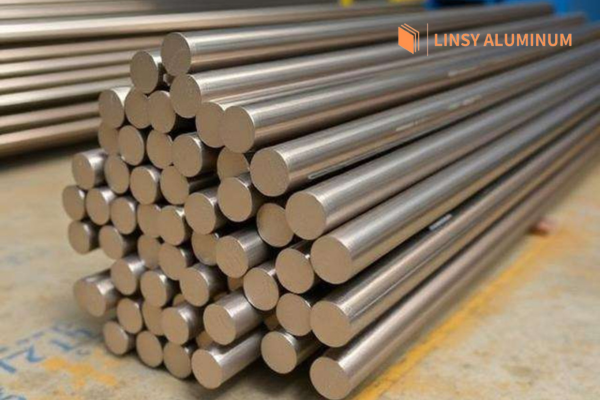
Sa composition fait l'objet d'un contrôle rigoureux :
| Élément | Gamme type (wt%) | Rôle |
|---|---|---|
| Aluminium | Équilibre | Métal commun |
| Cuivre (Cu) | 5.0–6.0% | Augmente la résistance mécanique, réduit la résistance à la corrosion |
| Plomb (Pb) + Bismuth (Bi) | 0,4–0,71 TP3T combinés | Permettre l'autolubrification et le bris des copeaux |
| Fer (Fe) | ≤ 0,71 TP3T | Contrôlé pour éviter la formation de composés intermétalliques grossiers |
| Silicium (Si) | ≤ 0,41 TP3T | Réduit au minimum pour préserver l'usinabilité |
La teneur en bismuth est essentielle. De nombreux alliages “ type 2011 ” à bas coût omettent le Bi ou n'utilisent que du Pb, ce qui entraîne des copeaux filandreux et un mauvais état de surface. Le véritable 2011 exige les deux.
Le rôle du plomb et du bismuth
La présence de plomb (Pb) et de bismuth (Bi) est le secret qui explique pourquoi l'alliage d'aluminium 2011 est considéré comme un alliage à usinage facile. Chacun de ces éléments représente entre 0,2% et 0,6% de la composition de l'alliage et joue un rôle essentiel dans le processus d'usinage.
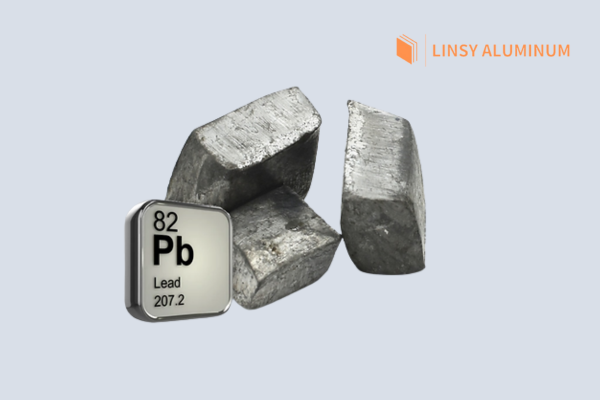
Plus précisément, le plomb et le bismuth jouent le rôle de brise-copeaux. Lors d'une coupe à grande vitesse, ces éléments métalliques tendres fondent légèrement sous l'effet du frottement, ce qui lubrifie l'outil de coupe et garantit que les copeaux de métal se détachent proprement et en petits morceaux.
C'est cette caractéristique qui rend l'alliage 2011 particulièrement facile à usiner. Il en résulte un état de surface plus lisse, une usure réduite des outils et des cycles de production plus rapides. Cet alliage est donc idéal pour les machines à vis automatiques, où l'efficacité et la précision sont primordiales.
Les caractéristiques essentielles qui comptent pour vous
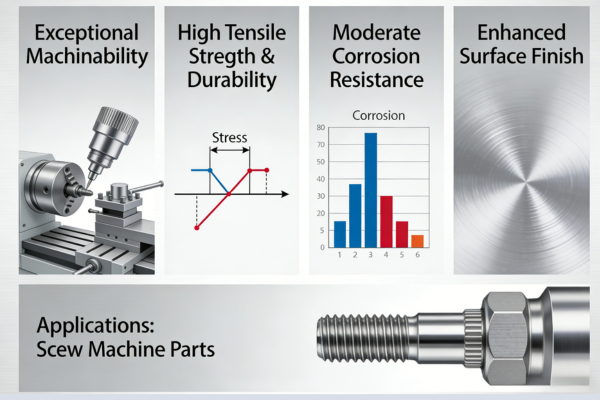
L'usinabilité exceptionnelle est l'une des principales caractéristiques de l'aluminium 2011, ce qui en fait un matériau de choix pour la fabrication de composants de précision. Cet alliage offre une résistance à la traction et une durabilité élevées, qualités indispensables pour des applications telles que les pièces usinées sur des machines à vis. Il présente également une résistance modérée à la corrosion, garantissant ainsi une longue durée de vie dans divers environnements. La finition de surface obtenue par usinage renforce son attrait esthétique. La compréhension de ces propriétés clés permet de prendre des décisions éclairées lors du choix des matériaux pour répondre aux exigences spécifiques de chaque secteur d'activité.
| Propriété | Valeur |
|---|---|
| Densité | 2,83 g/cm³ |
| Résistance à la traction | 55–62 ksi (380–425 MPa) |
| Limite d'élasticité | 45 à 52 ksi (310 à 360 MPa) |
| Élongation | 8–12% |
| Dureté Brinell | 110–120 HB |
| Indice d'usinabilité | 200–300% en 6061-T6 |
Choisir le bon état de trempe : T3, T351 ou T6 ?
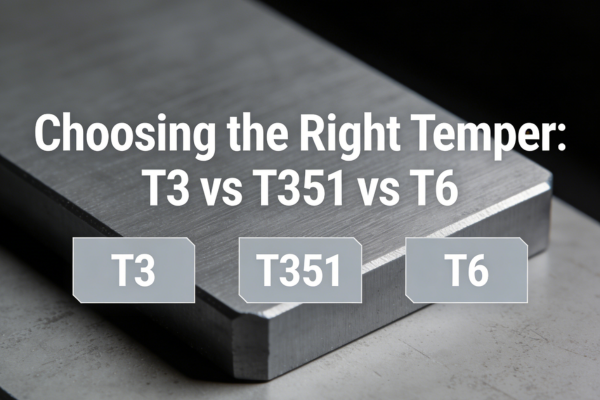
Le choix du traitement thermique approprié pour l'aluminium 2011 est essentiel pour obtenir les caractéristiques de performance souhaitées.
- Le traitement thermique T3 implique un écrouissage qui améliore la résistance à la traction, ce qui le rend idéal pour les applications nécessitant une grande précision.
- Le T351 offre un meilleur détendage et une résistance modérée à la corrosion, ce qui le rend adapté aux environnements plus exigeants.
- Le T6, obtenu par vieillissement et traitement thermique en solution, offre une excellente usinabilité et une grande résistance, ce qui en fait un alliage idéal pour des opérations telles que le fraisage. Comprendre ces différences vous aide à choisir l'alliage le mieux adapté à vos besoins spécifiques en matière d'usinage, tout en garantissant qualité et durabilité.
| Tempérer | Processus | Caractéristiques principales | Quand l'indiquer |
|---|---|---|---|
| T3 | Traitement thermique en solution + travail à froid + vieillissement naturel | Usinabilité optimale, résistance modérée | Pièces tournées à usage général (raccords, douilles) |
| T351 | T3 + détendu par étirement | Stabilité dimensionnelle améliorée, résistance légèrement inférieure | Arbres de précision, pièces à parois minces, composants à tolérances serrées |
| T6 / T8 | Vieilli artificiellement | Résistance accrue, ductilité et usinabilité réduites | Rare ; uniquement lorsque une résistance à la traction supérieure à 60 ksi est requise |
Plus de 60% de problèmes de déformation après usinage sont dus à l'utilisation du T3 à la place du T351. Si votre pièce présente un rapport longueur/diamètre supérieur à 5:1 ou une épaisseur de paroi inférieure à 2 mm, l'utilisation du T351 est vivement recommandée.
Comparaison entre l'aluminium de 2011 et d'autres alliages
Lorsque vous choisissez un alliage d’aluminium, comparez le 2011 à d’autres options courantes afin d’en évaluer les atouts. Son principal avantage réside dans son usinabilité inégalée, grâce à sa composition unique à base de cuivre, de plomb et de bismuth. Si d’autres alliages peuvent offrir une meilleure résistance à la corrosion ou une meilleure soudabilité, aucun n’égale la rapidité et la précision du 2011 en matière d’usinage automatisé. Cela en fait un alliage idéal pour des besoins de fabrication spécifiques. La section suivante le comparera à des alliages courants tels que le 6061 et le 6262.
De nombreux ingénieurs demandent : “ Dois-je passer à une alternative sans plomb ? ” La réponse dépend de vos priorités.
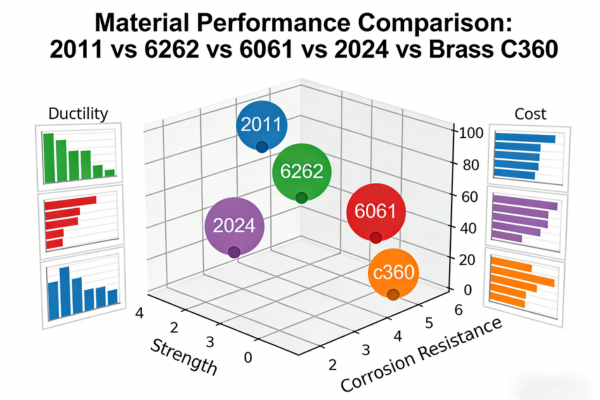
| Alliage | Usinabilité* | Sans plomb ? | Résistance à la corrosion | Cas d'utilisation type |
|---|---|---|---|---|
| 2011-T3 | ★★★★★ (Référence) | ❌ (mais exempté) | Pauvre | Corps de vannes à grand débit, boîtiers de capteurs |
| 6262-T9 | ★★★★☆ | ✅ | Bon | Produits destinés au marché de l'UE devant être entièrement conformes à la directive RoHS |
| 6061-T6 | ★★☆☆☆ | ✅ | Excellent | Pièces structurelles, composants anodisés |
| 2024-T4 | ★★☆☆☆ | ✅ | Pauvre | Structures aérospatiales (haute résistance) |
| Laiton C360 | ★★★★★ | ✅ | Modéré | Petites pièces non en aluminium (densité plus élevée) |
Notre avis : Sauf si votre contrat client interdit explicitement le plomb — même avec l'exemption RoHS — le 2011 reste le choix le plus économique pour les pièces décolletées à grand volume. Des alternatives comme le 6262 coûtent 15 à 20 % de plus et restent en retrait en termes de régularité d'état de surface. Pour une comparaison plus approfondie au niveau des matériaux, consultez notre guide complet sur les alliages d'aluminium 2011.
Qui devrait utiliser la version 2011 en 2026 ? (Et qui le regrettera ?)
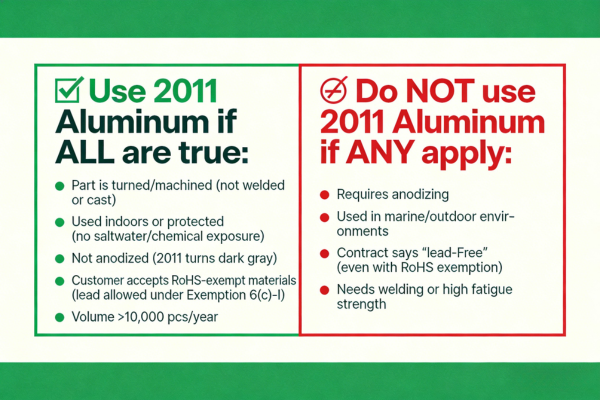
Utiliser « Aluminium 2011 » si TOUTES les conditions sont remplies:
- La partie est tourné/usiné (ni soudé ni moulé)
- D'occasion à l'intérieur ou à l'abri (pas d'exposition à l'eau de mer ni à des produits chimiques)
- Non anodisé (2011 devient gris foncé)
- Le client accepte Matériaux exemptés de la directive RoHS (plomb autorisé en vertu de l'exemption 6(c)-I)
- Volume > 10 000 pièces/an
N'utilisez PAS l'aluminium 2011, le cas échéant:
- Nécessite anodisation
- Utilisé dans nautique/plein air environnements
- Le contrat stipule que “ sans plomb ” (même en cas d'exemption de la directive RoHS)
- Besoins soudage ou résistance élevée à la fatigue
L'aluminium de 2011 sera-t-il conforme à la directive RoHS en 2026 ? (La vérité)
Oui, mais à certaines conditions.
Sous Directive RoHS 3 de l'UE (directive 2015/863), la teneur en plomb est limitée à 0,11 TP3T dans les matériaux homogènes. Cependant, Dérogation 6(c)-I autorise expressément :
“ Plomb dans les alliages d'usinage pour applications mécaniques. ”
Cette exemption couvercles en aluminium de 2011— mais seulement si tu peux le prouver.
Ce que vous devez vérifier auprès de votre fournisseur
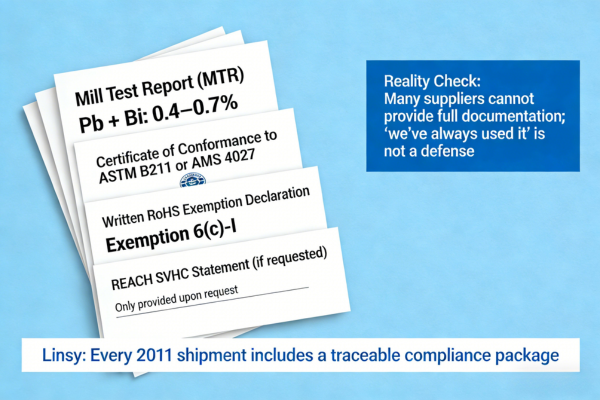
Pour garantir la conformité dans l'Union européenne, au Royaume-Uni, en Californie (Prop 65) ou sur d'autres marchés réglementés, exigez :
- Rapport d'essai en usine (MTR) présentant Pb + Bi dans la plage de 0,4 à 0,71 TP3T
- Certificat de conformité conforme à la norme ASTM B211 ou AMS 4027
- Déclaration écrite d'exemption de la directive RoHS en invoquant l'exception 6(c)-I
- Déclaration relative aux substances SVHC dans le cadre du règlement REACH (si nécessaire)
Vérification de la réalité: De nombreux fournisseurs, en particulier ceux qui s'approvisionnent auprès de laminoirs utilisant des matières recyclées, ne peuvent pas fournir une documentation complète. Lors des audits, “ nous avons toujours utilisé cela ” ne constitue pas une défense.
Chez Linsy, chaque expédition de 2011 comprend un dossier de conformité traçable, car nous savons que votre réputation ne repose pas uniquement sur les performances techniques.
Alternatives à 2011 : options sans plomb pour 2026
| Si vous avez besoin de… | Choisir | Usinabilité par rapport à 2011 | Coût par rapport à 2011 | Notes |
|---|---|---|---|---|
| Performances les plus proches, conforme à la directive RoHS | 6262-T9 | ~90% | +15–20% | Meilleur substitut sans plomb dans l'ensemble ; largement disponible |
| Finition de surface de haute qualité, projets de l'UE | 6020 | ~85% | +20% | Offre mondiale limitée ; principalement en Europe |
| Option sans aluminium | Laiton C360 | ~100% | +50%+ | Plus lourd ; idéal pour les raccords de plomberie et d'électricité |
| Petit volume / prototype | 6061-T6 | ~40% | Plus bas | Mauvaise usinabilité — mais bon marché et facile à se procurer |
Nos conseils:
- Si le plomb est autorisé → rester sur 2011 (meilleur rapport qualité-prix).
- Si le plomb est interdit → test 6262 premier avant de procéder à la refonte.
Comment s'approvisionner en aluminium 2011 en toute sécurité en 2026 : liste de contrôle pour les fournisseurs
Sur la base de plusieurs années d'expérience terrain et des retours clients, voici comment réduire les risques dans votre approvisionnement en 2011 :
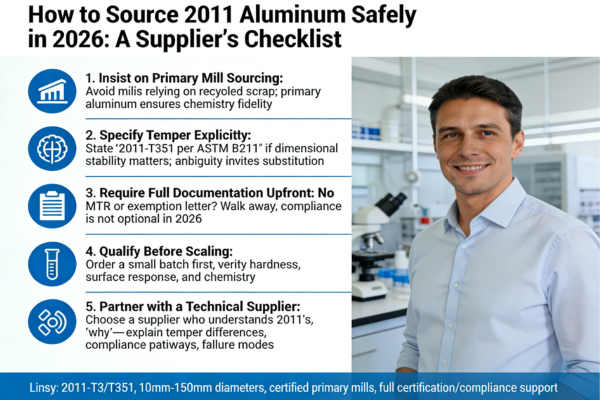
1. Exiger un approvisionnement auprès de laminoirs primaires
Évitez les usines qui utilisent des déchets recyclés. Les teneurs en bismuth variables entraînent un comportement imprévisible lors de l'usinage. L'aluminium primaire garantit la fidélité chimique.
2. Spécifier explicitement la trempe
N'écrivez pas simplement “ 2011 ”. Indiquez “ 2011-T351 selon ASTM B211 ” si la stabilité dimensionnelle est importante. L'ambiguïté ouvre la voie à la substitution.
3. Exiger une documentation complète en amont
Pas de MTR ? Pas de lettre d'exemption ? Laissez tomber. La mise en conformité n'est pas facultative en 2026.
4. Qualifier avant de passer à l'échelle
Commandez d'abord un petit lot. Vérifiez la dureté, la réponse de surface et la composition chimique. Un test de 500 pièces peut éviter un rejet de 50 000 pièces.
5. S'associer à un fournisseur technique
Choisissez un fournisseur qui comprend pourquoi Le 2011 fonctionne — pas seulement comment l'expédier. Vous avez besoin de quelqu'un qui puisse expliquer les différences de trempe, les voies de conformité et les modes de défaillance.
Chez Linsy, nous fournissons le 2011-T3 et le T351 en diamètres de 10 mm à 150 mm, approvisionnés exclusivement auprès de laminoirs primaires certifiés, avec certification complète et accompagnement en matière de conformité. Nous ne livrons pas seulement du matériau ; nous livrons confiance.
Conclusion
L'aluminium 2011 est inégalé pour l'usinage de précision à grand volume, mais c'est un alliage étroit avec de réels compromis : il ne peut pas être anodisé proprement, il résiste mal au soudage, et il dépend d'une exemption RoHS qui ne tient que lorsque vos documents sont en ordre. Sautez les étapes de conformité et le même alliage “ économique ” devient une cargaison rejetée.
C'est là que Linsy intervient. Nous fournissons le 2011-T3 et le T351 provenant de laminoirs primaires certifiés, avec des rapports d'essais de laminoir complets, des déclarations d'exemption RoHS et des déclarations REACH sur chaque livraison. Pour une comparaison complète des matériaux, consultez notre guide complet sur les alliages d'aluminium 2011.
Prêt à spécifier votre prochaine commande ? Contactez Linsy pour de l'aluminium 2011 certifié et un dossier de conformité traçable : demandez un devis sur l'alliage d'aluminium 2011.
Questions fréquemment posées
L'aluminium 2011 est-il adapté aux applications structurelles ou de soudage ?
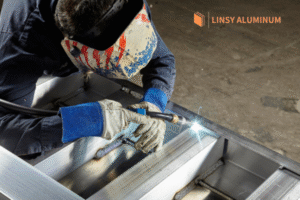
Non, l'alliage d'aluminium 2011 n'est pas recommandé pour les applications structurelles ou de soudage. Sa soudabilité est extrêmement médiocre et sa résistance à la traction est inférieure à celle des autres alliages industriels utilisés à des fins structurelles. Son principal atout réside dans son excellente usinabilité pour la fabrication de pièces de précision, et non dans les applications nécessitant une grande intégrité structurelle.
Que signifie le traitement thermique T3 pour l'aluminium de 2011 ?
La nuance T3 de l'aluminium de 2011 signifie que le matériau a subi un traitement thermique de mise en solution, un formage à froid, puis un vieillissement naturel. Ce procédé confère à l'aluminium une résistance à la traction modérée et de bonnes propriétés physiques, offrant un bon équilibre entre résistance et formabilité, ce qui le rend particulièrement adapté aux opérations d'usinage courantes.
Où puis-je acheter en ligne des barres rondes en aluminium de 2011 ?
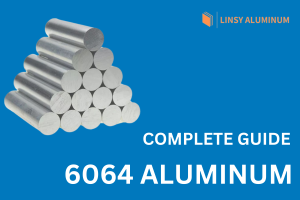
Vous pouvez acheter des barres rondes en aluminium 2011 en ligne auprès de fournisseurs spécialisés en métaux comme Linsy Aluminum. Nous proposons cet alliage sous diverses formes, notamment des barres rondes, et pouvons fournir des dimensions coupées sur mesure, prêtes pour vos processus d'usinage. Il est idéal pour la fabrication de pièces telles que des raccords et des connecteurs.
Peut-on anodiser le can 2011 ?
Techniquement, oui, mais non recommandé. Le cuivre provoque une coloration foncée et irrégulière (généralement gris anthracite) et une mauvaise absorption de la teinture. Pour les pièces anodisées, utilisez les alliages 6063 ou 6061.
L'année 2011 est-elle interdite en Europe ?
Non. C'est expressément exempté en vertu de la directive RoHS 3 (exemption 6(c)-I) pour les applications d'usinage. La documentation est essentielle.