8009 알루미늄이란 무엇인가?
8009 알루미늄은 8xxx 계열 — 구리, 마그네슘 또는 아연 대신 철을 주 첨가 원소로 사용하는 계열 — 중 하나이며, 단 하나의 용도를 위해 존재합니다: 일반적으로 150°C에서 300°C 사이의 고온에서 하중을 지지해야 하는 부품입니다. 이는 6061과 2024가 열처리를 통해 얻은 강도의 대부분을 이미 상실한 온도 범위입니다.
이 합금의 강도는 열처리에서 전혀 나오지 않습니다. 강도는 제조 과정에서 금속에 혼합된 철, 규소, 바나듐으로 이루어진 매우 많은 수의 미세 입자에서 나옵니다. 이것이 8009와 대부분의 구매자가 알고 있는 합금 사이의 근본적인 차이입니다. 이 금속은 일반적인 방법으로 고체 블록으로 주조되는 대신 극도로 빠르게 냉각된 분말로 만들어지며, 이러한 급속 냉각이 입자를 제 역할을 할 수 있을 만큼 미세하게 유지시켜 줍니다.
이러한 이점의 비용은 엔지니어링 측이 아닌 구매 측에 있습니다. 분말을 생산할 수 있는 공장이 매우 적기 때문에 이 소재는 카탈로그 품목이 아닙니다. 다양한 템퍼의 사다리가 아닌 두 가지 상태로 공급됩니다. 그리고 이를 위해 작성된 항공우주 규격은 판재만을 대상으로 하므로, 더 두껍거나 다른 형상의 제품은 표준이 아닌 도면에 따라 주문해야 합니다. 합금이 온도 조건에 맞기만 하면, 남은 것은 입고 상태를 파악하는 일입니다.
6061과 2024가 연화되는 곳에서 8009가 강도를 유지하는 이유
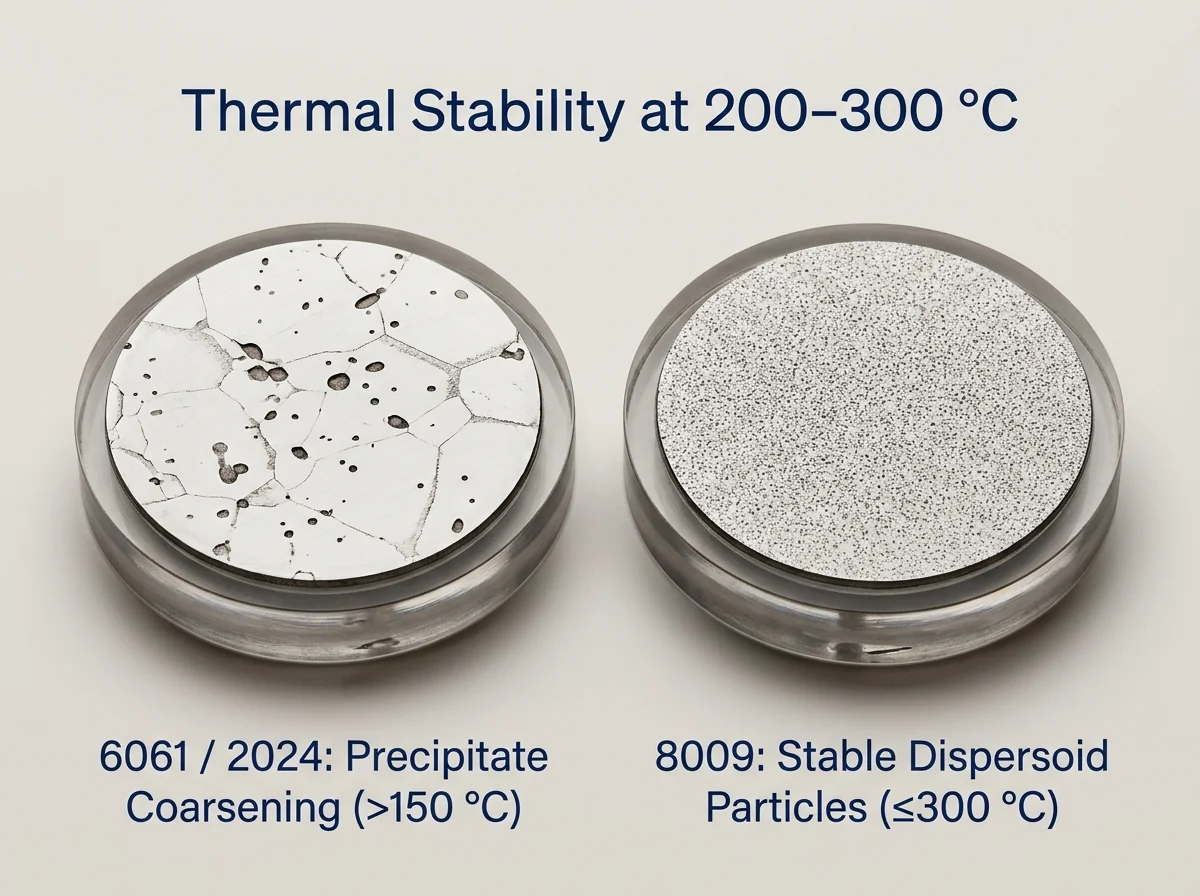
6061과 2024는 열처리에서 강도를 얻으며, 열처리는 열에 의해 되돌려집니다. 약 150°C 이상부터 경화를 부여했던 조직이 점차 분해되면서 강도도 함께 사라집니다. 벤치에서 한계 내에 충분히 들어오는 6061-T6 브래킷이 200°C에서는 심각하게 과응력을 받을 수 있으며, 상온 데이터시트 어디에도 이에 대한 경고가 없습니다.
8009는 다르게 작동합니다. 강도를 부여하는 입자들은 이미 금속 내에 존재하며 온도에서 안정적입니다: 성장하지 않고, 알루미늄으로 다시 용해되지도 않습니다. 부품을 가열해도 이러한 입자들은 냉간 상태에서와 마찬가지로 금속이 늘어나는 것을 계속 억제합니다.
이것이 강도가 절벽에서 떨어지는 대신 점진적으로 감소하는 이유입니다. 얼마나 남아 있는지, 그리고 얼마나 오래 유지되는지는 아래 표에서 확인할 수 있습니다.
상온 및 고온에서의 8009 알루미늄 특성
| 속성 | 가치 | 기준 |
|---|---|---|
| 밀도 | 2.92 g/cm³ | 전형값 |
| 인장강도, 상온 | 450 MPa | 전형값 |
| 항복강도, 상온 | 385 MPa | 전형값 |
| 신장 | ~15% | 전형값 |
| 인장 탄성계수 | 90 GPa | 전형값 |
| 경도 | ~140 HB | 전형값 |
| 열 전도성 | ~115 W/m·K | 전형값 |
| 열팽창 | ~19.0 µm/m·°C | 전형값 |
상온에서 8009는 파단 전 약 450 MPa를 견디고, 탄성 회복이 멈추기 전 385 MPa를 견딥니다. 비교하자면, 대부분의 작업장에서 가장 잘 알려진 합금인 6061-T6는 동일한 두 지표에서 310 MPa와 276 MPa를 견디며, 7075-T6는 572 MPa와 503 MPa를 견딥니다. 따라서 8009는 냉간 상태에서 6061보다 강하고 7075보다 약하며, 이는 상온이 이 합금을 구매하는 이유가 아님을 의미합니다. 실무에서 더 중요한 두 가지 수치가 있습니다. 밀도는 2.92 g/cm³로 철 함량 때문에 6061보다 약 8% 무겁지만, 여전히 강철 무게의 절반에 훨씬 못 미칩니다. 경도는 약 140 HB로 7075에 가까우므로, 이미 7075를 가공하는 작업장이라면 절삭 방식에 놀라지 않을 것입니다.
고온에서의 수치가 이 합금이 존재하는 이유입니다.
| 온도 | 1,000시간 후 인장강도 | 1,000시간 후 항복강도 |
|---|---|---|
| 100 °C | 410 MPa | 370 MPa |
| 150°C | 380 MPa | 350 MPa |
| 200°C | 350 MPa | 310 MPa |
| 250°C | 310 MPa | 275 MPa |
| 300°C | 270 MPa | 240 MPa |
200°C에서 이 합금은 해당 온도에서 1,000시간 후에도 350 MPa를 유지합니다 — 이는 냉간 상태 대비 약 78%에 해당합니다. 250°C에서는 310 MPa를 유지하고, 300°C에서도 270 MPa를 유지하는데, 이는 6061-T6가 상온에서 시작하는 값보다 약간 낮은 수준입니다. 200°C에서 300°C로의 감소가 상온에서 200°C로의 감소보다 가파르며, 이것이 실질적인 해석입니다: 200–300°C가 작업 구간이며, 그 상단 절반은 하단 절반보다 더 많은 안전 여유가 필요합니다.
이는 공개된 전형값이며, 규격이 보증하는 최소값이 아닙니다. 공급업체에 실제로 공급받는 열처리에 적용되는 값을 요청하고, 설계 기준 수치를 암묵적으로 남겨두지 말고 구매 주문서에 명시하십시오.
템퍼 및 제품 형태 — AMS 4308이 실제로 다루는 범위
AMS 4308은 SAE International에서 발행한 이 합금의 항공우주 소재 규격입니다. 화학 조성, 상태 및 소재가 충족해야 하는 강도 수치를 규정하며, 소재 입고 시 검사관이 기준으로 삼는 문서입니다. 도면에 "AMS 4308"이라고 명시되어 있으면, 그것이 공급업체가 약속하는 내용입니다.
화학 조성은 6개 항목으로 요약되며, 이것들이 성적서에서 확인할 가치가 있는 항목입니다.
| 요소 | 범위 (중량%) | 기능 |
|---|---|---|
| 철(Fe) | 8.4 – 8.9 | 주 첨가 원소; 고온에서 강도를 유지하는 입자를 형성 |
| 실리콘(Si) | 1.7 – 1.9 | 철 및 바나듐과 함께 작용하여 해당 입자를 형성 |
| 바나듐(V) | 1.1 – 1.5 | 부품이 고온에서 작동할 때 해당 입자의 안정성을 유지 |
| 아연(Zn) | 최대 0.25 | 불순물 — 잘못된 성적서를 잡아내는 항목 |
| 산소 (O) | 0.30 최대 | 분말 공정 경로의 지문; 잉곳 주조 합금은 이러한 한도를 가질 수 없음 |
| 알루미늄 | 잔액 | 나머지 |
이는 AMS 4308B에 명시된 8.6Fe – 1.8Si – 1.3V 화학 조성과 일치하는 공개된 전형적 한도입니다. 견적 중인 배치에 대한 인증값을 요청하십시오.
O(어닐링)
O는 연질 상태입니다. 금속은 성형 — 절곡, 압연 또는 프레스 성형 — 이 가능하도록 의도적으로 가열 및 서냉되며, 그 대가로 강도를 포기합니다. 입고 후에도 부품 성형이 필요한 경우 O 상태로 구매하고, 성형 완료 전까지는 낮은 강도 수치를 감수할 계획을 세우십시오.
H112 / F (제조 상태)
H112 — 종종 F, 즉 제조 상태로 표기됨 — 는 열간 가공 후 밀에서 출하될 때 추가 처리가 적용되지 않은 상태입니다. 이는 기본 구조용 상태이며 AMS 4308 제목에 명시된 상태인데, 추가하거나 생략할 시효 단계가 없기 때문입니다: 합금이 가진 강도는 공정이 만들어낸 강도입니다.
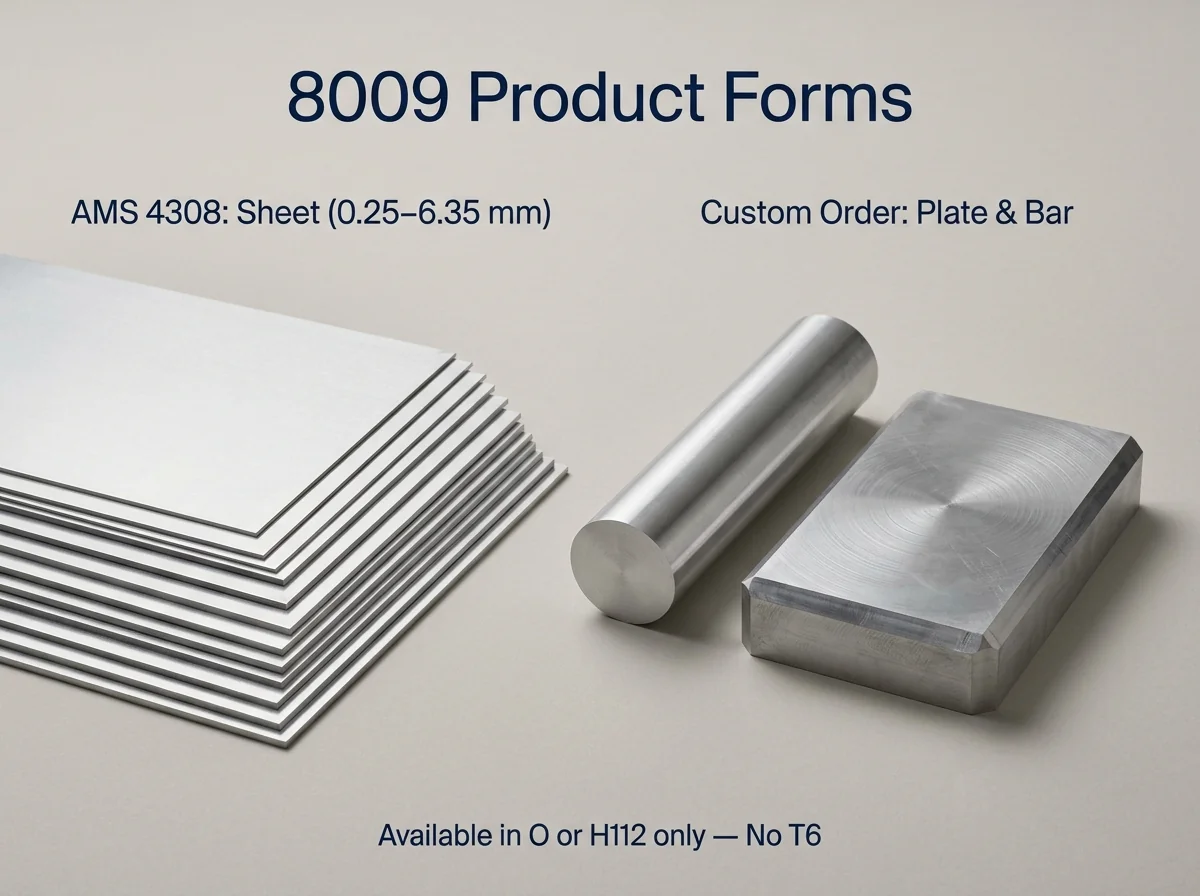
형태 문제가 대부분의 구매 주문서가 잘못되는 지점입니다.
| 양식 | Covered by | What has to be on the order |
|---|---|---|
| Sheet, 0.25–6.35 mm | AMS 4308B | Standard product — chemistry, state and mechanical values are fixed by the specification |
| Plate over 6.35 mm | No AMS coverage | Chemistry limits and mechanical values stated on the order |
| 봉재 및 환봉 | No AMS coverage | Chemistry limits and mechanical values stated on the order |
| Extrusion profile | No AMS coverage | Chemistry, values and section agreed per drawing |
| 튜브 | No AMS coverage | Chemistry, values and dimensions agreed per drawing |
| Foil and strip below 0.25 mm | No AMS coverage | Chemistry and values stated on the order |
Only the first row has a specification standing behind it. Everything below that line is exactly as good as what the purchase order says, which is why the chemistry and the mechanical values have to be written down instead of referenced.
One more thing to settle before the RFQ goes out: 8009 has no T6 or T8 temper. A T6 or T8 designation means the alloy is hardened by a heat treatment cycle after forming, and this alloy does not harden that way — the particles are already in it and will not re-form. If an offer names T6 or T8 for 8009, the offer is describing a different material.
Two lines on the certificate catch most of the confusion. A zinc figure of 5–6% describes 7075, not 8009, which carries almost no zinc. And a strength figure far above the table above usually means the numbers were carried over from another grade rather than measured on that batch.
We buy 8009 billet, plate and bar from producers that run the powder route, then cut, machine and finish to drawing. For forms outside the AMS range, we quote against the chemistry and the properties your drawing names.
Where 8009 Is Used
Aerospace and Engine-Adjacent Structures
The reason 8009 appears in aerospace work is a weight comparison, not a strength comparison. Above 150 °C the usual alternatives are titanium, steel, and the few heat-resistant aluminiums such as 2618. Titanium is about 50% heavier for the same volume and steel close to three times. A part that can stay aluminium up to 300 °C removes that penalty for anything whose service temperature lands in the band — supersonic airframe skins that heat up in flight, rocket structure, thermal-protection hardware, and brackets and housings close to an engine where the metal soaks up radiant heat without seeing combustion.
The fit is specific rather than general. If the part runs below 150 °C, 7075 or 2024 gives more strength per kilogram and is easier to buy. If it runs above 350 °C, aluminium stops competing and the titanium or steel argument takes over. 8009 earns its place in the band where neither of those answers works.
High-Performance Automotive and Specialty Heat Exchangers
Turbocharger and exhaust-adjacent parts see the same problem in a smaller package: cyclic heating and cooling, with load on the part the whole time. A piston or a housing that softens a little more with every heat cycle loses its clearances before it loses its shape, which is why slow stretching under load at temperature — creep — decides the material here rather than peak strength.
Specialty heat exchangers and high-temperature tooling follow the same logic from the other direction — the part is hot by design, and the question is whether the wall keeps its dimensions over a long campaign. The limiting factor for cost here is usually the size of the part rather than the material: 8009 is expensive relative to 6061, and that premium is easiest to justify on small, highly loaded components.
8009 vs 6061, 2024, 2618 and 7075 — Choosing by Service Temperature
| 합금 및 템퍼 | Tensile, room temp | Yield, room temp | Practical service ceiling | What it is for |
|---|---|---|---|---|
| 7075-T6 | 572 MPa | 503 MPa | ~120 °C | Strongest at room temperature; wrong choice for a hot part |
| 2024-T3 | 483 MPa | 345 MPa | ~150°C | Airframe skins and fatigue-critical structure |
| 6061-T6 | 310 MPa | 276 MPa | ~150°C | The default general-purpose structural alloy |
| 2618-T61 | ~440 MPa | ~370 MPa | ~200 °C | Forged pistons and compressor parts |
| 8009 (H112) | 450 MPa | 385 MPa | 200–300 °C | Parts that must stay aluminium while running hot |
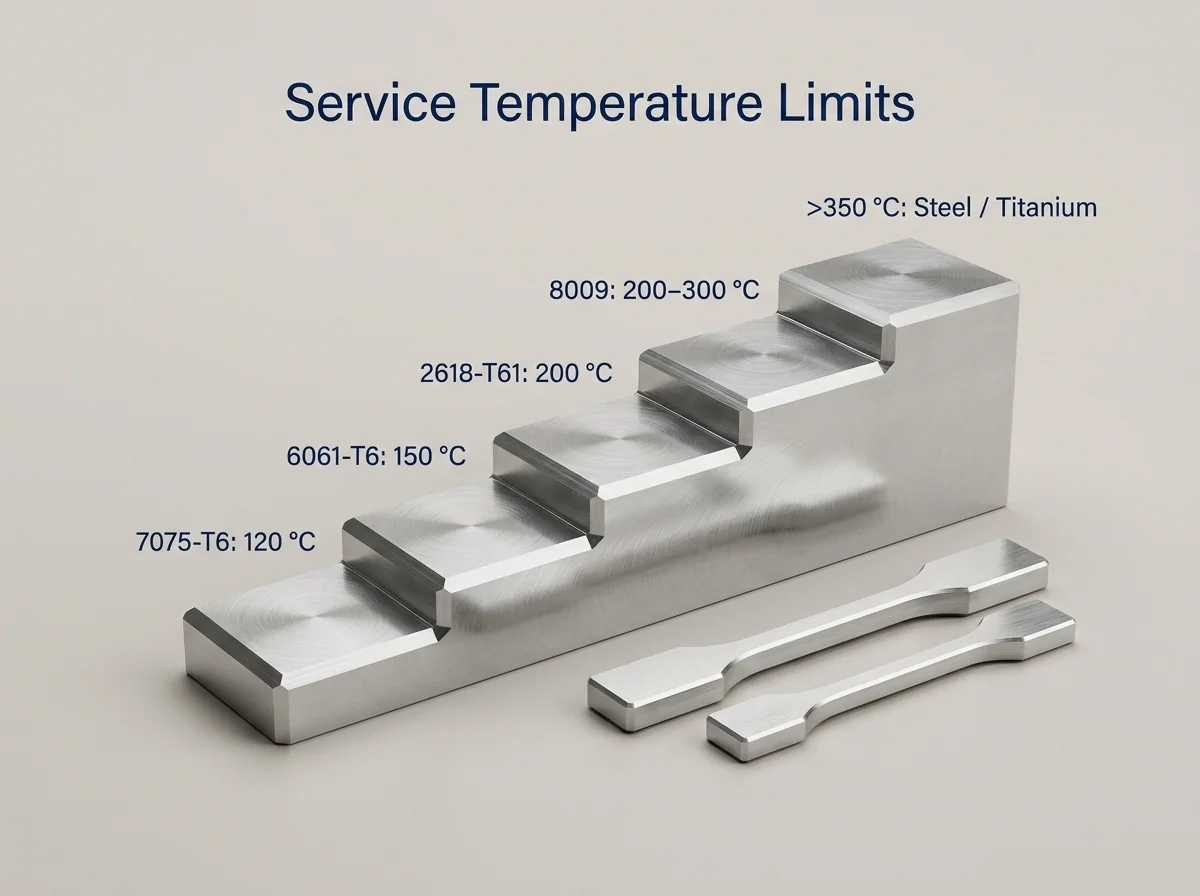
Room-temperature values above are the minimums published in ASTM B209 for sheet, except 2618, where they are typical forging values to AMS 4132. Service ceilings are practical design limits rather than values printed in any specification, and a specific duty cycle can justify going beyond them with the right testing.
Read that table by the fourth column, not the second. 7075 wins the room-temperature column and is the wrong material for a 250 °C part. 2618 is the right answer for a piston crown at 200 °C and stops being one above it. 8009 is the only grade here with a service ceiling above 200 °C.
That is also why the two alloys are easy to compare the wrong way round. Put the datasheets side by side and 7075 shows 572 MPa against 8009’s 450 MPa, which reads like 8009 is the weaker alloy. It is weaker — at room temperature, on a bench, which is not where the part works.
Working With 8009 — Machining, Joining and Finishing
가공: it cuts like a hard aluminium, not like 6061. At around 140 HB it behaves much closer to 7075, which means a shop that already runs 7075 will be comfortable and a shop that only runs 6061 should expect faster tool wear and lighter cuts. There is no free-machining version of this alloy, so how the chips break comes down to how the machine is set rather than to the metal.
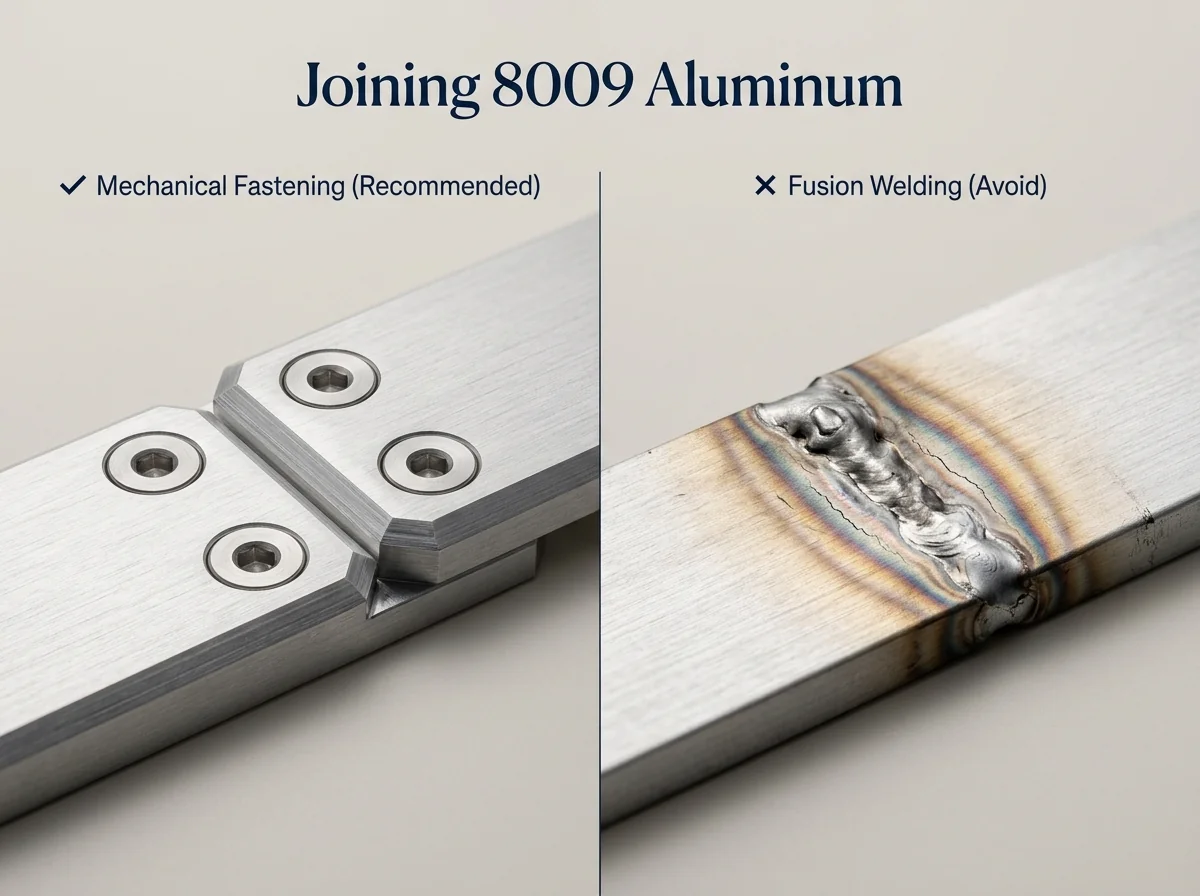
접합: welding costs you the property you bought the alloy for. A fusion weld destroys the particle structure in the weld zone, and the joint loses the high-temperature strength that justified the material in the first place. For a load-bearing joint, plan on mechanical fastening, or on a joining method that does not melt the metal and has been qualified for this alloy; treat a fusion-welded joint as non-structural unless it has been tested and accepted on its own.
내식성 보호: it holds up well in normal workshop and atmospheric service but it is not a marine alloy. Anodizing works, and so do chemical conversion coatings — a chemical surface treatment that leaves a protective layer on the metal. For a part that will see salt air or chemical exposure, specify the finish on the drawing rather than deciding it after the part is made.
성형: shape it in O, and accept that you cannot heat-treat the strength back afterwards. This is the biggest practical difference from the 2xxx and 7xxx grades, where forming in a soft state and then aging to full strength is routine. In 8009 the H112 values are set when the material is worked hot, not by a treatment you can repeat in your own shop — so a part that needs heavy forming either starts in O and stays softer, or is formed near-final and machined from H112.
장점 및 한계 요약
| 치수 | 이점 | 비용 |
|---|---|---|
| Strength above 200 °C | Holds 350 MPa at 200 °C and 270 MPa at 300 °C after 1,000 hours | Nothing comparable in the 6xxx or 7xxx families at that temperature |
| Room-temperature strength | 450 MPa tensile, comparable to 2618 | Below 7075 and 2024; not a reason to choose it |
| 무게 | 2.92 g/cm³ — under half of steel, so it replaces hot steel parts directly | About 8% heavier than 6061 for the same volume |
| Fatigue at temperature | 160 MPa at 250 °C — published typical value — supports cyclic hot service | Cost per kilogram is several times 6061 |
| 가공 | Cuts predictably, close to 7075 | ~140 HB wears tooling faster than 6061 |
| 접합 | Mechanical fastening and methods that do not melt the metal both work | Fusion welding removes the strength advantage locally |
| Supply | Available as billet, plate and bar from powder-route producers | Narrow producer base; lead time follows billet availability; sheet only under AMS 4308 |
| 성형 | O temper forms well | Formed parts cannot be re-hardened to H112 |
결론
8009 solves a real problem — carrying load at 200 to 300 °C without moving to titanium or steel — but nothing about it is standard. One producer tier, a specification that covers sheet only, and just two usable states mean the buying problem replaces the engineering problem as soon as the alloy is chosen.
We buy 8009 billet, plate and bar from powder-route producers, then cut and machine to your drawing. Every order ships with an MTC, and SGS reports are available if your project needs them.
Send us the drawing with the form, state and quantity for a supply check and a cutting quote.
자주 묻는 질문
Can 8009 aluminum be used at 400 °C?
No — there is no published basis for 400 °C. Published 1,000-hour test values, rather than specification minimums, support 200–300 °C; above 350 °C the particle structure needs assessment against your duty cycle.
Does 8009 have a T6 temper?
No. 8009 is strengthened by particles already in the metal, so there is no solution-treat-and-age step to make T6 or T8. It ships in O or H112 only, and an offer naming T6 describes another alloy.
Can you supply 8009 in bar or tube when AMS 4308 covers sheet only?
Yes, as a drawing-controlled item. Outside the AMS thickness range there is no specification to point at, so chemistry and mechanical values travel on the purchase order, and the MTC reports what was tested.
What is the minimum order and lead time for 8009?
Low MOQ, typically 10–60 days. The date depends on billet availability and the cutting or machining you need, so it is confirmed with the quote rather than quoted in advance. Send the drawing, form, state and quantity.