What Is 6060 Aluminum?
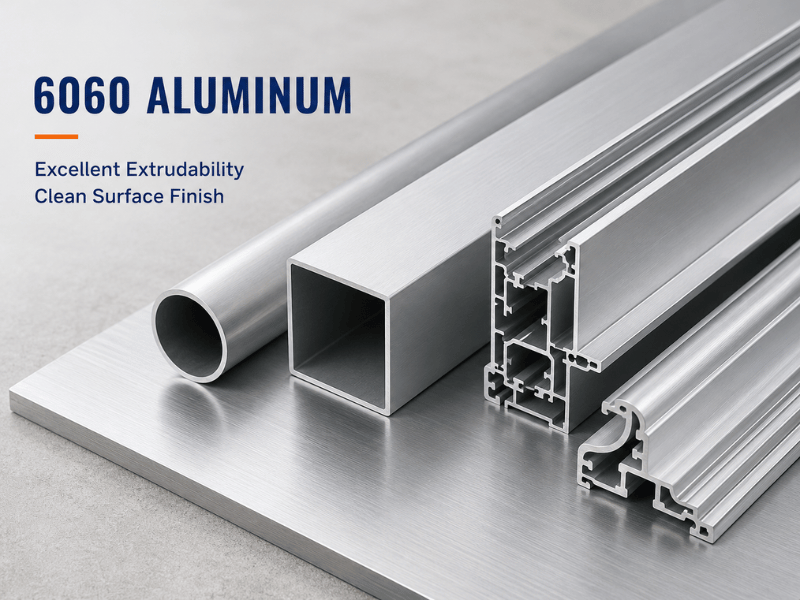
6060 is a lower-strength member of the 6000 series (Al-Mg-Si family), closely related to 6063 but with composition tuned for easy extrusion and a clean surface after anodizing. Strength comes from magnesium-silicide precipitates formed during the T5/T6 aging treatment — in the O temper it is soft and formable, and in T5/T6 it reaches moderate structural strength.
The alloy’s reason for existing is extrusion. It flows through the die at high speed, holds thin walls and complex cross-sections, and comes out with a surface that anodizes to a uniform bright finish. When the project needs an intricate profile with good looks more than high strength, 6060 is usually the default choice over 6061 or 6063.
Chemical Composition and Mechanical Properties
Chemical Composition
6060 is defined by a low magnesium and silicon balance — just enough Mg₂Si to age-harden, without the higher magnesium content that makes 6061 stronger but harder to extrude into fine sections. The limits below follow EN AW-6060.
| Element | Composition Range (% by weight) | Role |
|---|---|---|
| Aluminum (Al) | Balance | Base metal |
| Silicon (Si) | 0.30–0.60 | Precipitate former with Mg |
| Magnesium (Mg) | 0.35–0.60 | Strength via Mg₂Si aging |
| Iron (Fe) | 0.10–0.30 | Impurity limit |
| Copper (Cu) | ≤0.10 | Impurity limit |
| Manganese (Mn) | ≤0.10 | Impurity limit |
| Chromium (Cr) | ≤0.05 | Impurity limit |
| Zinc (Zn) | ≤0.15 | Impurity limit |
| Titanium (Ti) | ≤0.10 | Grain refiner |
| Others (each) | ≤0.05 | Trace elements |
| Others (total) | ≤0.15 | Total trace |
Physical and Mechanical Properties
6060 is a typical 6000-series aluminum on the physical side: density 2.70 g/cm³, melting range 585–655°C, thermal conductivity 200–220 W/m·K, electrical conductivity about 50–55% IACS, coefficient of thermal expansion 23.4 µm/m·K (20–100°C), and modulus of elasticity around 69.5 GPa. The values below are typical for extruded profiles (wall ≤ 25 mm) per EN 755-2. Confirm against the mill test certificate for the specific temper and section.
| Property | O | T4 | T5 | T6 | T66 |
|---|---|---|---|---|---|
| Ultimate Tensile Strength (UTS) | ~120 MPa | ≥120 MPa | ≥160 MPa | ≥190 MPa | ≥215 MPa |
| Yield Strength (0.2%) | ~55 MPa | ≥60 MPa | ≥120 MPa | ≥150 MPa | ≥160 MPa |
| Elongation | ~25% | ≥16% | ≥8% | ≥8% | ≥8% |
| Hardness (HBW) | ~45 | ~50 | ~60 | ~70 | ~75 |
The headline point: even at T6, 6060 stays in the moderate-strength band (≈190 MPa UTS). That is roughly 60% of 6061-T6 (310 MPa) and about 70% of 6063-T6 (215 MPa). The tensile range is wide only because it spans the soft O/T4 tempers through T66.
Where 6060 Is Used
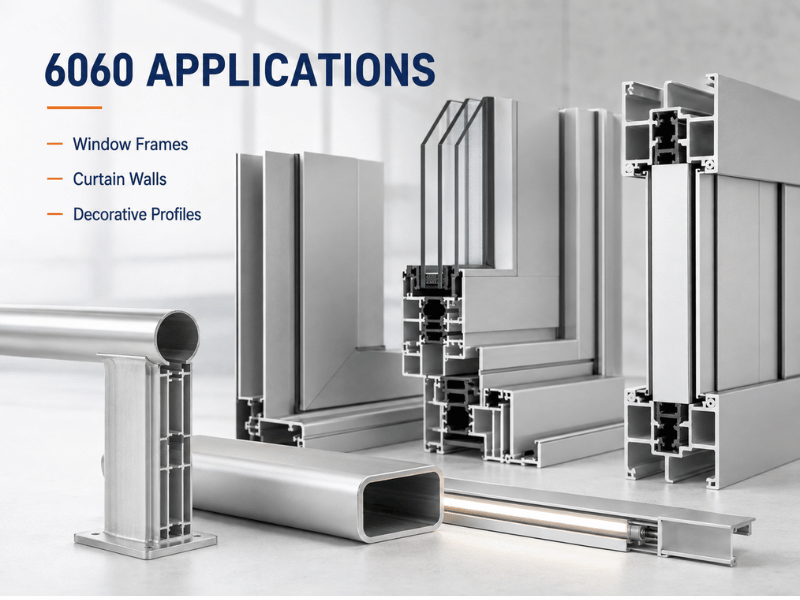
6060’s defining advantage is the extrusion-plus-finish combination. Most applications fall into categories where a clean, complex, anodize-ready profile matters more than load capacity.
Architectural Frames and Curtain Walls
The primary domain. Window frames, door frames, curtain-wall mullions, and facade sections use 6060 because it extrudes into slender, thin-walled shapes and anodizes to a consistent bright surface. T5 is the standard architectural temper here — it balances strength with dimensional stability straight off the press.
Railings, Handrails, and Decorative Trim
Balustrades, handrails, and interior trim rely on the same properties: smooth extruded surfaces, good anodizing response, and enough strength for non-structural or lightly loaded members. Where appearance is the priority, 6063 is often cited as the aesthetic benchmark — but 6060 holds finer wall tolerances in complex sections.
Furniture Tubing and Consumer Goods
Furniture tubing, display structures, and consumer products use 6060 for its light weight, formability in softer tempers, and cost relative to higher-strength alloys. T4 is relevant when the part needs secondary bending or forming after extrusion.
Transport Interiors and Lighting
Transport interior profiles, lighting tracks, and fixture bodies use 6060 where weight reduction and a clean finish matter but structural load is low. Exterior transport applications should confirm corrosion exposure before specifying — see the corrosion note under Working with 6060.
6060 Temper Options
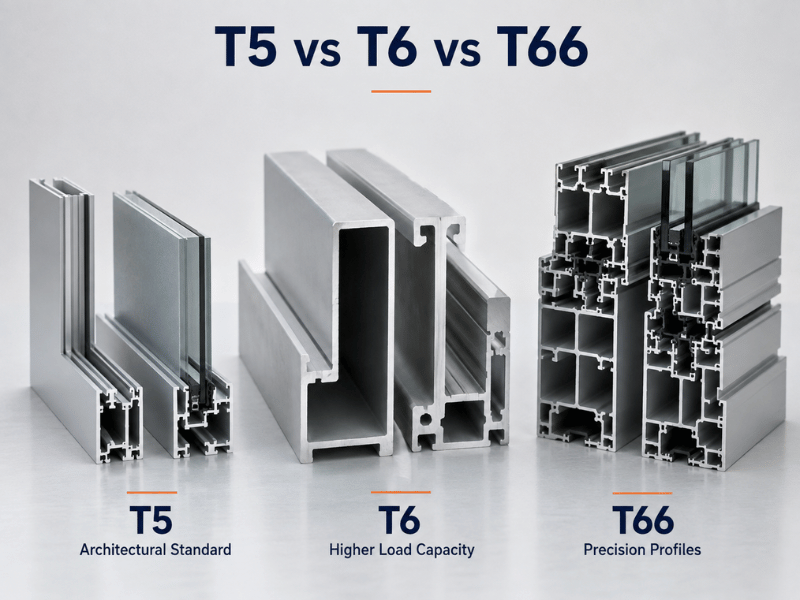
6060 is supplied across a temper range that trades strength for formability. For most architectural extrusion, T5 dominates; T6 and T66 are chosen when the section must carry more load.
| Temper | Treatment | UTS (MPa) | YS (MPa) | Best For | Avoid When |
|---|---|---|---|---|---|
| O | Annealed (soft) | ~120 | ~55 | Bending and forming operations | Any structural or load-bearing use |
| T4 | Solution heat-treated + naturally aged | ≥120 | ≥60 | Parts needing secondary cold forming (bending, flanging) | High strength is required |
| T5 | Cooled from extrusion + artificially aged | ≥160 | ≥120 | Standard window/door frames, architectural trim | Heavy structural load |
| T6 | Solution heat-treated + aged | ≥190 | ≥150 | Moderate-load sections, high-performance frames | Extreme thin walls where T5 already suffices |
| T66 | Enhanced T6 (controlled extrusion/cooling) | ≥215 | ≥160 | High-performance curtain walls, precision profiles | Cost-sensitive standard trim |
When T5 Is the Right Call
T5 is the workhorse architectural temper. It is cooled directly from the extrusion press and aged, so it reaches moderate strength without a separate quench — keeping cost down and surface quality high. For standard window, door, and trim profiles, T5 is the default.
When T6 or T66 Fits Better
If the section must carry real structural load — wider curtain-wall spans, load-bearing balustrades — step up to T6 (≥150 MPa yield) or T66 (≥160 MPa yield). T66 adds yield through tighter extrusion and cooling control and is the common choice for high-performance curtain walls. The cost is a slightly more involved process route.
A Note on O and T4
O and T4 are formability tempers, not strength tempers. O is fully soft; T4 is naturally aged and still ductile enough for post-extrusion bending and flanging. Specify them only when the part will be formed after supply — for finished profiles, T5/T6/T66 are the practical options.
6060 vs 6061 vs 6063
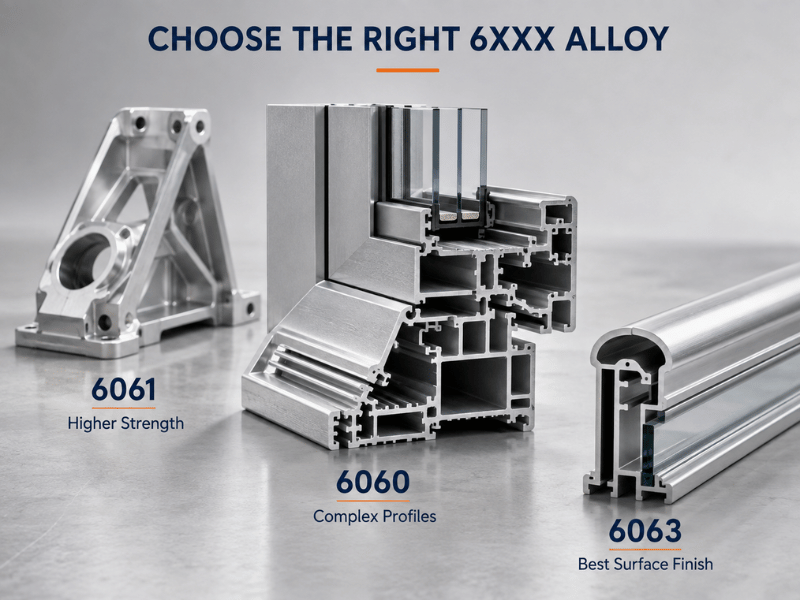
These three 6000-series alloys cover most extrusion and general-fabrication decisions. The table maps the selection criteria.
| Property | 6060 | 6061 | 6063 |
|---|---|---|---|
| Main Composition | Al + 0.5% Mg + 0.45% Si | Al + 1.0% Mg + 0.6% Si | Al + 0.7% Mg + 0.4% Si |
| T6 Strength (UTS / YS) | 190 / 150 MPa | 310 / 276 MPa | 215 / 170 MPa |
| Extrudability | Excellent (complex thin walls) | Good (less complex shapes) | Excellent (smooth finishes) |
| Corrosion Resistance | Good | Very Good | Excellent |
| Weldability | Very Good | Excellent | Very Good |
| Surface Finish (anodized) | Good | Good | Excellent (best for aesthetics) |
| Typical Use | Window frames, furniture, trim | Structural parts, bike frames, marine | Architectural trim, pipes, railings |
When 6060 Wins
Complex, thin-walled profiles where finish matters more than strength. 6060 extrudes intricate cross-sections at high press speed and anodizes to a clean bright surface. For window frames, furniture tubing, and decorative trim, it is the pragmatic choice — 6061 is stronger but less willing to form fine sections, and 6063, while the surface-finish benchmark, gives up a little on complex-wall extrudability.
Formability after supply. In O or T4, 6060 bends and flanges without cracking. When the part requires secondary cold work, 6060 (or 6063) is more suitable than 6061-T6.
When 6061 or 6063 Fits Better
Structural load or welding simplicity. 6061-T6 delivers roughly 60% higher yield strength (276 MPa) and welds with all common processes. For machine frames, bike frames, and marine structures where load governs, 6061 is the standard. The 6061 aluminum guide covers the full profile.
Maximum anodized appearance. 6063 produces the finest, most uniform anodized layer in the family and is the default for high-visibility decorative trim and pipe railing. If the project is pure aesthetics with simple geometry, 6063 edges out 6060 on surface quality. The 6063 aluminum guide covers the detail.
Working with 6060
Extrusion
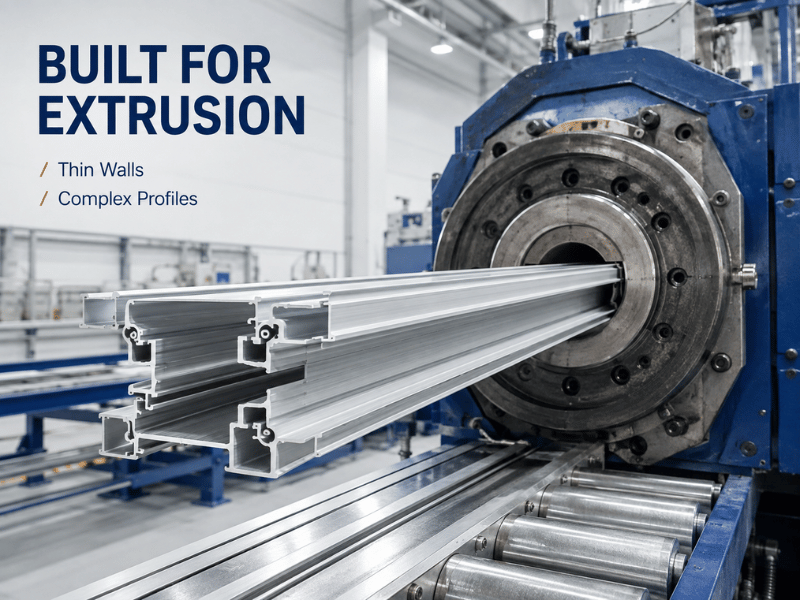
Extrusion is the primary production route for 6060. Typical billet temperatures run 480–520°C with exit temperatures kept below ~550°C to avoid surface tearing. The low deformation resistance allows high extrusion speeds (commonly 20–80 m/min depending on shape and press) and stable output, even for multi-cavity and thin-walled sections. Tight dimensional tolerances are achievable straight from the die.
Machining
6060 machines cleanly with standard carbide tooling. In the T5/T6 tempers it is stable for trimming, drilling, and light milling; deeper pockets or asymmetric cuts should account for residual stress in the section. It is softer than 6061, so tool wear is low and surface finish is easy to hold — useful for parts that combine extrusion with secondary CNC work.
Welding
6060 is readily welded by TIG (GTAW) and MIG (GMAW) using standard 4xxx or 5xxx filler. One caveat: post-weld strength in the heat-affected zone (the area next to the weld) drops below the parent T6 value. Design the joint as the strength-limiting feature, or select T4/T5 where post-weld strength loss is less critical. For critical welds, confirm the procedure against the service load.
Surface Treatment and Corrosion
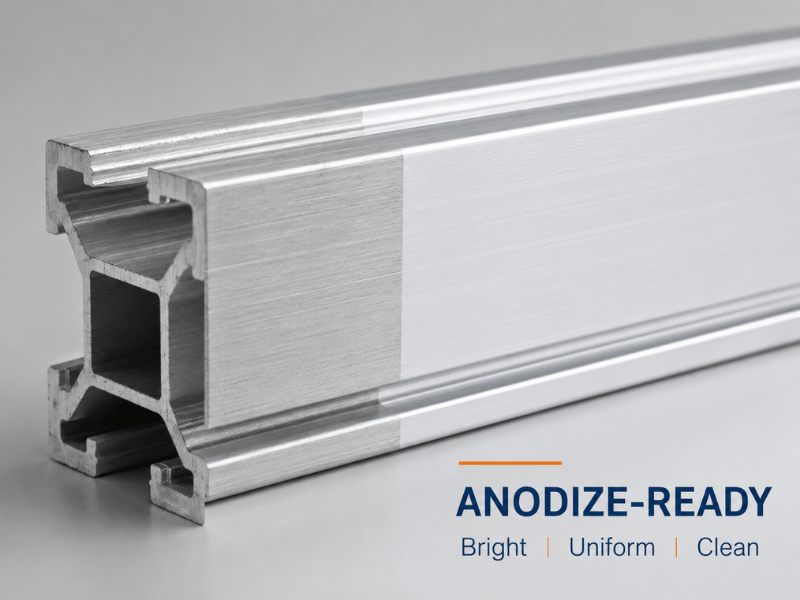
6060 anodizes well — sulfuric acid anodizing (Type II) produces a uniform bright layer, which is why it dominates visible architectural profiles. Powder coating (including RAL 9016) and polishing are also standard. Corrosion resistance is good in atmospheric and mild industrial environments and is suitable for indoor and most outdoor architectural use. For direct saltwater immersion or aggressive chloride exposure, protection is required — anodizing plus a sealed topcoat, or a switch to 6061/6082 or a 5xxx-series alloy.
Pros and Limitations at a Glance
| Factor | Advantage | Limitation |
|---|---|---|
| Extrudability | Flows into thin, complex sections at high press speed | — |
| Surface finish | Anodizes to a uniform bright layer | Below 6063 on peak aesthetics |
| Strength | Adequate for architectural and light structural roles | ~60% of 6061-T6; not for highly loaded members |
| Weldability | Readily welded by TIG/MIG | HAZ strength loss below parent T6 |
| Corrosion resistance | Good in atmospheric/mild industrial use | Not for unprotected saltwater immersion |
| Cost | Lower than high-strength alloys | — |
| Formability | Bends/flanges in O and T4 | T6/T66 are not forming tempers |
Conclusion
6060 aluminum occupies a clear position in the 6000 series: it trades peak strength for the best extrusion behavior and a clean anodized finish in its family. For window frames, furniture tubing, decorative trim, and light architectural profiles where shape complexity and surface quality govern, 6060 is the practical default. The trade-off is equally clear — moderate strength and limited saltwater corrosion resistance mean it is not a substitute for 6061 or 6082 in structural or marine service.
Linsy Aluminum supplies 6060 aluminum alloy in extruded profile, tube, bar, plate, and wire forms across O, T4, T5, T6, and T66 tempers. Factory-direct supply with MTC documentation on every order and SGS test reports available on request means the material arrives with full traceability. In-house processing — CNC machining, TIG/MIG welding, laser cutting, and surface finishing including anodizing and powder coating — supports both material-only and fabrication-ready delivery. Low-MOQ custom production covers non-stock cross-sections and specifications with a typical lead time of 10–60 days.
Send the drawing or specification to Linsy Aluminum for a 6060 temper and section check, or request a quote for your project.
Frequently Asked Questions
What is the difference between 6060 and 6063?
Both are low-strength Al-Mg-Si extrusion alloys and are often interchangeable for trim. 6063 produces the finest, most uniform anodized surface and is the benchmark for high-visibility decorative work, while 6060 extrudes more complex thin-wall sections at higher press speed. If the geometry is intricate, lean 6060; if surface perfection is the priority on simple shapes, lean 6063.
Which temper should I specify for window frames?
T5. It is cooled from the extrusion press and artificially aged, reaching moderate strength (≥120 MPa yield) without a separate quench, which keeps cost and surface quality optimal for standard window and door profiles. Step up to T6 or T66 only when the section must carry higher structural load.
Can 6060 be welded with standard equipment?
Yes. TIG and MIG welding both work with standard 4xxx or 5xxx filler. The one limitation is post-weld strength loss in the heat-affected zone for T6/T66 sections — design the joint expecting that reduction, or use T4/T5 where the strength drop is less critical.
Is 6060 suitable for marine or saltwater environments?
For atmospheric and mild industrial exposure, yes — it is commonly used in architectural outdoor service. For direct saltwater immersion or sustained chloride contact, it needs anodizing plus a sealed topcoat, or a different alloy such as 6061, 6082, or a 5xxx series. Bare 6060 will pit in chloride-rich conditions.
What specifications and standards does 6060 conform to?
6060 is supplied to common extrusion and bar standards including ASTM B221, EN 755, EN 12020, and GB/T 6892. Equivalent designations are EN AW-6060, UNS A96060, and ISO Al-MgSi0.5. Confirm the exact standard and temper on the mill test certificate before finalizing a cross-section or load calculation.