Cos'è l'alluminio 6060?
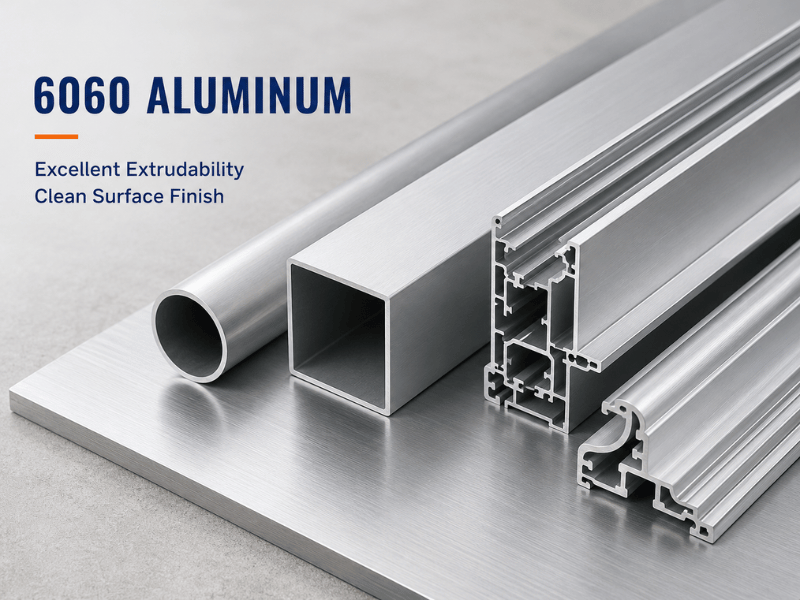
Il 6060 è un membro a resistenza inferiore della serie 6000 (famiglia Al-Mg-Si), strettamente correlato al 6063 ma con una composizione calibrata per una facile estrusione e una superficie pulita dopo l'anodizzazione. La resistenza deriva dai precipitati di siliciuro di magnesio formatisi durante il trattamento di invecchiamento T5/T6 — nella tempra O è morbido e formabile, mentre in T5/T6 raggiunge una resistenza strutturale moderata.
La ragione d'essere di questa lega è l'estrusione. Scorre attraverso la filiera ad alta velocità, mantiene pareti sottili e sezioni trasversali complesse, e fuoriesce con una superficie che si anodizza fino a ottenere una finitura brillante uniforme. Quando il progetto richiede un profilo intricato con un buon aspetto estetico più che un'elevata resistenza, il 6060 è solitamente la scelta predefinita rispetto al 6061 o al 6063.
Composizione chimica e proprietà meccaniche
Composizione chimica
Il 6060 è definito da un basso equilibrio tra magnesio e silicio — appena abbastanza Mg₂Si per l'indurimento per invecchiamento, senza il contenuto più elevato di magnesio che rende il 6061 più resistente ma più difficile da estrudere in sezioni sottili. I limiti seguenti seguono la norma EN AW-6060.
| Elemento | Gamma di composizione (% in peso) | Ruolo |
|---|---|---|
| Alluminio (Al) | Equilibrio | Metallo comune |
| Silicio (Si) | 0.30–0.60 | Formatore di precipitati con Mg |
| Magnesio (Mg) | 0.35–0.60 | Resistenza tramite invecchiamento Mg₂Si |
| Ferro (Fe) | 0.10–0.30 | Limite di impurità |
| Rame (Cu) | ≤0,10 | Limite di impurità |
| Manganese (Mn) | ≤0,10 | Limite di impurità |
| Cromo (Cr) | ≤0,05 | Limite di impurità |
| Zinco (Zn) | ≤0,15 | Limite di impurità |
| Titanio (Ti) | ≤0,10 | Affinatore di grano |
| Altri (ciascuno) | ≤0,05 | Elementi traccia |
| Altri (totale) | ≤0,15 | Traccia totale |
Proprietà fisiche e meccaniche
Il 6060 è un tipico alluminio della serie 6000 dal punto di vista fisico: densità 2,70 g/cm³, intervallo di fusione 585–655°C, conducibilità termica 200–220 W/m·K, conducibilità elettrica circa 50–55% IACS, coefficiente di dilatazione termica 23,4 µm/m·K (20–100°C) e modulo di elasticità circa 69,5 GPa. I valori seguenti sono tipici per profili estrusi (parete ≤ 25 mm) secondo EN 755-2. Verificare contro il certificato di prova del laminatoio per la specifica tempra e sezione.
| Proprietà | O | T4 | T5 | T6 | T66 |
|---|---|---|---|---|---|
| Resistenza alla trazione finale (UTS) | ~120 MPa | ≥120 MPa | ≥160 MPa | ≥190 MPa | ≥215 MPa |
| Limite di snervamento (0,2%) | ~55 MPa | ≥60 MPa | ≥120 MPa | ≥150 MPa | ≥160 MPa |
| Allungamento | ~25% | ≥16% | ≥8% | ≥8% | ≥8% |
| Durezza (HBW) | ~45 | ~50 | ~60 | ~70 | ~75 |
Il punto principale: anche in T6, il 6060 rimane nella fascia di resistenza moderata (≈190 MPa di carico di rottura). Ciò corrisponde a circa il 60% del 6061-T6 (310 MPa) e a circa il 70% del 6063-T6 (215 MPa). L'intervallo di trazione è ampio solo perché copre le tempra morbide O/T4 fino alla T66.
Dove Viene Utilizzato il 6060
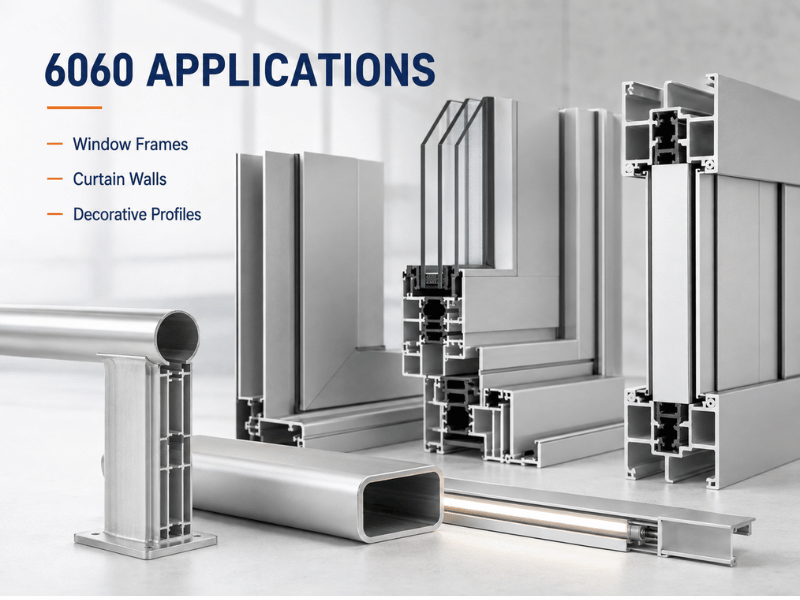
Il vantaggio distintivo del 6060 è la combinazione estrusione-più-finitura. La maggior parte delle applicazioni rientra in categorie in cui un profilo pulito, complesso e pronto per l'anodizzazione conta più della capacità di carico.
Telai Architettonici e Facciate Continue
Il dominio principale. Telai per finestre, telai per porte, montanti per facciate continue e sezioni per facciate utilizzano il 6060 perché si estrude in forme sottili a parete sottile e si anodizza fino a ottenere una superficie brillante uniforme. La T5 è la tempra architettonica standard qui — bilancia resistenza e stabilità dimensionale direttamente all'uscita dalla pressa.
Corrimano, Ringhiere e Profili Decorativi
Balaustre, corrimano e profili per interni si affidano alle stesse proprietà: superfici estruso lisce, buona risposta all'anodizzazione e resistenza sufficiente per elementi non strutturali o a carico leggero. Dove l'aspetto estetico è la priorità, il 6063 è spesso citato come riferimento estetico — ma il 6060 mantiene tolleranze di parete più fini in sezioni complesse.
Tubolari per Mobili e Beni di Consumo
Tubolari per mobili, strutture espositive e prodotti di consumo utilizzano il 6060 per il suo peso ridotto, la formabilità nelle tempra più morbide e il costo rispetto alle leghe a resistenza più elevata. La T4 è rilevante quando il pezzo richiede piegatura o formatura secondaria dopo l'estrusione.
Interni per Trasporti e Illuminazione
Profili per interni di trasporto, binari per illuminazione e corpi di apparecchi utilizzano il 6060 dove la riduzione del peso e una finitura pulita contano ma il carico strutturale è basso. Le applicazioni esterne per trasporti devono confermare l'esposizione alla corrosione prima della specifica — vedere la nota sulla corrosione nella sezione Lavorazione del 6060.
Opzioni di Tempra del 6060
Il 6060 è fornito in una gamma di tempra che bilanciano resistenza e formabilità. Per la maggior parte delle estrusioni architettoniche, la T5 domina; la T6 e la T66 sono scelte quando la sezione deve sopportare un carico maggiore.
| Temperamento | Trattamento | UTS (MPa) | YS (MPa) | Il migliore per | Evitare quando |
|---|---|---|---|---|---|
| O | Ricotto (morbido) | ~120 | ~55 | Operazioni di piegatura e formatura | Qualsiasi uso strutturale o portante |
| T4 | Trattamento termico + stagionatura naturale | ≥120 | ≥60 | Parti che richiedono formatura a freddo secondaria (piegatura, flangiatura) | È richiesta un'elevata resistenza |
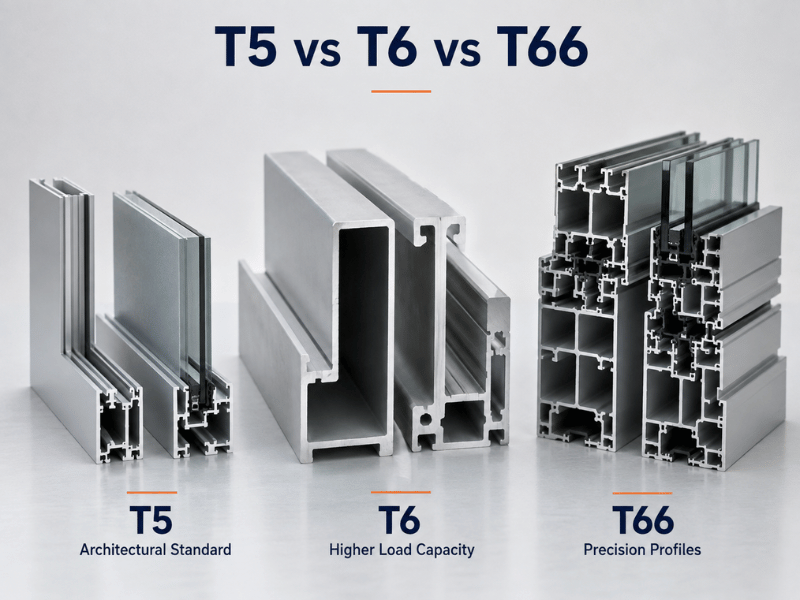
| T5 | Raffreddata dall'estrusione + invecchiamento artificiale | ≥160 | ≥120 | Telai standard per finestre/porte, profili architettonici | Carico strutturale elevato |
| T6 | Trattamento termico di soluzione + invecchiamento | ≥190 | ≥150 | Sezioni a carico moderato, telai ad alte prestazioni | Pareti estremamente sottili dove la T5 è già sufficiente |
| T66 | T6 potenziata (estrusione/raffreddamento controllato) | ≥215 | ≥160 | Facciate continue ad alte prestazioni, profili di precisione | Profili standard sensibili ai costi |
Quando la T5 è la Scelta Giusta
La T5 è la tempra architettonica di riferimento. Viene raffreddata direttamente dalla pressa di estrusione e invecchiata, quindi raggiunge una resistenza moderata senza una tempra separata — mantenendo bassi i costi e alta la qualità superficiale. Per profili standard di finestre, porte e finiture, la T5 è l'opzione predefinita.
Quando la T6 o la T66 Sono Più Adatte
Se la sezione deve sopportare un carico strutturale reale — campate più ampie per facciate continue, balaustre portanti — passare alla T6 (≥150 MPa di snervamento) o alla T66 (≥160 MPa di snervamento). La T66 aumenta lo snervamento attraverso un controllo più rigoroso di estrusione e raffreddamento ed è la scelta comune per facciate continue ad alte prestazioni. Il costo è un percorso di processo leggermente più complesso.
Nota su O e T4
O e T4 sono tempra di formabilità, non tempra di resistenza. La O è completamente morbida; la T4 è invecchiata naturalmente e ancora sufficientemente duttile per piegatura e flangiatura post-estrusione. Specificarle solo quando il pezzo sarà formato dopo la fornitura — per profili finiti, T5/T6/T66 sono le opzioni pratiche.
6060 vs 6061 vs 6063
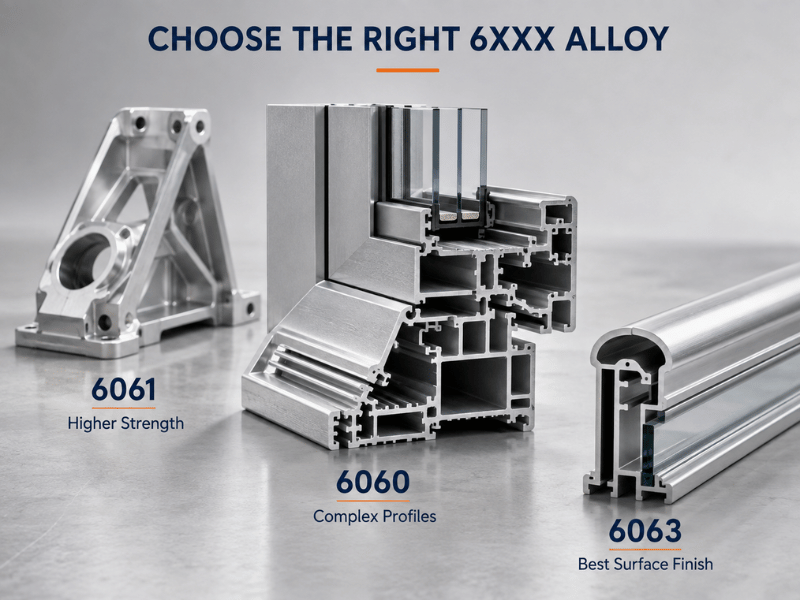
Queste tre leghe della serie 6000 coprono la maggior parte delle decisioni relative a estrusione e fabbricazione generale. La tabella mappa i criteri di selezione.
| Proprietà | 6060 | 6061 | 6063 |
|---|---|---|---|
| Composizione principale | Al + 0,5% Mg + 0,45% Si | Al + 1,0% Mg + 0,6% Si | Al + 0,7% Mg + 0,4% Si |
| Resistenza T6 (UTS / YS) | 190 / 150 MPa | 310 / 276 MPa | 215 / 170 MPa |
| Estrudibilità | Eccellente (pareti sottili complesse) | Buono (forme meno complesse) | Eccellente (finiture lisce) |
| Resistenza alla corrosione | Buono | Molto buono | Eccellente |
| Saldabilità | Molto buono | Eccellente | Molto buono |
| Finitura superficiale (anodizzata) | Buono | Buono | Eccellente (migliore per l'estetica) |
| Uso tipico | Telai per finestre, mobili, profilati decorativi | Parti strutturali, telai per biciclette, applicazioni marine | Profilati architettonici, tubi, ringhiere |
Quando vince il 6060
Profili complessi a parete sottile dove la finitura conta più della resistenza. Il 6060 estrude sezioni trasversali intricate ad alta velocità di pressa e si anodizza in una superficie brillante e pulita. Per telai per finestre, tubi per mobili e profilati decorativi, è la scelta pragmatica — il 6061 è più resistente ma meno disposto a formare sezioni fini, e il 6063, pur essendo il punto di riferimento per la finitura superficiale, cede leggermente sull'estrudibilità di pareti complesse.
Formabilità dopo la fornitura. In O o T4, il 6060 si piega e flangia senza cricche. Quando il pezzo richiede lavorazioni a freddo secondarie, il 6060 (o 6063) è più adatto del 6061-T6.
Quando 6061 o 6063 Si Adattano Meglio
Carico strutturale o semplicità di saldatura. Il 6061-T6 offre circa il 60% di resistenza allo snervamento in più (276 MPa) e salda con tutti i processi comuni. Per telai di macchine, telai per biciclette e strutture marine dove il carico è predominante, il 6061 è lo standard. La guida all'alluminio 6061 copre l'intero profilo.
Massima estetica anodizzata. Il 6063 produce lo strato anodizzato più fine e uniforme della famiglia ed è il default per profilati decorativi ad alta visibilità e ringhiere in tubo. Se il progetto è puramente estetico con geometria semplice, il 6063 supera il 6060 sulla qualità superficiale. La guida all'alluminio 6063 copre i dettagli.
Lavorazione del 6060
Estrusione
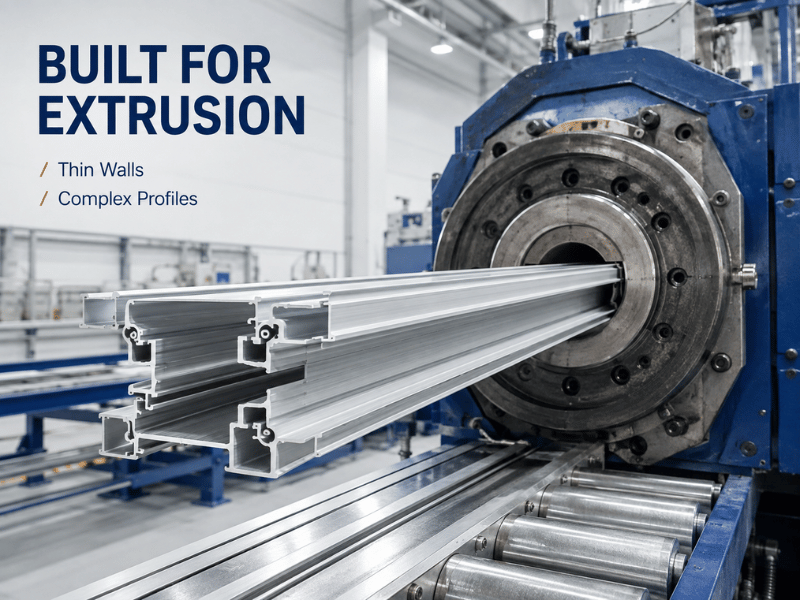
L'estrusione è la via di produzione primaria per il 6060. Le temperature tipiche della billetta vanno da 480–520°C con temperature di uscita mantenute sotto ~550°C per evitare lacerazioni superficiali. La bassa resistenza alla deformazione consente alte velocità di estrusione (comunemente 20–80 m/min a seconda della forma e della pressa) e una produzione stabile, anche per sezioni multi-cavità e a parete sottile. Tolleranze dimensionali strette sono ottenibili direttamente dalla filiera.
Lavorazione meccanica
Il 6060 si lavora a macchina in modo pulito con utensili in carburo standard. Nei temperamenti T5/T6 è stabile per rifilatura, foratura e fresatura leggera; tasche più profonde o tagli asimmetrici devono tenere conto delle tensioni residue nella sezione. È più morbido del 6061, quindi l'usura degli utensili è bassa e la finitura superficiale è facile da mantenere — utile per parti che combinano estrusione e lavorazione CNC secondaria.
Saldatura
Il 6060 è facilmente saldabile con TIG (GTAW) e MIG (GMAW) utilizzando apporti standard della serie 4xxx o 5xxx. Un'avvertenza: la resistenza post-saldatura nella zona termicamente alterata (l'area adiacente alla saldatura) scende al di sotto del valore T6 del materiale base. Progettare il giunto come elemento limitante della resistenza, oppure scegliere T4/T5 dove la perdita di resistenza post-saldatura è meno critica. Per saldature critiche, confermare la procedura in base al carico di servizio.
Trattamento superficiale e corrosione
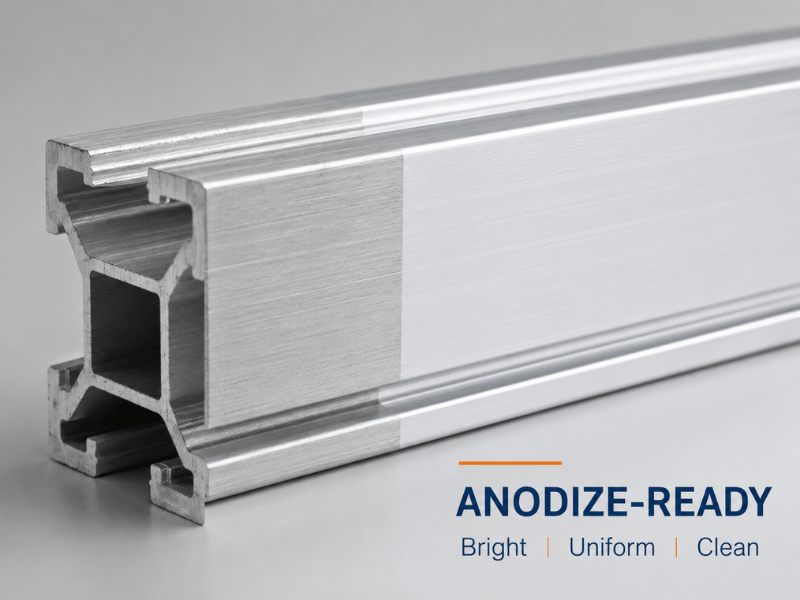
Il 6060 si anodizza bene — l'anodizzazione con acido solforico (Tipo II) produce uno strato brillante e uniforme, motivo per cui domina i profili architettonici visibili. La verniciatura a polvere (incluso RAL 9016) e la lucidatura sono anch'esse standard. La resistenza alla corrosione è buona in ambienti atmosferici e industriali leggeri ed è adatta per uso architettonico interno e per la maggior parte degli esterni. Per immersione diretta in acqua salata o esposizione aggressiva a cloruri, è richiesta protezione — anodizzazione più topcoat sigillato, oppure passaggio a 6061/6082 o a una lega della serie 5xxx.
Vantaggi e Limitazioni in Sintesi
| Fattore | Vantaggio | Limitazione |
|---|---|---|
| Estrudibilità | Scorre in sezioni sottili e complesse ad alta velocità di pressa | — |
| Finitura superficiale | Si anodizza in uno strato brillante e uniforme | Sotto il 6063 per estetica di punta |
| La forza | Adeguato per ruoli architettonici e strutturali leggeri | ~60% del 6061-T6; non per elementi altamente caricati |
| Saldabilità | Facilmente saldabile con TIG/MIG | Perdita di resistenza in ZTA sotto il T6 del materiale base |
| Resistenza alla corrosione | Buono in uso atmosferico/industriale leggero | Non per immersione in acqua salata senza protezione |
| Costo | Inferiore rispetto alle leghe ad alta resistenza | — |
| Formabilità | Si piega e flangia in O e T4 | T6/T66 non sono temperamenti per formatura |
Conclusione
L'alluminio 6060 occupa una posizione chiara nella serie 6000: scambia la resistenza di punta per il miglior comportamento di estrusione e una finitura anodizzata pulita nella sua famiglia. Per telai per finestre, tubi per mobili, profilati decorativi e profili architettonici leggeri dove complessità di forma e qualità superficiale sono predominanti, il 6060 è il default pratico. Il compromesso è altrettanto chiaro — resistenza moderata e limitata resistenza alla corrosione in acqua salata significano che non è un sostituto del 6061 o 6082 in servizio strutturale o marino.
Linsy Aluminum fornisce Lega di alluminio 6060 in forme di profilato estruso, tubo, barra, piastra e filo nei temperamenti O, T4, T5, T6 e T66. Fornitura diretta dalla fabbrica con documentazione MTC su ogni ordine e rapporti di prova SGS disponibili su richiesta significa che il materiale arriva con piena tracciabilità. Lavorazioni interne — lavorazione CNC, saldatura TIG/MIG, taglio laser e finitura superficiale inclusa anodizzazione e verniciatura a polvere — supportano sia la consegna del solo materiale che quella pronta per la fabbricazione. Produzione personalizzata con MOQ basso copre sezioni trasversali e specifiche non standard con un tempo di consegna tipico di 10–60 giorni.
Inviare il disegno o la specifica a Linsy Aluminum per una verifica del temperamento e della sezione del 6060, oppure richiedere un preventivo per il proprio progetto.
Domande frequenti
Qual è la differenza tra 6060 e 6063?
Entrambe sono leghe da estrusione Al-Mg-Si a bassa resistenza e sono spesso intercambiabili per profilati decorativi. Il 6063 produce la superficie anodizzata più fine e uniforme ed è il punto di riferimento per lavori decorativi ad alta visibilità, mentre il 6060 estrude sezioni a parete sottile più complesse a maggiore velocità di pressa. Se la geometria è intricata, orientarsi sul 6060; se la perfezione superficiale è la priorità su forme semplici, orientarsi sul 6063.
Quale temperamento dovrei specificare per telai per finestre?
T5. Viene raffreddato dalla pressa di estrusione e invecchiato artificialmente, raggiungendo resistenza moderata (≥120 MPa di snervamento) senza tempra separata, il che mantiene costo e qualità superficiale ottimali per profili standard di finestre e porte. Passare a T6 o T66 solo quando la sezione deve sopportare un carico strutturale maggiore.
Il 6060 può essere saldato con attrezzature standard?
Sì. La saldatura TIG e MIG funzionano entrambe con apporti standard della serie 4xxx o 5xxx. L'unica limitazione è la perdita di resistenza post-saldatura nella zona termicamente alterata per sezioni T6/T66 — progettare il giunto aspettandosi quella riduzione, oppure usare T4/T5 dove la perdita di resistenza è meno critica.
Il 6060 è adatto per ambienti marini o acqua salata?
Per esposizione atmosferica e industriale leggera, sì — è comunemente usato in servizio architettonico esterno. Per immersione diretta in acqua salata o contatto prolungato con cloruri, richiede anodizzazione più topcoat sigillato, oppure una lega diversa come 6061, 6082 o una serie 5xxx. Il 6060 nudo si corrode per vaiolatura in condizioni ricche di cloruri.
A quali specifiche e norme conforma il 6060?
Il 6060 è fornito secondo le comuni norme per estrusi e barre, tra cui ASTM B221, EN 755, EN 12020 e GB/T 6892. Le designazioni equivalenti sono EN AW-6060, UNS A96060 e ISO Al-MgSi0.5. Confermare la norma e la tempra esatte sul certificato di prova del produttore prima di finalizzare una sezione trasversale o un calcolo di carico.