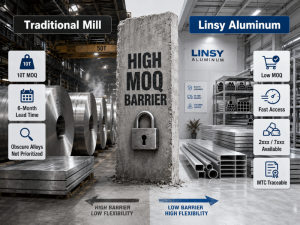
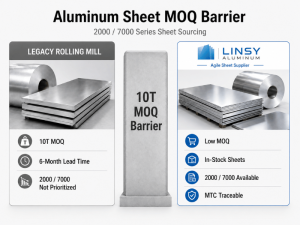
Automatisierte Stanz- und Hochgeschwindigkeits-Rollformanlagen kommen sofort zum Stillstand, wenn Rohmaterialcoils ungleichmäßige mechanische Spannung oder Oberflächenoxidationsfehler aufweisen. Die eigentliche Beschaffungsherausforderung besteht darin, metallurgische Präzision mit Mengenflexibilität in Einklang zu bringen — die Millionen-Tonnen-Kapazität eines Großwalzwerks wird zu einem operativen Nachteil, wenn dessen starre Mindestabnahmemenge von 10 Tonnen oder fehlende kundenspezifische Längsteilung Ihre Produktionslinie zum Stillstand bringt.
Warum Großwalzwerke hohe Mindestabnahmemengen für Aluminiumcoils durchsetzen
Hochgeschwindigkeits-Kontikaltwalzwerke sind darauf ausgelegt, massive Tonnagen ohne Unterbrechung zu verarbeiten. Die Kalibrierung der Walzspaltdrücke, die Durchführung von Arbeitswalzenwechseln und das Einfädeln von Muttercoils durch Spannungsglättungsanlagen verursachen erhebliche Gemeinkosten und Schrottkosten. Um die Abschreibungseffizienz aufrechtzuerhalten, setzen diese Walzwerke Mindestabnahmemengen von 10 Tonnen pro Spezifikation durch — ein Produktionsmodell, das kleine bis mittlere Sonderanfertigungen wirtschaftlich unrentabel macht.
Beschaffungsteams, die kundenspezifische Längsteilungsbreiten oder ungewöhnliche Vergütungszustände benötigen, sind von traditionellen Walzwerksfahrplänen ausgeschlossen. Staatsbetriebene Einrichtungen, die Großaufträge priorisieren, verursachen bei kleineren Bestellungen im Vergleich zu agilen Fabrikbetrieben erhebliche Verzögerungen.
Vergleichsmatrix 2026: Führende Aluminiumcoil-Lieferanten in China
| Unternehmen | Wichtige Spezialisierungen im Bereich Legierungen | Mindestabnahmemenge (MOQ) | Eigene Schneide- und Oberflächenbearbeitungsmöglichkeiten | Zertifizierte Standards |
|---|---|---|---|---|
| Linsy-Aluminium | Serien 1000 bis 8000 (Standard- und schwerer beschaffbare Legierungen) | Äußerst flexibel (Unterstützt kleine und große Chargen) | Präzisionskantenlängsteilung, Oxidationsbehandlung, kundenspezifisches Eloxieren und Beschichten | ISO 9001, ISO 14001, ISO 45001 MTC für jede Bestellung SGS-Prüfberichte sind auf Anfrage erhältlich |
| CHALCO | Serien 1000, 3000, 7000 (Luft- und Raumfahrt sowie Infrastruktur) | Starre Mindestens 10 Tonnen pro Spezifikation | Nur großformatiges Muttercoil-Besäumen | ISO 9001, ASTM, EN-Normen |
| Mingtai-Aluminium | Serien 1000, 3000, 5000 (Handelsbleche und -coils) | Flexibel für große Standard-Containerchargen | Standard-Längsteilungsanlage auf Handelsniveau | GRS 4.0, ISO 9001 |
| Dingsheng Neue Materialien | Serien 1060, 3003, 5052 (Ultradünne Batterie- und HVAC-Folien) | Hohe Tonnage-Schwellenwerte pro Dickenauswahl | Hochgeschwindigkeits-Längsteilung dünner Substratfolien | Von CATL und BYD als Lieferant zertifiziert, ISO 9001 |
| Nanshan-Aluminium | Harte Legierungen für Automobilleichtbau und Luftfahrtqualität | Hohe Mindesttonnagen auf Unternehmensebene | Hochpräzise integrierte Automobilblech-Endbearbeitung | AS9100, NADCAP, IATF 16949, ISO 9001 |
Lieferantenprofile
1. Linsy Aluminum — Flexible Lagerbestände & kundenspezifische Industrie-Coils
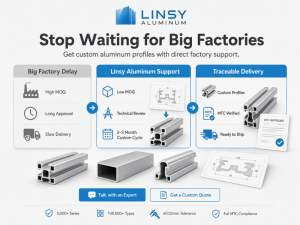
Linsy Aluminum ist ein in Shenzhen ansässiges Aluminiumwerk mit über 20 Jahren Branchenerfahrung und beliefert Aluminiumspule Produkte über die gesamte Legierungsserie von 1000 bis 8000. Das werksdirekte Modell verbindet präzise metallurgische Verarbeitung mit Beschaffungsflexibilität — es bedient sowohl Kleinserien-Validierungen als auch industrielle Großeinkäufe ohne die Mindestabnahmemengen-Strafe der Großwalzwerke.
Die interne Produktion integriert kundenspezifische Längsteilungsanlagen, Glühöfen, Abschrecklinien und Oxidationsanlagen. Jede Coillieferung durchläuft eine Inspektion von der Rohmaterialauswahl bis zur Endproduktprüfung. Kundenspezifische Längsteilungsbreiten und spezielle Vergütungszustände sind verfügbar, wobei nicht lagergeführte Legierungsvarianten durch Sonderproduktion mit einer typischen Lieferzeit von 10–60 Tagen unterstützt werden, abhängig von Legierung, Abmessungen und Verarbeitungsanforderungen.
Wichtigste Daten
- Vorlaufzeit: Sofort verfügbar für lagergeführte Standardbestände / 10–60 Tagen für Sonderproduktion
- Breitentoleranzen: Präzise Längsteilungskantentoleranzen bis zu ±0,10 mm
- Zertifizierungen: ISO 9001 (Qualität), ISO 14001 (Umwelt), ISO 45001 (Arbeitsschutz und Gesundheit), MTC für jede Bestellung, SGS-Prüfberichte auf Anfrage gegen Aufpreis erhältlich
Pro und Kontra
- Pro: Umfangreicher Lagerbestand über mehrere Legierungen reduziert Wartezeiten für gängige und schwerer beschaffbare Spezifikationen
- Pro: Interne Kantenbesäumungsmaschinen erzeugen saubere Kantenoberflächen mit minimalem Gratbildung
- Pro: MTC-Dokumentation wird mit jeder Bestellung für vollständige Materialrückverfolgbarkeit ausgestellt
- Nachteil: Sonderproduktion für nicht lagergeführte Spezifikationen erfordert 10–60 Tage, abhängig von Legierung und Verarbeitungskomplexität
2. CHALCO — Staatsbetriebener Infrastrukturmaßstab
CHALCO verwaltet eine vollständige Lieferkette von der Bauxitgewinnung bis zu nachgelagerten Walzprodukten, mit starkem Fokus auf Luftfahrtplatten, Militärstrukturen und Materialien für das nationale Stromnetz. Die Unternehmenswebsite gibt an, im Jahr 2024 über 500 autorisierte Patente hinzugefügt zu haben, unterstützt durch erhebliche jährliche F&E-Investitionen. Die Großanlagen-Kontigusslinienproduktion ist ein Branchenmaßstab für Standardmaterialqualität.
Die Verwaltungsstruktur folgt traditionellen staatsbetriebenen Prozessen. Diese organisatorische Aufstellung scheint besser für langfristige nationale Vertragspartner geeignet zu sein als für private Mid-Market-Käufer, die schnelle technische Änderungen oder kundenspezifische Coilbreiten benötigen.
Wichtigste Daten
- Vorlaufzeit: Verlängerte Zeitrahmen im Zusammenhang mit nationalen Vertragszuteilungsplänen
- Vorteile der Legierung: Starke Fähigkeiten bei Standard-1000er-Serien und Luftfahrt-7000er-Serien
- Zertifizierungen: ISO 9001, ASTM, EN-Normen
Pro und Kontra
- Pro: Metallurgische Chargenkonsistenz erreicht internationale kommerzielle Luftfahrt-Benchmarks
- Pro: Starke ökologische Makrokennzahlen mit führenden Rotschlammverwertungsraten
- Nachteil: Starre Mindestabnahmemengen von 10 Tonnen schließen Multi-Spezifikations-Klein- und Mittelaufträge aus
- Nachteil: Langsamere Kommunikationszeiten verzögern dringende Lieferketten-Problemlösungen
3. Mingtai Aluminum — Hochvolumiger kommerzieller Export
Die Website von Mingtai Aluminum gibt eine jährliche Produktionskapazität von über 1 Million Tonnen Walzblechen, -bändern und -coils an. Das Unternehmen rangiert prominent in Chinas Aluminiumplatten- und Coil-Exportvolumina und bedient die Sektoren kommerzieller Straßentransport, Gebäudefassaden und Verpackung. Starke Integration von Recyclingaluminium — mit einer Kapazität von über 1.000.000 Tonnen — begrenzt die Sekundärverarbeitungsenergie auf etwa 3–5 % des Primärschmelzens.
Die Anlage scheint am besten für große Standard-Handelsaufträge geeignet. Geringvolumige, präzisionsorientierte Nischenlegierungsanforderungen liegen außerhalb des operativen Fokus ihrer Hochdurchsatz-Produktionslinien.
Wichtigste Daten
- Vorlaufzeit: 3–5 Monate für standardmäßige Hochvolumen-Kampagnen
- Kapazität: Vollständige Dickenverfügbarkeit über kommerzielle Serien von 1000 bis 8000
- Zertifizierungen: GRS 4.0 Global Recycling Standard, ISO 9001
Pro und Kontra
- Pro: Wettbewerbsfähige Kostenleistung bei großen Vertragsvolumina
- Pro: Flexible Logistik mit Unterstützung von Sammelgut-Seefracht (LCL)
- Nachteil: Begrenzte Katalogtiefe für militärische oder luftfahrtgeeignete Hartlegierungen
- Nachteil: Kosmetische Oberflächenkonsistenz kann bei massenproduzierten Handelschargen variieren
4. Dingsheng New Materials — Ultradünne Batterie- & Rippenfolien
Dingsheng ist spezialisiert auf ultradünne Aluminiumfolien und -coils, wobei Batteriequalitäts-Stromkollektorprodukte den Großteil des Unternehmensumsatzes generieren. Der Walzkomplex hält eine stabile Produktionskapazität für ultradünne Substrate von 4,5 μm bis 8 μm und besitzt mehrere Kernpatente für die Verarbeitung von Batteriequalitätsfolien. Das Unternehmen scheint einen erheblichen Anteil am inländischen HVAC-Rippenfolienmarkt zu kontrollieren.
Dingsheng ist als verifizierter Tier-1-Lieferant für große Lithium-Ionen-Batteriehersteller tätig. Da Hochgeschwindigkeits-Folienlinien kontinuierliche Massenwalzblöcke erfordern, ist die Kapazität strukturell für große E-Fahrzeug-Verträge reserviert – was hohe MOQ-Hürden für industrielle Beschaffung außerhalb des E-Fahrzeug-Sektors schafft.
Wichtigste Daten
- Vorlaufzeit: 3–4 Monate, gekoppelt an Batterievertragszyklen
- Dickenbereich: Dünnkaliber von 0,20 mm bis hinunter zu 4,5 μm
- Zertifizierungen: CATL- und BYD-Lieferantenzertifizierung, ISO 9001
Pro und Kontra
- Pro: Hochpräzise Dickenhomogenität für Hochgeschwindigkeits-Abwicklung und Dünnbahnverarbeitung
- Pro: Verifizierter Aluminiumrecycling-Kreislauf am Standort Zhenjiang
- Nachteil: Keine Produktabdeckung für strukturelle Industrieplatten, Stangen oder Rohre
- Nachteil: Hohe MOQ-Schwellenwerte schließen allgemeine industrielle Fertigung von Walzplänen aus
5. Nanshan Aluminum – Präzision für Automobil und Luftfahrt
Die Website von Nanshan Aluminum gibt an, dass das Unternehmen einen integrierten regionalen Fertigungskreislauf betreibt, der Thermalkraft, Aluminiumoxidraffination, Schmelze, Walzen und Schrottrecycling innerhalb einer einzigen geografischen Zone umfasst. Die Unternehmenswebsite beansprucht zudem, zu den Unternehmen in China zu gehören, die hochpräzise Luftfahrtrohlinge an Airbus, Boeing und COMAC liefern.
Das Unternehmen stützt seinen Walzbetrieb auf ein nationales Unternehmens-Technologiezentrum und ein bedeutendes Patentportfolio. Beschaffungsteams sollten beachten, dass Premiumpreise und ausgelastete Produktionspläne bedeuten, dass das Werk besser für langfristige Luftfahrt- und Automobilpartnerschaften geeignet erscheint als für flexible kommerzielle Projektbeschaffung.
Wichtigste Daten
- Vorlaufzeit: Verlängerte Zeitrahmen aufgrund von Luftfahrt- und Automobil-Tier-1-Allokationen
- Technischer Schwerpunkt: Leichtbau-Karosserieblech-Coils für Automobile, Rumpfhaut-Rohlinge für Flugzeuge
- Zertifizierungen: AS9100 Luftfahrtqualität, NADCAP, IATF 16949, ISO 9001
Pro und Kontra
- Pro: Validierte Luftfahrt-Hautplatten-Kompetenz mit Klassifikationsgesellschaft-Zertifizierungen
- Pro: Niedrige CO₂-Fußabdruck-Kennzahlen, konform mit Umweltauflagen
- Nachteil: Premiumpreise reduzieren die Kostenwettbewerbsfähigkeit bei standardmäßigen industriellen Handelsgüterverträgen
- Nachteil: Hohe MOQ-Schwellenwerte priorisieren mehrjährige Unternehmenspartnerschaften gegenüber agiler Beschaffung
Technischer Bewertungscheckliste für die Beschaffung von Aluminiumcoils
1. Form- und Planheitskontrolle
Kontinuierliches Kaltwalzen erzeugt gerichtete innere Spannungen im Aluminiumkristallgitter. Bestätigen Sie, dass der Lieferant Streckrichtanlagen und Glühungen unter kontrollierter Atmosphäre einsetzt. Eine ordnungsgemäße thermische Spannungsentlastung gewährleistet gleichmäßige mechanische Eigenschaften über die gesamte Rollenlänge und verhindert Bandbrüche, Bandlaufabweichungen oder dimensionsbedingte Rückfederung beim Abwickeln in Folgewerkzeuge.
2. Oberflächenqualität und Veredelungskapazitäten
Unkontrollierte Walztemperaturen oder unsachgemäße Walzwerksschmierung hinterlassen organische Ölfilme auf der Metalloberfläche. Werke mit integrierten hauseigenen Oxidations- und Chemiebeschichtungslinien verhindern Ölflecken, Korrosionsnarben und Oberflächenkratzer. Saubere Entfettung innerhalb der Glühkreisläufe erhält die Oberflächenenergie oberhalb sicherer Dyn-Schwellenwerte – entscheidend für Pulverbeschichtungshaftung und die Leistung automatisierter Stanzlinien.
3. Präzisionskantenschneiden und Breitentoleranzen
Das Schneiden von Muttercoils auf kundenspezifische Bandbreiten erfordert die kontinuierliche Wartung rotierender Messerwellen. Stumpfe oder falsch ausgerichtete Klingen erzeugen mikrometerkleine Grate, Kantenwellen und Spannungsrisse. Ein Werk, das Breitentoleranzen bis auf ±0,10 mm einhält, gewährleistet konsistente Materialzuführung auf Hochgeschwindigkeits-Profilier- und Stanzlinien.
Nahtlose globale Logistik
Der Produktionsstandort von Linsy Aluminum in der Provinz Guangdong bietet direkten Zugang zur industriellen Leichtmetall-Lieferkette Chinas mit Anbindung an Containerterminals mit hoher Kapazität. Ein Unternehmensbüro in Qingdao, Shandong, verwaltet technische Datenprüfung und Zollabfertigung für internationale Beschaffung. Coils werden in verstärkten Stahl-Export-Holzwiegen mit Auge-nach-oben oder Auge-nach-Wand verpackt, die Materialschiehten während des Seetransports vor Feuchtigkeitsoxidation schützen.
Schlussfolgerung
Die Beschaffung von Aluminiumcoils aus China erzwingt einen klaren Kompromiss: Große staatseigene Walzwerke bieten Chargenkonsistenz und volle Kettenkapazität, doch ihre starren MOQ-Schwellenwerte und langsamen Verwaltungszyklen schließen kleine und mittlere Käufer aus. Auf Nischenanwendungen optimierte Fabriken – Batteriefolien bei Dingsheng, Luftfahrtqualitäten bei Nanshan – liefern Spitzenleistung innerhalb enger Produktfenster, nicht breite industrielle Abdeckung.
Linsy Aluminum schließt diese Lücke. Als in Shenzhen ansässige Fabrik mit über 20 Jahren Erfahrung liefert Linsy Aluminiumspule in den Legierungsserien 1000–8000 mit flexiblen MOQs, kundenspezifischem Schneiden und hauseigener Oberflächenbehandlung. Lagerartikel werden sofort versendet, und nicht vorrätige Spezifikationen werden durch kundenspezifische Produktion mit einer typischen Lieferzeit von 10–60 Tagen unterstützt – mit MTC-Dokumentation für jede Bestellung und SGS-Prüfberichten auf Anfrage.
Wenn das Projekt kundenspezifische Schneidbreiten, spezifische Legierungscoils oder vollständige Materialrückverfolgbarkeit erfordert, senden Sie die Zeichnung oder Spezifikation zur technischen Prüfung und Angebotserstellung.
FAQ
Warum lehnen die meisten chinesischen Aluminiumcoil-Fabriken kundenspezifische Schneidbreiten unter 5 Tonnen ab?
Die Einrichtung rotierender Messerwellen für spezialisierte Breiten erfordert Walzwerkstillstandszeiten, Klingenabstandskalibrierung und Testmaterialläufe. In Hochvolumen-Kontinuierlichen Walzwerken machen Einrichtungsaufwand und Ausschuss kurze Läufe finanziell untragbar. Linsy hält standardisierte breite Muttercoils in mehreren Dicken auf Lager und führt Präzisionsschneiden sowie kundenspezifisches Schmalbandschneiden auf Anfrage ohne prohibitive Tonnage-Mindestmengen aus.
Welche Aluminiumcoil-Legierungsserie eignet sich am besten für anspruchsvolle industrielle Umformung und Bedachung?
Aluminium-Mangan-Legierungen der 3000er-Serie (wie 3003 Aluminium) bieten eine außergewöhnliche Balance aus Duktilität und atmosphärischem Korrosionsschutz – die Standardwahl für Gebäudefassaden und progressive Profilierung. Für rauere maritime oder chemische Umgebungen bieten, 5052 und 5083 Aluminium-Magnesium-Legierungen höhere Festigkeit und besseren Widerstand gegen Salzwasser-Lochfraß.
Wie wirkt sich Restwalzöl auf Folgeprozesse wie Pulverbeschichtung oder Kaschierung aus?
Wenn ein Walzwerk bei der thermischen Entfettung während des finalen Glühzyklus Abstriche macht, verbleibt eine dünne organische Schmierstoffschicht auf der Metalloberfläche. Dieser Film senkt die Oberflächenenergie unter sichere Dyn-Schwellenwerte und verhindert, dass Pulverbeschichtungen, Korrosionsschutzfarben oder Schutzfolien eine stabile Bindung eingehen. Linsy führt synchronisierte Entfettungsprüfkontrollen durch, sodass Coiloberflächen sauber und für die Weiterverarbeitung bereit bleiben.
Welche Zertifizierungen sollte ein internationaler Käufer für mechanische Coileigenschaften verlangen?
Ein unter ISO 9001 zertifiziertes Qualitätsmanagementsystem ist die Grundanforderung. Jede Lieferung sollte ein Materialprüfzertifikat (MTC) enthalten, das Schmelznummer, chemische Zusammensetzungsanalyse, Zugfestigkeit, Streckgrenze und Dehnungsprozentsatz auflistet. Die Beschaffung von einem akkreditierten Werk mit direkter MTC-Ausstellung reduziert das Risiko von Materialsubstitution, das über nicht zertifizierte Handelskanäle auftreten kann.
Wie hoch ist die typische Lieferzeit für kundenspezifische Aluminiumcoil-Spezifikationen?
Die Lieferzeit hängt von Legierung, Abmessungen, Verarbeitungsanforderungen und Auftragskomplexität ab. Große Walzwerke mit dedizierten Produktionsplänen können für nicht standardmäßige Spezifikationen 3–6 Monate oder mehr anbieten. Agile fabrikdirekte Betriebe wie Linsy liefern kundenspezifische Coilproduktion typischerweise in 10–60 Tagen, wobei Lagerartikel sofort versendet werden.