Introduction
Aluminum and titanium are both lightweight, strong, and corrosion-resistant metals. They serve very different positions in the material market, however. Titanium costs 10–30 times more per kilogram than aluminum, and each metal dominates specific applications where its unique combination of properties delivers the best results.
This guide compares aluminum and titanium across the dimensions that matter most for material selection: physical properties, strength-to-weight ratio, corrosion and temperature resistance, and machinability. The goal is to help engineers and procurement teams identify which material fits their application — not which material is “better” in absolute terms.
Aluminum vs Titanium: Key Properties Compared
Physical Properties
|
Property |
Aluminum |
Titanium |
|
Melting Point |
~660 °C |
~1668 °C |
|
Tensile Strength |
70–700 MPa (varies by alloy) |
900–1200 MPa (varies by grade) |
|
Corrosion Resistance |
Excellent (forms protective oxide layer) |
Exceptional (resists saltwater, acids, and alkalis) |
Both metals have a high strength-to-weight ratio and form their own passive oxide layers. Titanium’s higher melting point and broader chemical resistance make it the default choice for extreme environments. Aluminum’s lower cost and easier processing make it the practical choice for most commercial applications.
Strength-to-Weight Ratio
|
Property |
Aluminum |
Titanium |
|
Strength-to-Weight Ratio |
~158 kN·m/kg |
~187 kN·m/kg |
|
Tensile Strength |
140–690 MPa |
345–1,380 MPa |
|
Density |
~2.7 g/cm³ |
~4.5 g/cm³ |
|
Cost |
Lower (commodity pricing) |
Higher (10–30x aluminum per kg) |
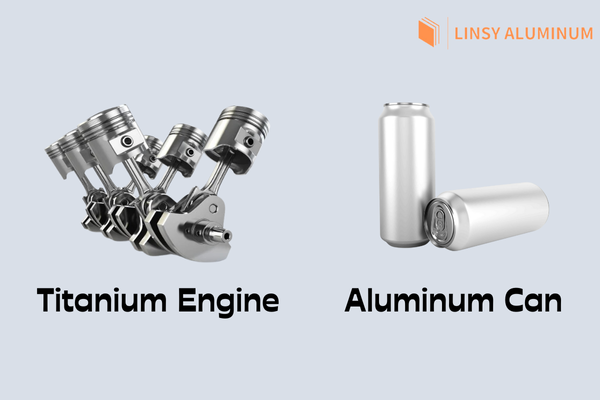
Titanium achieves a higher strength-to-weight ratio than aluminum, which is why it appears in aerospace engines and high-performance structural components. However, titanium is roughly 60% denser than aluminum. For applications where absolute weight savings matter more than peak tensile strength — such as aircraft skins, automotive body panels, and consumer electronics housings — aluminum delivers better results at a fraction of the material cost.
Corrosion and Temperature Resistance
|
Property |
Aluminum |
Titanium |
|---|---|---|
|
Protective Layer |
Alumina (Al₂O₃) oxide layer; less effective in acids and alkalis |
Titanium dioxide (TiO₂) layer; resists air, water, acids, and alkalis |
|
Typical Environments |
General-purpose; moderate corrosive exposure (packaging, construction) |
Marine, chemical processing, medical implants, deep-sea hardware |
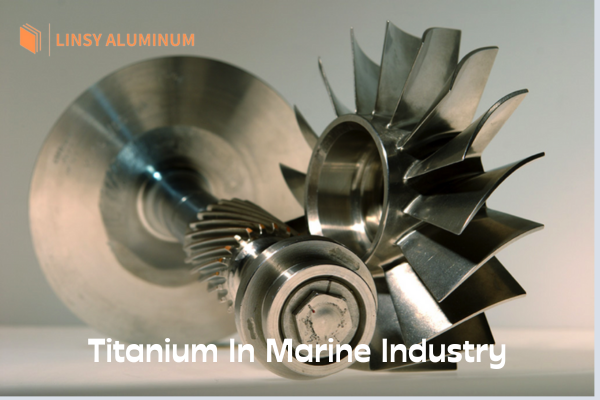
Titanium’s corrosion resistance far exceeds aluminum’s in aggressive chemical environments, including saltwater, strong acids, and alkalis. Aluminum’s oxide layer provides adequate protection in atmospheric and freshwater conditions but requires anodizing or coatings for more demanding exposure.
|
Property |
Aluminum |
Titanium |
|---|---|---|
|
Melting Point |
~660°C |
~1668°C |
|
Strength Retention |
Loses strength above ~200°C |
Retains strength up to ~600°C |
|
Thermal Conductivity |
~205–235 W/m·K |
~6–20 W/m·K |
|
Applications |
Heat sinks, radiators, heat exchangers (high thermal conductivity) |
Aerospace engines, exhaust components (high-temperature strength retention) |
Recommendations
- Choose Aluminum If: The application requires good corrosion resistance in moderate conditions or high thermal conductivity (e.g., electronics cooling, automotive radiators).
- Choose Titanium If: The project demands exceptional corrosion resistance or sustained performance at elevated temperatures (e.g., aerospace engine components, marine hardware, chemical process equipment).
Machinability

Machinability is one of the widest practical gaps between these two metals. Aluminum cuts cleanly at high speeds with standard tooling. Titanium resists machining due to its low thermal conductivity, tendency to work-harden, and propensity for galling on cutting tools.
|
Property |
Aluminum |
Titanium |
|
Ease of Machining |
High: soft, cuts at fast speeds, minimal tool wear |
Low: requires slow speeds, specialized tooling, and cooling |
|
Surface Finish |
Smooth finishes achievable with standard tooling |
Challenging — risk of galling and built-up edge on tools |
|
Cost of Machining |
Low: faster cycle times and lower tool consumption |
High: slow speeds, frequent tool changes, additional cooling |
|
Applications |
High-volume production, automotive parts, consumer electronics |
Aerospace components, medical implants, high-performance applications |
Recommendations
- Choose Aluminum: When speed, cost-efficiency, and ease of machining are primary project drivers.
- Choose Titanium: When the part must withstand extreme stress or harsh environments, and the higher per-part machining cost is justified by performance requirements.
How to Choose Between Aluminum and Titanium
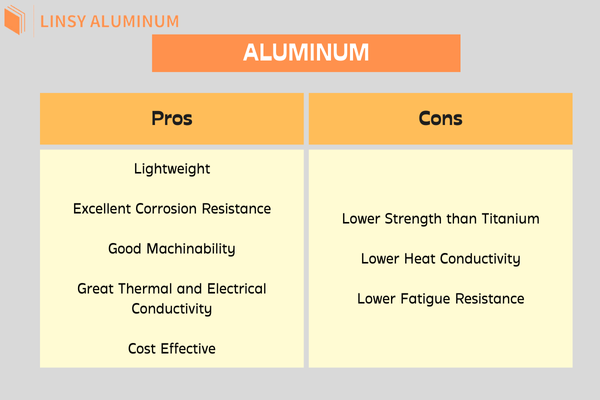
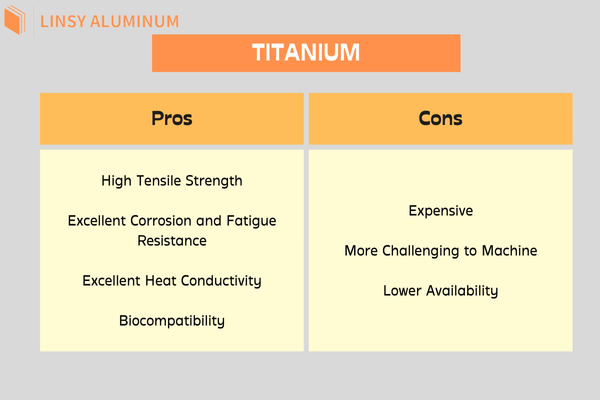
Material selection is a trade-off between performance requirements and project constraints. There is no universal “better” metal — only the metal that fits your specific situation.
Choose Titanium If:
- Your application operates in extreme environments: aerospace engines, deep-sea hardware, chemical processing, or medical implants.
- Biocompatibility is a hard requirement.
- The budget allows for 10–30x higher material cost and the additional machining expense.
Choose Aluminum If:
- Lightweight design and cost efficiency are primary drivers (e.g., vehicle components, consumer electronics, building materials).
- High thermal or electrical conductivity is needed.
- Your fabrication process requires fast machining, easy welding, and flexible forming — without the specialized tooling titanium demands.
Conclusion
Aluminum and titanium each serve essential roles in modern manufacturing, but they belong to different parts of the material spectrum. Titanium excels in applications where its extreme corrosion resistance, high-temperature strength, and biocompatibility justify its cost — aerospace engines, surgical implants, and deep-sea equipment. For the other 95% of manufacturing, where budget, formability, and material availability carry more weight, aluminum is the pragmatic choice.
Linsy Aluminum is a Shenzhen-based aluminum factory with 20+ years of industry experience, supplying plate, sheet, bar, tube, wire, coil, profile, and block in 1000 through 8000 series alloys. Whether you need stock material from inventory or low-MOQ custom production with a 10–60 day lead time, Linsy provides factory-direct supply backed by ISO 9001, ISO 14001, and ISO 45001 management systems. Every order includes a Material Test Certificate (MTC), and SGS test reports are available on request.
In-house capabilities include CNC machining, TIG (GTAW) welding, MIG (GMAW) welding, laser cutting, and surface finishing — including anodizing, polishing, mill finish, powder coating to RAL 9016, and PVC protective film.
Contact Linsy Aluminum today to discuss your aluminum requirements and request a quote.
Other comparisons:
Frequently Asked Questions
Which costs more, aluminum or titanium?
Titanium costs 10–30 times more than aluminum per kilogram. This price difference reflects titanium’s higher extraction and refining costs, more limited global supply chain, and the energy-intensive Kroll process used to produce titanium sponge. Aluminum’s lower cost comes from abundant bauxite ore and mature, scaled-up smelting infrastructure.
When is titanium worth the premium over aluminum?
Titanium earns its cost in applications where failure is unacceptable and aluminum cannot perform: aerospace engine components operating above 400°C, surgical implants requiring biocompatibility, deep-sea hardware exposed to saltwater at extreme pressures, and chemical process equipment handling strong acids. For these use cases, titanium is not “expensive” — it is the only material that works. For applications where aluminum’s properties are sufficient, the premium is rarely justified.
Which metal offers better corrosion resistance?
Titanium offers superior corrosion resistance, particularly in saltwater, strong acids, and alkalis. Its passive TiO₂ layer is chemically more robust than aluminum’s Al₂O₃ layer. Aluminum provides good corrosion resistance in atmospheric and freshwater environments, but anodizing or protective coatings become necessary in more aggressive conditions where titanium would resist corrosion without additional treatment.
Why is titanium harder to machine than aluminum?
Titanium’s low thermal conductivity traps heat at the cutting edge, causing rapid tool wear. It also work-hardens and tends to gall — sticking to and tearing cutting tools instead of shearing cleanly. These properties demand slow cutting speeds, rigid setups, and copious coolant. Aluminum machines easily at high speeds with standard tooling, which is why machined aluminum parts are far more common in volume production.
Which metal is lighter, aluminum or titanium?
Aluminum is lighter. Aluminum has a density of approximately 2.7 g/cm³, while titanium is approximately 4.5 g/cm³ — about 60% denser. However, titanium’s higher strength can sometimes allow thinner wall sections, partially offsetting the weight penalty in strength-critical designs. For applications where absolute minimum weight is the priority and strength requirements are moderate, aluminum is the lighter choice.
How can I tell titanium and aluminum apart?
Titanium feels noticeably denser for a given volume and produces a darker grey surface tone compared to aluminum’s lighter silver appearance. Titanium does not develop the dull grey oxide film commonly seen on aluminum. Titanium also has much lower electrical conductivity and produces white sparks when ground, while aluminum does not spark. A simple density test — weighing a known volume — provides the most reliable field identification.