铝合金 3003 H14 综合指南

308751729937665_.pic

免费样品

308771729937665_.pic

中国制造商

308781729937665_.pic

快速反应

308761729937665_.pic

批量购买折扣

308771729937665_.pic

中国制造商

主要亮点

  • 3003 H14 is a manganese-strengthened 3000-series alloy that forms and shapes easily while keeping good corrosion resistance.
  • The H14 temper means strain-hardened (cold-worked) to about half-hard, giving moderate strength without heat treatment.
  • It is non-heat-treatable, so strength comes from cold working rather than post-weld heat treatment.
  • Common uses include roofing, gutters, heat exchangers, fuel tanks, and general sheet fabrication.
  • Compared with 5052 it forms better; compared with 6061 it is cheaper and easier to work but offers lower strength.

导言

3003 H14 aluminum is one of the most widely used general-purpose aluminum alloys. It balances moderate strength, excellent formability, and good corrosion resistance for construction, automotive, and manufacturing work.

This guide explains what 3003 H14 is, how its chemistry and H14 temper affect performance, where it is used, and how it compares with 5052 and 6061. If you need stock or cut-to-size material, see our 3003 铝合金 product range.

了解 3003 H14 铝合金

3003 H14 aluminum alloy

3003 belongs to the 3000 series, where manganese is the main alloying element. The added manganese raises strength above near-pure alloys such as 1100 while keeping the alloy easy to form and weld.

The “H14” part describes the temper. In aluminum temper designations, H means strain-hardened and the following digits describe how much cold work was applied. H14 is roughly half-hard, so the material is stronger and harder than the annealed (O) condition but still easy to bend and shape.

化学成分

3003 is made to standard composition limits, so quality stays consistent from batch to batch. Manganese (Mn) is the key addition at about 1.0-1.5%, and it is what lifts strength above pure aluminum. Small amounts of iron, silicon, copper, and zinc are present and affect casting, corrosion behavior, and mechanical properties.

要素 百分比(按重量计的 %)
铝 (Al) ~98.7%
锰 (Mn) ~1.0-1.5%
铜 (Cu) ≤0.20%
硅 (Si) ≤0.60%
铁(Fe) ≤0.70%
锌 (Zn) ≤0.10%

主要特性和优势

The main advantage of 3003 H14 is formability. It bends, spins, and draws well, which simplifies manufacturing and widens design choices. Because it cannot be heat-treated, its strength comes from cold working rather than heat.

It also resists corrosion well, so it suits outdoor and wet environments without extra coatings. The table below lists typical property values.

财产 价值
拉伸强度 ~22,000 PSI (≈152 MPa)
屈服强度 ~21,000 PSI (≈145 MPa)
断裂伸长率 ~8%
密度 ~2.73 g/cm³
导热性 ~160 W/m·K
耐腐蚀性 优秀

H14 温度意味着什么?

What does the H14 temper mean

In aluminum, “temper” describes the condition produced by mechanical or thermal treatment. Temper codes pair a letter with digits; for the 3000 series, H tempers mean strain-hardened.

H14 means the alloy was cold-worked to about half the hardness of a fully hard H18 temper. A higher second digit means more cold work and greater strength. Knowing the temper helps engineers pick the right balance of strength and formability.

Common Applications of 3003 H14 Aluminum

建筑业

Aluminum in the construction industry

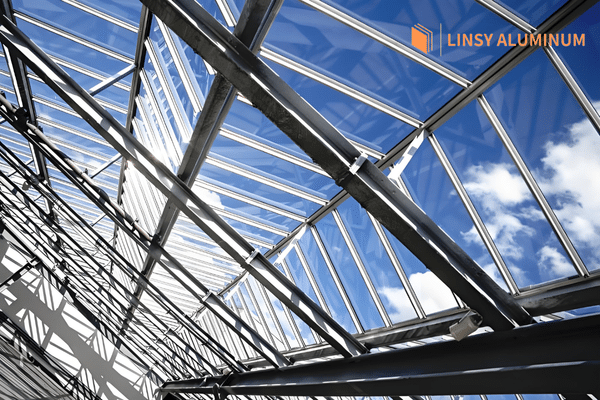
Construction needs light, corrosion-resistant materials, and 3003 H14 fits well. It is widely supplied as 3003 铝板 for building and architectural work.

  • Roofing and siding: low weight reduces structural load while weather resistance protects the building.
  • Rain gutters and downspouts: corrosion resistance keeps them working for years with little maintenance.
  • Flashing and trim: easy forming lets fabricators shape custom profiles that seal openings.

汽车行业

Aluminum in the automotive industry

Carmakers use 3003 H14 to cut weight without high cost. It is not as strong as 6061 or steel, but it is ideal for non-structural parts that need formability and corrosion resistance.

  • Radiators and heat exchangers: good thermal conductivity and corrosion resistance suit cooling systems. Drawn 3003 铝圆管 is common here.
  • Interior trim and moldings: light, strong, and easy to finish for decorative parts.
  • 燃料箱: non-sparking behavior adds safety to fuel systems.

包装行业

Aluminum in the packaging industry

3003 H14 is popular in packaging because it is strong, formable, and consistent with aluminum standards. Width and thickness can be customized, so it fits many packaging needs better than carbon steel in weight-sensitive uses.

3003 H14 铝材的优缺点

3003 pros and cons

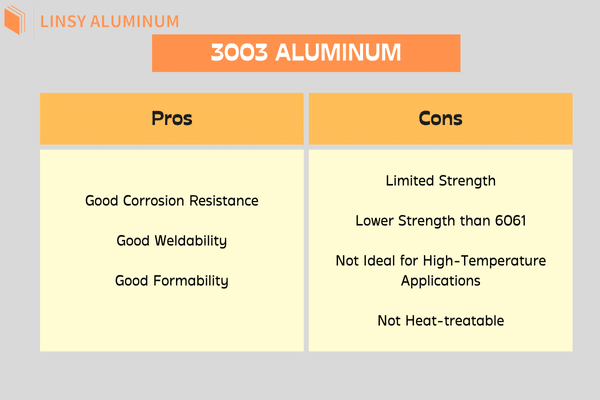
Like any engineering material, 3003 H14 has trade-offs. It forms and welds easily, resists corrosion, and has moderate tensile strength (about 20-26 ksi). The limits are low strength for highly stressed parts and no option to raise strength by heat treatment.

Comparison of 3003 with Other Aluminum Alloys

Seeing 3003 H14 next to 5052 and 6061 shows where it fits. The choice comes down to how much strength you need versus how easily the part must form.

Aluminum 3003 vs. 5052

3003 与 5052

Both 3003 and 5052 are non-heat-treatable and gain strength from cold work. 5052 adds magnesium, which gives higher tensile and yield strength, so it suits heavier-load parts. 3003 wins on formability.

财产 3003 H14 5052 H32
拉伸强度 20-26 ksi 31-38 ksi
屈服强度 21 ksi 28 ksi
伸长率 8% 12%
焊接性 良好 很好,但有一些注意事项
成型性 优秀 良好

Pick 5052 when you need more strength; pick 3003 when complex forming matters most.

Aluminum 3003 vs. 6061

3003 与 6061

6061 is heat-treatable, so it reaches higher strength (often over 40 ksi) but needs heat-treatment steps that raise cost and complexity. 3003 cannot be heat-treated, which keeps it simpler and cheaper for moderate-strength jobs.

For a deeper side-by-side, read our 3003 vs 6061 comparison. When choosing between sheet alloys, our 3104 vs 3003 vs 3004 sheet guide helps you match the alloy to the job.

结论

3003 H14 is a practical general-purpose alloy, but its limits are real: it cannot be heat-treated to gain strength, so it is not the right pick for highly stressed structural parts. Sourcing it from an inconsistent supplier adds risk, since off-spec thickness or temper can fail forming and welding downstream.

Linsy Aluminum is a Shenzhen-based factory with 20+ years of experience supplying 3003 H14 plate, sheet, bar, tube, and profile. Every order ships with an MTC (Material Test Certificate), and SGS test reports are available on request. With factory-direct supply, in-house CNC machining, welding, and laser cutting, plus ISO 9001, ISO 14001, and ISO 45001 management systems, Linsy gives you consistent material and short custom lead times of 10-60 days.

Contact Linsy Aluminum today to discuss your 3003 H14 requirements and request a quote.

常见问题

铝 1100 和铝 3003 有什么区别?

1100 is nearly pure aluminum, so it is softer and weaker than 3003. Adding manganese in 3003 raises strength and keeps good formability, making it more useful for fabricated parts.

3003 H14 与其他铝合金的区别是什么?

The H14 temper means strain-hardened to about half-hard, so it is stronger than the annealed condition yet still easy to form. Its balance of formability, corrosion resistance, and moderate strength sets it apart from heat-treatable alloys like 6061.

3003 H14 最常用于哪些行业?

It is common in construction (roofing, gutters, trim), automotive (radiators, trim, fuel tanks), and packaging, plus general manufacturing where formability and corrosion resistance matter more than high strength.

3003 H14 铝材是否容易焊接或加工?

3003 H14 welds readily with standard arc welding and machines and cuts cleanly. Its non-heat-treatable nature means welded joints keep their properties without post-weld heat treatment.

黄大卫

David Huang 是中国铝合金行业备受尊敬的专家,在先进铝合金的开发、制造和应用方面拥有十多年的经验。他曾成功地为航空航天、汽车和建筑等不同领域的全球领先企业提供项目解决方案和专业技术知识。此外,David 还是中国多家主要铝材制造商值得信赖的顾问。

全天候服务 10 分钟内响应!

如需更多产品目录、详细信息和报价,请直接与我们联系!

WhatsApp 电话