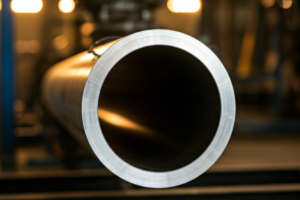
Le 5083 est un alliage de la série 5xxx non traitable thermiquement, élaboré autour de 4 à 5 % de magnésium, et il s'agit du grade le plus résistant parmi les nuances d'aluminium écrouies courantes — le choix par défaut lorsque la résistance à la corrosion en eau de mer, la soudabilité et le poids priment davantage que la résistance maximale obtenue par traitement thermique. Il acquiert sa résistance par écrouissage à froid dans les états trempés H, plutôt que par traitement thermique de mise en solution, ce qui explique pourquoi il se soude sans le fort adoucissement de la zone affectée thermiquement qui affecte les alliages 6xxx et 7xxx.
Qu'est-ce que l'Aluminium 5083 ?
Le 5083 appartient à la série 5000 (Al-Mg-Mn) : le magnésium est l'élément durcissant principal maintenu en solution solide, le manganèse et le chrome affinent la structure granulaire, et l'alliage est délibérément non traitable thermiquement. La résistance provient entièrement de l'écrouissage en usine, de sorte que l'état trempé commandé détermine l'équilibre entre résistance et formabilité — il n'existe aucune condition “ T ” vers laquelle effectuer un traitement thermique. Cette composition chimique confère également au 5083 sa résistance à la corrosion en eau de mer et en fait le matériau de référence pour les applications marines et cryogéniques dans la construction navale, le transport et les équipements sous pression.
Le compromis est simple : le 5083 renonce à la résistance maximale des nuances traitables thermiquement et ne peut pas être anodisé de manière décorative, en échange d'une soudabilité et d'une résistance à la corrosion qu'aucun alliage traité thermiquement ne peut égaler en eau salée. Le choix entre le 5083 et ses proches voisins comme le 5052 et le 6061 dépend de la résistance requise pour la pièce par rapport à l'exposition au soudage et à l'eau de mer qu'elle subira.
Composition Chimique du 5083
Le 5083 est contrôlé selon des limites strictes, car la teneur en magnésium détermine à la fois la résistance et le comportement à la corrosion. Le tableau ci-dessous présente la plage de composition standard ; le certificat MTC du lot indique les valeurs réelles.
| Élément | Poids % | Rôle |
|---|---|---|
| Aluminium (Al) | Équilibre | Métal commun |
| Magnésium (Mg) | 4.0 - 4.9 | Élément durcissant principal ; confère la résistance à la corrosion marine |
| Manganèse (Mn) | 0.40 – 1.0 | Affine la structure granulaire, ajoute de la ténacité |
| Chrome (Cr) | 0.05 - 0.25 | Stabilise la structure granulaire, limite la sensibilité à la corrosion sous contrainte |
| Silicium (Si) | ≤ 0,40 | Impureté contrôlée |
| Fer (Fe) | ≤ 0,40 | Impureté contrôlée |
| Cuivre (Cu) | ≤ 0,10 | Maintenue à un niveau faible pour éviter la corrosion galvanique |
| Zinc (Zn) | ≤ 0.25 | Impureté contrôlée |
| Titane (Ti) | ≤ 0.15 | Affineur de grain |
La teneur élevée en magnésium est la raison pour laquelle le 5083 surpasse le 5052 en résistance, mais elle impose également la limite opérationnelle clé : une exposition prolongée au-delà d'environ 65 °C (150 °F) permet au magnésium de précipiter sous forme de phase β (Al₃Mg₂) aux joints de grains, ce qui crée une sensibilité à la corrosion intergranulaire et à la corrosion sous contrainte. Cette règle des 65 °C est également abordée dans les sections relatives au fonctionnement et à la sélection.
Propriétés Mécaniques et Physiques du 5083
Les valeurs typiques à température ambiante selon l'état trempé sont présentées ci-dessous. Elles servent de référence — les minimums sont confirmés par rapport à la norme applicable (ASTM B209 / EN 485) sur le certificat d'essai en usine avant la conception.
| Tempérer | Résistance à la traction (MPa) | Limite d'élasticité (MPa) | Élongation (%) | Brinell (HB) |
|---|---|---|---|---|
| O (recuit) | 275 – 350 | ≥ 125 | ≥ 14 | ~75 |
| H111 | 285 – 335 | 145 – 200 | 12 – 18 | ~80 |
| H112 | ≥ 275 | ≥ 125 | ≥ 10 | ~75 |
| H116 (marine) | ≥ 305 | ≥ 215 | ≥ 10 | 85 – 95 |
| H321 (marine) | 305 – 385 | 215 – 295 | ≥ 10 | 85 – 95 |
| H32 | ~315 – 360 | ~235 – 250 | ~12 | ~100 |
Constantes physiques utilisées pour le dimensionnement et l'analyse :
- Densité : 2,66 g/cm³ (2 660 kg/m³)
- Module d'élasticité : ~70 GPa
- Conductivité thermique : ~120 W/m·K
- Conductivité électrique : ~29 % IACS
- Coefficient de dilatation thermique : ~23,9 µm/m·K
- Plage de fusion : 574 – 638 °C
Le 5083 conserve sa ténacité à des températures cryogéniques au lieu de devenir fragile, ce qui explique sa présence dans les réservoirs de GNL et de carburant. Il est également non magnétique, un avantage discret pour les structures navales et les capteurs.
États Trempés du 5083 et Sélection
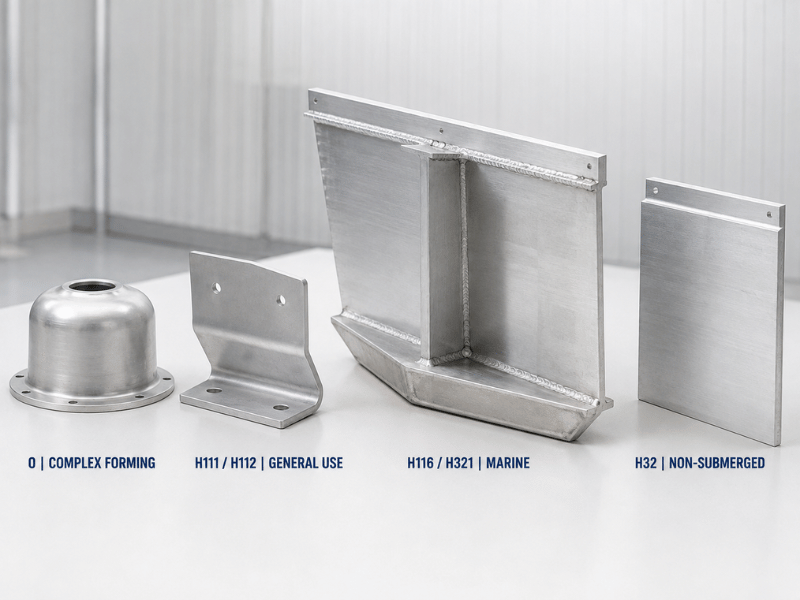
Étant donné que le 5083 est écroui, l'état trempé constitue le levier qui détermine la résistance, la formabilité et la classification de corrosion. Les états trempés marins (H116 / H321) sont ceux certifiés pour les tôles structurelles en eau de mer ; les états trempés plus doux sont destinés au formage et aux travaux généraux.
| Tempérer | La force | Formabilité | Classification IGC/SCC marine | Utilisation typique |
|---|---|---|---|---|
| O | Le plus bas | Excellent | Modéré | Emboutissage profond, pièces formées complexes |
| H111 / H112 | Modéré | Bon | Modéré | Tôle générale, supports légèrement formés |
| H116 | Haut | Juste | Supérieure (testée selon ASTM G66/G67) | Tôles de coque, ponts, structures offshore |
| H321 | Haut | Juste | Supérieure (testée selon ASTM G66/G67) | Structures marines soudées nécessitant une stabilité |
| H32 | Plage H la plus élevée | Plus bas | Bonne (uniquement hors immersion) | Structures non immergées où la résistance prime |
H116 vs H321. Mécaniquement, les deux sont essentiellement identiques et les principales sociétés de classification les acceptent de manière interchangeable pour les tôles de coque primaires. Ils ne diffèrent que par le procédé en usine : le H116 est un procédé thermomécanique contrôlé dont la résistance à la corrosion est vérifiée par des essais d'exfoliation/SCC (ASTM G66 ASSET, ASTM G67 NAMLT), tandis que le H321 est écroui puis stabilisé par un traitement à basse température afin que les propriétés restent stables après soudage et chauffage. Pour un contact continu avec l'eau de mer, le H116 ou le H321 est spécifié — et non les états trempés plus doux. Pour une analyse approfondie de la condition marine, consultez notre guide de l'aluminium 5083-H321.
La limite de sensibilisation à 65 °C. Le 5083 n'est pas spécifié pour un service continu au-delà d'environ 65 °C. À cette température, la teneur élevée en magnésium sensibilise l'alliage — la phase β précipite aux joints de grains et le matériau devient vulnérable à une fissuration soudaine par corrosion sous contrainte. Pour les flux de processus à chaud, un autre alliage ou une conception plaquée/protégée est utilisé à la place.
5083 vs 5052, 5082 et 6061
Le 5083 est le grade non-trempable à chaud le plus résistant parmi les plus courants, mais “ le plus résistant ” ne signifie pas toujours “ le plus adapté ”. Le tableau présente les options voisines côte à côte.
| vs 5083 | La force | Formabilité | Corrosion (eau salée) | Quand il est préféré |
|---|---|---|---|---|
| 5052 | Plus bas | Meilleur | Très bonne | Emboutissage profond, pièces cintrées, service plus léger |
| 5082 | Limite d’élasticité similaire / légèrement supérieure | Semblable | Semblable | Là où un grade quasi conforme mais stocké différemment convient |
| 6061 | Plus élevé sous forme T6 | Bon | Inférieur (trempable) | Superstructures soudées et peintes, pièces non immergées |
Le 5083 dépasse le 5052 en résistance à la traction et à l’élasticité tout en conservant une résistance à la corrosion comparable, ce qui en fait le choix standard pour les applications structurelles et marines exigeantes ; la formabilité plus aisée du 5052 est privilégiée lorsque l’emboutissage ou le cintrage prédomine. Par rapport au 6061, le 5083 échange la résistance maximale contre la soudabilité et le comportement en eau de mer — le 6061 est mieux adapté aux structures non immergées et peintes où la résistance après traitement thermique et une formabilité simplifiée sont recherchées. Pour le détail de la comparaison avec le 5052, voir notre aperçu de l’aluminium 5052; pour l’alternative trempable, notre guide 6061-T6511.
Où le 5083 est utilisé
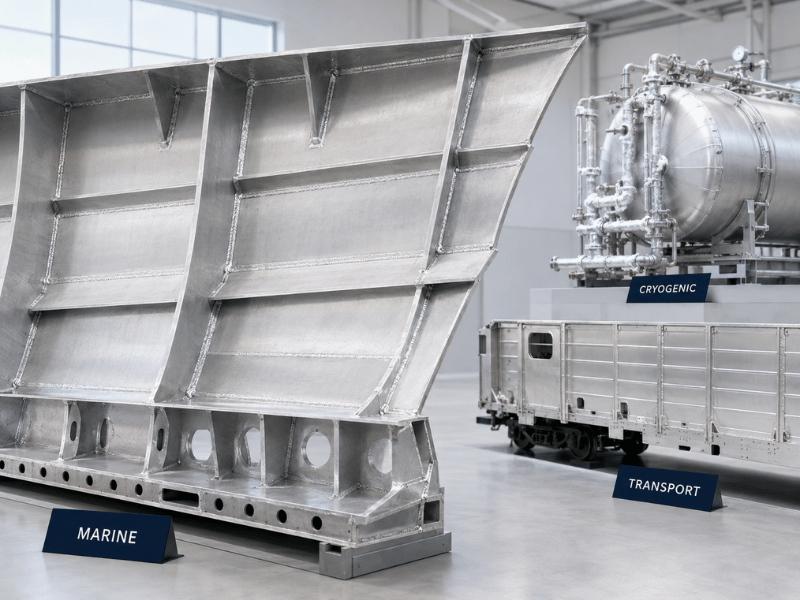
Le 5083 est utilisé partout où la fiabilité en service sévère prime sur le coût minimal.
- Marine et construction navale. Tôles de coque, ponts, cloisons, superstructures, réservoirs de carburant et de ballast, rambardes — le secteur qui définit l’alliage. Pour une vue complète du choix des matériaux dans la famille 5xxx, voir notre guide des qualités d’aluminium marine.
- Cryogénie et GNL. Réservoirs et confinement car il conserve sa ténacité bien en dessous de zéro.
- Transport. Caisses de wagons ferroviaires, citernes routières, structures de bus et de camions où le poids et la durée de vie en fatigue comptent.
- Équipements sous pression. Récipients sous pression non chauffés et stockage de produits chimiques régis par des codes tels que l’ASME VIII.
- Défense et offshore. Coques navales, hélistations, quartiers de superstructure — partout où une structure non magnétique et absorbant les chocs est spécifiée.
Dans l’aéronautique, il est limité à des rôles non structurels et cryogéniques (intérieurs, planchers, réservoirs de carburant), et non aux revêtements d’ailes primaires, qui utilisent les alliages trempables 2024 ou 7075.
Travailler le 5083
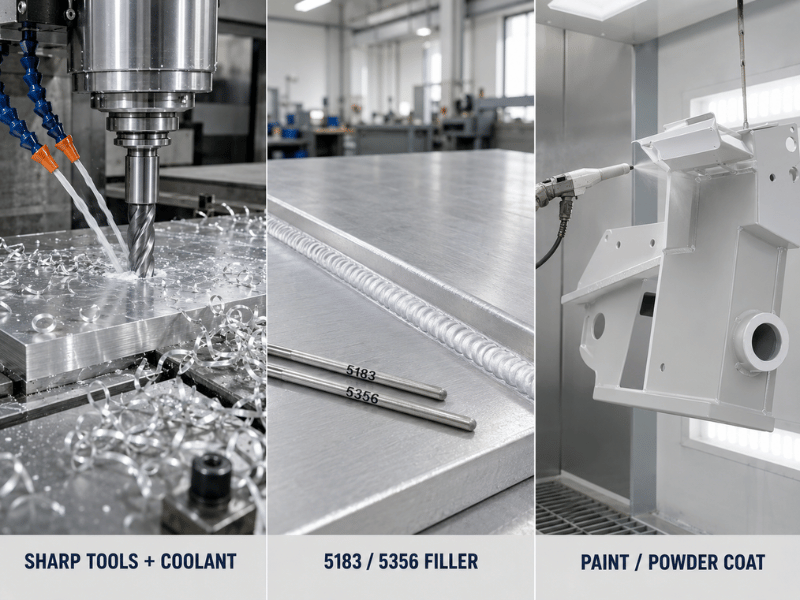
- Usinage. Le 5083 est collant et tend à produire de longs copeaux filandreux. Des outils tranchants, des vitesses et avances correctes, ainsi qu’un lubrifiant maintiennent tolérances et finition ; le temps d’arrêt est évité afin que la coupe ne durcisse pas la surface par écrouissage.
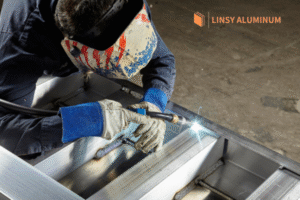
- Soudage. Des métaux d’apport 5xxx sont utilisés — 5183 ou 5356 pour les joints généraux, 5556 lorsque la résistance maximale du joint est requise dans les structures H116/H321. Comme le 5083 n’est pas trempable, le joint soudé conserve environ 80 à 90 % de la résistance du métal de base ; la zone affectée thermiquement ne s’adoucit que vers l’état voisin, et non vers l’état O. La marge est calculée autour de cette résistance conservée plutôt que d’une chute due au traitement thermique.
- Formabilité. Les états O et H111/H112 se forment et se cintrent facilement ; les états H116/H321 nécessitent des rayons de cintrage minimaux contrôlés pour éviter les fissures le long de la ligne. Le matériau est recuit avant formage sévère, et les rayons de cintrage restent dans les limites de l’état.
- Protection contre la corrosion. Le film d’oxyde naturel résiste à l’eau de mer et à la plupart des produits chimiques industriels. La peinture ou le revêtement en poudre est la finition de choix — le 5083 s’anodise en un film gris et irrégulier et n’est pas utilisé pour l’anodisation décorative. En dessous de 65 °C et avec des métaux dissemblables isolés, il ne nécessite guère plus.
5083 : Avantages et limites
Points forts
- Résistance la plus élevée parmi les alliages non trempables courants
- Excellente résistance à l’eau de mer et à la corrosion générale, en particulier en H116/H321
- Se soude bien et conserve la majeure partie de la résistance du joint (pas d’adoucissement par traitement thermique)
- Ténace à des températures cryogéniques ; non magnétique
Limites
- Ne peut pas être renforcé par traitement thermique — la résistance plafonne dans la plage H
- Non anodisable de manière décorative
- Sensibilisation au-dessus d’environ 65 °C — inutilisable pour un service continu à chaud
- Coûte plus cher que les grades 5xxx à plus faible teneur en magnésium en raison de sa teneur en Mg
Guide de sélection du 5083 : Aller / Non-aller
- Le 5083-H116 ou H321 est sélectionné pour les tôles de coque, les ponts, l’offshore et toute pièce en contact continu avec l’eau de mer. Pour une sélection spécifique aux plaques — épaisseur, tolérances et documentation — voir notre guide de sélection des tôles 5083.
- Le 5083-O ou H111/H112 est spécifié pour les composants formés, les réservoirs et les supports où le soudage et une résistance modérée suffisent.
- Le 5083-H32 est réservé aux structures non immergées où la résistance maximale de la plage H est requise et où la corrosion est gérée par revêtement.
- Le 5083 est exclu au-dessus d’environ 65 °C, pour les apparences anodisées décoratives, ou lorsqu’une résistance maximale d’un grade trempable est obligatoire et que le soudage est minimal — dans ces cas, le 6061-T6 ou le 7075-T651 convient mieux.
Conclusion
Le 5083 est le plus résistant des alliages d’aluminium écrouis courants et le choix sûr par défaut lorsque la résistance à l’eau de mer et la soudabilité déterminent la construction — l’état est adapté à l’application (O/H111 pour le formage, H116 ou H321 pour les plaques marines et structurelles, H32 pour une utilisation à haute résistance non immergée), la limite d’environ 65 °C est respectée dans chaque spécification, et les compromis sont étroits et concevables : l’anodisation décorative est évitée, une zone de soudure légèrement plus souple est tolérée, et le service continu à chaud est exclu.
Linsy Aluminum fournit des plaques, tôles et barres en 5083 dans les états O, H111, H112, H116, H321 et H32, avec des certificats d’essai en usine (MTC) pour chaque commande et des rapports d’essai SGS disponibles sur demande ; les grades marins H116/H321 sont fournis conformément à l’ASTM B209 et aux normes dimensionnelles et d’essai pertinentes lorsque le projet l’exige — les certifications de sociétés de classification (DNV/ABS/LR) ne sont pas délivrées, donc les approbations sont confirmées avec le chantier dès le début, et le délai de fabrication personnalisé typique est de 10 à 60 jours. Les dessins ou spécifications peuvent être envoyés à Linsy pour confirmation des états, dimensions et documentation.
Questions fréquemment posées
L’aluminium 5083 est-il adapté à un usage marin ?
Oui — c'est l'aluminium marin standard. En H116 ou H321, il résiste à l'exfoliation et à la corrosion sous contrainte en eau de mer, se soude de manière fiable et conserve sa résistance à basse température, ce qui explique pourquoi il domine dans les coques, les ponts et les réservoirs.
Quelle est la différence entre le 5083-H116 et le H321 ?
Mécaniquement, ils sont identiques et les sociétés de classification les acceptent de manière interchangeable. Le H116 est un procédé marin contrôlé, vérifié par des essais de corrosion (ASTM G66/G67) ; le H321 est écroui puis stabilisé, de sorte que les propriétés restent stables pendant le soudage. Les deux conviennent pour le bordé de coque.
Quelle est la température de service maximale pour le 5083 ?
Environ 65 °C (150 °F) en service continu. Au-delà, la teneur élevée en magnésium sensibilise l'alliage et favorise la corrosion sous contrainte ; un autre matériau est donc utilisé pour les flux de procédé à chaud.
Le 5083 peut-il être anodisé ?
Le 5083 n'est pas utilisé pour l'anodisation décorative. Sa teneur en magnésium produit un film anodique gris et irrégulier ; les fabricants préfèrent donc la peinture ou le revêtement en poudre. L'anodisation peut néanmoins ajouter une couche anticorrosion lorsque l'apparence n'a pas d'importance, mais la finition est sombre et non uniforme.
Le 5083 est-il plus résistant que le 5052 ?
Oui. Le 5083 se situe au-dessus du 5052 en termes de résistance à la traction et de limite d'élasticité parmi les nuances non traitables thermiquement, au prix d'une certaine formabilité — le 5083 pour les applications structurelles et marines, le 5052 lorsque l'emboutissage profond ou le cintrage prédomine.