“Marine grade aluminum” is not one alloy — it is a job description. Any aluminum that can survive decades of salt spray, sustained tensile load, and constant wave pounding without losing structural integrity earns the label, and the alloys that earn it share one thing: they resist chloride attack and weld cleanly, because a boat is mostly a welded box that lives in the ocean. The family is dominated by the 5000 series (aluminum-magnesium), with the 6000 series filling a narrower role above the waterline.
This guide walks through which marine grade aluminum to specify for which part, why the 5000 series owns the hull, and where 6061-T6 fits despite its weaker seawater resistance. If you are choosing material for a vessel or an offshore structure, the decision comes down to one question: does this part sit in the water, above it, or get formed into a complex shape?
What “Marine Grade Aluminum” Actually Means
Marine grade is a corrosion-and-weldability standard, not a single composition. The alloys that carry it form a dense, self-healing aluminum oxide film and keep most of their strength after welding — both non-negotiable on a vessel. Two series do the work:
- 5000 series (Al-Mg). Non-heat-treatable; magnesium (roughly 2.5–5.5%) forms a stable solid solution that shrugs off chloride attack. Strength comes from cold work, so there is no heat-treatable zone to soften during welding. This is the hull, the deck, and the tankage.
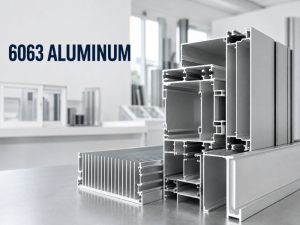
- 6000 series (Al-Mg-Si). Heat-treatable; reaches higher strength in the T6 condition and extrudes into complex shapes, but its seawater corrosion resistance is lower and it can suffer intergranular corrosion in chloride service. It stays above the waterline — masts, frames, railings.
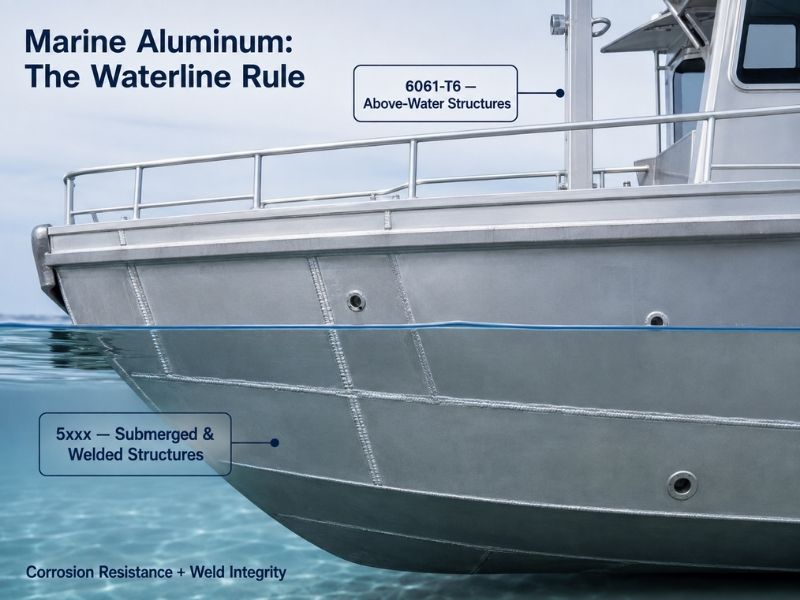
The 2000 (Al-Cu) and 7000 (Al-Zn-Mg) series are deliberately excluded from marine use unless specially clad and coated: their copper or high-zinc chemistry makes them corrosion-prone in salt. A proper marine specification is almost always a 5000-series number, with 6061-T6 as the structural exception.
Why the 5000 Series Dominates Marine Work
The reason 5xxx alloys are called the “guardian of the seas” is a combination of three properties that 6xxx alloys only partially match:
- Seawater corrosion resistance. Magnesium in solid solution gives 5xxx alloys excellent resistance to pitting and crevice corrosion in chloride environments, with no special heat treatment required. 6000-series alloys are good in atmosphere and mild marine exposure but fall short in continuous saltwater.
- Weld integrity. Because 5xxx alloys are not heat-treatable, the weld heat-affected zone does not over-age and lose strength the way a heat-treated alloy does. Post-weld joint efficiency stays around 70–80% (higher for 5083), which is why welded hulls and tanks are built from 5xxx.
- Low-temperature toughness. 5083 in particular keeps its ductility down to cryogenic temperatures (about −196 °C), which is why it is the global standard for LNG carrier tanks.
The trade the 6xxx series wins instead is strength-per-extrusion and surface finish: 6061-T6 machines and anodizes beautifully and pushes higher yield, but it belongs to superstructures and fittings, not submerged shells.
The Common Marine Grade Alloys
Six alloys cover almost every marine job. The table below is the quick-reference; the sections after it explain when each one is the right call.
| Alloy | Series | Mg (%) | Typical UTS (MPa) | Common marine tempers | Best for |
|---|---|---|---|---|---|
| 5052 | 5xxx | 2.2–2.8 | ~210–260 (H32 ≈ 228) | H32, H34, O | Fuel tanks, interior panels, superstructure, small boat hulls |
| 5083 | 5xxx | 4.0–4.9 | ≥303 (H116); ~310–315 | H116, H321, H111, O | Hull plates, decks, offshore structures, LNG tanks |
| 5086 | 5xxx | 3.5–4.5 | ≥275 (H32); ~290 | H32, H34, H116 | High-speed craft, ballast and fuel tanks, corrosion-sensitive parts |
| 5454 | 5xxx | 2.4–3.0 | ≥250 (H32) | H32, H34, O | Engine rooms, seawater piping, pressure vessels |
| 5456 | 5xxx | 4.7–5.5 | ≥315 (H321) | H321, H116, O | Heavy structures, naval armor, icebreakers |
| 6061-T6 | 6xxx | 0.8–1.2 | ~310 | T6, T651 | Masts, frames, railings, superstructure (not submerged) |
Alloy-by-Alloy: Which to Pick
5083 — the hull standard. The highest-strength of the non-heat-treatable alloys and the benchmark marine grade. In the H116 or H321 temper it is stabilized against stress-corrosion cracking, which is why classification societies specify it for commercial and military hull plating. It also keeps its toughness at cryogenic temperatures, so it doubles as the LNG tank alloy. Deep dive: our 5083 aluminum alloys guide.
5052 — the formable all-rounder. Lower magnesium means moderate strength but the best formability and fatigue resistance in the family. It bends, draws, and stamps with little risk of cracking, which is why it shows up in fuel tanks, cabin panels, and non-structural interiors. For small freshwater or recreational boats it is often enough on its own. Deep dive: our 5052 aluminum guide.
5086 — the corrosion specialist. Sits between 5052 and 5083 in strength but is often rated with equal or better resistance to pitting and crevice corrosion, plus good vibration-fatigue life in rough seas. That makes it a strong pick for high-speed craft, ballast tanks, and components where 5052 would be slightly under-spec’d. Deep dive: our 5086 aluminum guide.
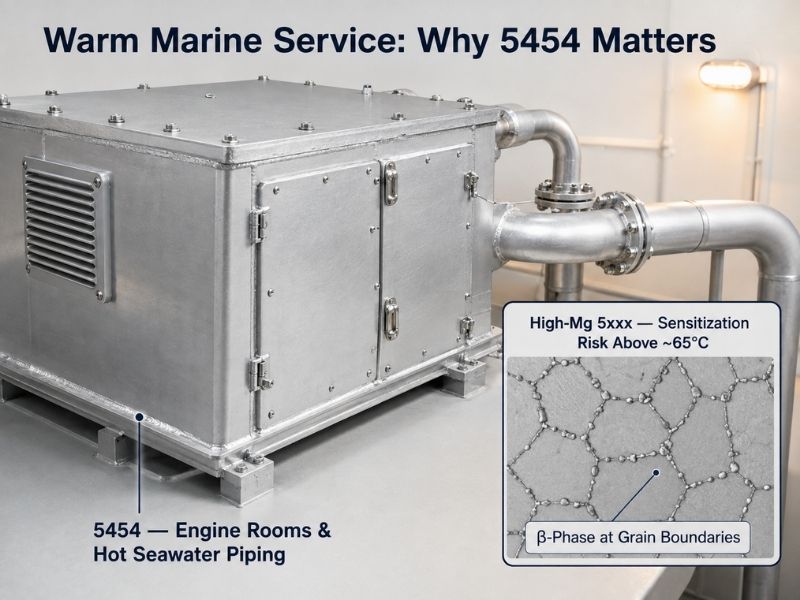
5454 — the warm-environment choice. About 22% stronger than 5052 with good weldability, but its lower magnesium content is the point: high-magnesium 5xxx alloys sensitize (β-phase precipitation at grain boundaries) if held above roughly 65 °C (150 °F), which invites stress-corrosion cracking. 5454 stays safe in engine rooms and around hot seawater piping. Deep dive: our 5454 aluminum guide.
5456 — the heavy-duty high strength. The strongest of the 5xxx marine alloys, used for naval armor and extreme-load structures. Its high magnesium demands the stabilized H321 temper to keep stress-corrosion sensitivity in check, so it is a specified-grade material rather than a general substitute for 5083. Deep dive: our 5456 aluminum guide.
6061-T6 — the structural extrusion. Heat-treatable, high-strength, and the best of the group for machining and anodizing, which is why it is the default for masts, frames, railings, and superstructure fittings. Its weakness is seawater: it can suffer intergranular and crevice corrosion, so it is specified for above-water structures and must be coated and cathodically protected if it sits near or in the water. Deep dive: our 6061-T6 guide.
How to Choose: By Application
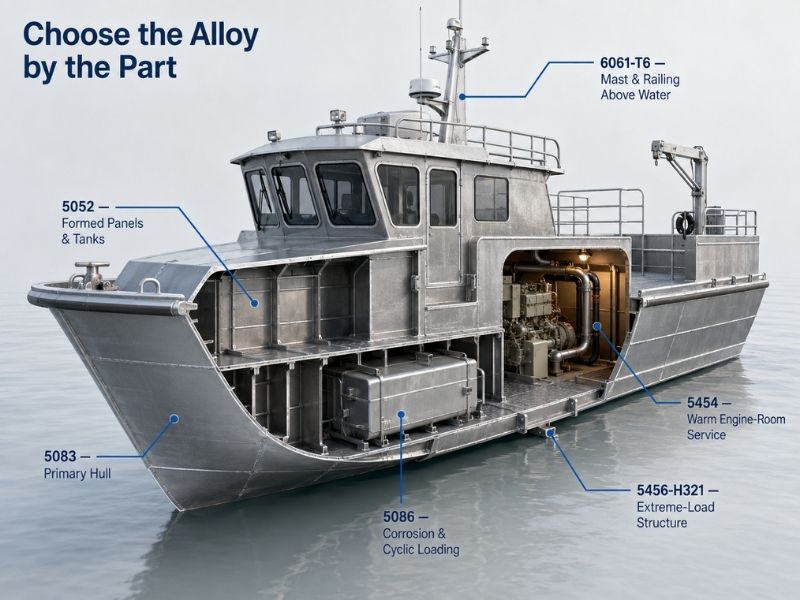
The fastest way to a correct specification is to match the part to the alloy, not the other way around.
| Part / condition | Specify | Why |
|---|---|---|
| Primary hull shell, saltwater, classed vessel | 5083-H116 / H321 | Highest 5xxx strength, certified SCC resistance |
| Small recreational boat (<10 m) | 5052-H32 or 5083 | 5052 for cost/forming; 5083 if loads are higher |
| Deck and house structures | 5083 (structural) + 5052 (non-structural) | Strength where it matters, formability elsewhere |
| Fuel and water tanks | 5052-H32 or 5086 | Formability (5052) or corrosion margin (5086) |
| High-speed craft, cyclic loading | 5086 | Better vibration-fatigue life than 5083 |
| Engine room, elevated temperature | 5454 | Safe above 65 °C where high-Mg 5xxx sensitize |
| Naval armor, extreme load | 5456-H321 | Highest 5xxx strength, stabilized temper |
| Masts, frames, railings (above water) | 6061-T6 | Strength + anodizing; coat if near water |
| Below the waterline | 5xxx only | Never specify 6xxx for submerged service |
Marine Tempers: H116/H321 vs H32 vs O
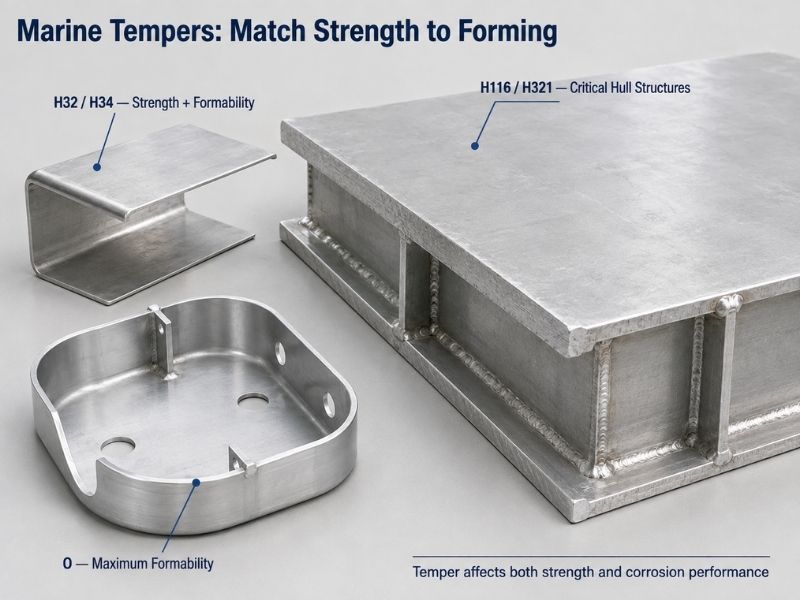
Temper controls both strength and corrosion behavior, and for marine work the stabilized tempers matter:
- H116 / H321. Specifically stabilized for marine service; they resist intergranular corrosion and exfoliation and are the default for critical hull structures. H116 is cold-worked then stabilized; H321 adds a small cold stretch after solution treatment. Properties are close; H116 is common in Europe and Asia, H321 in North America.
- H32 / H34. Strain-hardened and stabilized — a balance of strength and formability for plates that need bending or rolling.
- H111 / H112. Partial anneal or as-fabricated; used where final temper is not critical and formability matters.
- O. Fully annealed; maximum formability for deep-drawn parts like tank baffles.
One caution that applies to every high-magnesium 5xxx alloy: avoid prolonged service above about 65 °C (150 °F), where β-phase precipitation undermines corrosion resistance. That is exactly why engine-room and hot-piping applications lean toward 5454.
Working With Marine Aluminum
- Welding. Use a 5xxx filler for 5xxx base metal — ER5356 is the general choice, ER5183 where 5083 needs matched joint strength, ER5554 for 5454 color match after anodizing. 6061 uses ER4043 or ER5356. Do not weld 5xxx and 6xxx base metals together expecting a matched joint; if you must join them, ER5356 is the compromise filler and the joint will be over-matched on one side and under-matched on the other. Post-weld strength retention runs about 70–80% for 5xxx and is lower for 6xxx.
- Forming. 5052 forms tightest; 5083 and 5456 need wider bend radii and controlled tooling. Confirm the minimum bend radius from thickness and temper before committing a design.
- Corrosion protection. Anodizing of 5xxx alloys is limited (it can gray and the magnesium-rich surface is fussy), so marine protection is normally a high-quality epoxy coating plus sacrificial anodes — cathodic protection is what actually stops pitting on a hull. 6061-T6 near or in water needs coating and cathodic protection too, and must be electrically isolated from steel, copper, and stainless to avoid severe galvanic attack.
Pros and Limitations
Against steel, marine aluminum cuts weight to about one-third, which raises speed, payload, and fuel economy and removes the perpetual sandblasting-and-repainting cycle. Against fiberglass, it is structural, repairable by welding, and fully recyclable. The limitations are real: material cost is higher up front, high-magnesium 5xxx alloys demand correct tempers and temperature control to avoid stress-corrosion cracking, and 6xxx alloys must stay out of submerged service. Pick the alloy to the environment and the life-cycle cost usually favors aluminum.
Conclusion
For hulls, decks, and tanks below or near the water, a 5000-series alloy is the answer — 5083-H116/H321 for primary structure, 5052 where forming and cost lead, 5086 for corrosion margin, 5454 for warm spaces, 5456 for extreme load. 6061-T6 earns its place above the waterline where strength and extrudability matter, never submerged. Match the alloy to the part and the vessel stays sound for decades.
Linsy Aluminum supplies marine-grade aluminum plate and sheet — including 5083, 5086, and 5052 — for shipbuilding and offshore projects, with mill test certificates on every order, optional SGS testing, and in-house cutting, welding, and surface finishing. Send us your drawing or specification and we will confirm stock, lead time, and a quote.
Share your marine grade aluminum requirement (alloy, temper, thickness, quantity) with Linsy Aluminum for stock check and pricing.
Frequently Asked Questions
What is the best marine grade aluminum?
There is no single best — it depends on the part. 5083-H116/H321 is the standard for hulls and primary structure; 5052-H32 is the right call for formed, non-structural, or small-boat parts; 5086 adds corrosion margin. For above-water structures, 6061-T6 is common.
Can 6061-T6 be used in saltwater?
Yes for above-water structures such as masts, frames, and railings, where its strength and anodizing finish pay off. It should not be used for submerged or below-waterline service because it is prone to intergranular and crevice corrosion in chloride environments — coat and cathodically protect it if it sits near the water.
What is the difference between 5083-H116 and H321?
Both are stabilized marine tempers with similar properties and certified stress-corrosion resistance. H116 is cold-worked then stabilized; H321 adds a small cold stretch after solution treatment. H116 is more common in Europe and Asia, H321 in North America; either is acceptable for marine hull plate.
Is 5052 good for boat hulls?
For small recreational boats (typically under 10 m) in freshwater or mild service, 5052-H32 is widely used and cost-effective. For larger vessels, commercial workboats, or charter boats, most classification societies require 5083-H116/H321 for hull plating.
How do I protect marine aluminum from corrosion?
Use a quality marine coating plus sacrificial anodes (cathodic protection) on hulls and tanks — that is what actually stops pitting in seawater. Anodizing alone is limited for 5xxx alloys. Keep dissimilar metals (steel, copper, stainless) electrically isolated to avoid galvanic corrosion.