What Is 5456 Aluminum?
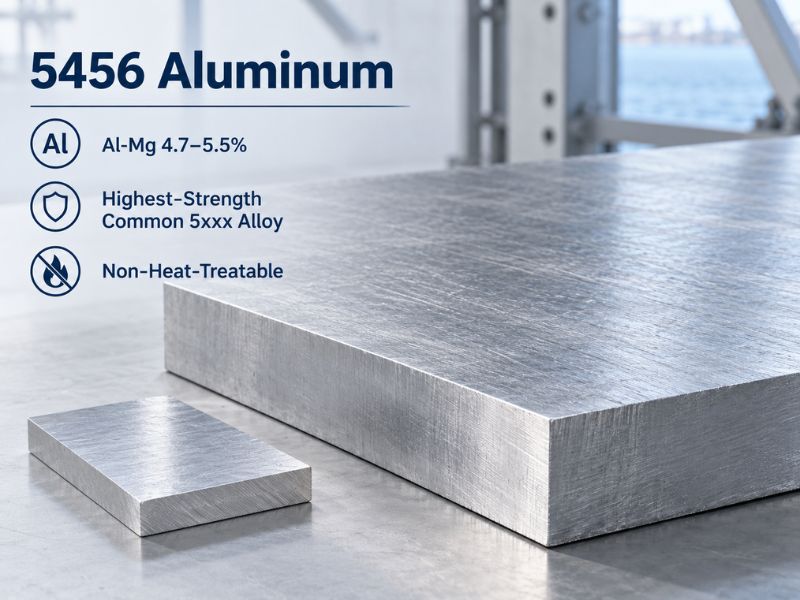
5456 is a wrought aluminum-magnesium alloy in the 5xxx series, with 4.7–5.5% magnesium replacing solid-solution strengthening where heat treatment would otherwise go. It is non-heat-treatable, so every extra megapascal comes from strain hardening and alloy content rather than from a quench-and-age cycle. Manganese adds toughness and chromium controls grain structure, which together give 5456 the highest as-fabricated strength of the commonly stocked 5xxx alloys.
That magnesium level is also the source of the alloy’s one serious constraint. Above roughly 3% magnesium, an Al-Mg alloy held for extended periods above about 65 °C precipitates a beta phase along the grain boundaries, and that network is anodic to the surrounding matrix. Corrosion then travels along the grain boundaries instead of across the surface, which is why high-magnesium grades need a specific temper — not just a specific alloy — to be considered acceptable for marine service.
5456 Chemical Composition
Limits below are per ASTM B209 for sheet and plate. The titanium figure differs between neighbouring grades: 5456 permits 0.20 max, while 5056 permits only 0.15 max, so the two must not be copied from each other.
| Element | Composition (% by weight) |
|---|---|
| Silicon (Si) | 0.25 max |
| Iron (Fe) | 0.40 max |
| Copper (Cu) | 0.10 max |
| Manganese (Mn) | 0.50–1.00 |
| Magnesium (Mg) | 4.7–5.5 |
| Chromium (Cr) | 0.05–0.20 |
| Zinc (Zn) | 0.25 max |
| Titanium (Ti) | 0.20 max |
| Others, each | 0.05 max |
| Others, total | 0.15 max |
| Aluminum (Al) | Balance |
Two entries deserve attention on a purchase order. Magnesium at this level is what delivers the strength that puts 5456 above 5083, so a certificate showing magnesium near the low end of the range should prompt a question about how much of the strength advantage survives. Copper is capped at 0.10% because copper directly works against seawater corrosion performance.
5456 Mechanical Properties by Temper
Typical values below are drawn from ASM and Aluminum Association data for rolled products. They are useful for comparison and early design work, but guaranteed figures follow the applicable specification and thickness, and the mill test certificate governs what was actually delivered.
| Temper | Tensile Strength (MPa) | Yield Strength (MPa) | Elongation (%) | Typical Hardness (HB) |
|---|---|---|---|---|
| O (annealed) | 310 | 159 | 24 | — |
| H111 | 310 | 180 | 14 | — |
| H112 | 310 | 166 | 22 | — |
| H116 / H321 | 350 | 255 | 12 | 90 |
For anything governed by ASTM B928, the code minimum is the binding number, not the typical value:
| Temper | Thickness Range | Tensile Strength, min (MPa) | Yield Strength, min (MPa) | Elongation, min (%) |
|---|---|---|---|---|
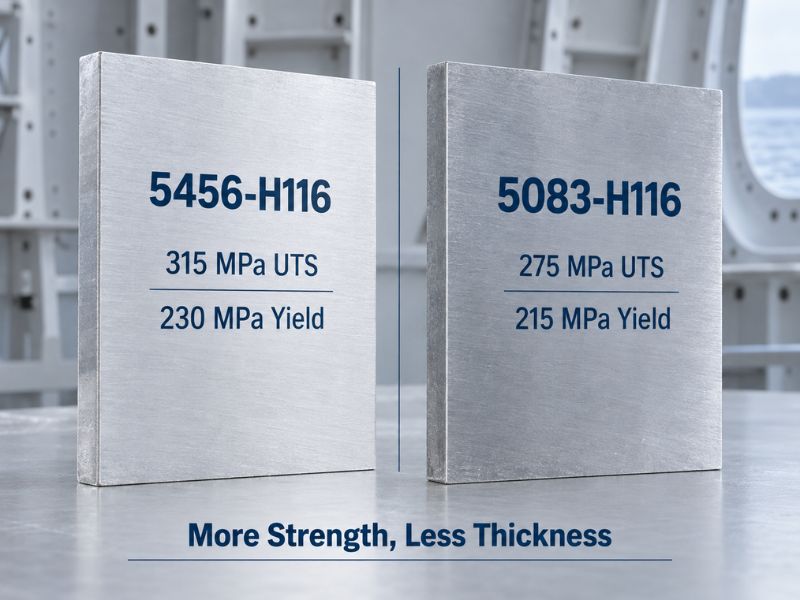
| 5456-H116 / H321 | 3–40 mm | 315 | 230 | 10 |
| 5083-H116 / H321 | 3–50 mm | 275 | 215 | 10 |
| 5086-H116 / H321 | 3–50 mm | 240 | 195 | 10 |
The row that matters most here is the first. Compared with 5083-H116, 5456-H116 buys roughly 40 MPa more tensile strength and about 15 MPa more yield at the same code minimum, which is the entire commercial case for choosing it over the far more commonly stocked 5083.
Why H116 and H321 Exist: The 65°C Sensitization Limit
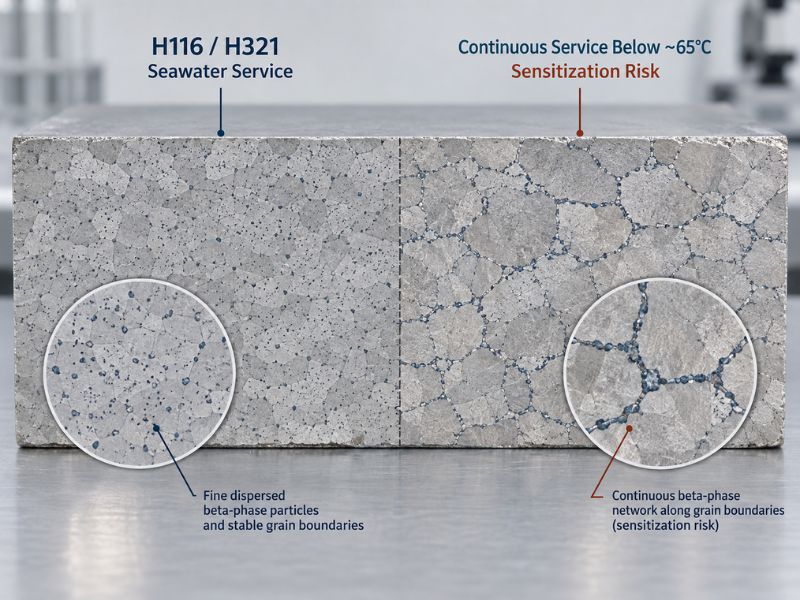
Sensitization is the failure mode that governs how 5456 may be specified. Above about 3% magnesium, prolonged exposure in the 65 °C and above range drives dissolved magnesium out of solid solution and into beta-phase particles along the grain boundaries. Once those particles form a connected network, the alloy becomes vulnerable to intergranular corrosion, exfoliation corrosion, and stress corrosion cracking — all of which progress internally and are easily missed by visual inspection.
5456 cannot be exempted from this by heat treatment. It is a non-heat-treatable alloy, and there is no aging cycle that dissolves an established grain-boundary network. Once sensitization has occurred, the condition is permanent.
H116 and H321 exist specifically to delay that mechanism. Both are strain-hardened conditions that receive a stabilising thermal treatment, which drives any beta-phase particles into a fine, dispersed distribution inside the grains rather than a continuous film between them. ASTM B928 then verifies the result: H116 and H321 plate must pass an exfoliation corrosion test at a rating no worse than PB and an intergranular corrosion mass-loss limit of 15 mg/cm².
| Condition | Practically Means | Typical Proposal Language |
|---|---|---|
| H116 | Strain hardened, stabilised to meet B928 exfoliation and intergranular limits | Specified where classification society approval is required |
| H321 | Strain hardened and stabilised with a controlled cold-work step | Specified for welded structure with defined mechanical minimums |
| H112 | Lightly strain hardened from the mill process, no corrosion qualification | Acceptable for general structure, not for seawater contact on its own |
| O | Fully annealed, maximum formability | Used for severe forming, usually followed by welding |
The practical rule is simple: if the part sees seawater and stays in place for years, the temper line must read H116 or H321. A quotation that offers H112 for the same part is cheaper because it carries no corrosion qualification, not because the metal is any different.
5456 Physical Properties
| Property | Typical Value |
|---|---|
| Density | 2.66 g/cm³ |
| Melting Range | 570–638 °C |
| Thermal Conductivity | 117–127 W/m·K |
| Electrical Conductivity | 28.5–29.5% IACS |
| Elastic Modulus | 69–74 GPa |
| Coefficient of Thermal Expansion | 23.9 × 10⁻⁶ /°C |
| Magnetic Response | Non-magnetic |
Those two conductivity figures are lower than most designers expect, and they follow directly from the magnesium content. Every percent of magnesium in solid solution scatters electrons and phonons, so 5456 at roughly 29% IACS and 120 W/m·K sits well below 5052 near 35% IACS and 138 W/m·K. Any application using the part as a conductor or a heat spreader is working against the chemistry.
Corrosion Resistance and Marine Service
In seawater and marine atmospheres, 5456 performs well — provided the temper carries its corrosion qualification. The oxide film that forms spontaneously is stabilised by the magnesium and chromium content, which slows chloride attack and keeps pitting shallow. In practice this translates into lower drydock maintenance compared with painted steel and a long service record on hull plating.
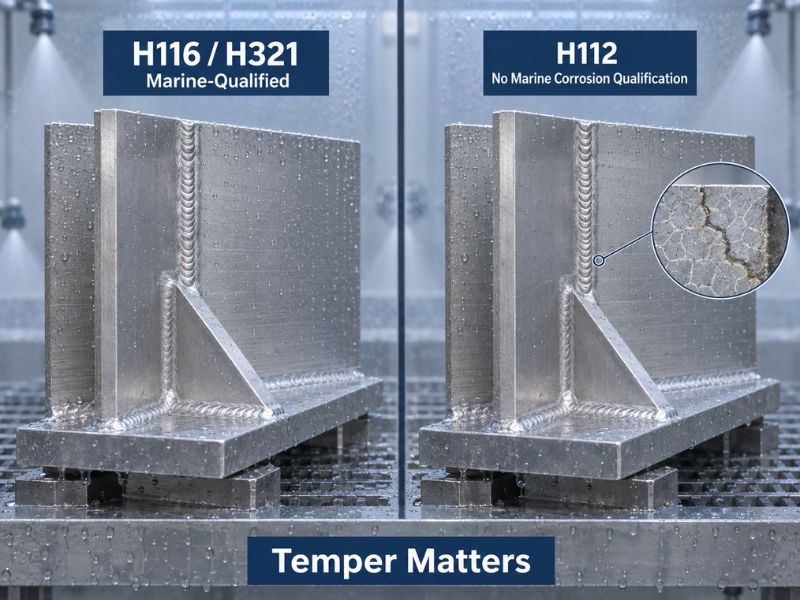
Three conditions change that picture:
- Sustained temperature above roughly 65 °C. Engine-room structures, heated tanks, and exhaust-adjacent fittings are the classic failures. Either move the part away from the heat source or step to 5454, whose lower magnesium content keeps it outside the sensitization range.
- Thick sections under sustained tensile stress. Thick plate holds more restraint stress after welding, and SCC needs both a susceptible path and stress. Thicker cross-sections on 5456 deserve explicit engineering review.
- Contact with dissimilar metals. Aluminum is anodic to copper, brass, and stainless steel. Isolation and drainage need to be designed in, not discovered in service.
Working With 5456: Forming, Welding, and Machining
Welding. 5456 welds well by MIG and TIG, but joint design cannot use parent-metal properties. Because the alloy is non-heat-treatable, the heat-affected zone is annealed back toward the O condition and stays there — no post-weld treatment restores it. Weld-metal properties from an ER5556 deposit on 5083 or 5456 base plate run about 280–310 MPa tensile and 130–165 MPa yield, against 255 MPa yield for H116 parent metal. That is roughly a 35–45% drop in yield near the joint, and AWS D1.2 allowable stresses already assume this, so design to the annealed HAZ value rather than the temper purchased.
| Filler | Magnesium Content | When It Fits | Watch Out For |
|---|---|---|---|
| ER5556 | ~5.0% | Default for 5456 — matches the base alloy and carries corrosion performance best | Limited availability outside marine supply chains |
| ER5183 | ~4.8% | Where maximum as-welded strength on the joint matters | Confirm against the approved procedure |
| ER5356 | ~4.5% | General 5xxx fabrication, widely stocked | Not preferred for sustained service above about 65 °C |
| ER4043 | Silicon-bearing | Avoid on 5456 | Silicon combines with magnesium into brittle Mg₂Si and the weld anodizes black |
Forming. Formability follows the temper. O and H111 handle heavy bending and drawing; H116 and H321 will take moderate forming but bend radii must be opened up relative to what a shop accustomed to 5052 would expect. Cold-forming H321 plate hard and then putting it into service invites both cracking and higher residual stress, which feeds directly into the SCC mechanism above.
Machining. 5456 machines acceptably but is gummier than the heat-treatable alloys, so chip evacuation and sharp tooling matter more than spindle power. Chip control improves with higher rake angles and positive cutting geometry.
Finishing. Like all 5xxx alloys, 5456 anodizes to a muted grey rather than a bright finish, and it will not colour-match a 6063 extrusion. If appearance is a criterion, specify that requirement before the order is placed rather than discovering it at assembly.
5456 vs 5083 vs 5086 vs 5052: How to Choose
| Alloy and Temper | Tensile, min (MPa) | Yield, min (MPa) | Magnesium (%) | Where It Wins |
|---|---|---|---|---|
| 5456-H116 | 315 | 230 | 4.7–5.5 | Highest strength of the group in seawater contact |
| 5083-H116 | 275 | 215 | 4.0–4.9 | Broadest availability, best-documented marine record |
| 5086-H116 | 240 | 195 | 3.5–4.5 | Good marine performance at lower cost and better formability |
| 5052-H32 | 215 | 160 | 2.2–2.8 | Forming-heavy sheet work, no sensitization limit |
Reading down the magnesium column explains almost everything about how these four behave. Higher magnesium buys strength and costs temperature capability: the two high-magnesium grades carry the 65 °C restriction, while 5052 at 2.2–2.8% does not. Availability runs the other way — 5083 is stocked almost everywhere, and 5456 is a special order at many service centres, which is reflected in both price and lead time.
Go/No-Go: When to Specify 5456
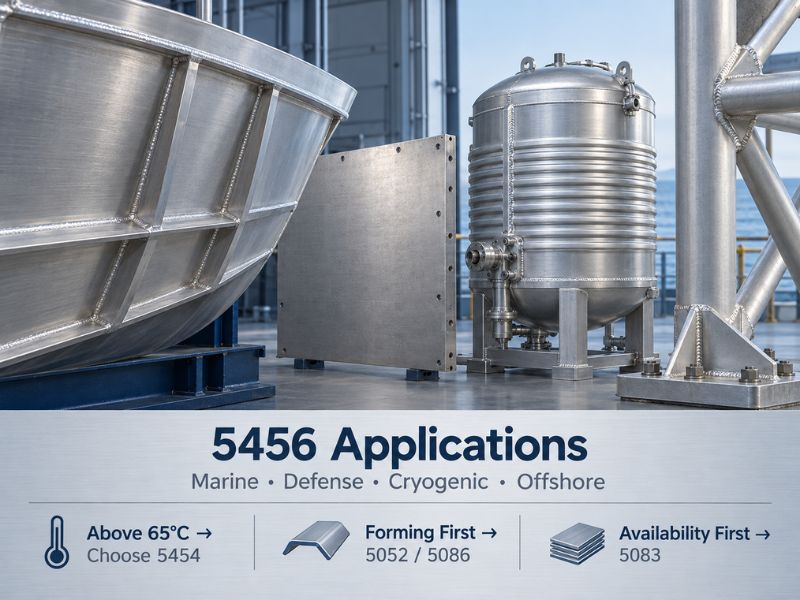
The entries below answer whether to use the alloy. Applications are covered separately in the next section — this section covers the decision, that one covers the destinations.
Go — 5456 fits when:
- The design needs more strength than 5083-H116 provides and thickness cannot increase to compensate
- The structure is welded, stays in seawater contact, and the specification can require H116 or H321 with B928 test results
- Impact resistance and toughness at low temperature matter, including cryogenic and offshore service
- Thermal growth must stay predictable against a documented expansion coefficient under dynamic load
No-Go — choose something else when:
- Continuous metal temperature may exceed roughly 65 °C — move to 5454 instead
- Lead time and stock availability dominate the decision — 5083 is the safer supply chain
- The part needs a bright or colour-matched anodized finish — use 6xxx
- Forming dominates over strength — 5052 or 5086 will cost less and form easier
- The project requires strength that only heat treatment delivers — move to a heat-treatable series
Where 5456 Is Used
Marine and shipbuilding. Hull plating, decks, bulkheads, and superstructures on patrol boats, workboats, and high-speed craft are the core application set. 5456 earns its place where weight reduction is worth paying for, since the strength margin over 5083 lets a hull designer remove thickness rather than add it.
Defence and protective structures. Armor plate for military vehicles, military bridging components, and blast-resistant assemblies use 5456 for energy absorption combined with ballistic performance. MIL-DTL-46027 is one specification covering this territory, and it carries its own temper and testing requirements beyond the commercial standards.
Pressure vessels and heavy welded fabrications. 5456 appears in storage tanks, pressure vessels, and large transportation frames where welded joint integrity governs the design. Joint efficiency must always be calculated from the annealed HAZ properties, not from H116 parent-metal figures.
Cryogenic and offshore service. Unlike carbon steel, 5xxx alloys do not suffer a ductile-to-brittle transition as temperature falls, and both strength and elongation improve. That makes 5456 usable for cryogenic tanks and for offshore structures exposed to cold climates.
Pros and Limitations at a Glance
| Dimension | Advantage | Limitation |
|---|---|---|
| Strength | Highest as-fabricated strength of the common 5xxx alloys | No heat-treat route exists to raise it further |
| Corrosion | Excellent seawater performance with H116/H321 qualification | Requires that temper; H112 carries no corrosion qualification |
| Temperature | Stable in cold service, including cryogenic | Unusable above roughly 65 °C because of sensitization |
| Weldability | Welds cleanly by MIG and TIG with matching filler | HAZ anneals to O condition with ~35–45% yield loss, permanent |
| Availability | Supplied by marine-focused mills and stockists | Thinner supply chain and longer lead times than 5083 |
| Cost | Justifies itself where strength removes thickness | Higher per-kilo price and often a customs temper requirement |
| Formability | Workable in O and H111 | H116/H321 need wide bend radii and careful cold work |
| Appearance | Acceptable with paint or coating | Anodizes grey, will not bright-match 6063 |
Sourcing 5456: What to Specify
A 5456 enquiry that carries the following items will come back priced correctly the first time. One that does not will return a cheaper quote for material that will not pass inspection:
| Specification Item | What to State | Why It Changes the Quote |
|---|---|---|
| Temper | H116 or H321 for anything touching seawater | Corrosion-tested plate costs more than H112 |
| Standard | ASTM B928 for marine, B209 for general product form | Each carries different test requirements |
| Thickness range | Relevant ranges change mechanical minimums | Minimums drop as thickness increases |
| Exfoliation / IGC test | Required if the part is contact seawater | B928 requires ≤PB and ≤15 mg/cm² |
| certificates | MTC required; SGS testing if specified by the project | Traceability is part of the deliverable |
| Form and size | Plate, sheet, bar, tube, or profile with dimensions | Determines mill routing and lead time |
Linsy supplies 5456 in plate, sheet, bar, tube, and extruded profiles, most commonly in O, H111, H112, H116, and H321 temper. Typical plate-range supply runs from 6 mm up to 120 mm thick, with sheet and coil down to about 0.5 mm; other sizes can be discussed against the order specification. Every shipment leaves with a mill test certificate documenting composition and mechanical properties, and third-party SGS reports — including chemical, mechanical, ultrasonic, and dimensional — can be arranged on request. Production runs under ISO 9001, ISO 14001, and ISO 45001 systems.
Custom sizes for non-stock items typically run 10–60 days depending on alloy, dimensions, processing, and order complexity, and low-MOQ custom production is available. In-house support covers CNC machining, MIG and TIG welding, laser cutting, and surface finishing including anodizing and polishing.
Conclusion
5456 buys roughly 40 MPa of additional strength over 5083-H116 at the same code minimum, and it charges for that with two hard conditions: the temper must be H116 or H321 for anything touching seawater, and the structure must stay below about 65 °C or move to 5454. Those two rules are where 5456 projects go wrong, and neither appears in a datasheet handed over at quotation stage.
Linsy Aluminum works with exactly that boundary. We supply 5456 across plate, sheet, bar, tube, and profiles in O, H111, H112, H116, and H321, with the mill test certificate issued for every order and optional SGS reports where a project requires third-party verification. If there is any doubt about whether the service temperature or the temper is right for a design, send the drawing and the operating conditions — we will confirm which specification actually needs to appear on the purchase order before it is placed.
Frequently Asked Questions
Is 5456 stronger than 5083?
Yes, by a useful margin at the code minimum. ASTM B928 sets 5456-H116 at 315 MPa tensile and 230 MPa yield against 275 MPa and 215 MPa for 5083-H116, so the difference is about 40 MPa tensile and 15 MPa yield in the same thickness range. The trade-off is supply: 5083 is stocked far more widely, and its marine service record is documented across more vessels.
Why is 65 °C the stated limit for 5456?
Above about 3% magnesium, extended exposure around 65 °C and above pulls dissolved magnesium out of solution and precipitates beta phase along grain boundaries. That creates an anodic path between grains, opening the door to intergranular corrosion, exfoliation, and stress corrosion cracking. Because 5456 cannot be heat treated, the condition cannot be reversed once it develops. Parts near engines, heated tanks, or exhaust runs are the usual offenders, and 5454 is the standard substitute in those zones.
Which temper should be specified for a seawater-facing hull plate?
H116 or H321, stated with ASTM B928. Both receive a stabilising treatment that disperses beta-phase particles inside the grains rather than letting them form a continuous film at the boundaries, and B928 verifies the outcome with an exfoliation test at PB or better and an intergranular mass-loss limit of 15 mg/cm². H112 sits outside that qualification and is not a substitute in saltwater contact.
What happens to strength after welding 5456?
The heat-affected zone anneals back toward the O condition and stays there, since no post-weld heat treatment restores strain hardening. An ER5556 deposit on 5456 base plate typically gives 280–310 MPa tensile and 130–165 MPa yield, against about 255 MPa yield for H116 parent metal — a 35–45% reduction near the weld. AWS D1.2 allowable stresses already assume this, so joints must be designed to annealed HAZ values rather than the specified temper.
Can 5456 be anodized?
Yes, but it does not produce the finish most people expect. Like all 5xxx alloys it anodizes to a muted grey rather than a bright surface, and it will not colour-match a 6063 extrusion. Where appearance matters, that needs to be agreed before ordering, or captured through paint and coating instead.