What Is 6082-T6 Aluminum?
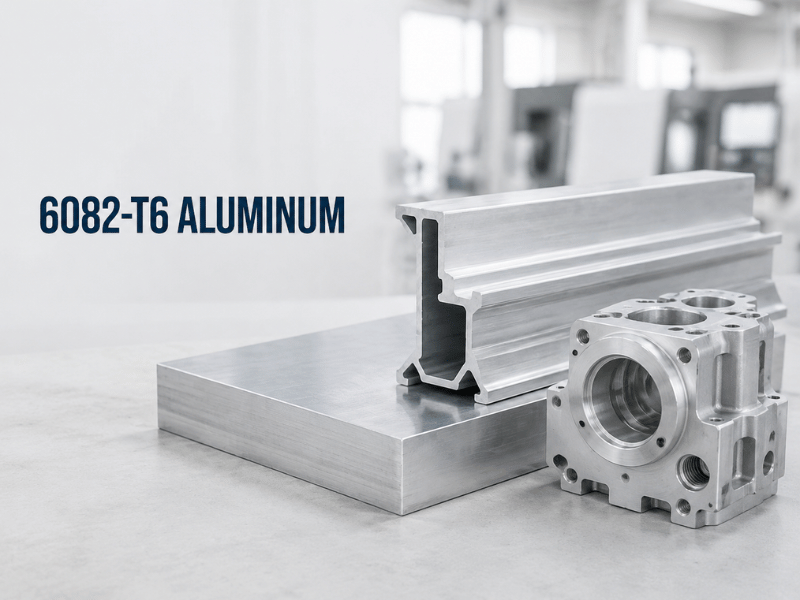
6082 is a 6000-series alloy built on a magnesium-silicon system with an unusually high manganese content (0.4–1.0%), and it is the strongest of the common structural 6000-series grades — the European counterpart to 6061, widely specified to Eurocode 9 for bridges, cranes, and frames. Strength comes from magnesium-silicide precipitates formed during the T6 aging treatment, while manganese refines the grain and increases strength without compromising corrosion resistance.
That manganese-rich composition is also why 6082 is harder to push through an extrusion die than 6061 or 6063, so it trades some formability for the highest strength-to-weight ratio in the family. The temper you choose — most often T6 for structural and machined parts — decides whether you get peak strength or easier post-machining stability, which is the real decision behind every 6082 specification.
Understanding the T6 Temper
The “T6” label is a fixed heat-treatment route, not the as-supplied condition. A 6082 section leaves the press soft; only the T6 cycle brings it to full strength.
Solution heat treatment heats the part to about 530°C so the magnesium, silicon, and manganese dissolve into a single-phase solid solution. Rapid water quenching locks those elements in place before they can precipitate. Artificial aging at roughly 170–180°C for several hours then precipitates fine Mg₂Si particles that block dislocation movement and raise strength.
T6 vs T651 for 6082
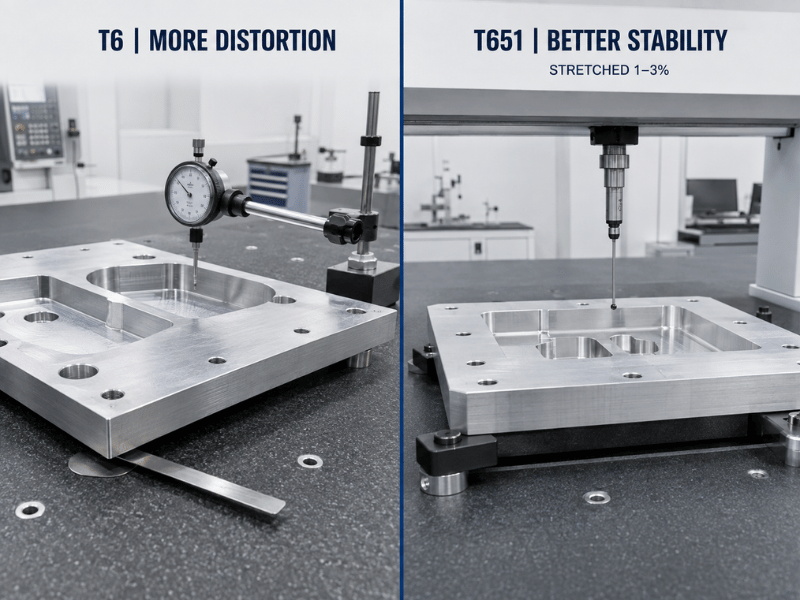
T651 is the stress-relieved version of T6. After quenching, the section is stretched 1–3% to remove residual stress, then aged. Mechanical strength remains the same, but machined parts maintain their dimensions much better after material removal — which is why T651 is the default for CNC-machined 6082 components with tight tolerances.
6082-T6 Chemical Composition
6082’s strength comes from its high silicon-to-manganese balance — just enough Mg₂Si to age-harden hard, with manganese pushing strength higher than in 6061 or 6063. The limits below follow EN AW-6082 (EN 573-3).
| Element | Composition Range (% by weight) | Role |
|---|---|---|
| Aluminum (Al) | Balance | Base metal |
| Silicon (Si) | 0.70–1.30 | Precipitate former with Mg |
| Iron (Fe) | ≤0.50 | Impurity limit |
| Copper (Cu) | ≤0.10 | Impurity limit |
| Manganese (Mn) | 0.40–1.00 | Grain control, strength |
| Magnesium (Mg) | 0.60–1.20 | Strength via Mg₂Si aging |
| Chromium (Cr) | ≤0.25 | Grain refinement |
| Zinc (Zn) | ≤0.20 | Impurity limit |
| Titanium (Ti) | ≤0.10 | Grain refiner |
| Others (each) | ≤0.05 | Trace elements |
| Others (total) | ≤0.15 | Total trace |
6082-T6 Mechanical and Physical Properties
These are typical T6 values for extruded sections and plate per EN 755-2 / EN 485-2. Note that strength scales with section size: small bar reaches the top of the range, thick plate sits near the minimum. Confirm against the mill test certificate for the specific product form.
| Property | 6082-T6 |
|---|---|
| Ultimate Tensile Strength (UTS) | 295–310 MPa |
| Yield Strength (YS) | 240–260 MPa |
| Elongation | 8–12% |
| Hardness | ~95 HB |
| Density | 2.70 g/cm³ |
| Modulus of Elasticity | ~70 GPa |
| Thermal Conductivity | ~180 W/m·K |
| Electrical Conductivity | ~37% IACS |
The number that drives most specs is tensile strength near 310 MPa combined with good weldability — that pairing is what lets 6082 replace steel in weight-critical frames without forcing a switch to a harder-to-weld alloy.
Where 6082-T6 Is Used
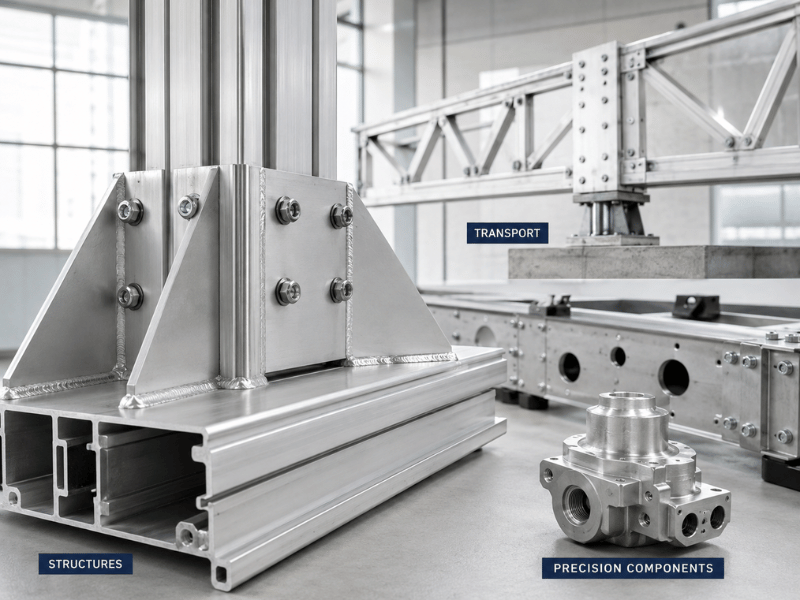
6082-T6 earns its place wherever structural load, weldability, and weight sit on the same critical path.
Structural and Transport Frames
Bridges, roof trusses, crane booms, truck and rail bodies, and tower frameworks use 6082-T6 because it carries high static load, welds on site, and meets Eurocode 9 structural design across the EU and UK. Its strength-to-weight is the reason it replaced 6061 in many European structural roles.
Marine and Outdoor Structures
Boat frameworks, gangways, and pylon structures use it where the alloy’s good general corrosion resistance and anodizing response matter. In direct seawater or sustained immersion, coating or cladding is still needed — 6082 is not a 5xxx-grade marine substitute.
Machined and Precision Components
CNC-machined shafts, bushings, hydraulic parts, and fittings are usually specified in T651 so the stress-relieved stock stays dimensionally stable after cutting. The alloy’s good machinability plus near-310 MPa strength makes it a default for European machine shops.
6082-T6 vs 6061 vs 6063 — How to Choose
| Property | 6082-T6 | 6061-T6 | 6063-T6 |
|---|---|---|---|
| Ultimate Tensile Strength | ~310 MPa | ~310 MPa | ~215 MPa |
| Yield Strength | ~260 MPa | ~276 MPa | ~170 MPa |
| Extrudability | Good (simpler sections) | Good | Excellent (thin, complex) |
| Weldability | Good | Excellent | Very good |
| Machinability | Good | Good | Fair |
| Best for | EU structural, bridges, frames | General US structural, bike, marine | Architectural trim, profiles |
When 6082-T6 Is the Right Call
- The project follows European or Eurocode 9 structural specs, or needs the highest 6000-series strength in larger sections — bridges, cranes, trusses, truck frames.
- Machined parts need both near-310 MPa strength and stable dimensions after cutting — specify T651.
When 6061 or 6063 Fits Better
6061-T6 carries a slightly higher yield (~276 MPa) and welds more easily, so it stays the North American default for general fabrication, bike frames, and marine fittings. 6063-T6 is the choice for architectural and decorative extrusions where thin, complex profiles and a bright anodized finish matter more than strength.
Working with 6082-T6 — What You Need to Know
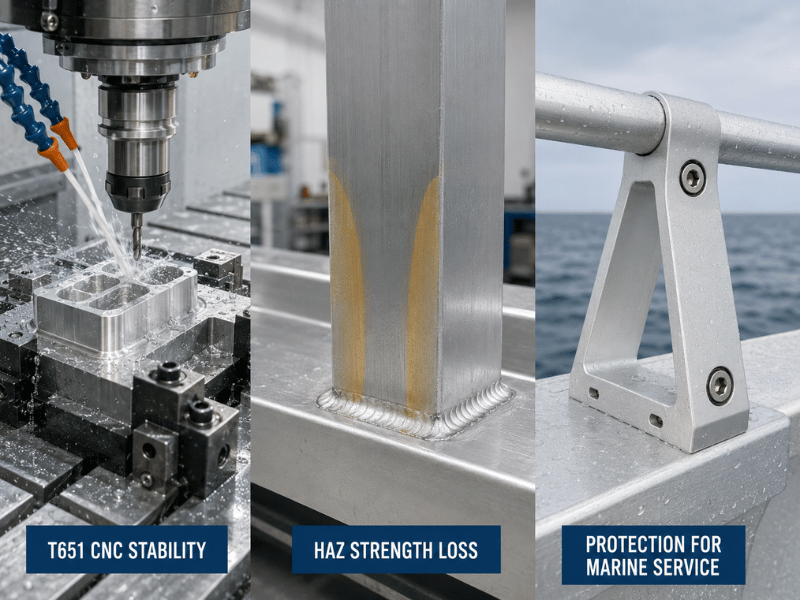
Machining is straightforward in T6 or T651. Carbide tooling, rigid fixturing, and flood coolant keep the surface clean; T651 is preferred for precision parts because the stretched stock resists warping after material removal.
Welding is good but not loss-free. The heat-affected zone loses much of its strength, so design joints for the reduced local capacity and pick the filler deliberately: 5356 keeps strength and color-matches after anodizing, while 4043 offers better crack resistance. 6082 welds reliably to itself and to 6061.
Corrosion resistance is very good in air and mild industrial atmospheres, and the alloy anodizes well — including hard anodizing. For marine or sustained-moisture service, apply coating or cladding; in chloride-rich environments 6082 will pit where a 5xxx alloy would not.
Pros and Limitations at a Glance
| Dimension | Strength | Watch-out |
|---|---|---|
| Strength-to-weight | Highest of common 6000-series | Less formable than 6061/6063 |
| Weldability | Good with right filler | HAZ strength loss |
| Machinability | Good, better as T651 | Work-hardens the surface |
| Corrosion | Very good in air, anodizes well | Pits in seawater without coating |
| Extrudability | Good for simple sections | Struggles with thin complex dies |
| Availability | Common in EU supply | Thick T651 sections cost more |
| Cost | Moderate, above 6063 | Justified by load/weight gain |
Conclusion
6082-T6 pairs the highest strength of the 6000-series with genuine weldability, which is why it anchors European structural and machined work — the trade-off is real: it extrudes less easily than 6061 or 6063, loses strength in the weld zone, and needs coating in marine service.
Linsy Aluminum, a Shenzhen-based factory with more than 20 years of experience, supplies 6082-T6 and related tempers across sheet, coil, tube, and bar with full MTC documentation per order and SGS test reports available on request; typical custom lead time runs 10–60 days depending on size and processing. Send the specification or drawing for a grade-and-temper review — Linsy Aluminum supports low-MOQ custom 6082 orders with in-house heat treatment and finishing.
Frequently Asked Questions
What is the difference between 6082-T6 and T651?
Both reach the same strength, but T651 is stretched 1–3% after quenching to remove residual stress before aging. That makes machined parts hold their dimensions after cutting, so T651 is the usual call for precision CNC components while plain T6 suits less critical structural use.
Can 6082-T6 be welded?
Yes. Weldability is good, but the heat-affected zone drops in strength, so joints must be designed for the reduced local capacity. Use 5356 filler to keep strength and anodize color match, or 4043 where crack resistance matters most; 6082 welds reliably to itself and to 6061.
Is 6082-T6 stronger than 6061-T6?
In tensile strength they are about equal, near 310 MPa. 6061-T6 actually has a slightly higher yield (~276 MPa vs ~260 MPa) and welds more easily, while 6082-T6 holds its strength better in larger sections and machines well — which is why 6082 is the European structural default and 6061 the North American one.
Is 6082-T6 suitable for marine or saltwater use?
It works in marine atmospheres with coating or cladding, and anodizes well, but it is not a 5xxx-grade seawater substitute. In direct immersion or chloride-rich environments, 6082 will pit without protection, so specify coating or move to a 5xxx alloy for sustained saltwater duty.
What tempers does 6082 come in?
The common tempers are O (annealed, for forming), T4 (solution + natural age), T6 (peak strength), T651 (stress-relieved for machining), and H112 (as-rolled plate with no separate heat treatment). For structural and machined parts, T6 and T651 cover most specifications.