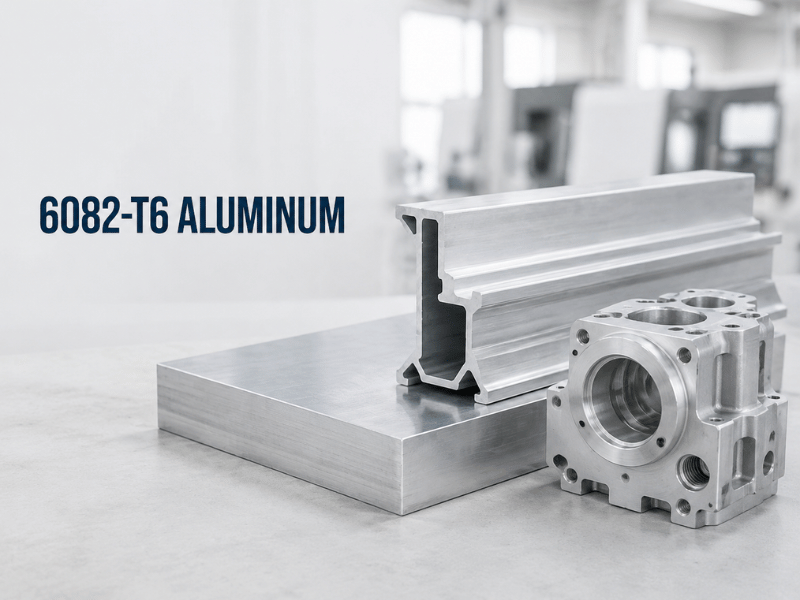
What Is 6082-T6 Aluminum?
6082 is a 6000-series alloy built on a magnesium-silicon system with an unusually high manganese content (0.4–1.0%), and it is the strongest of the common structural 6000-series grades — the European counterpart to 6061, widely specified to Eurocode 9 for bridges, cranes, and frames. Strength comes from magnesium-silicide precipitates formed during the T6 aging treatment, while manganese refines the grain and increases strength without compromising corrosion resistance.
That manganese-rich composition is also why 6082 is harder to push through an extrusion die than 6061 or 6063, so it trades some formability for the highest strength-to-weight ratio in the family. The temper you choose — most often T6 for structural and machined parts — decides whether you get peak strength or easier post-machining stability, which is the real decision behind every 6082 specification.
Zrozumienie stanu T6
The “T6” label is a fixed heat-treatment route, not the as-supplied condition. A 6082 section leaves the press soft; only the T6 cycle brings it to full strength.
Solution heat treatment heats the part to about 530°C so the magnesium, silicon, and manganese dissolve into a single-phase solid solution. Rapid water quenching locks those elements in place before they can precipitate. Artificial aging at roughly 170–180°C for several hours then precipitates fine Mg₂Si particles that block dislocation movement and raise strength.
T6 vs T651 for 6082
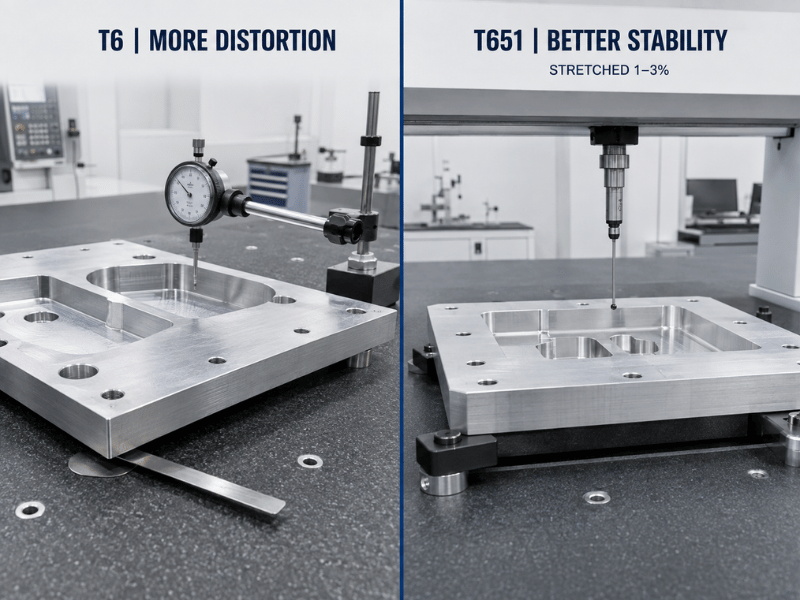
T651 is the stress-relieved version of T6. After quenching, the section is stretched 1–3% to remove residual stress, then aged. Mechanical strength remains the same, but machined parts maintain their dimensions much better after material removal — which is why T651 is the default for CNC-machined 6082 components with tight tolerances.
6082-T6 Chemical Composition
6082’s strength comes from its high silicon-to-manganese balance — just enough Mg₂Si to age-harden hard, with manganese pushing strength higher than in 6061 or 6063. The limits below follow EN AW-6082 (EN 573-3).
| Element | Zakres składu (wagowo %) | Rola |
|---|---|---|
| Aluminium (Al) | Równowaga | Metal nieszlachetny |
| Krzem (Si) | 0.70–1.30 | Kreator wydzieleń z Mg |
| Żelazo (Fe) | ≤0,50 | Limit zanieczyszczeń |
| Miedź (Cu) | ≤0,10 | Limit zanieczyszczeń |
| Mangan (Mn) | 0.40–1.00 | Grain control, strength |
| Magnez (Mg) | 0.60–1.20 | Wytrzymałość poprzez starzenie Mg₂Si |
| Chrom (Cr) | ≤0.25 | Rozdrobnienie ziarna |
| Cynk (Zn) | ≤0.20 | Limit zanieczyszczeń |
| Tytan (Ti) | ≤0,10 | Rafinator ziarna |
| Inni (każdy) | ≤0,05 | Pierwiastki śladowe |
| Inne (łącznie) | ≤0,15 | Całkowita zawartość śladowa |
6082-T6 Mechanical and Physical Properties
These are typical T6 values for extruded sections and plate per EN 755-2 / EN 485-2. Note that strength scales with section size: small bar reaches the top of the range, thick plate sits near the minimum. Confirm against the mill test certificate for the specific product form.
| Nieruchomość | 6082-T6 |
|---|---|
| Najwyższa wytrzymałość na rozciąganie (UTS) | 295–310 MPa |
| Yield Strength (YS) | 240–260 MPa |
| Wydłużenie | 8-12% |
| Twardość | ~95 HB |
| Gęstość | 2,70 g/cm³ |
| Moduł sprężystości | ~70 GPa |
| Przewodność cieplna | ~180 W/m-K |
| Przewodność elektryczna | ~37% IACS |
The number that drives most specs is tensile strength near 310 MPa combined with good weldability — that pairing is what lets 6082 replace steel in weight-critical frames without forcing a switch to a harder-to-weld alloy.
Where 6082-T6 Is Used
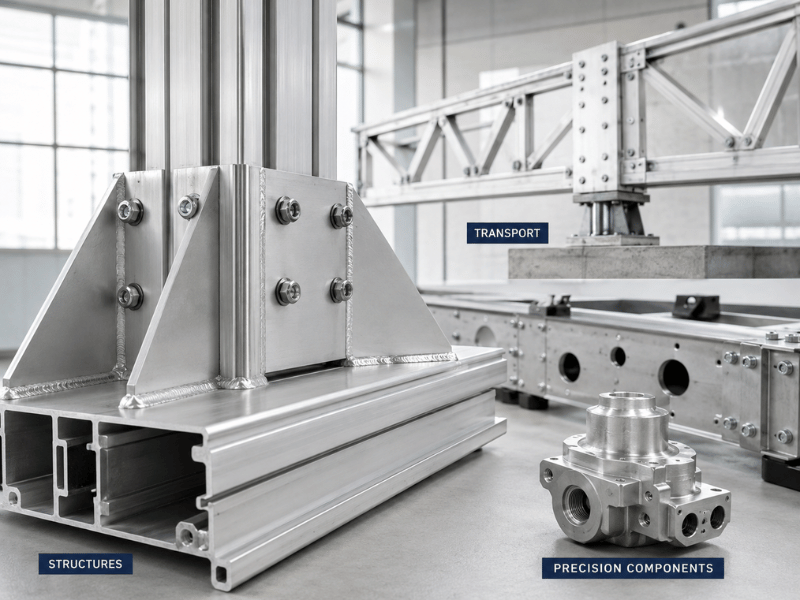
6082-T6 earns its place wherever structural load, weldability, and weight sit on the same critical path.
Structural and Transport Frames
Bridges, roof trusses, crane booms, truck and rail bodies, and tower frameworks use 6082-T6 because it carries high static load, welds on site, and meets Eurocode 9 structural design across the EU and UK. Its strength-to-weight is the reason it replaced 6061 in many European structural roles.
Marine and Outdoor Structures
Boat frameworks, gangways, and pylon structures use it where the alloy’s good general corrosion resistance and anodizing response matter. In direct seawater or sustained immersion, coating or cladding is still needed — 6082 is not a 5xxx-grade marine substitute.
Machined and Precision Components
CNC-machined shafts, bushings, hydraulic parts, and fittings are usually specified in T651 so the stress-relieved stock stays dimensionally stable after cutting. The alloy’s good machinability plus near-310 MPa strength makes it a default for European machine shops.
6082-T6 vs 6061 vs 6063 — How to Choose
| Nieruchomość | 6082-T6 | 6061-T6 | 6063-T6 |
|---|---|---|---|
| Ostateczna wytrzymałość na rozciąganie | ~310 MPa | ~310 MPa | ~215 MPa |
| Wytrzymałość na rozciąganie | ~260 MPa | ~276 MPa | ~170 MPa |
| Wytłaczalność | Good (simpler sections) | Dobry | Excellent (thin, complex) |
| Spawalność | Dobry | Doskonały | Bardzo dobra |
| Obrabialność | Dobry | Dobry | Uczciwy |
| Najlepsze dla | EU structural, bridges, frames | General US structural, bike, marine | Architectural trim, profiles |
When 6082-T6 Is the Right Call
- The project follows European or Eurocode 9 structural specs, or needs the highest 6000-series strength in larger sections — bridges, cranes, trusses, truck frames.
- Machined parts need both near-310 MPa strength and stable dimensions after cutting — specify T651.
Kiedy stop 6061 lub 6063 sprawdza się lepiej
6061-T6 carries a slightly higher yield (~276 MPa) and welds more easily, so it stays the North American default for general fabrication, bike frames, and marine fittings. 6063-T6 is the choice for architectural and decorative extrusions where thin, complex profiles and a bright anodized finish matter more than strength.
Working with 6082-T6 — What You Need to Know
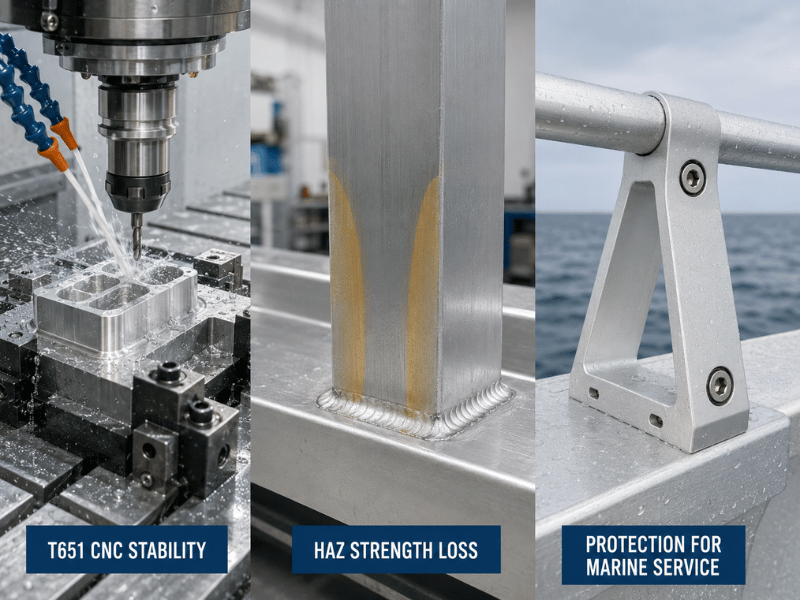
Machining is straightforward in T6 or T651. Carbide tooling, rigid fixturing, and flood coolant keep the surface clean; T651 is preferred for precision parts because the stretched stock resists warping after material removal.
Welding is good but not loss-free. The heat-affected zone loses much of its strength, so design joints for the reduced local capacity and pick the filler deliberately: 5356 keeps strength and color-matches after anodizing, while 4043 offers better crack resistance. 6082 welds reliably to itself and to 6061.
Corrosion resistance is very good in air and mild industrial atmospheres, and the alloy anodizes well — including hard anodizing. For marine or sustained-moisture service, apply coating or cladding; in chloride-rich environments 6082 will pit where a 5xxx alloy would not.
Zalety i Ograniczenia w Skrócie
| Wymiar | Siła | Watch-out |
|---|---|---|
| Stosunek wytrzymałości do masy | Highest of common 6000-series | Less formable than 6061/6063 |
| Spawalność | Good with right filler | HAZ强度损失 |
| Obrabialność | 良好,优于T651 | 对表面进行加工硬化 |
| Odporność korozyjna | 在空气中性能极佳,阳极氧化效果好 | 无涂层时在海水环境中易点蚀 |
| Wytłaczalność | 适用于简单截面 | 在薄壁复杂模具方面存在困难 |
| Dostępność | 在欧洲供应中常见 | 厚T651截面成本更高 |
| Koszt | 中等,高于6063 | 通过载荷/重量增益可证明其合理性 |
Wnioski
6082-T6将6000系铝合金的最高强度与真正的可焊性相结合,这正是其成为欧洲结构件和机加工件核心材料的原因——但代价是实实在在的:其挤压成型性不如6061或6063,焊缝区域强度下降,且在海洋环境中需要涂层保护。.
林思铝业,一家位于深圳、拥有20余年经验的工厂,供应 6082-T6及相关回火状态产品 涵盖板材、卷材、管材和棒材,每笔订单均附完整MTC文件,并可应要求提供SGS检测报告;常规定制交期为10至60天,具体取决于尺寸和加工要求。请发送规格或图纸以供牌号和回火状态评审——林思铝业支持低起订量6082定制订单,配备厂内热处理和精整能力。.
Często zadawane pytania
6082-T6和T651有什么区别?
两者强度相同,但T651在淬火后、时效前经过1–3%的拉伸以消除残余应力。这使得机加工零件在切削后能保持尺寸稳定,因此T651通常用于精密CNC部件,而普通T6适用于要求较低的结构用途。.
6082-T6可以焊接吗?
可以。可焊性良好,但热影响区强度下降,因此接头设计必须考虑局部承载能力的降低。使用5356填充材料以保持强度和阳极氧化颜色匹配,或在对抗裂性要求最高时使用4043;6082可与自身及6061可靠焊接。.
6082-T6比6061-T6强度更高吗?
在抗拉强度方面两者大致相当,接近310 MPa。6061-T6的屈服强度实际上略高(约276 MPa对比约260 MPa),且焊接更容易,而6082-T6在较大截面上能更好地保持强度且机加工性能优异——这就是6082成为欧洲结构件默认材料、6061成为北美默认材料的原因。.
6082-T6适用于海洋或盐水环境吗?
在带涂层或包覆层的海洋大气环境中可以使用,阳极氧化效果好,但它不是5xxx系海水替代材料。在直接浸没或富氯环境中,6082无保护时会点蚀,因此需指定涂层,或在持续盐水工况下改用5xxx系合金。.
6082有哪些回火状态?
常见回火状态包括O(退火态,用于成型)、T4(固溶+自然时效)、T6(峰值强度)、T651(消除应力,用于机加工)和H112(热轧态板材,无单独热处理)。对于结构件和机加工件,T6和T651覆盖大多数规格要求。.