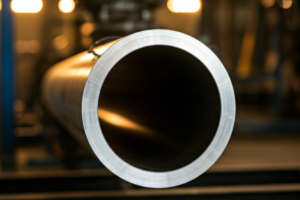
What Is 7075-T6 Aircraft-Grade Forged Aluminum?
7075-T6 is the highest-strength common wrought aluminum alloy, reaching an ultimate tensile strength near 572 MPa (83 ksi) at roughly one-third the weight of steel. “Aircraft-grade” is not a spec — it describes the role: airframe and engine parts where strength-to-weight and fatigue life decide whether the structure flies safely for decades. Forging, rather than machining from plate, is what earns 7075-T6 that role, because the process aligns the grain with the part’s load path.
The temper and the forging route together decide whether a given aircraft part should be 7075-T6 at all. T6 gives peak strength but the weakest stress-corrosion-cracking (SCC) resistance of the 7075 family, so the selection question is less “is 7075 strong enough?” and more “does the service environment allow the T6 temper, or should an overaged temper carry the load?”
7075-T6 Chemical Composition
The strength comes from a zinc-magnesium-copper system. Zinc is the dominant addition; magnesium forms the MgZn₂ precipitates that harden the matrix; copper raises strength further but pulls corrosion resistance down. Chromium improves toughness and limits grain growth.
| Element | Weight % | Notes |
|---|---|---|
| Zinc (Zn) | 5.1–6.1 | Primary strengthening element |
| Magnesium (Mg) | 2.1–2.9 | Forms MgZn₂ precipitates with Zn |
| Copper (Cu) | 1.2–2.0 | Raises strength; lowers corrosion resistance |
| Chromium (Cr) | 0.18–0.28 | Toughness, grain refinement |
| Silicon (Si) | 0.40 max | Impurity |
| Iron (Fe) | 0.50 max | Impurity |
| Manganese (Mn) | 0.30 max | Impurity |
| Titanium (Ti) | 0.20 max | Grain refiner |
| Others (each / total) | 0.05 / 0.15 max | Trace limits |
| Aluminum (Al) | Remainder (90.0–91.4) | Base metal |
Mechanical Properties of 7075-T6 Forgings
These are typical values for T6 forgings and plate. Always confirm against the mill test certificate (MTC) for the specific section, temper, and heat-treat lot.
| Property | 7075-T6 Value | Practical meaning |
|---|---|---|
| Ultimate Tensile Strength (UTS) | 572 MPa (83 ksi) | Highest of common wrought Al |
| Yield Strength (YS) | 503 MPa (73 ksi) | ~80% above 6061-T6 |
| Elongation | 8–11% | Drops in stress-relieved variants |
| Hardness | ~150 HB | — |
| Density | 2.81 g/cm³ | One-third of steel |
| Thermal conductivity | ~130 W/m·K | Below 6xxx and pure Al |
| Modulus of Elasticity | ~72 GPa | — |
| Fatigue strength (10⁷ cycles) | ~160 MPa | Raised by forged grain flow |
Yield strength is the number that drives most airframe decisions. At 503 MPa, 7075-T6 carries roughly 80% more load than 6061-T6 before it yields — which is why it replaces steel in weight-critical structures. That same precipitation-strengthened microstructure is what makes it sensitive to SCC and hard to weld.
Why Forging Matters for Aircraft-Grade 7075-T6
Forging starts from a heated billet and squeezes it between dies. The pressure closes internal voids and forces the grain to follow the part’s outline, producing a denser, tougher component than casting and a more fatigue-resistant one than machining from plate.
| Form | Grain structure | Fatigue life | Best use |
|---|---|---|---|
| Cast | Random, porous | Lowest | Non-critical, complex shapes |
| Machined plate | Cut across original grain | Moderate | Low-quantity, simple parts |
| Forged | Aligned to load path | Highest | Critical airframe & landing-gear loads |
Closed-die forging is the default for finished aerospace parts because the cavity defines the shape and the grain follows the contour. Open-die work stays useful for rings, blocks, and preforms that are later machined.
7075 Forging Tempers and AMS Specifications
Different tempers trade strength against SCC resistance. The AMS (Aerospace Material Specification) numbers below are the procurement references buyers quote on purchase orders.
| Temper | AMS spec | UTS (min) | YS (min) | Elong (min) | SCC resistance |
|---|---|---|---|---|---|
| T6 | 4126 | 83 ksi (572 MPa) | 73 ksi (503 MPa) | 11% | Lowest |
| T73 | 4141 (die forgings) | 83 ksi (572 MPa) | 73 ksi (503 MPa) | 8% | High |
| T7352 | 4147 | 83 ksi (572 MPa) | 73 ksi (503 MPa) | 9% | High + toughness |
| T74 | 4131 | 85 ksi (586 MPa) | 73 ksi (503 MPa) | 9% | Moderate–High |
AMS minimums hold T6, T73, and T7352 at the same 572 MPa floor, but typical as-forged values differ: T6 reaches the highest typical strength, while T73 trades roughly 10–15% strength for markedly better SCC resistance. T652 — T6 plus 1–5% compressive stress relief — is the usual spec for machined aerospace forgings because it cuts residual stress and improves dimensional stability. Confirm actual values against the MTC.
Aerospace Applications of Forged 7075-T6
Forged 7075-T6 earns its place wherever strength, fatigue life, and weight sit on the same critical path.
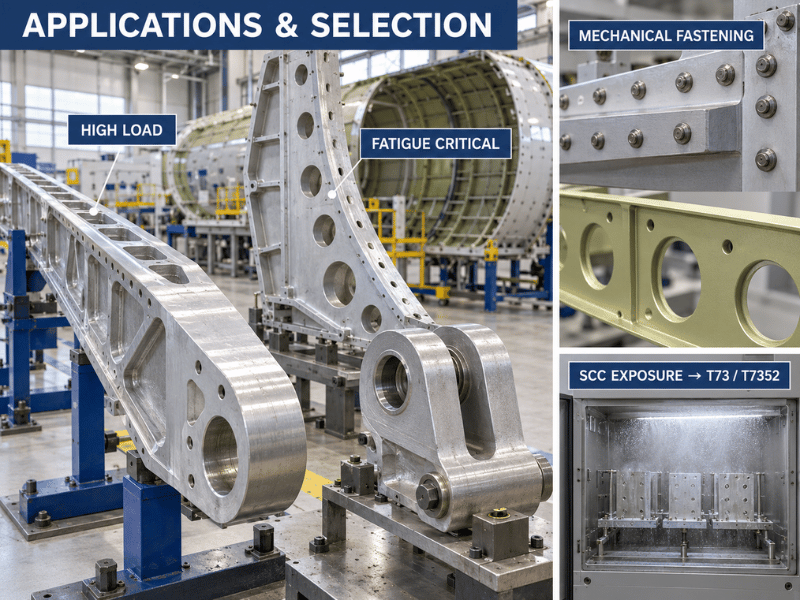
- Wing spars, ribs, and fuselage fittings use the aligned grain flow to resist the cyclic loads these parts see for decades. SCC-critical sections move to T73 or T7352; the rest stay at T6 or T652 with coating.
- Landing-gear components rely on impact resistance and fatigue strength under repeated touchdown loads.
- Missile and ordnance parts exploit the strength-to-weight ratio under extreme acceleration and thermal swing.
- Aircraft fasteners (rivets, bolts) use consistent mechanical properties that meet aviation quality and safety limits.
- Seat frameworks and cargo components gain stiffness without adding passenger-carrying mass.
Go/No-Go: When to Specify Forged 7075-T6
Use the conditions below to self-check before specifying the alloy and temper.
Go when:
- The part must carry high static or fatigue load and weight reduction from steel is the project goal.
- The geometry can be coated, clad, or kept in a protected internal structure.
- The service environment is non-corrosive or the part can move to T73/T7352 for SCC resistance.
- Near-net-shape forging cuts material and machining cost at production volume.
No-Go when:
- The part sits in sustained tensile load in a chloride or marine environment and must stay at T6 — specify T73/T7352 instead.
- Welding or field repair by fusion is required — 7075 does not weld reliably.
- The part is thin, flat, and simple enough that machined plate meets the load — forging adds tooling cost with no benefit.
- Budget is the priority and 6xxx-series strength is acceptable — 6061-T6 costs less and welds.
Working with Forged 7075-T6
Machining is straightforward with the right setup. Carbide tooling, rigid fixturing, and flood coolant keep the work-hardenable surface from smearing; 7075-T6 produces clean chips and holds tight tolerances.
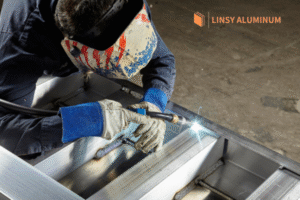
Welding is generally avoided. Copper and zinc cause hot cracking, the heat-affected zone loses much of its strength, and the joint performs poorly on corrosion and SCC. Rivets, bolts, and adhesive bonding are the normal joining routes.
Corrosion protection is mandatory in most environments. T6 resists indoor atmosphere but pits in chloride exposure, so anodizing, painting, or cladding is standard. For any saline or sustained-moisture service, move to T73 rather than relying on coating alone.
Design for the process early. Hold a forging reduction ratio of at least 4:1, use generous fillets and draft angles, avoid thin sections that cool too fast, and orient the part so the grain flow runs along the main stress path. These choices decide whether the forging beats a machined plate on fatigue.
Pros and Limitations at a Glance
| Dimension | Strength | Watch-out |
|---|---|---|
| Strength-to-weight | Highest of common wrought Al | Higher material and forging cost |
| Fatigue life | Excellent with aligned grain flow | Depends on forging quality |
| Machinability | Good with carbide + coolant | Work-hardens the surface |
| Corrosion | Moderate general, poor SCC (T6) | Needs coating; T73 for saline |
| Weldability | Poor — joining by fasteners | Limits repair options |
| Temper choice | T6 → T73/T7352 → T74 ladder | Match to SCC exposure |
Conclusion
Forged 7075-T6 aircraft-grade aluminum converts the strongest common wrought aluminum into dense, fatigue-resistant parts whose grain follows the load path — the trade-off is real: T6 gives peak strength but the weakest SCC resistance of the family, only moderate general corrosion resistance, and essentially no weldability, so coating and mechanical joining are the norm.
Linsy Aluminum supplies 7075-T6 and related tempers and coordinates forged shapes through partner process facilities, with in-house CNC machining, welding, laser cutting, and surface finishing (anodizing, polishing) to complete your part. Every order ships with an MTC, and SGS test reports (chemical, mechanical, ultrasonic, RoHS + REACH) are available on request; typical custom lead time runs 10–60 days depending on size and processing, with low-MOQ support for non-stock items.
Send the forging drawing for a feasibility and grade-fit review — Linsy covers material supply and downstream processing across the 1000–8000 series.
Frequently Asked Questions
What is the difference between 7075-T6 and T652 forgings?
Both reach near-identical strength, but T652 adds 1–5% compressive stress relief right after quenching. That cuts residual stress from 60–90 MPa to 20–40 MPa and improves dimensional stability, so T652 is the usual spec for machined aerospace forgings while T6 suits less critical parts.
How does 7075-T6 compare to 2024-T3 and 6061-T6?
7075-T6 has the highest strength of the three — about 572 MPa UTS versus ~483 MPa for 2024-T3 and ~310 MPa for 6061-T6. 2024-T3 offers better fatigue and slightly better corrosion than 7075 but lower strength; 6061-T6 is far easier to weld and corrodes less, at roughly half the strength. Choose 7075-T6 when strength-to-weight dominates.
Can 7075-T6 aluminum be welded?
Welding is generally avoided. Copper and zinc cause hot cracking, the heat-affected zone loses much of its strength, and the joint is vulnerable to corrosion and SCC. Rivets, bolts, or adhesive bonding are the standard joining methods.
Which 7075 forging temper should I use for a marine or saltwater part?
Not T6. In chloride environments T6 pits and has the worst SCC resistance of the 7075 family. Specify the overaged T73 or T7352 temper, which trade strength for markedly better SCC resistance, and still apply coating or cladding.
Is forged 7075-T6 stronger than machining the same part from plate?
Forging does not raise the alloy’s base strength, but it closes internal voids and aligns the grain with the part shape, raising toughness and fatigue life versus a machined plate of the same alloy and temper. It also saves material through near-net shape, though closed-die tooling adds upfront cost that pays off in production volume.