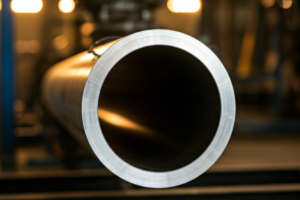
Was ist 7075-T6 Flugzeugqualität geschmiedetes Aluminium?
7075-T6 ist die hochfesteste gängige Knetaluminiumlegierung und erreicht eine Zugfestigkeit von nahezu 572 MPa (83 ksi) bei etwa einem Drittel des Gewichts von Stahl. “Flugzeugqualität” ist keine Spezifikation — sie beschreibt die Rolle: Rumpf- und Triebwerksteile, bei denen das Festigkeits-Gewichts-Verhältnis und die Ermüdungslebensdauer darüber entscheiden, ob die Struktur über Jahrzehnte sicher fliegt. Schmieden, anstatt der Bearbeitung aus Plattenmaterial, ist es, was 7075-T6 diese Rolle verleiht, weil der Prozess die Faserrichtung mit dem Lastpfad des Bauteils ausrichtet.
Die Wärmebehandlung und der Schmiedeweg entscheiden gemeinsam darüber, ob ein gegebenes Flugzeugteil überhaupt aus 7075-T6 gefertigt werden sollte. T6 liefert Spitzenfestigkeit, aber die schwächste Beständigkeit gegen Spannungsrisskorrosion (SCC) der 7075-Familie, sodass die Auswahlfrage weniger lautet “Ist 7075 fest genug?” sondern vielmehr “Erlaubt die Einsatzumgebung die T6-Wärmebehandlung, oder sollte eine überalterte Wärmebehandlung die Last tragen?”
Chemische Zusammensetzung von 7075-T6
Die Festigkeit stammt aus einem Zink-Magnesium-Kupfer-System. Zink ist der dominierende Zusatz; Magnesium bildet die MgZn₂-Ausscheidungen, die die Matrix aushärten; Kupfer erhöht die Festigkeit weiter, senkt jedoch die Korrosionsbeständigkeit. Chrom verbessert die Zähigkeit und begrenzt das Kornwachstum.
| Element | Gewicht % | Anmerkungen |
|---|---|---|
| Zink (Zn) | 5.1–6.1 | Primäres Verfestigungselement |
| Magnesium (Mg) | 2.1–2.9 | Bildet MgZn₂-Ausscheidungen mit Zn |
| Kupfer (Cu) | 1.2–2.0 | Erhöht die Festigkeit; senkt die Korrosionsbeständigkeit |
| Chrom (Cr) | 0.18–0.28 | Zähigkeit, Kornfeinung |
| Silizium (Si) | 0,40 max. | Verunreinigung |
| Eisen (Fe) | 0,50 max. | Verunreinigung |
| Mangan (Mn) | 0,30 max. | Verunreinigung |
| Titan (Ti) | 0,20 max. | Kornfeinungsmittel |
| Sonstige (jeweils / gesamt) | 0,05 / 0,15 max. | Spurengrenzwerte |
| Aluminium (Al) | Rest (90,0–91,4) | Unedles Metall |
Mechanische Eigenschaften von 7075-T6 Schmiedeteilen
Dies sind typische Werte für T6-Schmiedeteile und -Platten. Stets gegen das Mühlenzeugnis (MTC) für den spezifischen Querschnitt, die Wärmebehandlung und die Wärmebehandlungscharge bestätigen.
| Eigentum | 7075-T6 Wert | Praktische Bedeutung |
|---|---|---|
| Höchstzugkraft (UTS) | 572 MPa (83 ksi) | Höchster gängiger Knetaluminiumlegierungen |
| Streckgrenze (YS) | 503 MPa (73 ksi) | ~80% über 6061-T6 |
| Dehnung | 8–11% | Sinkt bei spannungsarmgeglühten Varianten |
| Härte | ~150 HB | — |
| Dichte | 2,81 g/cm³ | Ein Drittel von Stahl |
| Wärmeleitfähigkeit | ~130 W/m-K | Unter 6xxx und reinem Al |
| Elastizitätsmodul | ~72 GPa | — |
| Dauerfestigkeit (10⁷ Zyklen) | ~160 MPa | Erhöht durch geschmiedeten Faserverlauf |
Die Streckgrenze ist der Wert, der die meisten Rumpfentscheidungen bestimmt. Bei 503 MPa trägt 7075-T6 etwa 80% mehr Last als 6061-T6, bevor es fließt — weshalb es Stahl in gewichtskritischen Strukturen ersetzt. Dieselbe ausscheidungsgehärtete Mikrostruktur ist es, die es empfindlich gegenüber SCC und schwer schweißbar macht.
Warum Schmieden für Flugzeugqualität 7075-T6 wichtig ist
Schmieden beginnt mit einem erwärmten Knüppel und presst ihn zwischen Gesenken. Der Druck schließt innere Hohlräume und zwingt das Korn, der Kontur des Bauteils zu folgen, wodurch ein dichteres, zäheres Bauteil als beim Gießen und ein ermüdungsbeständigeres als bei der Bearbeitung aus Plattenmaterial entsteht.
| Formular | Kornstruktur | Ermüdungslebensdauer | Beste Verwendung |
|---|---|---|---|
| Gegossen | Zufällig, porös | Niedrigste | Unkritische, komplexe Formen |
| Bearbeitete Platte | Quer zum ursprünglichen Faserverlauf geschnitten | Mäßig | Geringe Stückzahl, einfache Teile |
| Geschmiedet | Am Lastpfad ausgerichtet | Höchste | Kritische Rumpf- und Fahrwerkslasten |
Gesenkformen ist der Standard für fertige Luft- und Raumfahrtteile, weil der Hohlraum die Form definiert und das Korn der Kontur folgt. Freiformschmieden bleibt nützlich für Ringe, Blöcke und Vorformen, die später bearbeitet werden.
7075 Schmiedewärmebehandlungen und AMS-Spezifikationen
Verschiedene Wärmebehandlungen tauschen Festigkeit gegen SCC-Beständigkeit. Die unten aufgeführten AMS-Nummern (Aerospace Material Specification) sind die Beschaffungsreferenzen, die Käufer auf Bestellungen angeben.
| Temperament | AMS-Spez. | UTS (min) | YS (min) | Dehnung (min) | SCC-Beständigkeit |
|---|---|---|---|---|---|
| T6 | 4126 | 83 ksi (572 MPa) | 73 ksi (503 MPa) | 11% | Niedrigste |
| T73 | 4141 (Gesenkschmiedeteile) | 83 ksi (572 MPa) | 73 ksi (503 MPa) | 8% | Hoch |
| T7352 | 4147 | 83 ksi (572 MPa) | 73 ksi (503 MPa) | 9% | Hoch + Zähigkeit |
| T74 | 4131 | 85 ksi (586 MPa) | 73 ksi (503 MPa) | 9% | Mäßig–Hoch |
AMS-Mindestwerte halten T6, T73 und T7352 auf demselben Mindestwert von 572 MPa, aber die typischen Schmiedewerte unterscheiden sich: T6 erreicht die höchste typische Festigkeit, während T73 etwa 10–15% Festigkeit gegen deutlich besseren SCC-Widerstand eintauscht. T652 — T6 plus 1–5% Druckeigenspannungsabbau — ist die übliche Spezifikation für bearbeitete Luft- und Raumfahrt-Schmiedeteile, da es Eigenspannungen reduziert und die Maßstabilität verbessert. Bestätigen Sie die tatsächlichen Werte anhand des MTC.
Luft- und Raumfahrtanwendungen von geschmiedetem 7075-T6
Geschmiedetes 7075-T6 verdient seinen Platz überall dort, wo Festigkeit, Ermüdungslebensdauer und Gewicht auf demselben kritischen Pfad liegen.
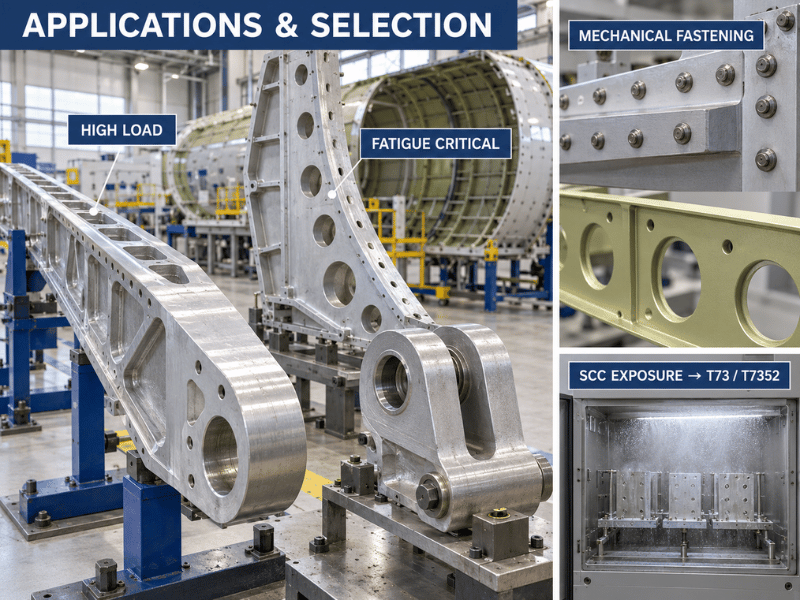
- Flügelholme, Rippen und Rumpfbeschläge nutzen den ausgerichteten Faserverlauf, um den zyklischen Belastungen standzuhalten, denen diese Teile jahrzehntelang ausgesetzt sind. SCC-kritische Bereiche wechseln zu T73 oder T7352; der Rest bleibt bei T6 oder T652 mit Beschichtung.
- Fahrwerkkomponenten verlassen sich auf Schlagfestigkeit und Ermüdungsfestigkeit unter wiederholten Aufsetzlasten.
- Raketen- und Munitionsteile nutzen das Festigkeits-Gewichts-Verhältnis unter extremer Beschleunigung und thermischem Wechsel.
- Flugzeugbefestigungselemente (Nieten, Bolzen) verwenden konsistente mechanische Eigenschaften, die die Qualitäts- und Sicherheitsgrenzen der Luftfahrt erfüllen.
- Sitzrahmen und Frachtkomponenten gewinnen Steifigkeit ohne zusätzliche Passagiermasse.
Go/No-Go: Wann geschmiedetes 7075-T6 spezifiziert werden sollte
Verwenden Sie die folgenden Bedingungen zur Selbstprüfung, bevor Sie die Legierung und den Wärmebehandlungszustand spezifizieren.
Go, wenn:
- Das Teil hohe statische oder Ermüdungsbelastung tragen muss und Gewichtsreduzierung gegenüber Stahl das Projektziel ist.
- Die Geometrie beschichtet, plattiert oder in einer geschützten Innenstruktur gehalten werden kann.
- Die Einsatzumgebung nicht korrosiv ist oder das Teil zu T73/T7352 für SCC-Beständigkeit wechseln kann.
- Near-Net-Shape-Schmieden Material- und Bearbeitungskosten bei Produktionsvolumen senkt.
No-Go, wenn:
- Das Teil unter anhaltender Zugbelastung in einer Chlorid- oder Meeresumgebung steht und bei T6 bleiben muss — spezifizieren Sie stattdessen T73/T7352.
- Schweißen oder Feldreparatur durch Schmelzverbindung erforderlich ist — 7075 lässt sich nicht zuverlässig schweißen.
- Das Teil dünn, flach und einfach genug ist, dass bearbeitete Platte die Last aufnimmt — Schmieden erhöht die Werkzeugkosten ohne Nutzen.
- Das Budget Priorität hat und Festigkeit der 6xxx-Serie akzeptabel ist — 6061-T6 kostet weniger und lässt sich schweißen.
Arbeiten mit geschmiedetem 7075-T6
Die Bearbeitung ist mit der richtigen Einrichtung unkompliziert. Hartmetallwerkzeuge, starre Aufspannung und Flutkühlung verhindern, dass die kalthärtbare Oberfläche verschmiert; 7075-T6 erzeugt saubere Späne und hält enge Toleranzen.
Schweißen wird im Allgemeinen vermieden. Kupfer und Zink verursachen Heißrisse, die wärmebeeinflusste Zone verliert einen Großteil ihrer Festigkeit, und die Verbindung schneidet schlecht bei Korrosion und SCC ab. Nieten, Bolzen und Klebeverbindung sind die üblichen Fügeverfahren.
Korrosionsschutz ist in den meisten Umgebungen obligatorisch. T6 widersteht Innenraumatmosphäre, bildet aber bei Chloridexposition Lochfraß, daher sind Anodisieren, Lackieren oder Plattieren Standard. Für jeden salzhaltigen oder dauerfeuchten Einsatz wechseln Sie zu T73, anstatt sich allein auf die Beschichtung zu verlassen.
Frühzeitig für den Prozess konstruieren. Halten Sie ein Schmiedeverhältnis von mindestens 4:1 ein, verwenden Sie großzügige Radien und Entformungsschrägen, vermeiden Sie dünne Querschnitte, die zu schnell abkühlen, und richten Sie das Teil so aus, dass der Faserverlauf entlang des Hauptspannungspfads verläuft. Diese Entscheidungen bestimmen, ob das Schmiedeteil eine bearbeitete Platte bei der Ermüdung übertrifft.
Vor- und Nachteile im Überblick
| Abmessung | Stärke | Achtung |
|---|---|---|
| Festigkeit-zu-Gewicht | Höchster gängiger Knetaluminiumlegierungen | Höhere Material- und Schmiedekosten |
| Ermüdungslebensdauer | Ausgezeichnet mit ausgerichtetem Faserverlauf | Abhängig von der Schmiedequalität |
| Bearbeitbarkeit | Gut mit Hartmetall + Kühlmittel | Verfestigt die Oberfläche |
| Korrosion | Mäßig allgemein, schlecht SCC (T6) | Benötigt Beschichtung; T73 für salzhaltige Umgebung |
| Schweißeignung | Schlecht — Verbindung durch Befestigungselemente | Schränkt Reparaturmöglichkeiten ein |
| Wahl des Wärmebehandlungszustands | T6 → T73/T7352 → T74-Leiter | An SCC-Exposition anpassen |
Schlussfolgerung
Geschmiedetes 7075-T6 in Flugzeugqualität verwandelt das stärkste gängige Knetaluminium in dichte, ermüdungsbeständige Teile, deren Faserverlauf dem Lastpfad folgt — der Kompromiss ist real: T6 liefert Spitzenfestigkeit, aber den schwächsten SCC-Widerstand der Familie, nur mäßige allgemeine Korrosionsbeständigkeit und praktisch keine Schweißbarkeit, daher sind Beschichtung und mechanisches Fügen die Norm.
Linsy Aluminum liefert 7075-T6 und verwandte Wärmebehandlungszustände und koordiniert Schmiedeformen über Partnerprozessanlagen, mit hauseigener CNC-Bearbeitung, Schweißen, Laserschneiden und Oberflächenveredelung (Anodisieren, Polieren) zur Fertigstellung Ihres Teils. Jede Bestellung wird mit einem MTC geliefert, und SGS-Prüfberichte (chemisch, mechanisch, Ultraschall, RoHS + REACH) sind auf Anfrage erhältlich; die typische kundenspezifische Lieferzeit beträgt 10–60 Tage je nach Größe und Verarbeitung, mit Unterstützung für niedrige MOQ bei Nicht-Lagerartikeln.
Senden Sie die Schmiedeeichnung für eine Machbarkeits- und Sortenprüfung — Linsy deckt Materialversorgung und nachgelagerte Verarbeitung über die 1000–8000-Serie ab.
Häufig gestellte Fragen
Was ist der Unterschied zwischen 7075-T6- und T652-Schmiedeteilen?
Beide erreichen nahezu identische Festigkeit, aber T652 fügt 1–5% Druckeigenspannungsabbau direkt nach dem Abschrecken hinzu. Das reduziert Eigenspannungen von 60–90 MPa auf 20–40 MPa und verbessert die Maßstabilität, daher ist T652 die übliche Spezifikation für bearbeitete Luft- und Raumfahrt-Schmiedeteile, während T6 für weniger kritische Teile geeignet ist.
Wie schlägt sich 7075-T6 im Vergleich zu 2024-T3 und 6061-T6?
7075-T6 hat die höchste Festigkeit der drei — etwa 572 MPa Zugfestigkeit gegenüber ~483 MPa für 2024-T3 und ~310 MPa für 6061-T6. 2024-T3 bietet bessere Ermüdungseigenschaften und eine etwas bessere Korrosionsbeständigkeit als 7075, jedoch geringere Festigkeit; 6061-T6 ist weitaus leichter zu schweißen und korrodiert weniger, bei etwa halber Festigkeit. Wählen Sie 7075-T6, wenn das Festigkeits-Gewichts-Verhältnis dominiert.
Kann 7075-T6-Aluminium geschweißt werden?
Schweißen wird im Allgemeinen vermieden. Kupfer und Zink verursachen Heißrisse, die wärmebeeinflusste Zone verliert einen Großteil ihrer Festigkeit, und die Verbindung ist anfällig für Korrosion und SCC. Nieten, Schrauben oder Klebeverbindungen sind die Standardfügeverfahren.
Welche 7075-Schmiedewarmbehandlung sollte ich für ein Marine- oder Salzwasserteil verwenden?
Nicht T6. In chloridhaltigen Umgebungen neigt T6 zu Lochfraß und weist die schlechteste Spannungsrisskorrosionsbeständigkeit der 7075-Familie auf. Spezifizieren Sie die überalterte T73- oder T7352-Warmbehandlung, die Festigkeit gegen deutlich bessere Spannungsrisskorrosionsbeständigkeit eintauscht, und wenden Sie dennoch eine Beschichtung oder Plattierung an.
Ist geschmiedetes 7075-T6 stärker als die Bearbeitung desselben Teils aus Plattenmaterial?
Schmieden erhöht nicht die Grundfestigkeit der Legierung, aber es schließt innere Hohlräume und richtet das Gefüge an der Teileform aus, was die Zähigkeit und die Ermüdungslebensdauer im Vergleich zu einem bearbeiteten Plattenmaterial derselben Legierung und Warmbehandlung erhöht. Es spart auch Material durch endkonturnahe Formgebung, obwohl geschlossene Gesenke zusätzliche Vorlaufkosten verursachen, die sich bei Produktionsvolumen amortisieren.