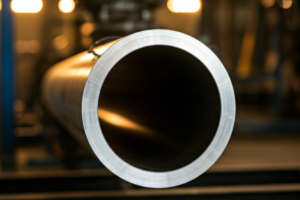
Qu'est-ce que l'aluminium forgé de qualité aéronautique 7075-T6 ?
Le 7075-T6 est l'alliage d'aluminium corroyé courant à la plus haute résistance, atteignant une résistance ultime à la traction proche de 572 MPa (83 ksi) pour environ un tiers du poids de l'acier. “ Qualité aéronautique ” n'est pas une spécification — cela décrit le rôle : pièces de cellule et de moteur où le rapport résistance/poids et la durée de vie en fatigue déterminent si la structure vole en toute sécurité pendant des décennies. Le forgeage, plutôt que l'usinage dans la masse, est ce qui confère au 7075-T6 ce rôle, car le procédé aligne le grain avec le chemin de charge de la pièce.
Le revenu et la gamme de forgeage déterminent ensemble si une pièce aéronautique donnée doit être en 7075-T6. Le T6 offre la résistance maximale mais la plus faible résistance à la fissuration par corrosion sous contrainte (SCC) de la famille 7075, de sorte que la question de sélection est moins “ le 7075 est-il assez résistant ? ” que “ l'environnement de service permet-il le revenu T6, ou un revenu sur-revenu doit-il supporter la charge ? ”
Composition chimique du 7075-T6
La résistance provient d'un système zinc-magnésium-cuivre. Le zinc est l'élément d'addition dominant ; le magnésium forme les précipités MgZn₂ qui durcissent la matrice ; le cuivre augmente davantage la résistance mais réduit la résistance à la corrosion. Le chrome améliore la ténacité et limite la croissance des grains.
| Élément | Poids % | Notes |
|---|---|---|
| Zinc (Zn) | 5.1–6.1 | Élément de renforcement principal |
| Magnésium (Mg) | 2.1–2.9 | Forme des précipités MgZn₂ avec le Zn |
| Cuivre (Cu) | 1.2–2.0 | Augmente la résistance ; réduit la résistance à la corrosion |
| Chrome (Cr) | 0.18–0.28 | Ténacité, affinage du grain |
| Silicium (Si) | 0,40 max | Impureté |
| Fer (Fe) | 0,50 max | Impureté |
| Manganèse (Mn) | 0,30 max | Impureté |
| Titane (Ti) | 0,20 max | Affineur de grain |
| Autres (chaque / total) | 0,05 / 0,15 max | Limites à l'état de traces |
| Aluminium (Al) | Reste (90,0–91,4) | Métal commun |
Propriétés mécaniques des pièces forgées en 7075-T6
Ce sont des valeurs typiques pour les pièces forgées et les tôles en T6. Toujours confirmer par rapport au certificat de contrôle en usine (MTC) pour la section, le revenu et le lot de traitement thermique spécifiques.
| Propriété | Valeur du 7075-T6 | Signification pratique |
|---|---|---|
| Résistance ultime à la traction (UTS) | 572 MPa (83 ksi) | Le plus élevé des alliages d'aluminium corroyés courants |
| Limite d'élasticité (YS) | 503 MPa (73 ksi) | Environ 80 % de plus que le 6061-T6 |
| Élongation | 8–11% | Diminue dans les variantes détendues |
| Dureté | Environ 150 HB | — |
| Densité | 2,81 g/cm³ | Un tiers de l'acier |
| Conductivité thermique | ~130 W/m-K | Inférieur aux 6xxx et à l'Al pur |
| Module d'élasticité | Environ 72 GPa | — |
| Résistance à la fatigue (10⁷ cycles) | ~160 MPa | Augmenté par le flux de grain forgé |
La limite d'élasticité est le chiffre qui guide la plupart des décisions de cellule. À 503 MPa, le 7075-T6 supporte environ 80 % de charge en plus que le 6061-T6 avant de céder — c'est pourquoi il remplace l'acier dans les structures où le poids est critique. Cette même microstructure durcie par précipitation est ce qui le rend sensible à la SCC et difficile à souder.
Pourquoi le forgeage est important pour le 7075-T6 de qualité aéronautique
Le forgeage part d'un lopin chauffé et le comprime entre des matrices. La pression ferme les vides internes et force le grain à suivre le contour de la pièce, produisant un composant plus dense et plus tenace qu'une pièce coulée et plus résistant à la fatigue qu'une pièce usinée dans la masse.
| Formulaire | Structure du grain | Durée de vie en fatigue | Meilleure utilisation |
|---|---|---|---|
| Coulé | Aléatoire, poreux | Le plus bas | Formes complexes non critiques |
| Tôle usinée | Coupé à travers le grain d'origine | Modéré | Pièces simples en faible quantité |
| Forgé | Aligné au chemin de charge | Le plus élevé | Charges critiques de cellule et de train d'atterrissage |
Le forgeage en matrice fermée est la solution par défaut pour les pièces aérospatiales finies, car l’empreinte définit la forme et le grain suit le contour. Le forgeage en matrice ouverte reste utile pour les anneaux, les blocs et les ébauches qui sont ensuite usinés.
Revenus de forgeage 7075 et spécifications AMS
Différents revenus échangent la résistance contre la résistance à la SCC. Les numéros AMS (Aerospace Material Specification) ci-dessous sont les références d'approvisionnement que les acheteurs citent sur les bons de commande.
| Tempérer | Spécification AMS | Rm (min) | Re (min) | A (min) | Résistance à la SCC |
|---|---|---|---|---|---|
| T6 | 4126 | 83 ksi (572 MPa) | 73 ksi (503 MPa) | 11% | Le plus bas |
| T73 | 4141 (pièces forgées matricées) | 83 ksi (572 MPa) | 73 ksi (503 MPa) | 8% | Haut |
| T7352 | 4147 | 83 ksi (572 MPa) | 73 ksi (503 MPa) | 9% | Élevée + ténacité |
| T74 | 4131 | 85 ksi (586 MPa) | 73 ksi (503 MPa) | 9% | Modérée–Élevée |
Les minimums AMS maintiennent le T6, le T73 et le T7352 au même plancher de 572 MPa, mais les valeurs typiques à l'état forgé diffèrent : le T6 atteint la résistance typique la plus élevée, tandis que le T73 échange environ 10–15 % de résistance pour une résistance à la SCC nettement meilleure. Le T652 — T6 plus détente en compression de 1–5 % — est la spécification habituelle pour les pièces forgées aéronautiques usinées car il réduit les contraintes résiduelles et améliore la stabilité dimensionnelle. Confirmer les valeurs réelles par rapport au MTC.
Applications aéronautiques du 7075-T6 forgé
Le 7075-T6 forgé s’impose partout où la résistance, la durée de vie en fatigue et le poids se trouvent sur le même chemin critique.
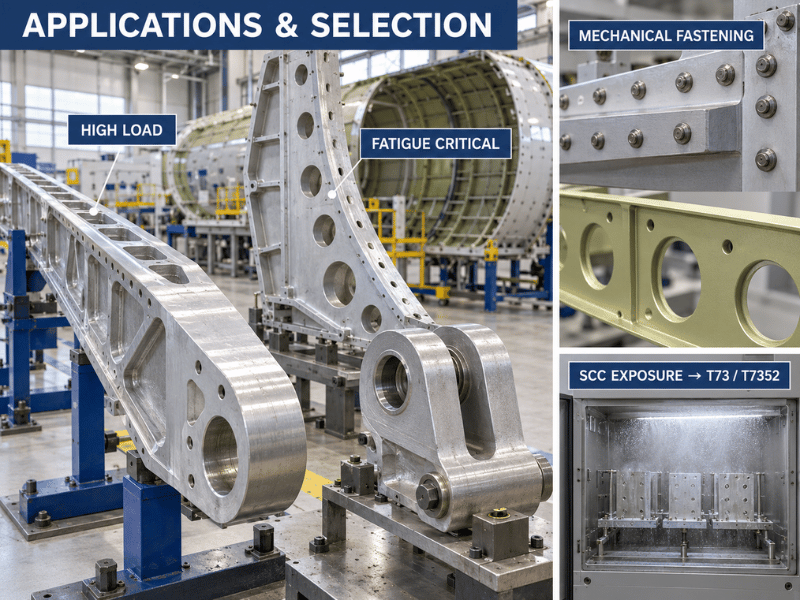
- Longrons d'aile, nervures et fixations de fuselage utilisent le flux de grain aligné pour résister aux charges cycliques que ces pièces subissent pendant des décennies. Les sections critiques à la SCC passent au T73 ou T7352 ; les autres restent en T6 ou T652 avec revêtement.
- Composants de train d'atterrissage s'appuyer sur la résistance aux chocs et la résistance à la fatigue sous des charges d'atterrissage répétées.
- Pièces de missiles et de munitions exploiter le rapport résistance-poids sous une accélération extrême et des variations thermiques.
- Fixations aéronautiques (rivets, boulons) utilisent des propriétés mécaniques constantes qui respectent les limites de qualité et de sécurité aéronautiques.
- Structures de sièges et composants de fret gagner en rigidité sans ajouter de masse transportée en passagers.
Go/No-Go : Quand spécifier le 7075-T6 forgé
Utilisez les conditions ci-dessous pour effectuer une auto-vérification avant de spécifier l'alliage et le revenu.
Go lorsque :
- La pièce doit supporter une charge statique ou de fatigue élevée et la réduction de poids par rapport à l'acier est l'objectif du projet.
- La géométrie peut être revêtue, plaquée ou maintenue dans une structure interne protégée.
- L'environnement de service est non corrosif ou la pièce peut passer au T73/T7352 pour la résistance à la CSC.
- Le forgeage près des cotes nettes réduit le coût des matériaux et d'usinage au volume de production.
No-Go lorsque :
- La pièce est soumise à une charge de traction soutenue dans un environnement chloruré ou marin et doit rester en T6 — spécifiez plutôt le T73/T7352.
- Le soudage ou la réparation sur site par fusion est requis — le 7075 ne se soude pas de manière fiable.
- La pièce est mince, plate et suffisamment simple pour qu'une plaque usinée supporte la charge — le forgeage ajoute un coût d'outillage sans bénéfice.
- Le budget est la priorité et la résistance de la série 6xxx est acceptable — le 6061-T6 coûte moins cher et se soude.
Travailler avec le 7075-T6 forgé
L'usinage est simple avec la bonne configuration. Outillage carbure, bridage rigide et arrosage abondant empêchent la surface écrouissable de baver ; le 7075-T6 produit des copeaux nets et maintient des tolérances serrées.
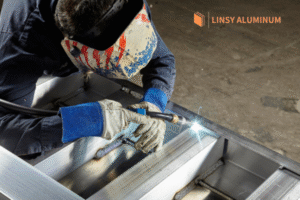
Le soudage est généralement évité. Le cuivre et le zinc provoquent une fissuration à chaud, la zone affectée thermiquement perd une grande partie de sa résistance, et le joint présente de mauvaises performances en corrosion et en CSC. Les rivets, boulons et le collage adhésif sont les voies d'assemblage normales.
La protection contre la corrosion est obligatoire dans la plupart des environnements. Le T6 résiste à l'atmosphère intérieure mais se pique en exposition aux chlorures, donc l'anodisation, la peinture ou le placage sont standard. Pour tout service salin ou à humidité soutenue, passez au T73 plutôt que de compter uniquement sur le revêtement.
Concevez pour le procédé dès le départ. Maintenez un taux de réduction de forgeage d'au moins 4:1, utilisez des congés et des dépouilles généreux, évitez les sections minces qui refroidissent trop vite, et orientez la pièce de sorte que le flux de grain suive le chemin de contrainte principal. Ces choix déterminent si le forgeage surpasse une plaque usinée en fatigue.
Avantages et limites en un coup d'œil
| Dimension | La force | Points d'attention |
|---|---|---|
| Rapport résistance/poids | Le plus élevé des alliages d'aluminium corroyés courants | Coût de matériau et de forgeage plus élevé |
| Durée de vie en fatigue | Excellente avec fibrage aligné | Dépend de la qualité du forgeage |
| Usinabilité | Bon avec carbure + arrosage | Durcit la surface |
| Corrosion | Générale modérée, CSC médiocre (T6) | Nécessite un revêtement ; T73 pour milieu salin |
| Soudabilité | Médiocre — assemblage par fixations | Limite les options de réparation |
| Choix du revenu | Échelle T6 → T73/T7352 → T74 | Adapter à l'exposition à la CSC |
Conclusion
Aluminium aéronautique 7075-T6 forgé convertit l'aluminium corroyé courant le plus résistant en pièces denses et résistantes à la fatigue dont le grain suit le chemin de charge — le compromis est réel : le T6 offre une résistance maximale mais la plus faible résistance à la CSC de la famille, une résistance à la corrosion générale seulement modérée, et pratiquement aucune soudabilité, donc le revêtement et l'assemblage mécanique sont la norme.
Linsy Aluminum fournit le 7075-T6 et les revenus associés et coordonne les formes forgées via des installations de traitement partenaires, avec usinage CNC, soudage, découpe laser et finition de surface (anodisation, polissage) en interne pour compléter votre pièce. Chaque commande est livrée avec un MTC, et des rapports d'essai SGS (chimique, mécanique, ultrasonique, RoHS + REACH) sont disponibles sur demande ; le délai de fabrication personnalisée typique est de 10 à 60 jours selon la taille et le traitement, avec un support de faible MOQ pour les articles non stockés.
Envoyez le dessin de forgeage pour une revue de faisabilité et d'adéquation de nuance — Linsy couvre l'approvisionnement en matériaux et le traitement en aval sur les séries 1000–8000.
Questions fréquemment posées
Quelle est la différence entre les pièces forgées 7075-T6 et T652 ?
Les deux atteignent une résistance quasi identique, mais le T652 ajoute une détente en compression de 1–5 % juste après la trempe. Cela réduit les contraintes résiduelles de 60–90 MPa à 20–40 MPa et améliore la stabilité dimensionnelle, de sorte que le T652 est la spécification habituelle pour les pièces forgées aérospatiales usinées, tandis que le T6 convient aux pièces moins critiques.
Comment le 7075-T6 se compare-t-il au 2024-T3 et au 6061-T6 ?
Le 7075-T6 a la résistance la plus élevée des trois — environ 572 MPa UTS contre ~483 MPa pour le 2024-T3 et ~310 MPa pour le 6061-T6. Le 2024-T3 offre une meilleure fatigue et une corrosion légèrement meilleure que le 7075 mais une résistance inférieure ; le 6061-T6 est bien plus facile à souder et se corrode moins, à environ la moitié de la résistance. Choisissez le 7075-T6 lorsque le rapport résistance-poids est dominant.
L'aluminium 7075-T6 peut-il être soudé ?
Le soudage est généralement évité. Le cuivre et le zinc provoquent une fissuration à chaud, la zone affectée thermiquement perd une grande partie de sa résistance, et le joint est vulnérable à la corrosion et à la CSC. Les rivets, boulons ou collage adhésif sont les méthodes d'assemblage standard.
Quel revenu de forgeage 7075 dois-je utiliser pour une pièce marine ou en eau salée ?
Pas le T6. Dans les environnements chlorurés, le T6 se pique et présente la pire résistance à la CSC de la famille 7075. Spécifiez le revenu sur-revenu T73 ou T7352, qui échange de la résistance contre une résistance à la CSC nettement meilleure, et appliquez toujours un revêtement ou un placage.
Le 7075-T6 forgé est-il plus résistant que l'usinage de la même pièce dans une plaque ?
Le forgeage n'augmente pas la résistance de base de l'alliage, mais il ferme les vides internes et aligne le grain avec la forme de la pièce, augmentant la ténacité et la durée de vie en fatigue par rapport à une plaque usinée du même alliage et revenu. Il économise aussi de la matière grâce à la forme près des cotes nettes, bien que l'outillage de matricage ajoute un coût initial qui est rentabilisé au volume de production.