当零件的形状比其强度更重要时,3003就是应当选择的合金。它的深冲和旋压性能几乎超过任何其他变形铝合金,无需涂层即可在户外和食品接触环境中使用,并且可以用普通车间设备进行焊接。它做不到的是提供结构强度,或像易切削牌号那样进行机加工。.
这种权衡就是这种合金的全部故事,而大多数规格错误都源于只看到了它的一半。采购方为储罐、风管或散热器芯体选择3003,然后要求同一种材料在加工中心承受载荷或保持公差,而这是它做不到的。.
3003铝合金是什么
3003 铝 是3xxx系列中的一种非热处理型Al-Mn合金,注册为UNS A93003,在欧洲称为EN AW-3003,或AlMn1Cu。1.0–1.5%的锰是唯一有意添加的元素,它使强度比工业纯铝提高约20% 1100 同时不牺牲成形性或耐腐蚀性。.
没有时效步骤,因此轧制厂完全通过冷轧减薄来产生全部强度。这一事实同时解释了 temper 体系和主要使用限制:任何后续退火或焊接步骤都会使局部强度回退。.
该合金于20世纪30年代实现标准化,如今是全球产量最高的轧制铝牌号之一。供应充足,价格稳定,并且比其他任何3xxx牌号都更多以不同 temper 状态备货。.
化学成分与标准
以下限值是3003的注册成分,并由ASTM B209和EN 573-3共同采用。所有数值均为重量百分比。.
| 要素 | 限值(wt %) |
| 硅 (Si) | ≤ 0.60 |
| 铁(Fe) | ≤ 0.70 |
| 铜 (Cu) | 0.05 - 0.20 |
| 锰 (Mn) | 1.00 – 1.50 |
| 锌 (Zn) | ≤ 0.10 |
| 钛 (Ti) | ≤ 0.05 |
| 其他,各 | ≤ 0.05 |
| 其他,合计 | ≤ 0.15 |
| 铝 (Al) | 剩余 |
该表是标准且完整的,因此其中没有可协商的内容。不过,有两点确实会让采购方吃亏。.
在两个标准中,3003都没有单独规定镁和铬,因此任何残留量都归入0.05%的“其他,单项”限值。一些轧制厂质保书会打印Mg ≤ 0.05和Cr ≤ 0.05,以使这一隐含限值明确化,这就是为什么两份数据表看起来不同,却描述的是完全相同的合金。.
同一种材料在不同体系中带有不同牌号,而且产品标准会随你购买的形式而变化。.
| 体系 | 名称 | 适用产品标准 |
| AA / UNS | 3003 / A93003 | ASTM B209(薄板和厚板)、B210(拉制管)、B211(棒、杆、线)、B221(挤压型材) |
| EN | EN AW-3003 / AlMn1Cu (DIN 3.0517) | EN 573-3(化学成分)、EN 485(轧制)、EN 754(拉制)、EN 755(挤压) |
| 国际标准化组织 | AlMn1Cu | ISO 6361 |
| JIS | A3003 | JIS H4000 / H4040 / H4080 |
| GB | 3003 | GB/T 3190、GB/T 3880 |
如果图纸只写了“3003”而没有其他内容,请在商定价格前确认产品形式。轧制和挤压库存采用不同标准、不同 temper 定义和不同力学最低值,而且差距足以改变设计。.
不同回火状态下的力学性能
Temper 对这些数值的影响远大于化学成分。从退火状态进行冷轧减薄会使抗拉强度大约翻倍,并消除大部分延展性,而其中每一步都是有意为之。.
| 财产 | 3003-O(退火) | 3003-H14(半硬) | 3003-H18(全硬) |
| 抗拉强度,Rm (MPa) | 95 – 130 | 140 – 180 | ≥ 185 |
| 屈服强度,Rp0.2 (MPa) | ≥ 35 | ≥ 115 | ≥ 165 |
| 伸长率 (%) | ≥ 25 | ≥ 5 | ≥ 3 |
| 硬度 (HB) | ≈ 28 | ≈ 40 | ≈ 55 |
对于扁平轧制加工,H14是常用默认状态,而O是你有意指定的 temper。当零件在供货后将被深冲、旋压或紧密弯曲时选择O;当它必须通过轻度成形保持形状时选择H14;当它根本不会被成形时选择H18。关于半硬路线的细节、其弯曲半径及其成形极限,见我们的 3003-H14指南.
最低值取决于厚度,因此没有标明厚度的数值不可用。ASTM B209会随着薄板变薄而降低伸长率最低值,而EN 485-2公布的H14数值略高于ASTM:抗拉范围为145–185 MPa,屈服最低值为125 MPa。请在订单上注明适用标准,并从随炉批提供的检验文件中读取认证值。.
物理特性
这些是大多数热工和重量计算背后的数值。密度和模量实际上固定,而导热系数数值会随 temper 略有变化。.
| 财产 | 价值 |
| 密度 | 2.73 g/cm³ |
| 熔化范围 | ≈ 640 – 655 °C |
| 导热性 | ≈ 160 – 190 W/(m·K),在退火 temper 下最高 |
| 导电性 | ≈ 40 – 44 % IACS |
| 热膨胀,20–100 °C | 23.1 µm/(m·K) |
| 弹性模量 | ≈ 69.5 GPa |
| 退火范围 | 350 – 400 °C |
密度通常是决定项目的数值。在2.73 g/cm³下,3003的重量约为钢的三分之一,这就是为什么它在储罐、管道和包覆层中取代镀锌薄板。导热性良好,但远低于铜,因此该合金竞争的是重量和成本,而不是原始传热能力。.
选择 Temper
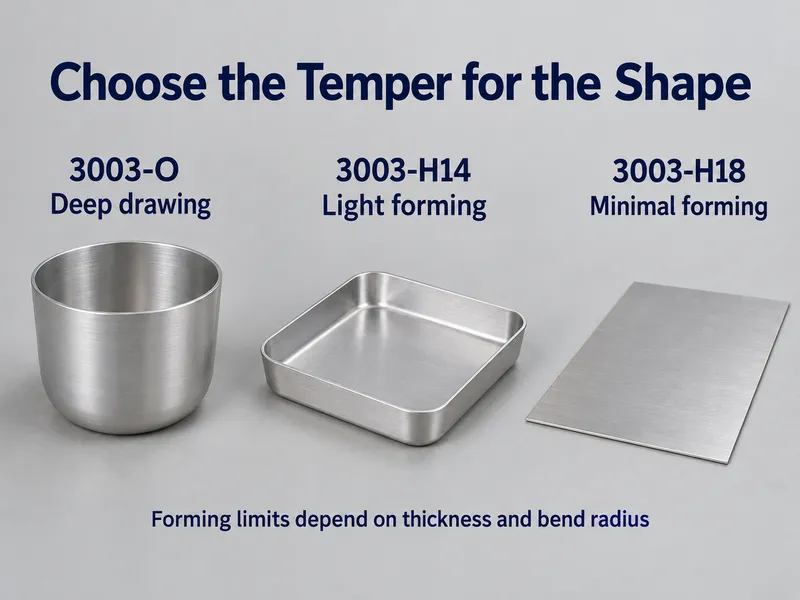
你指定的 temper 决定了强度与零件还能承受多少成形之间的平衡。大多数用量集中在O、H14和H22;其他状态则是为某一特定工艺或某一特定应力而存在。.
| 脾气 | 它是什么 | 典型用途 |
| O | 退火态,完全软化 | 深冲、旋压、复杂冲压件 |
| H12 | 四分之一硬度 | 适用于需要少量强度的一般成型 |
| H14 | 半硬 | 屋面、壁板、储罐、炊具、一般制造 |
| H16 | 四分之三硬度 | 结构板、标识牌 |
| H18 | 全硬 | 无供应后成型的平板 |
| H22 | 应变硬化后部分退火 | 交付后成型的零件,H14会开裂 |
| H112 | 制造态,无应变硬化控制 | 厚板和重型规格结构件 |
H22是买家最常忽视的回火状态。它提供的强度接近H14,但延展性明显更好,当成型发生在你的工厂而非轧制厂,且零件必须弯曲而不开裂时,这一点至关重要。.
3003的适用场合——以及不适用场合
当四项要求同时出现时,3003胜出:易于成型、户外级耐腐蚀性、焊接简便以及每公斤成本低。去掉其中任何一项,通常就由另一种合金来承担该任务。.
在以下情况下指定3003:
- 零件为深冲、旋压或严重弯曲成型,且最终厚度由模具而非应力决定。.
- 组件采用钎焊,或为散热器、冷凝器、蒸发器或冷却板。.
- 使用环境为户外、海洋大气、食品接触或轻度化学腐蚀,且你希望不添加涂层。.
- 产量高,且稳定、广泛可得的合金比最后几个百分点的强度更重要。.
在以下情况下改用其他牌号:
- 设计应力超过H18上限,该上限 5052 在H32或可热处理合金中容易应对。.
- 零件为机加工而非成型。.
- 冷作硬化回火状态必须在焊缝处保持全部强度。.
- 需要由连铸坯料进行装饰性阳极氧化。.
可加工性是最令买家意外的局限,因为3003在纸面上看起来像通用金属。该牌号太软、太韧,无法形成干净的切屑:它会涂抹、在切削刃上积屑并留下较差的表面质量。对于车削、铣削或钻孔零件,6061-T6、6262或2011才是正确选择,而额外的材料成本通常可通过缩短加工周期收回。.
3003铝合金的应用
热交换器、散热器和钎焊板
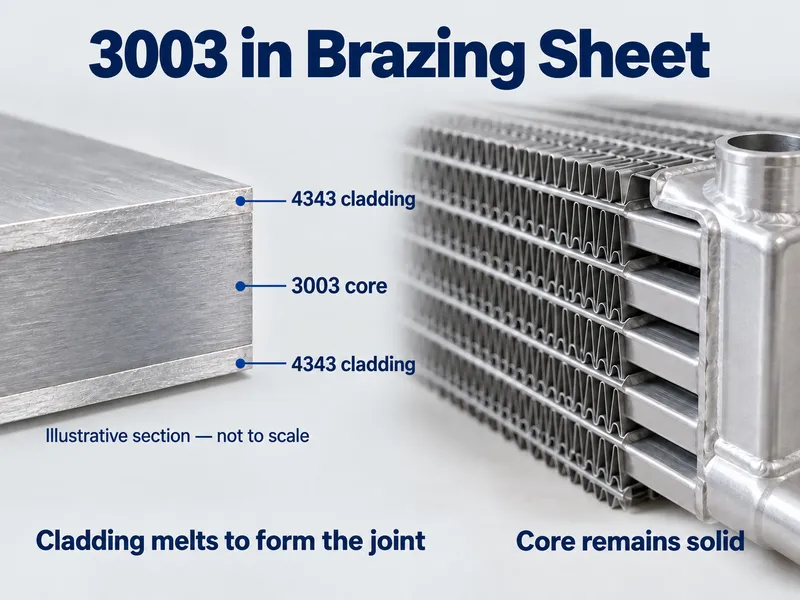
3003最大的单一用途是作为包覆钎焊板的芯层。典型结构为4343/3003/4343,或单面或双面为4045,其中4xxx表皮在炉中熔化,而3003芯层保持固态。.
这种结构使得无需添加钎料即可实现钎焊热交换器。表皮通过毛细作用流入接头,芯层承载强度并使流体通道保持尺寸。.
以这种方式制造的零件包括汽车散热器、冷凝器、蒸发器、增压空气冷却器、加热器芯、空调盘管翅片,以及用于电池包和储能中的液冷板。普通3003板材和翅片料覆盖同一市场中成本较低的一端,那里钎焊负荷较轻,但冲压和成型仍决定回火状态的选择。.
建筑、屋面和暖通空调
3003是屋面、壁板、檐槽、泛水板和墙板的默认包覆材料。它无需保护涂层即可耐候,并可辊压和折叠成这些系统所需的型材。.
同样的特性使其适用于风管、保温管道护套、暖通空调外壳和排水制品。若项目需要颜色,, 3003铝板 可接受油漆或预涂卷材饰面。.
交通运输和汽车
交通运输领域在重量和制造成本比强度更重要之处使用该合金:燃油箱、油底壳、拖车和卡车车身板、电池托盘以及非结构支架。.
同一行业在车辆热交换器中以吨计消耗该合金,这是按体积计最大的汽车应用。这里的预测和制造需求通常决定轧制订单按O还是H14状态生产。.
食品、化工和一般制造
食品接触和轻度腐蚀工况天然适用:炊具、食品加工托盘、储罐、轻型化工设备和淡水管道部件。.
除此之外,该牌号还覆盖一般钣金加工——机箱、标牌、铭牌、家具装饰件、照明反射器和成型电气外壳——凡中等强度足够且需要洁净表面之处。.
3003的对比
在与最常被拿来比较的合金对比中,3003位于非热处理合金组的中间,并远低于可热处理合金。.
合金强化方式常见回火状态下的强度选择它的最佳理由1100冷作H14 ≈ 110 – 145 MPa最高的导电性和耐腐蚀纯度3003冷作H14 ≈ 140 – 180 MPa通用型平衡3004冷作H34 ≈ 215 – 240 MPa更高强度的板材和罐料5052冷作H32 ≈ 210 – 260 MPa海洋和压力工况6061热处理T6 ≥ 290 MPa结构件和机加工零件
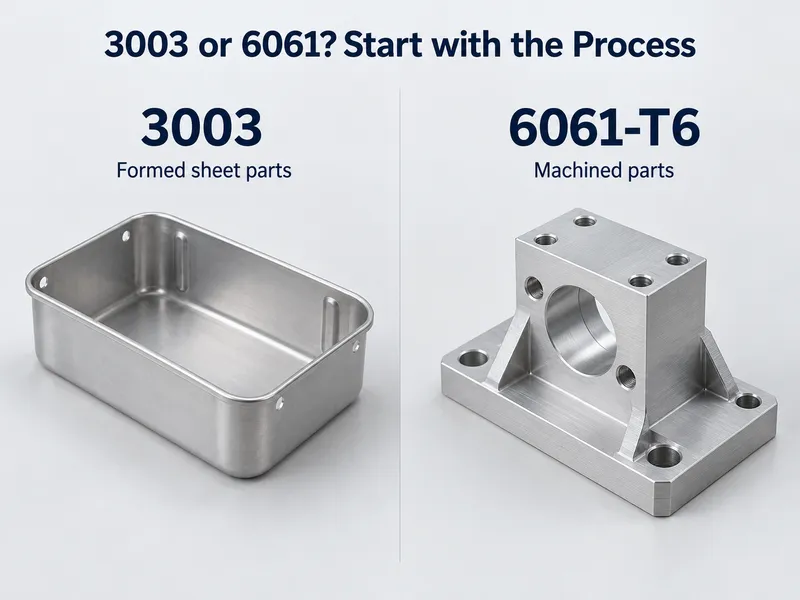
相对于6061的取舍在于工艺而非性能。如果零件由平板大批量成型,3003更便宜且延展性更好;如果零件为机加工、焊接受载框架或需要承载应力,6061胜出,3003无法胜任。.
完整的并排对比,包括腐蚀和焊接行为,见我们的 3003与6061对比. 。若问题是哪种轧制合金适合容器或面板, 3104与3003与3004板材对比 通过同样的决策流程加以解决。.
结论
3003是一种通用型Al-Mn板材合金,其代价是强度上限较低:H18抗拉强度仅约185 MPa,远低于5052-H32或6061-T6,且该牌号可加工性差。它凭借成型性、耐腐蚀性、可焊性和钎焊性能赢得其地位,而非承载能力。.
我们供应3003的板材、厚板、卷材、带材、管材、棒材和线材,回火状态包括O、H12、H14、H18、H22和H112,可提供标准尺寸或按图纸定制,起订量低,交期10–60天。每笔订单随附工厂测试证书,SGS报告可应要求提供。.
请将您的3003回火状态发送给我们, 、厚度和图纸,我们将确认库存、价格和交期。.
常见问题
在3003合金中,我可以设计的最高强度是多少?
根据ASTM B209,H18状态下抗拉强度约为185 MPa,这是该牌号可轧制到的最硬态。H14和H22强度较低,以强度换取成形性。如果设计应力超过H18的上限,请改用5052-H32或可热处理合金。.
3003的最低起订量和交期是多少?
标准状态和尺寸有现货;超出该范围的按低起订量生产,通常需要10–60天,具体取决于合金、尺寸和加工工艺。可供应板材、厚板、卷材、带材、管材、棒材和线材。.
我需要提供什么才能获取3003的报价?
四个细节即可确定大多数询价:
- 状态和厚度,因为力学最低值取决于两者。.
- 产品形式——板材、厚板、卷材、带材、管材、棒材或线材。.
- 适用标准,ASTM B209或其EN等效标准。.
- 是工厂测试证书即可,还是也需要第三方SGS检测。.
3003订单随附哪些文件?
一份工厂测试证书,报告该批次的实际化学成分和力学结果。SGS报告可应要求提供,需额外检测费用。EN 10204 3.2在项目需要时增加独立会签。.