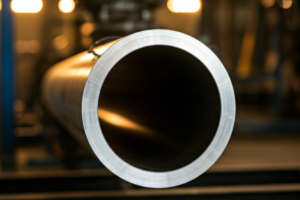
3003 is de legering om naar te grijpen wanneer de vorm van het onderdeel belangrijker is dan de sterkte. Het laat zich verder dieptrekken en spinvormen dan bijna elke andere gewalste aluminiumlegering, doorstaat buitentoepassingen en voedselcontact zonder coating, en laat zich lassen met gewone werkplaatsapparatuur. Wat het niet doet, is structurele sterkte leveren of zich laten verspanen als een free-cutting kwaliteit.
Die afweging is het hele verhaal van de legering, en de meeste specificatiefouten ontstaan doordat men slechts de helft ervan ziet. Een inkoper kiest 3003 voor een tank, een kanaal of een radiatorkern, en vraagt vervolgens hetzelfde materiaal om belasting te dragen of een tolerantie te houden in een bewerkingscentrum, wat het niet kan.
Wat 3003 Aluminiumlegering is
3003 aluminium is een niet-warmtebehandelbare Al-Mn-legering in de 3xxx-serie, geregistreerd als UNS A93003 en in Europa bekend als EN AW-3003, of AlMn1Cu. Mangaan bij 1,0–1,5% is de enige bewuste toevoeging, en het verhoogt de sterkte met ongeveer 20% ten opzichte van commercieel zuiver 1100 zonder vervormbaarheid of corrosieweerstand op te offeren.
Er is geen verouderingsstap, dus de walserij creëert de volledige sterkte door koud reductie. Dat enkele feit verklaart zowel het temper-systeem als de belangrijkste gebruiksbeperking: elke latere gloei- of lasstap geeft de sterkte plaatselijk terug.
De legering werd gestandaardiseerd in de jaren 1930 en behoort nu tot de meest geproduceerde gewalste aluminiumkwaliteiten ter wereld. Het aanbod is diep, de prijsstelling is stabiel en het is in meer tempers verkrijgbaar dan enige andere 3xxx-kwaliteit.
Chemische samenstelling en normen
De onderstaande limieten zijn de geregistreerde samenstelling voor 3003 en worden gedeeld door ASTM B209 en EN 573-3. Alle waarden zijn in gewichtsprocent.
| Element | Limiet (gew %) |
| Silicium (Si) | ≤ 0,60 |
| IJzer (Fe) | ≤ 0,70 |
| Koper (Cu) | 0.05 - 0.20 |
| Mangaan (Mn) | 1.00 – 1.50 |
| Zink (Zn) | ≤ 0,10 |
| Titanium (Ti) | ≤ 0,05 |
| Anderen, elk | ≤ 0,05 |
| Overige, totaal | ≤ 0.15 |
| Aluminium (Al) | Rest |
Deze tabel is standaard en volledig, dus er valt niets in te onderhandelen. Twee punten verrassen kopers echter.
Magnesium en chroom worden voor 3003 in geen van beide normen afzonderlijk gespecificeerd, dus elk residu valt onder de limiet van 0,05% “overige, elk”. Sommige walserijcertificaten vermelden Mg ≤ 0,05 en Cr ≤ 0,05 om die impliciete limiet expliciet te maken, waardoor twee datasheets er verschillend kunnen uitzien terwijl ze exact dezelfde legering beschrijven.
Hetzelfde materiaal draagt verschillende aanduidingen across systemen, en de productnorm verandert met de vorm die u koopt.
| Systeem | Benaming | Geldende productnormen |
| AA / UNS | 3003 / A93003 | ASTM B209 (plaat, dikke plaat), B210 (getrokken buis), B211 (staaf, rondstaaf, draad), B221 (geëxtrudeerde profielen) |
| NL | EN AW-3003 / AlMn1Cu (DIN 3.0517) | EN 573-3 (chemie), EN 485 (gewalst), EN 754 (getrokken), EN 755 (geëxtrudeerd) |
| ISO | AlMn1Cu | ISO 6361 |
| JIS | A3003 | JIS H4000 / H4040 / H4080 |
| GB | 3003 | GB/T 3190, GB/T 3880 |
Als een tekening alleen “3003” vermeldt en niets anders, bevestig dan de productvorm voordat de prijs wordt overeengekomen. Gewalste en geëxtrudeerde voorraad dragen verschillende normen, verschillende temper-definities en verschillende mechanische minima, en het verschil is groot genoeg om een ontwerp te veranderen.
Mechanische eigenschappen per hardingsgraad
De temper bepaalt deze waarden veel meer dan de chemie. Koud reductie vanuit de gegloeide toestand verdubbelt ruwweg de treksterkte en verwijdert het grootste deel van de ductiliteit, en elke stap daarvan is bewust.
| Eigendom | 3003-O (gegloeid) | 3003-H14 (halfhard) | 3003-H18 (volhard) |
| Treksterkte, Rm (MPa) | 95 – 130 | 140 – 180 | ≥ 185 |
| Vloeigrens, Rp0,2 (MPa) | ≥ 35 | ≥ 115 | ≥ 165 |
| Rek (%) | ≥ 25 | ≥ 5 | ≥ 3 |
| Hardheid (HB) | ≈ 28 | ≈ 40 | ≈ 55 |
Voor vlakgewalst werk is H14 de werkstandaard en O de temper die u bewust specificeert. Kies O wanneer het onderdeel na levering diepgetrokken, gesponnen of strak gebogen wordt, H14 wanneer het zijn vorm moet behouden door licht vormen, en H18 wanneer het helemaal niet gevormd wordt. Details van de halfharde route, de buigstralen en de vormlimieten staan in onze 3003-H14 gids.
Minimumwaarden zijn afhankelijk van de dikte, dus een waarde zonder dikteaanduiding is niet bruikbaar. ASTM B209 verlaagt het minimum voor rek naarmate plaat dunner wordt, en EN 485-2 publiceert iets hogere H14-waarden dan ASTM: een treksterktebereik van 145–185 MPa met een minimum vloeigrens van 125 MPa. Vermeld de geldende norm op de bestelling en lees de gecertificeerde waarden uit het inspectiedocument dat bij de warmte wordt geleverd.
Fysische eigenschappen
Dit zijn de waarden achter de meeste thermische en gewichtsberekeningen. Dichtheid en modulus zijn effectief vast, terwijl de geleidbaarheidswaarden enigszins verschuiven met de temper.
| Eigendom | Waarde |
| Dichtheid | 2,73 g/cm³ |
| Smelttraject | ≈ 640 – 655 °C |
| Thermische geleidbaarheid | ≈ 160 – 190 W/(m·K), het hoogst in de gegloeide temper |
| Elektrische geleidbaarheid | ≈ 40 – 44 % IACS |
| Thermische uitzetting, 20–100 °C | 23,1 µm/(m·K) |
| Elasticiteitsmodulus | ≈ 69,5 GPa |
| Gloeitemperatuurbereik | 350 – 400 °C |
Dichtheid is de waarde die meestal een project bepaalt. Bij 2,73 g/cm³ draagt 3003 ruwweg een derde van het gewicht van staal, waardoor het gegalvaniseerde plaat verdringt in tanks, kanalen en bekleding. Thermische geleidbaarheid is goed maar ruim onder koper, dus de legering concurreert op gewicht en kosten rather dan op ruwe warmteoverdracht.
Een temper kiezen
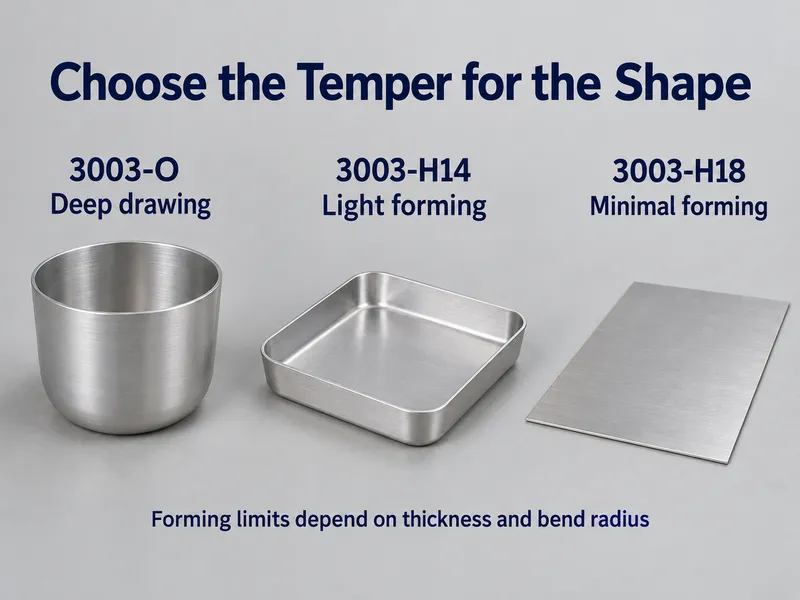
De temper die u noemt, bepaalt de balans tussen sterkte en hoeveel vormen het onderdeel nog aankan. Het grootste volume zit in O, H14 en H22; de andere bestaan voor één specifiek proces of één specifieke spanning.
| Temper | Wat het is | Typisch gebruik |
| O | Gegloeid, volledig zacht | Dieptrekken, spinvormen, complexe stansdelen |
| H12 | Quarter hard | Algemeen vormen waar een beetje sterkte helpt |
| H14 | Halfhard | Dakbedekking, gevelbekleding, tanks, kookgerei, algemene fabricage |
| H16 | Three-quarter hard | Structurele panelen, bewegwijzering |
| H18 | Volledig hard | Vlakke panelen zonder vormen na levering |
| H22 | Koudverstevigd, daarna gedeeltelijk gegloeid | Onderdelen die na levering worden gevormd, waar H14 zou scheuren |
| H112 | As-fabricated, geen controle op koudversteviging | Dikke plaat en zwaar constructiewerk |
H22 is de hardheid die kopers het vaakst over het hoofd zien. Het levert sterkte dicht bij H14 met merkbaar betere ductiliteit, wat van belang is wanneer het vormen in uw fabriek plaatsvindt in plaats van bij de walserij en het onderdeel moet buigen zonder te scheuren.
Waar 3003 wordt gekozen — en waar niet
3003 wint wanneer vier vereisten samenkomen: gemakkelijk vormen, corrosiebestendigheid voor buitenomgeving, eenvoudig lassen en een lage kostprijs per kilogram. Haal een van deze weg en meestal neemt een andere legering de taak over.
Kies 3003 wanneer:
- Het onderdeel diepgetrokken, gedraaid of sterk gebogen wordt, en de einddikte door de matrijs wordt bepaald rather dan door spanning.
- De constructie wordt gesoldeerd, of het is een radiator, condensor, verdamper of koelplaat.
- De toepassing is buiten, in mariene atmosfeer, voedselcontact of licht chemisch, en u voegt liever geen coating toe.
- Het volume is hoog en een stabiele, breed verkrijgbare legering is belangrijker dan de laatste paar procent sterkte.
Stap over naar een andere kwaliteit wanneer:
- De ontwerpspanning het H18-plafond overschrijdt, wat 5052 in H32 of een warmtebehandelbare legering gemakkelijk wordt opgevangen.
- Het onderdeel wordt bewerkt in plaats van gevormd.
- Een koudvervormde hardheid volledige sterkte moet behouden over een las.
- Decoratief anodiseren vereist is vanuit continu gegoten materiaal.
Bewerkbaarheid is de beperking die kopers het meest verrast, omdat 3003 op papier als een universeel metaal lijkt. De kwaliteit is te zacht en te ductiel om een schone spaander te vormen: het smeert, bouwt op op de snijkant en laat een slechte afwerking achter. Voor gedraaide, gefreesde of geboorde onderdelen zijn 6061-T6, 6262 of 2011 de juiste keuzes, en de extra materiaalkosten worden normaal terugverdiend in cyclustijd.
Toepassingen van 3003 aluminium
Warmtewisselaars, radiatoren en soldeerplaat
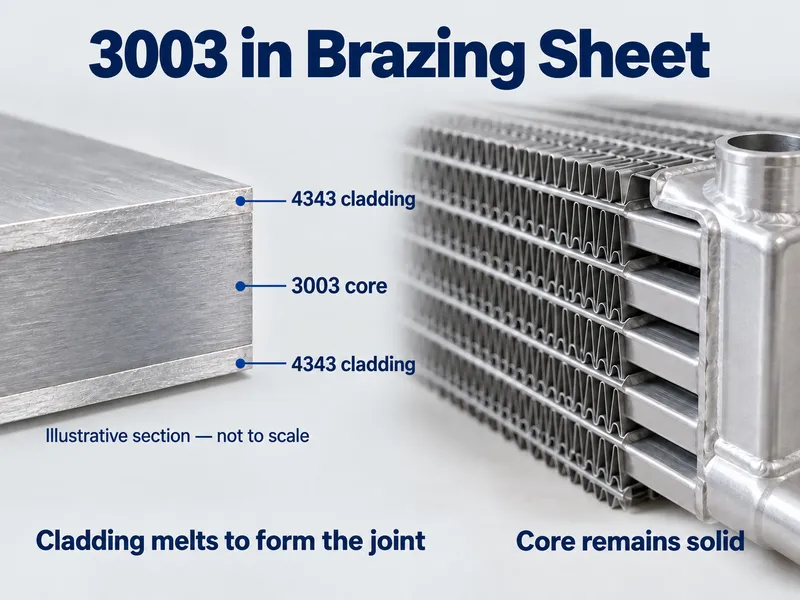
Het grootste enkele gebruik van 3003 is als kernlaag van geplateerd soldeerplaat. Een typische opbouw is 4343/3003/4343, of 4045 op een of beide zijden, waarbij de 4xxx-huid smelt in de oven terwijl de 3003-kern vast blijft.
Die structuur is wat een gesoldeerde warmtewisselaar mogelijk maakt zonder toegevoegd vulmateriaal. De huid vloeit door capillaire werking in de verbinding, en de kern draagt de sterkte en houdt de vloeistofkanalen op maat.
Op deze manier gebouwde onderdelen omvatten autoradiatoren, condensors, verdampers, charge-air coolers, verwarmingskernen, airconditioning lamellen en de vloeistofkoelplaten die worden gebruikt in batterijpakketten en energieopslag. Blanke 3003-plaat en lamellenmateriaal dekken het lagere-kostensegment van dezelfde markt, waar de soldeerbelasting licht is maar stampen en vormen nog steeds de hardheid bepalen.
Bouw, dakbedekking en HVAC
3003 is een standaard bekledingsmateriaal voor dakbedekking, gevelbekleding, goten, loodwerk en wandpanelen. Het verweert zonder beschermende coating, en het laat zich walsen en vouwen in de profielen die die systemen nodig hebben.
Dezelfde eigenschappen brengen het in luchtkanalen, geïsoleerde pijpbekleding, HVAC-behuizingen en afwateringsproducten. Waar een project kleur wenst, 3003 aluminium plaat neemt het verf of een voorgelakte coil-afwerking op.
Transport en automotive
Transport gebruikt de legering waar gewicht en fabricagekosten belangrijker zijn dan sterkte: brandstoftanks, oliepannen, trailer- en vrachtwagencarrosseriepanelen, batterijbakken en niet-structurele beugels.
Dezelfde sector verbruikt het bij de ton in warmtewisselaars voor voertuigen, wat de grootste automotive toepassing is qua volume. De vraag naar voorraad en fabricage hier bepaalt meestal of een walserijorder in O of H14 wordt uitgevoerd.
Voedsel, chemie en algemene fabricage
Voedselcontact en licht corrosieve toepassingen zijn een natuurlijke fit: kookgerei, voedselverwerkingsbakken, opslagtanks, lichte chemische apparatuur en componenten voor drinkwaterleidingen.
Daarbuiten dekt de kwaliteit algemeen plaatwerk — behuizingen, bewegwijzering, naamplaten, meubelbeslag, verlichtingsreflectoren en gevormde elektrische behuizingen — waar matige sterkte voldoende is en een schoon oppervlak gewenst is.
Hoe 3003 zich verhoudt
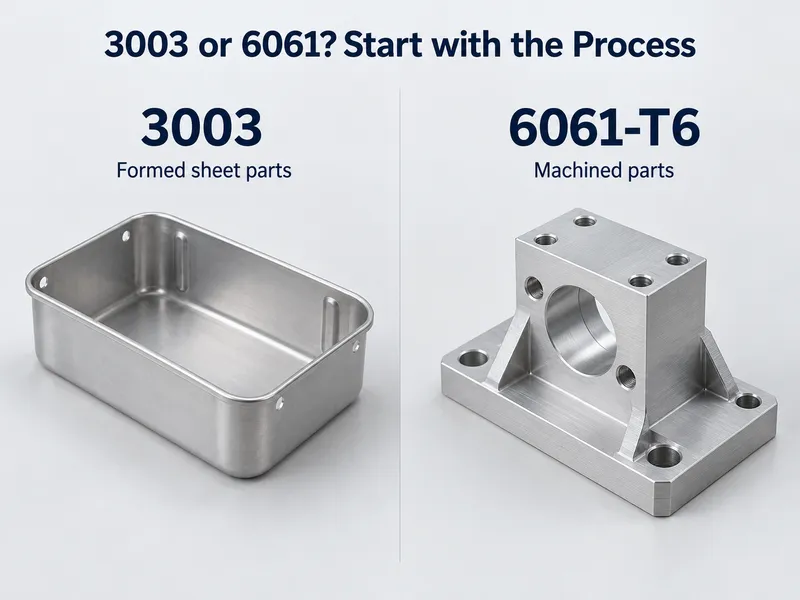
Ten opzichte van de legeringen waarmee het het vaakst wordt vergeleken, zit 3003 in het midden van de niet-warmtebehandelbare groep en ruim onder de warmtebehandelbare.
LegeringVersterkt doorSterkte bij een gangbare hardheidBeste reden om het te kiezen1100KoudvervormingH14 ≈ 110 – 145 MPaMaximale geleidbaarheid en corrosiezuiverheid3003KoudvervormingH14 ≈ 140 – 180 MPaDe universele balans3004KoudvervormingH34 ≈ 215 – 240 MPaSterkere plaat en blikmateriaal5052KoudvervormingH32 ≈ 210 – 260 MPaMariene en drukdienst6061WarmtebehandelingT6 ≥ 290 MPaStructurele en bewerkte onderdelen
De beslissing tegen 6061 gaat over proces rather dan eigenschappen. Als het onderdeel in volume uit vlakke plaat wordt gevormd, is 3003 goedkoper en ductieler; als het wordt bewerkt, gelast tot een belast frame of spanning moet dragen, wint 6061 en kan 3003 niet volgen.
De volledige vergelijking naast elkaar, inclusief corrosie- en lasgedrag, staat in onze 3003 vs 6061 vergelijking. Waar de vraag is welke gewalste legering geschikt is voor een container of een paneel, werkt de 3104 vs 3003 vs 3004 plaatvergelijking dezelfde beslissing uit.
Conclusie
3003 is een universele Al-Mn plaatlegering, en de afweging is een laag sterkteplafond: H18 bereikt slechts ongeveer 185 MPa treksterkte, ruim onder 5052-H32 of 6061-T6, en de kwaliteit laat zich slecht bewerken. Het verdient zijn plaats door vormbaarheid, corrosiebestendigheid, lasbaarheid en soldeergedrag, niet door draagvermogen.
Wij leveren 3003 als plaat, dikke plaat, coil, strip, buis, staaf en draad in O, H12, H14, H18, H22 en H112, in standaardmaten of volgens uw tekening, bij een lage MOQ met een levertijd van 10–60 dagen. Elke order wordt geleverd met een mill test certificate, en SGS-rapporten zijn op verzoek beschikbaar.
Stuur ons uw 3003-temper, dikte en tekening, en wij bevestigen voorraad, prijs en levertijd.
Veelgestelde vragen
Wat is de hoogste sterkte waarvoor ik in 3003 kan ontwerpen?
Ongeveer 185 MPa treksterkte in H18 volgens ASTM B209, de hardste temper waarin de kwaliteit wordt gewalst. H14 en H22 liggen lager en ruilen sterkte in voor vervormbaarheid. Als de ontwerpspanning boven het H18-plafond uitkomt, stap dan over op 5052-H32 of een warmtebehandelbare legering.
Wat is de minimale bestelhoeveelheid en levertijd voor 3003?
Standaardtempers en -afmetingen worden uit voorraad geleverd; alles buiten dat bereik loopt als productie met lage MOQ, doorgaans 10–60 dagen, afhankelijk van legering, afmetingen en bewerking. Plaat, dikke plaat, coil, strip, buis, staaf en draad worden allemaal geleverd.
Wat moet ik aanleveren voor een offerte voor 3003?
Vier details beslechten de meeste aanvragen:
- Temper en dikte, omdat de mechanische minimums van beide afhangen.
- Productvorm — plaat, dikke plaat, coil, strip, buis, staaf of draad.
- De geldende norm, ASTM B209 of het EN-equivalent daarvan.
- Of een mill test certificate volstaat of dat ook SGS-testing door een derde partij vereist is.
Welke documenten worden bij een 3003-bestelling geleverd?
Een mill test certificate met de werkelijke chemische samenstelling en mechanische resultaten voor de partij. SGS-rapporten zijn op verzoek beschikbaar tegen extra testkosten. EN 10204 3.2 voegt een onafhankelijke medeondertekening toe waar een project dat vereist.