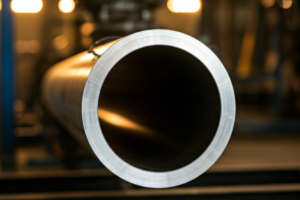
What Is 5052 Aluminum?
5052 is a 5xxx-series alloy with magnesium as the primary alloying element (2.2–2.8%). It is a non-heat-treatable grade that gains strength through strain hardening rather than precipitation, which keeps corrosion resistance and formability high while delivering moderate strength.
Because magnesium-based strength cannot be recovered by heat treatment, the final properties of any 5052 part depend on how much cold work and stabilization the mill applies — and exactly why the temper you specify, especially for sheet that must carry load without heavy forming, matters more than the alloy choice itself.
Understanding the H34 Temper
5052 is supplied annealed as 5052-O, then cold-rolled to build strength. The H3x family means the material is strain-hardened and then stabilized — heated at low temperature so it keeps its strength and does not soften at room temperature over time.
The second digit sets the work level. “4” means 1/2 hard, so H34 carries roughly twice the cold work of H32 and reads as a stiffer, stronger sheet stock.
Stabilization is what separates H3x from H1x tempers. An H1x grade is strain-hardened only and can lose some strength if stored warm; an H3x grade is thermally stabilized, so the properties you receive are the properties you keep.
How H34 Differs from H32
H32 is 1/4 hard; H34 is 1/2 hard. The extra cold work lifts ultimate tensile strength from about 228 MPa to 262 MPa and yield from 193 MPa to 214 MPa, at the cost of ductility — H34 elongation drops to 10–14% from H32’s 12–15%.
H34 is the call when a part needs more stiffness or load capacity than H32 can give but still gets bent or welded after delivery. Reach for H32 when tight radii or deep forming dominate the design.
5052-H34 Mechanical Properties
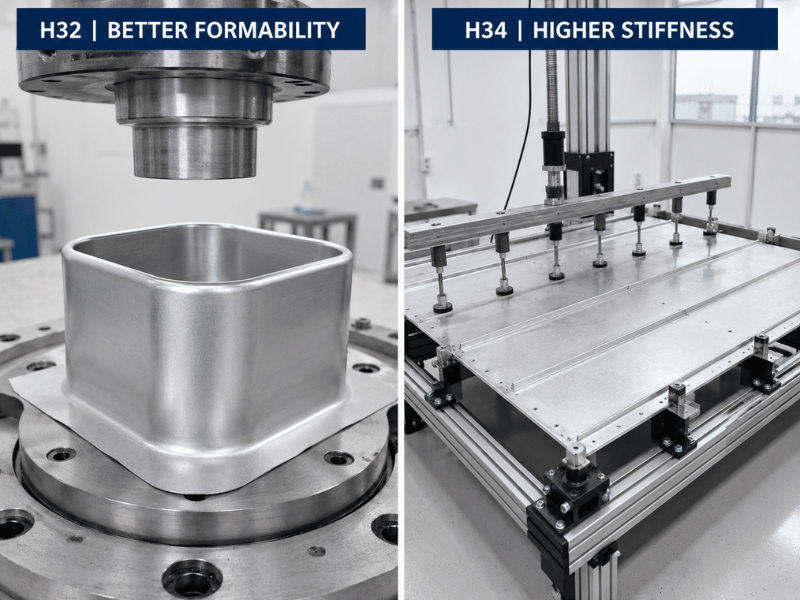
Values below are typical for sheet and plate; exact figures shift with thickness and product form. 5052-H32 is shown as the reference point for the lighter temper.
| Property | 5052-H34 (typical) | 5052-H32 (ref) |
|---|---|---|
| Density | 2.68 g/cm³ | 2.68 g/cm³ |
| Ultimate tensile strength | 262 MPa (38 ksi) | 228 MPa (33 ksi) |
| Yield strength (0.2% offset) | 214 MPa (31 ksi) | 193 MPa (28 ksi) |
| Elongation | 10–14% | 12–15% |
| Fatigue strength | 124 MPa (18 ksi) | 117 MPa (17 ksi) |
| Shear strength | 145 MPa (21 ksi) | 124 MPa (18 ksi) |
| Brinell hardness | 68 HB | 60 HB |
| Elastic modulus | 70 GPa | 70 GPa |
| Melting range | 607–649°C | 607–649°C |
| Thermal conductivity | 138 W/m·K | 138 W/m·K |
| Electrical conductivity | 35% IACS | 35% IACS |
Yield strength is the number that decides most H34 selections. At 214 MPa it resists deflection better than H32 under the same panel load, so a thinner H34 sheet can often replace a thicker H32 sheet where stiffness, not forming, sets the gage.
Where 5052-H34 Is Used
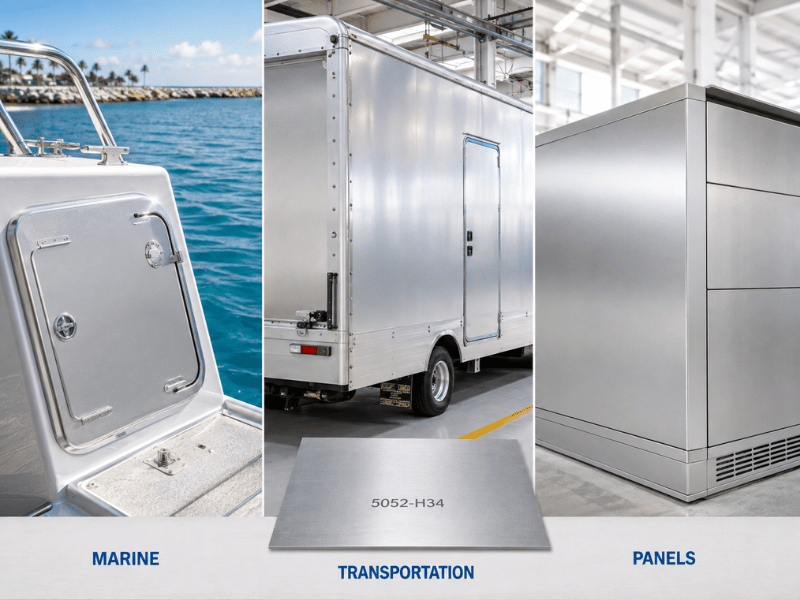
Structural and Marine Sheet Fabrication
5052-H34 sheet carries load in panels, stiffeners, brackets, and tank walls where a small weight penalty beats corrosion failure. Its higher yield lets fabricators hold flatness and resist deflection in boat structures, hatch covers, and offshore equipment exposed to salt water year-round.
The corrosion resistance carries through welding, so a welded H34 assembly keeps its seawater immunity without post-weld heat treatment.
Transportation, Architectural, and Appliance Panels
Vehicle skins, enclosures, signage, and appliance bodies draw on H34’s stiffness and surface quality. The temper holds its shape under vibration and handling better than softer tempers, which matters for large flat panels and exterior cladding.
Light forming is still possible, so H34 suits parts that are cut, bent on a wide radius, and finished in volume.
H34 vs Other 5052 Tempers — How to Choose
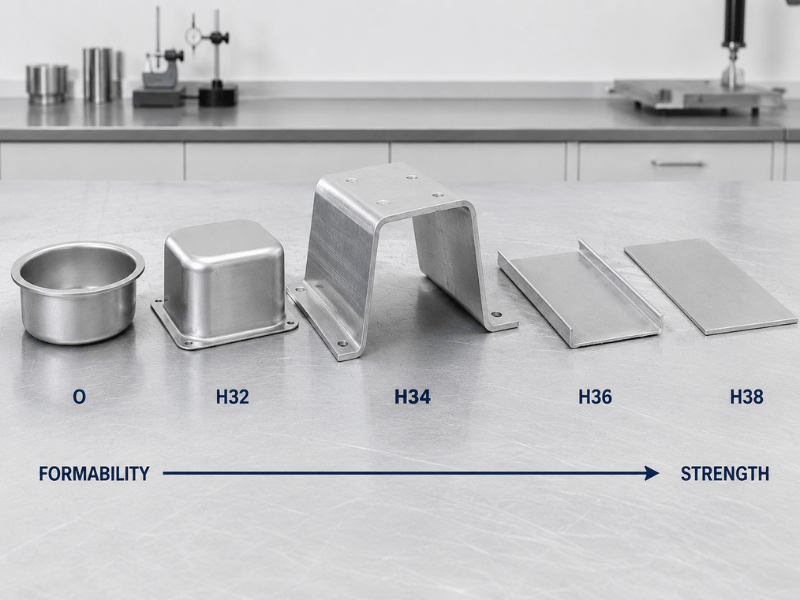
| Temper | Treatment | UTS (typical) | Yield (typical) | Best for | Avoid when |
|---|---|---|---|---|---|
| O | Annealed, fully soft | 193 MPa | 90 MPa | Deep drawing, complex forming | Any load-bearing use |
| H32 | 1/4 hard + stabilized | 228 MPa | 193 MPa | Formed and welded sheet parts | You need maximum strength |
| H34 | 1/2 hard + stabilized | 262 MPa | 214 MPa | Stiff, load-bearing sheet with light bends | Tight bend radii are required |
| H36 | 3/4 hard + stabilized | 276 MPa | 241 MPa | Panels needing higher yield | Any forming is involved |
| H38 | Full hard + stabilized | 290 MPa | 255 MPa | Flat, rigid, non-formed parts | The part gets bent at all |
When H34 Is the Right Call
Pick H34 when the design is stiffness- or load-driven and only light bending or welding follows delivery — brackets, stiffeners, and enclosures that must hold shape. Pick it over H32 when a thinner gage must still resist deflection under panel load.
When Another Temper Fits Better
Reach for 5052-O or H32 when the geometry needs deep draws or tight radii, since H34 cracks more easily on sharp bends. Move to H36 or H38 only for flat, rigid parts with no forming. For maximum structural strength in a different alloy family, 6061-T6 is the usual comparison — see our 5052 vs 6061 aluminum guide for the full trade-off, and our 5052-H32 guide when forming drives the spec.
Working with 5052-H34 — What You Need to Know
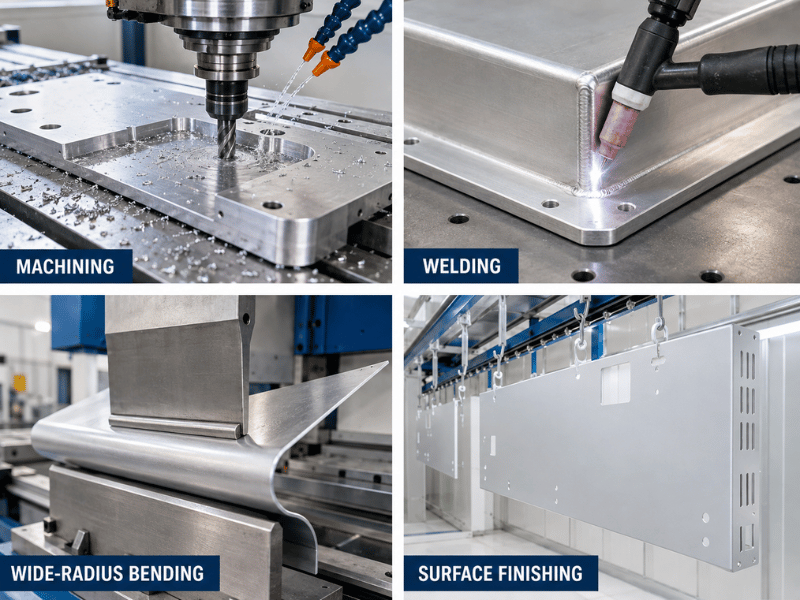
Machining runs at a fair-to-good level. The soft, ductile chip tends to build up on the cutting edge, so use sharp carbide tools, positive rake angles, and flood coolant to hold tolerances and surface finish.
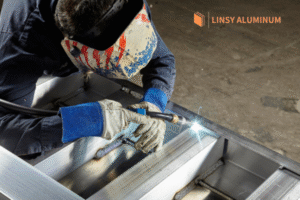
Welding is among the easiest of any aluminum grade. GTAW or MIG joints keep their strength through the heat-affected zone (HAZ — the band heated by welding) because 5052 does not age-harden; use ER5356 filler for the best corrosion resistance or ER4043 where lower crack sensitivity matters more than color match.
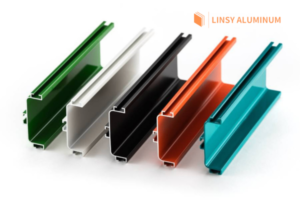
Corrosion protection is largely built in. Bare 5052-H34 already shrugs off salt water and industrial atmospheres, while anodizing, powder coat (RAL 9016), or PVC film add wear and cosmetic defense. When a 5052 part bolts to steel or copper, break the galvanic couple with isolation or coating.
Formability is the main limit of this temper. Air-bend radii must be wider than on H32, so plan the press-brake setup around the published minimum for the gage and expect moderate springback; tight radii risk micro-cracking.
Pros and Limitations at a Glance
| Dimension | What 5052-H34 does well | What to watch |
|---|---|---|
| Strength vs H32 | ~15% higher yield (214 vs 193 MPa) at same gage | ~25% below 6061-T6 yield (276 MPa) |
| Stiffness / deflection | Holds shape better under panel load | — |
| Fatigue | High (124 MPa) under cyclic load | — |
| Corrosion (saltwater) | Excellent, salt-water resistant | Keep Mg under 3%; avoid sustained high-temp stress |
| Formability | Good for light bends | Wider radii than H32; cracks on tight bends |
| Weldability | Excellent; HAZ keeps strength | Cosmetic anodize needs color-match coupon |
| Availability | Widely stocked as sheet and plate | — |
| Cost | Cost-effective vs high-Mg or 7xxx grades | — |
Conclusion
5052-H34 trades the easy forming of softer tempers for higher strength and stiffness — the right call when a sheet part must carry load or hold shape rather than be deeply formed. Linsy Aluminum supplies 5052-H32 and H34 sheet, plate, bar, tube, and wire, with in-house CNC machining, welding, laser cutting, and surface finishing such as anodizing and powder coat; every order ships with an MTC, and SGS reports are available on request, with typical custom lead times of 10–60 days.
Tell us your alloy, temper, and cut sizes, and we will confirm stock availability or a custom production window so your 5052-H34 parts arrive ready for fabrication.
Frequently Asked Questions
Is 5052-H34 stronger than 5052-H32?
Yes. H34 yields about 15% higher (214 vs 193 MPa) and pulls higher tensile (262 vs 228 MPa) at the same gage. The trade is formability: H34 bends on wider radii and cracks more easily on tight bends.
Can 5052-H34 be heat treated to increase strength?
No. 5052 is non-heat-treatable, so solution heat treatment and aging do nothing for it. For more strength within the alloy, move to H36 or H38; for a large jump, switch to a heat-treatable grade such as 6061-T6.
What bend radius should I use for 5052-H34 sheet?
Use a wider radius than you would for H32, and stay at or above the published minimum for the thickness to avoid micro-cracking. Plan the press-brake setup around moderate springback, which is more pronounced than on fully soft tempers.
Does 5052-H34 weld as well as H32?
Yes. Both weld with GTAW or MIG while keeping strength through the heat-affected zone; pick ER5356 for the best corrosion resistance or ER4043 when lower crack sensitivity matters more than matching the base color.
How does 5052-H34 compare with 6061-T6 for structural parts?
5052-H34 wins on saltwater corrosion and formability, while 6061-T6 wins on yield strength and machinability. For parts immersed or coated in salt spray, 5052-H34 is the safer long-term choice; for dry structural frames, 6061-T6 often fits.
Does 5052-H34 anodize well?
Yes, it anodizes cleanly to clear, yellow-tinted, or colored coatings. The yellow cast is normal for 5xxx alloys, so test a coupon when a close color match to 6061 or 6082 is required for a mixed assembly.