7050 e 7075 sono le due leghe ad alta resistenza della serie 7xxx che la maggior parte degli acquirenti aerospaziali e della difesa mette a confronto — spesso sullo stesso disegno. Sbagliare la scelta è costoso in entrambi i casi: un 7075-T6 specificato in una sezione spessa ed esposta alla corrosione può criccare sotto carico sostenuto, mentre un 7050 scelto per un componente sottile e critico per la resistenza paga un premio di tenacità che non utilizza mai.
Questo confronto analizza i dati che effettivamente li distinguono — composizione, resistenza di picco rispetto alla tenacità alla frattura, comportamento alla corrosione sotto sforzo, le tempre in cui ciascuno viene prodotto, limiti di fabbricazione e prezzo — così da poter abbinare la lega allo spessore della sezione, al carico e all'ambiente, piuttosto che a un numero di resistenza di facciata.
7050 vs 7075 a colpo d'occhio
| Fattore | 7050 | 7075 |
|---|---|---|
| Serie / tipo | 7xxx Al-Zn-Mg-Cu, con grani affinati allo zirconio | 7xxx Al-Zn-Mg-Cu, con grani affinati al cromo |
| UTS di picco (tempra comune) | 524 MPa (T7451); 552 MPa (T7651) | 572 MPa (T6 / T651) |
| Snervamento di picco | 469–490 MPa | 503 MPa (T6) |
| Tenacità alla frattura (K_Ic, L-T) | 32–38 MPa√m (elevata) | 26–30 MPa√m (moderata) |
| Resistenza alla SCC (trasversale corta) | Eccellente (T7451) | Scarsa a T6; buona a T73 / T7351 |
| Affinatore di grano | Zirconio (Zr) 0,08–0,15% | Cromo (Cr) 0,18–0,28% |
| Il migliore per | Strutture critiche in lastre spesse | Parti ad alta resistenza sottili / medie |
Composizione chimica
| Elemento | 7050 (wt%) | 7075 (wt%) | Cosa cambia la differenza |
|---|---|---|---|
| Zinco (Zn) | 5.7–6.7 | 5.1–6.1 | Entrambi elevati; elemento rinforzante primario |
| Magnesio (Mg) | 1.9–2.6 | 2.1–2.9 | 7075 leggermente superiore |
| Rame (Cu) | 2.0–2.6 | 1.2–2.0 | 7050 superiore — supporta tenacità e risposta al trattamento termico |
| Zirconio (Zr) | 0.08–0.15 | — (nessuno specificato) | Controllo dei grani del 7050 |
| Cromo (Cr) | ≤0,04 | 0.18–0.28 | Controllo dei grani del 7075 |
| Silicio (Si) | ≤0,12 | ≤0,40 | 7050 mantenuto più stretto |
| Ferro (Fe) | ≤0,15 | ≤0,50 | 7050 mantenuto più stretto |
| Manganese (Mn) | ≤0,10 | ≤0,30 | 7075 intervallo più ampio |
| Titanio (Ti) | ≤0,06 | ≤0,20 | — |
| Alluminio (Al) | Equilibrio | Equilibrio | — |
La differenza compositiva singola più importante è l'affinatore di grano. Il 7050 utilizza zirconio; il 7075 utilizza cromo. I dispersoidi di zirconio permettono al 7050 di mantenere la sua tenacità e resistere alla ricristallizzazione in sezioni spesse — la radice del suo vantaggio in termini di corrosione sotto sforzo.
Proprietà meccaniche
| Proprietà | 7075-T6 / T651 | 7050-T7451 | 7050-T7651 |
|---|---|---|---|
| Resistenza a trazione ultima | 572 MPa | 524 MPa | 552 MPa |
| Resistenza allo snervamento (0,2%) | 503 MPa | 469 MPa | 490 MPa |
| Allungamento | 10–13% | 11% | 11% |
| Durezza Brinell | ~150 HB | ~135 HB | ~135 HB |
| Densità | 2,81 g/cm³ | 2,83 g/cm³ | 2,83 g/cm³ |
| Conducibilità termica | ~130 W/m-K | ~150–190 W/m·K | ~150–190 W/m·K |
| Tenacità alla frattura K_Ic (L-T) | 26–30 MPa√m | 32–38 MPa√m | — |
Nota il malinteso comune che questo articolo precedentemente ripeteva: Il 7075-T6 è la lega a resistenza più elevata in sezioni sottili e medie (572 MPa UTS contro 524 MPa per il 7050-T7451). Il 7050 si avvicina al picco del 7075 solo con la tempra T7651 (552 MPa). Ciò che il 7050 cede in resistenza di picco lo restituisce come tenacità e resistenza ambientale.
Resistenza e Tenacità: Dove Divergono
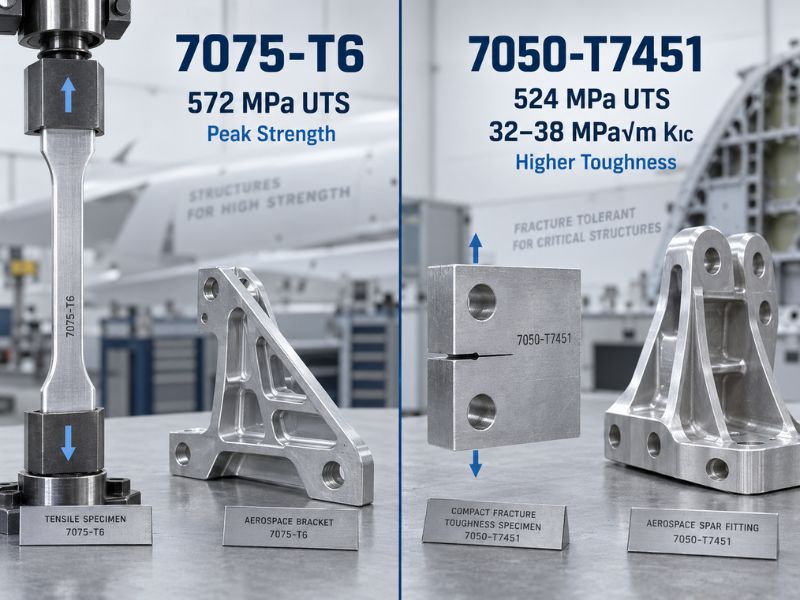
Il 7075-T6 offre la massima resistenza a trazione ultima tra i due in sezioni sottili e medie — circa 572 MPa UTS e 503 MPa di snervamento. Questo lo rende la scelta predefinita quando la resistenza statica assoluta per chilogrammo è la priorità e la sezione è modesta.
Il 7050 è deliberatamente sovrainvecchiato (T74 / T7451 / T7651). Il sovrainvecchiamento scambia circa il 10–15% della resistenza di picco per un grande guadagno in tenacità alla frattura e resistenza alla corrosione sotto sforzo. In lastre spesse, il 7050-T7451 rimane tenace e resistente alla propagazione delle cricche mentre il 7075-T6 perde entrambe le proprietà con l'aumentare dello spessore — ecco perché longheroni alari, paratie e raccordi spessi si affidano al 7050.
Resistenza alla Corrosione e alla Corrosione Sotto Sforzo
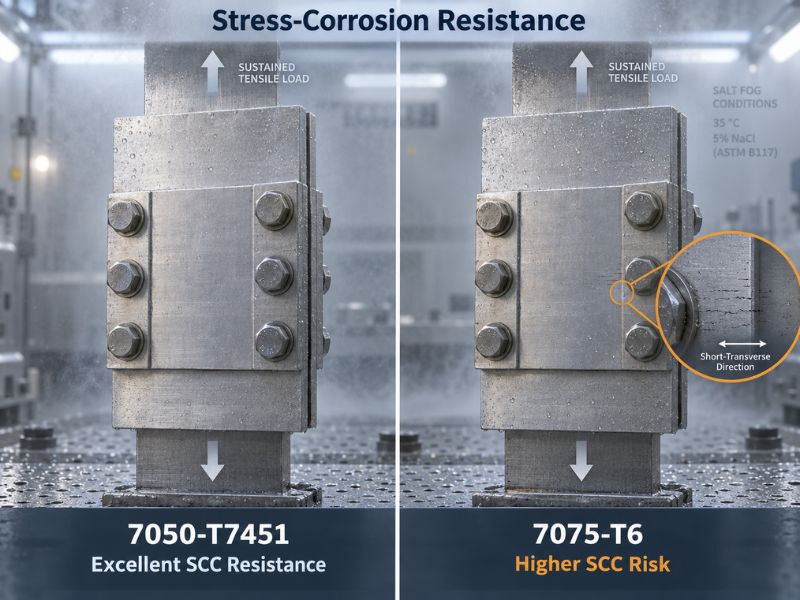
Questa è la divisione funzionale più chiara. Il 7075-T6 è soggetto a corrosione sotto sforzo (SCC), specialmente nella direzione trasversale corta di lastre spesse e in servizio marino o chimicamente esposto. La mitigazione usuale è una tempra sovrainvecchiata T73 / T7351 o rivestimento alclad più rivestimenti protettivi.
Il 7050 è stato progettato attorno a questa debolezza. La sua struttura a grani con zirconio e la tempra sovrainvecchiata T7451 gli conferiscono un'eccellente resistenza alla SCC anche in sezioni spesse e altamente sollecitate. Per qualsiasi componente che opera in umidità, sale o carico sostenuto, il 7050 è la scelta più sicura.
Tempra e Trattamento Termico
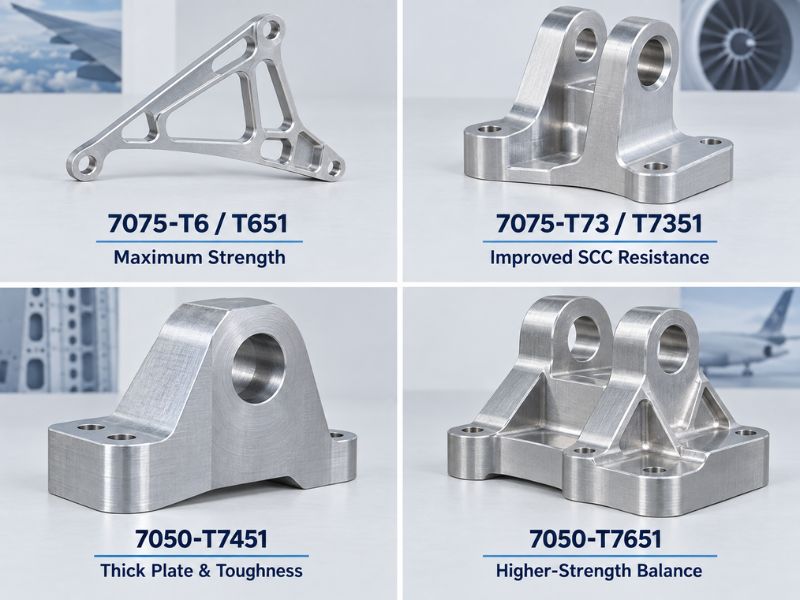
Entrambi seguono solubilizzazione, tempra e invecchiamento; la tempra stabilisce l'equilibrio resistenza-tenacità-corrosione.
- 7075: O (ricotto), T6 / T651 (resistenza di picco), T73 / T7351 (sovrainvecchiato per SCC), T76.
- 7050: T6, T74, T7451, T7351, T7651 — la maggior parte delle produzioni utilizza il range sovrainvecchiato T7xx perché è lì che risiede il suo vantaggio.
Lavorazione: Machining, Saldatura, Formatura
Entrambi si lavorano bene alle tempre T6 / T7, con il 7075 marginalmente più facile da tagliare. Nessuno dei due è un buon candidato per la saldatura per fusione: entrambi sono soggetti a cricche a caldo e grave perdita di resistenza post-saldatura, quindi le strutture 7xxx saldate sono rare e normalmente richiedono trattamento termico post-saldatura. La formatura è limitata rispetto alle leghe 5xxx o 6xxx; la maggiore resistenza e sensibilità alla tempra del 7050 lo rendono meno formabile del 7075 nella stessa tempra.
Applicazioni: Dove Ciascuno Vince
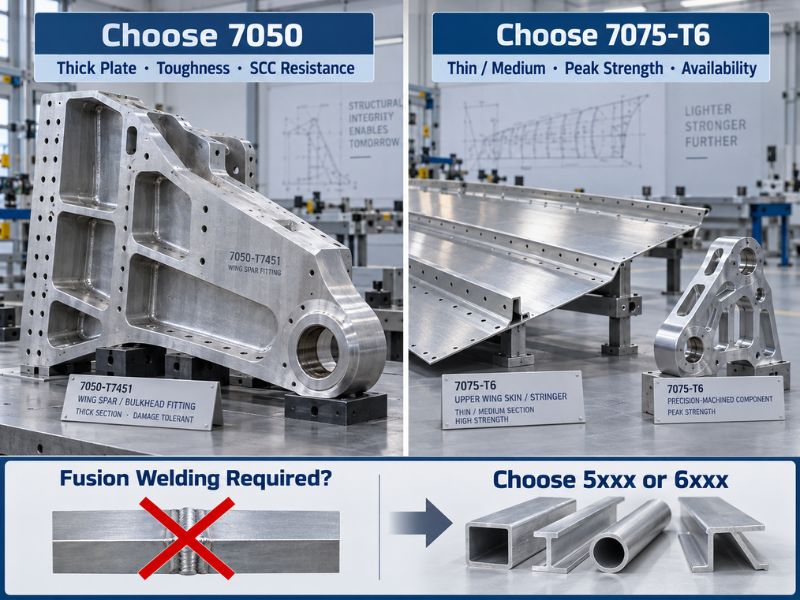
- 7050: longheroni e centine alari spessi, telai di fusoliera, paratie, attacchi del carrello di atterraggio, recipienti in pressione e lastre strutturali pesanti dove la tolleranza alle cricche conta più della resistenza di picco.
- 7075: pannelli alari (specialmente pannelli superiori in compressione), longheroni di fusoliera, componenti del carrello di atterraggio, telai per biciclette e automobili ad alte prestazioni e attrezzature di precisione o piastre per stampi dove la resistenza T6 e la lavorabilità dominano.
Prezzo e Disponibilità
Entrambe sono leghe premium con prezzi ben superiori alle gradi commodity 6xxx e 5xxx. Il 7075 è solitamente l'opzione a costo inferiore ed è più ampiamente disponibile in barre, lastre e forme estrose. Il 7050 tipicamente comporta un piccolo premio legato alla sua chimica allo zirconio, al controllo più stretto delle impurità e alla difficoltà di produzione delle lastre spesse. Confermare le quotazioni attuali del produttore per tempra e sezione — il divario è solitamente modesto ma reale.
Come Scegliere: Go / No-Go
Scegliere il 7050 quando:
- Lo spessore della sezione è grande (lastre da 25 mm in su) e la tolleranza alle cricche è critica.
- Il componente è soggetto a carico sostenuto in ambienti umidi, marini o chimici.
- La resistenza alla SCC nella direzione trasversale corta è un requisito di progetto.
- È necessaria una tenacità alla frattura in lastre spesse che il 7075-T6 non può fornire.
Scegliere il 7075-T6 quando:
- La resistenza statica di picco per peso è la priorità e la sezione è da sottile a media.
- Il componente è lavorato da lastra o barra e la saldabilità non è richiesta.
- Il costo e l'ampia disponibilità a magazzino superano il limite della SCC.
Evitare entrambi quando:
- Il progetto richiede saldatura per fusione come giunto primario — scegliere invece una grado saldabile 5xxx o 6xxx.
- L'esposizione alla corrosione è severa e nessuna delle due tempra sovrainvecchiate rientra nel budget — considerare 5083 o 6061 per quell'ambiente.
Conclusione
Il 7050 e il 7075 sono cugini a chimica simile, ma la scelta raramente riguarda la resistenza grezza: il 7075-T6 è la lega più resistente in sezioni sottili, mentre il 7050-T7451 vince in tenacità alla frattura, resistenza alla corrosione sotto sforzo e comportamento in lastre spesse.
Linsy Aluminum fornisce entrambi 7050 e 7075 in lastre, barre, tubi e forme personalizzate in tempre standard, con personalizzazione di dimensioni e finitura e MTC per ogni ordine. I tempi di consegna tipici per ordini personalizzati vanno da 10 a 60 giorni a seconda della lega, tempra, dimensione e lavorazione. Inviare il proprio disegno e le condizioni di servizio a Linsy Aluminum per una revisione di idoneità del grado e un preventivo aggiornato.
Domande frequenti
Qual è più resistente, 7050 o 7075?
Il 7075-T6 è più resistente in sezioni sottili e medie — circa 572 MPa UTS e 503 MPa di snervamento, rispetto a 524 MPa UTS per il 7050-T7451. Il 7050 si avvicina a quel picco solo con la tempra T7651 (552 MPa). Il vero vantaggio del 7050 è la tenacità e la resistenza alla SCC, non la resistenza di picco.
Quale resiste meglio alla corrosione?
Il 7050 resiste alla corrosione sotto sforzo molto meglio, specialmente in sezioni spesse e in esposizione marina o chimica. Il 7075-T6 è soggetto alla SCC e di solito necessita di rivestimento o sovrainvecchiamento (T73 / T7351) per gestirla.
Il 7050 o il 7075 possono essere saldati?
Entrambi sono scarsi candidati per la saldatura per fusione — criccano facilmente e perdono gran parte della loro resistenza nella saldatura. Utilizzare fissaggio meccanico o incollaggio, oppure scegliere una lega 5xxx / 6xxx se la saldatura è richiesta.
Quale dovrei scegliere per una piastra spessa?
7050-T7451. Il suo controllo dei grani allo zirconio e la tempra sovrainvecchiata mantengono alta la tenacità e la resistenza alla SCC in sezioni pesanti, mentre il 7075-T6 perde entrambe con l'aumentare dello spessore.
Il 7050 è più costoso del 7075?
Di solito un po'. Il 7075 è più ampiamente disponibile e a costo inferiore; il 7050 comporta un modesto premio dovuto alla sua chimica allo zirconio, limiti più stretti sulle impurità e produzione di lastre spesse. Il divario è tipicamente piccolo ma reale — confermare per tempra e sezione.