Le 7050 et le 7075 sont les deux alliages de la série 7xxx à haute résistance que la plupart des acheteurs de l'aérospatiale et de la défense comparent l'un à l'autre — souvent sur le même plan. Se tromper de choix coûte cher dans les deux cas : un 7075-T6 spécifié dans une section épaisse et exposée à la corrosion peut fissurer sous charge soutenue, tandis qu'un 7050 choisi pour une pièce mince critique en résistance paie une prime de ténacité qu'il n'utilise jamais.
Cette comparaison analyse les données qui les distinguent réellement — composition, résistance maximale versus ténacité à la rupture, comportement en corrosion sous contrainte, les revenus sous lesquels chacun est produit, les limites de fabrication et le prix — afin que vous puissiez associer l'alliage à l'épaisseur de votre section, à votre chargement et à votre environnement plutôt qu'à un chiffre de résistance mis en avant.
7050 vs 7075 en un coup d'œil
| Facteur | 7050 | 7075 |
|---|---|---|
| Série / type | 7xxx Al-Zn-Mg-Cu, à grain de zirconium | 7xxx Al-Zn-Mg-Cu, à grain de chrome |
| UTS maximale (revenu courant) | 524 MPa (T7451) ; 552 MPa (T7651) | 572 MPa (T6 / T651) |
| Limite d'élasticité maximale | 469–490 MPa | 503 MPa (T6) |
| Ténacité à la rupture (K_Ic, L-T) | 32–38 MPa√m (élevée) | 26–30 MPa√m (modérée) |
| Résistance à la CSC (sens transversal court) | Excellente (T7451) | Faible à T6 ; bonne à T73 / T7351 |
| Affineur de grain | Zirconium (Zr) 0,08–0,15% | Chrome (Cr) 0,18–0,28% |
| Meilleur pour | Structures critiques en plaques épaisses | Pièces à haute résistance minces / moyennes |
Composition chimique
| Élément | 7050 (% en masse) | 7075 (% en masse) | Ce que la différence change |
|---|---|---|---|
| Zinc (Zn) | 5.7–6.7 | 5.1–6.1 | Élevé dans les deux ; élément de renforcement principal |
| Magnésium (Mg) | 1.9–2.6 | 2.1–2.9 | 7075 légèrement supérieur |
| Cuivre (Cu) | 2.0–2.6 | 1.2–2.0 | 7050 supérieur — favorise la ténacité et la réponse au traitement thermique |
| Zirconium (Zr) | 0.08–0.15 | — (aucun spécifié) | Contrôle du grain du 7050 |
| Chrome (Cr) | ≤0,04 | 0.18–0.28 | Contrôle du grain du 7075 |
| Silicium (Si) | ≤0,12 | ≤0,40 | 7050 maintenu plus serré |
| Fer (Fe) | ≤0,15 | ≤0,50 | 7050 maintenu plus serré |
| Manganèse (Mn) | ≤0,10 | ≤0,30 | 7075 plage plus large |
| Titane (Ti) | ≤0,06 | ≤0,20 | — |
| Aluminium (Al) | Équilibre | Équilibre | — |
La différence de composition la plus importante est l'affinant de grain. Le 7050 utilise du zirconium ; le 7075 utilise du chrome. Les dispersoïdes de zirconium permettent au 7050 de conserver sa ténacité et de résister à la recristallisation dans les sections épaisses — la racine de son avantage en corrosion sous contrainte.
Propriétés mécaniques
| Propriété | 7075-T6 / T651 | 7050-T7451 | 7050-T7651 |
|---|---|---|---|
| Résistance à la traction ultime | 572 MPa | 524 MPa | 552 MPa |
| Limite d'élasticité (0,21 TP3T) | 503 MPa | 469 MPa | 490 MPa |
| Élongation | 10–13% | 11% | 11% |
| Dureté Brinell | Environ 150 HB | ~135 HB | ~135 HB |
| Densité | 2,81 g/cm³ | 2,83 g/cm³ | 2,83 g/cm³ |
| Conductivité thermique | ~130 W/m-K | ~150–190 W/m·K | ~150–190 W/m·K |
| Ténacité à la rupture K_Ic (L-T) | 26–30 MPa√m | 32–38 MPa√m | — |
Notez l'idée fausse courante que cet article répétait auparavant : Le 7075-T6 est l'alliage à plus haute résistance dans les sections minces et moyennes (572 MPa UTS contre 524 MPa pour le 7050-T7451). Le 7050 n'approche le maximum du 7075 qu'avec le revenu T7651 (552 MPa). Ce que le 7050 cède en résistance maximale, il le restitue en ténacité et en résistance environnementale.
Résistance et ténacité : où elles divergent
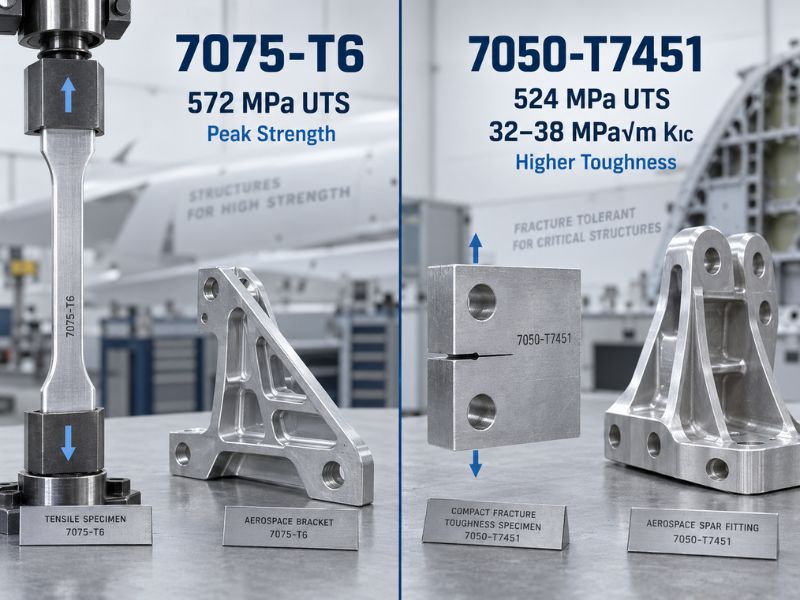
Le 7075-T6 offre la plus haute résistance ultime à la traction des deux dans les sections minces et moyennes — environ 572 MPa UTS et 503 MPa limite d'élasticité. Cela en fait le choix par défaut lorsque la résistance statique absolue par kilogramme est la priorité et que la section est modérée.
Le 7050 est délibérément sur-revenu (T74 / T7451 / T7651). Le sur-revenu échange environ 10–15% de la résistance de pointe contre un gain important en ténacité à la rupture et en résistance à la corrosion sous contrainte. En tôle épaisse, le 7050-T7451 reste tenace et résistant aux fissures tandis que le 7075-T6 perd les deux à mesure que l'épaisseur augmente — c'est pourquoi les longerons d'aile, les cloisons et les fixations épaisses s'appuient sur le 7050.
Résistance à la corrosion et à la corrosion sous contrainte
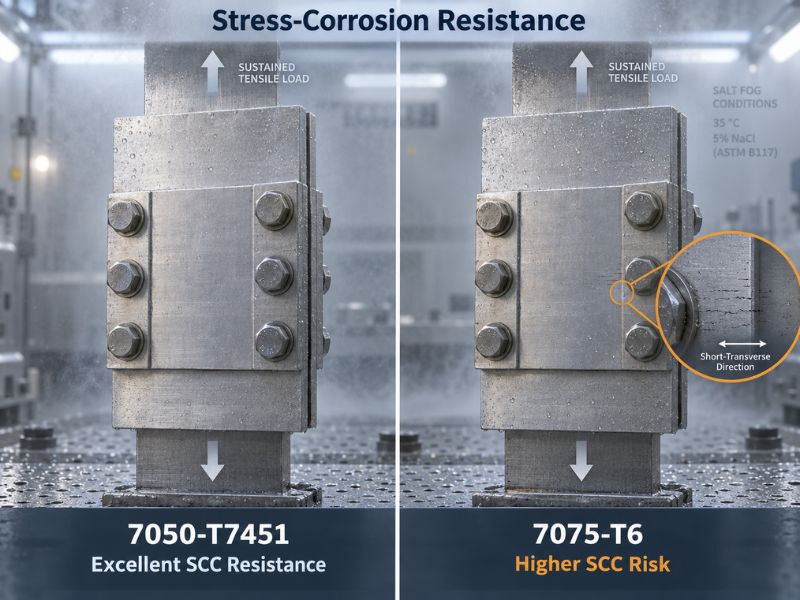
C'est la séparation fonctionnelle la plus claire. Le 7075-T6 est sujet à la fissuration par corrosion sous contrainte (SCC), en particulier dans la direction transversal-court des tôles épaisses et en service marin ou chimiquement exposé. L'atténuation habituelle est un revenu sur-revenu T73 / T7351 ou un placage alclad plus des revêtements protecteurs.
Le 7050 a été conçu autour de cette faiblesse. Sa structure de grains au zirconium et son revenu sur-revenu T7451 lui confèrent une excellente résistance à la SCC même dans les sections épaisses et fortement sollicitées. Pour toute pièce qui vit dans l'humidité, le sel ou sous charge soutenue, le 7050 est le choix le plus sûr.
Revenus et traitement thermique
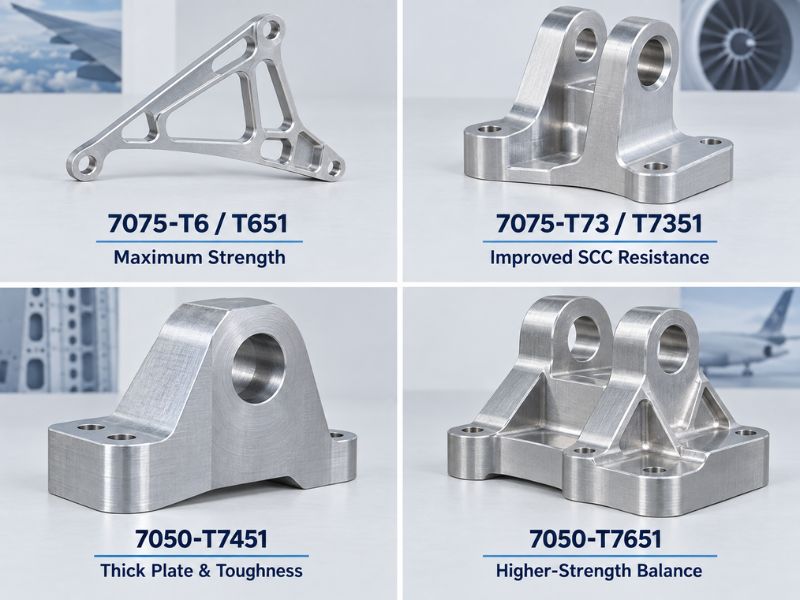
Les deux suivent un traitement de mise en solution, une trempe et un vieillissement ; le revenu établit l'équilibre résistance-ténacité-corrosion.
- 7075: O (recuit), T6 / T651 (résistance de pointe), T73 / T7351 (sur-revenu pour SCC), T76.
- 7050: T6, T74, T7451, T7351, T7651 — la plupart des productions se font dans la gamme sur-revenue T7xx car c'est là que réside son avantage.
Fabrication : usinage, soudage, formage
Les deux s'usinent bien dans les revenus T6 / T7, le 7075 étant marginalement plus facile à couper. Ni l'un ni l'autre n'est un bon candidat au soudage par fusion : les deux sont sujets à la fissuration à chaud et à une perte de résistance sévère après soudage, de sorte que les structures 7xxx soudées sont rares et nécessitent normalement un traitement thermique après soudage. Le formage est limité par rapport aux alliages 5xxx ou 6xxx ; la résistance plus élevée et la sensibilité à la trempe du 7050 le rendent moins formable que le 7075 dans le même revenu.
Applications : où chacun excelle
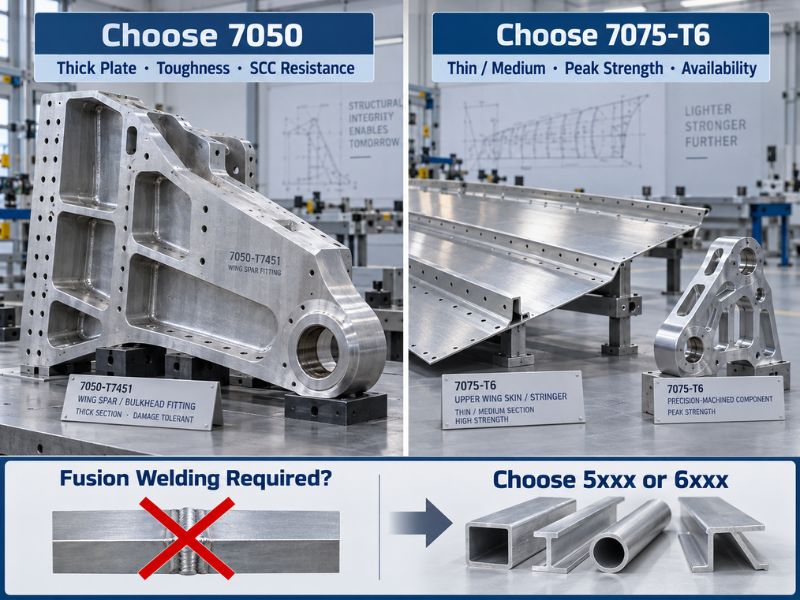
- 7050: longerons et nervures d'aile épais, cadres de fuselage, cloisons, fixations de train d'atterrissage, récipients sous pression et tôles structurelles lourdes où la tolérance aux fissures importe plus que la résistance de pointe.
- 7075: peaux d'aile (en particulier les peaux supérieures en compression), lisses de fuselage, composants de train d'atterrissage, cadres de vélos et automobiles haute performance, et outillage de précision ou plaques de moulage où la résistance T6 et l'usinabilité dominent.
Prix et disponibilité
Les deux sont des alliages premium dont le prix est bien supérieur aux qualités courantes 6xxx et 5xxx. Le 7075 est généralement l'option la moins coûteuse et est plus largement stocké en barres, tôles et formes extrudées. Le 7050 porte généralement une petite prime liée à sa chimie au zirconium, à un contrôle plus strict des impuretés et à la difficulté de production des tôles épaisses. Confirmez les devis actuels des laminoirs par revenu et section — l'écart est généralement modeste mais réel.
Comment choisir : Go / No-Go
Choisissez le 7050 lorsque :
- L'épaisseur de section est importante (tôle de 25 mm et plus) et la tolérance aux fissures est critique.
- La pièce subit une charge soutenue dans des environnements humides, marins ou chimiques.
- La résistance à la SCC dans la direction transversal-court est une exigence de conception.
- Vous avez besoin d'une ténacité à la rupture en tôle épaisse que le 7075-T6 ne peut pas fournir.
Choisissez le 7075-T6 lorsque :
- La résistance statique de pointe par poids est la priorité et la section est mince à moyenne.
- La pièce est usinée à partir de tôle ou de barre et la soudabilité n'est pas requise.
- Le coût et la large disponibilité en stock l'emportent sur la limitation SCC.
Évitez les deux lorsque :
- La conception exige le soudage par fusion comme joint principal — choisissez plutôt une qualité soudable 5xxx ou 6xxx.
- L'exposition à la corrosion est sévère et aucun revenu sur-revenu ne correspond au budget — envisagez le 5083 ou le 6061 pour cet environnement.
Conclusion
Le 7050 et le 7075 sont des cousins à chimie proche, mais le choix porte rarement sur la résistance brute : le 7075-T6 est l'alliage le plus résistant dans les sections minces, tandis que le 7050-T7451 gagne en ténacité à la rupture, en résistance à la corrosion sous contrainte et en comportement en tôle épaisse.
Linsy Aluminum fournit les deux 7050 et 7075 en tôle, barre, tube et formes personnalisées dans les revenus standard, avec personnalisation des dimensions et finitions et MTC pour chaque commande. Les délais typiques de personnalisation vont de 10 à 60 jours selon l'alliage, le revenu, la taille et le traitement. Envoyez votre dessin et vos conditions de service à Linsy Aluminum pour un examen d'adéquation de la nuance et un devis actuel.
Questions fréquemment posées
Lequel est plus résistant, le 7050 ou le 7075 ?
Le 7075-T6 est plus résistant dans les sections minces et moyennes — environ 572 MPa UTS et 503 MPa limite d'élasticité, contre 524 MPa UTS pour le 7050-T7451. Le 7050 n'approche ce pic qu'avec le revenu T7651 (552 MPa). Le véritable avantage du 7050 est la ténacité et la résistance à la SCC, pas la résistance de pointe.
Lequel résiste le mieux à la corrosion ?
Le 7050 résiste bien mieux à la fissuration par corrosion sous contrainte, en particulier dans les sections épaisses et en exposition marine ou chimique. Le 7075-T6 est sujet à la SCC et nécessite généralement un placage ou un sur-revenu (T73 / T7351) pour la gérer.
Le 7050 ou le 7075 peuvent-ils être soudés ?
Les deux sont de mauvais candidats au soudage par fusion — ils fissurent facilement et perdent une grande partie de leur résistance à la soudure. Utilisez la fixation mécanique ou le collage, ou choisissez un alliage 5xxx / 6xxx si le soudage est requis.
Lequel dois-je choisir pour une plaque épaisse ?
7050-T7451. Son contrôle des grains au zirconium et son revenu sur-revenu maintiennent une ténacité et une résistance à la SCC élevées dans les sections lourdes, tandis que le 7075-T6 perd les deux à mesure que l'épaisseur augmente.
Le 7050 est-il plus cher que le 7075 ?
Généralement un peu. Le 7075 est plus largement stocké et moins coûteux ; le 7050 porte une prime modeste liée à sa chimie au zirconium, à des limites d'impuretés plus strictes et à la production de tôles épaisses. L'écart est généralement faible mais réel — confirmez par revenu et section.