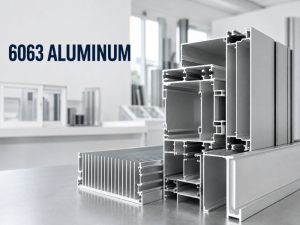
What Is 6063 Aluminum Extrusion
6063 is an Al-Mg-Si alloy with low total alloying content, which is exactly why it dominates architectural extrusion. Its magnesium and silicon form a small amount of Mg₂Si, which dissolves and precipitates during heat treatment, providing moderate strength without compromising formability.
Extrusion turns a heated 6063 billet into long profiles by forcing it through a die. Because the alloy flows so readily at press temperatures, it produces thin-walled, complex, and hollow sections with a clean surface that anodizes to a bright, uniform finish — the property that makes it the default choice for window frames, railings, and trim.
Why 6063 Extrudes Better Than Its Siblings
Extrudability depends on how easily the metal flows through the die at a given temperature and pressure. 6063 ranks at the top of the 6000 series on this metric.
- A low alloy load (~1% Mg₂Si) keeps the melt sufficiently viscous to fill thin, hollow dies at high ram speed.
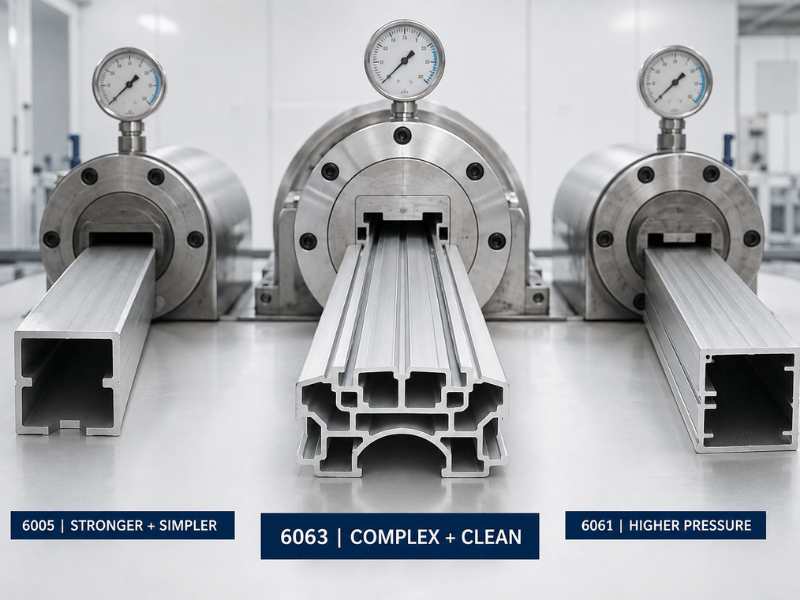
- 6061 carries more Mg, Si, Cu, and Cr, so it needs higher pressure and runs slower; its extrusions also show more die lines and surface streaking.
- 6005 is stronger but less forgiving on finish and complex geometry.
The practical payoff is tool life and throughput: 6063 holds tighter shapes at lower cost per meter than 6061 or 6005 for the same profile.
The 6063 Extrusion Process
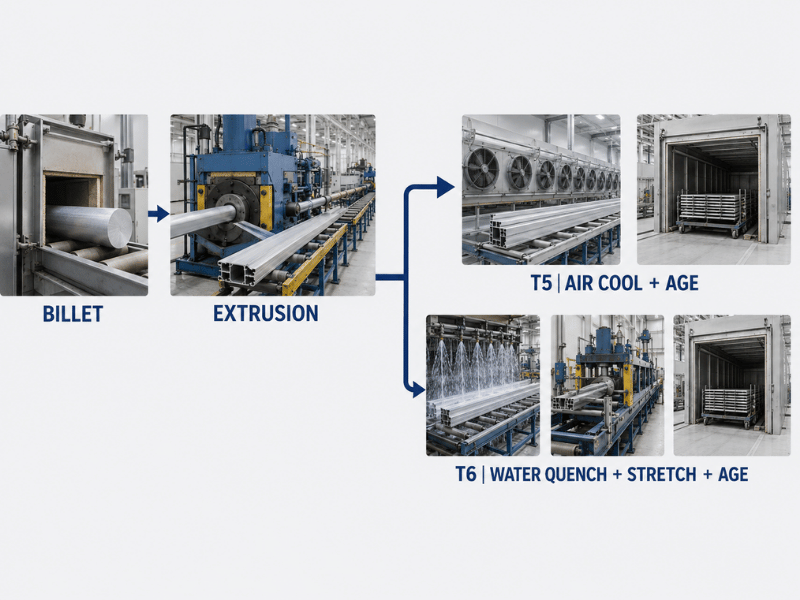
Extrusion is a sequence of temperature-controlled steps, and the temper you want determines how the line is run.
| Process step | 6063-T5 | 6063-T6 |
|---|---|---|
| Billet / container / die temp | 430–480 / 400–450 / 450–470 °C | same |
| Target die-exit temperature | 500–520 °C | 520–545 °C |
| Quench method | Forced air (≥4 °C/min) | Water spray, mist, or bath (20–30 °C/s) |
| Aging oven | 175–185 °C, 2–5 h | 180–195 °C, 5–8 h |
| Residual stress / distortion | Low — shapes stay straight | Higher — usually needs stretching |
T5 cools in air straight off the run-out table, so the profile keeps its shape with minimal residual stress. T6 is solution-heat-treated and water-quenched, which locks in higher strength but risks warping that stretching must correct. The harder quench also lengthens the aging cycle and raises energy cost.
Tempers for Extruded 6063
Most 6063 extrusions ship in T5, T52, or T6. Each temper sets a different strength-versus-stability trade-off.
| Temper | Tensile (MPa) | Yield (MPa) | Elongation (%) | Notes |
|---|---|---|---|---|
| O | 90 | 55 | 25 | Annealed, soft, for forming |
| T4 | 150 | 90 | 20 | Naturally aged |
| T5 | 185 | 145 | 12 | Air-quenched + aged; standard architectural |
| T52 | 185 | 130 | 12 | T5 plus stretch stress relief |
| T6 | 240 | 215 | 12 | Solution treated + water quenched; load-bearing |
T52 applies a light stretch after aging to remove residual stress, so long lengths stay flatter than straight T5 — useful when the profile will be machined on one side.
6063-T5 vs T6: Which to Specify
Pick the temper from the part’s load path, not from a default habit.
- Choose T5 when the profile is architectural or decorative: window and door frames, curtain-wall trim, furniture, lighting channels. The lower strength is more than enough, and the stable shape saves finishing cost.
- Choose T6 only when the section carries real structural load — equipment frames, load-bearing supports, guards — where the ~30% strength gain over T5 outweighs the added distortion risk and cost.
- Choose T52 when you need T5-level strength but will machine one face and cannot tolerate bow after cutting.
If a part does not see significant load, specifying T6 wastes money on quench, stretch, and a longer oven cycle.
6063 Extrusion Chemical Composition
| Element | Composition (wt%) |
|---|---|
| Silicon (Si) | 0.20–0.60 |
| Iron (Fe) | 0.35 max |
| Copper (Cu) | 0.10 max |
| Manganese (Mn) | 0.10 max |
| Magnesium (Mg) | 0.45–0.90 |
| Chromium (Cr) | 0.10 max |
| Zinc (Zn) | 0.10 max |
| Titanium (Ti) | 0.10 max |
| Others (each / total) | 0.05 / 0.15 max |
| Aluminum (Al) | Remainder |
The tight Si and Mg bands are what allow 6063 to achieve both good extrudability and a bright anodized skin; pushing Mg higher would increase strength but hurt surface quality.
Mechanical & Physical Properties
Beyond the temper table above, 6063 has properties that affect design directly:
- Density: 2.70 g/cm³ — typical for aluminum.
- Modulus of elasticity: ~69 GPa.
- Thermal conductivity: ~200 W/m·K — good for heat sinks and enclosures.
- Electrical conductivity: ~53% IACS.
These values sit close to other 6000-series alloys, so stiffness and weight rarely drive a 6063-vs-6061 choice; surface and formability do.
Common Extruded 6063 Shapes
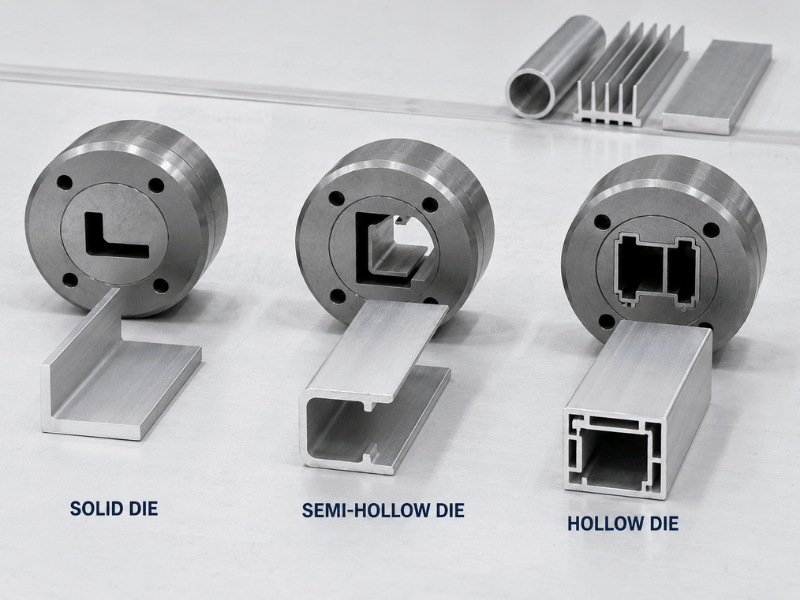
6063 is produced across the full range of extruded and rolled forms:
- Custom and standard profiles (T5, T6, T52) — frames, railings, trim.
- Round / square / rectangular tube (T5, T6) — structures, furniture, fixtures.
- Round / flat / square bar (T5, T6) — handles, fittings, spacers.
- Angle, channel, and structural sections (T5, T6) — support and framing.
- Sheet and coil (O, T4, T5, T6) — panels, cladding, decorative skins.
Hollow and semi-hollow dies are where 6063’s flow advantage shows most: it fills bridge and port designs that 6061 would short-fill or streak.
6063 vs 6061 vs 6005 for Extrusion
| Factor | 6063 | 6061 | 6005 |
|---|---|---|---|
| Extrudability | Excellent | Good | Good |
| Typical T5 strength | 185 / 145 MPa | — (T6: 310 / 276) | ~260 / 240 MPa |
| Surface after anodize | Bright, uniform | Streak-prone | Good, less fine |
| Best fit | Architectural, decorative | Structural, welded | Structural framing |
| Cost per meter (same profile) | Lowest | Higher | Mid |
Use 6063 when appearance and form matter, 6061 when you need weld strength or heavy load, and 6005 when you want more strength than 6063 with acceptable finish for solar rails and frameworks.
Surface Finish & Corrosion
6063’s standout trait is finish quality. It anodises to a clear, even layer under sulfuric acid (Type II) treatment and also accepts colour anodising, polishing, and powder coating (including RAL 9016).
Corrosion resistance is good in atmospheric and indoor environments but limited in marine or sustained-moisture service. For coastal or wet exposure, specify anodizing or powder coating, and avoid relying on the bare mill finish.
Design & Specifying Tips
Get a usable quote and a clean run by sending the right inputs:
- Drawing with wall thickness — standard extrusion handles a minimum wall thickness of ~1.0–1.2 mm; thinner walls require a feasibility check.
- Temper and alloy state — name T5, T52, or T6, not just “6063.”
- Finish — mill, anodized, or powder coat, with color if specified.
- Tolerances — reference EN 755 for European jobs; local standards otherwise.
- Quantities — prototype vs production volume changes die and lead-time options.
Internal fillets, modest draft angles, and uniform wall thickness all improve fill and reduce die stress.
Pros and Limitations at a Glance
| Strength | Limit |
|---|---|
| Best surface finish in the 6000 series | Lower strength than 6061 or 6005 |
| Excellent extrudability, thin/hollow sections | Not for high-load structural members |
| Strong anodizing and powder-coat response | Limited corrosion resistance in marine use |
| Good, low-cost architectural fit | Weld zone loses strength (HAZ softening) |
| Easy to cut, drill, and form after extrusion | T6 needs stretch correction after quench |
Conclusion
6063 aluminum extrusion trades peak strength for the best finish, formability, and cost among 6000-series alloys, which is why it dominates architectural and decorative profiles — but choosing T5 versus T6 (and confirming the profile will not be under structural load) is where savings or failures are decided.
Linsy Aluminum, a Shenzhen-based factory with more than 20 years of experience, supplies 6063-T5, T52, and T6 extrusions and related tempers with full MTC documentation per order and SGS test reports available on request; typical custom lead time runs 10–60 days depending on size and processing, with low-MOQ custom production and in-house CNC machining, welding, anodizing, and powder coating.
Send your drawing and required temper to Linsy Aluminum for a feasibility review and quote on 6063 aluminum extrusions.
Frequently Asked Questions
What is the difference between 6063-T5 and T6 extrusion?
T5 is air-quenched and aged, giving 185/145 MPa with low distortion and lower cost. T6 is solution heat treated and water quenched, reaching 240/215 MPa but with higher residual stress that usually needs stretching. Specify T6 only when the load path demands the extra strength.
Can 6063 be extruded into complex thin-wall profiles?
Yes. Its low alloy content gives it the best extrudability in the 6000 series, so it fills thin-walled and hollow dies that 6061 would short-fill or streak. Minimum wall thickness is typically around 1.0–1.2 mm for standard tooling.
Is 6063 aluminum extrusion good for anodizing?
It is one of the best alloys for anodizing. It produces a uniform, bright layer under Type II sulfuric-acid anodizing and also accepts color anodizing, polishing, and powder coating, which is why it dominates visible architectural profiles.
6063 vs 6061 — which extrudes better?
6063 extrudes better: it flows at lower pressure, runs faster, and finishes cleaner. 6061 is stronger and welds better but shows more die lines and surface streaking. Choose 6063 for appearance and form, 6061 for strength and welded structures.
What tolerances apply to 6063 extrusions?
Dimensional tolerances follow EN 755 for European projects and the equivalent local standard elsewhere, covering profile dimensions, straightness, twist, and corner radii. State the standard on the drawing so the mill holds the right band.