Qu’est-ce que l’aluminium 2024 ?
2024 est l'alliage de référence à base de cuivre de la série 2xxx. Le cuivre à 3,8–4,91 TP3T, avec le magnésium à 1,2–1,81 TP3T et le manganèse à 0,3–0,91 TP3T, rend cet alliage apte au traitement thermique : de fins précipités se forment à l'intérieur du métal et épinglent les dislocations, et c'est de là que provient la résistance. Dans ses états les plus résistants, le 2024 supporte des charges qui exigeraient autrement de l'acier, à environ un tiers de la densité.
La teneur en cuivre impose également des compromis spécifiques. Le 2024 figure parmi les alliages d'aluminium les moins résistants à la corrosion en usage courant, car les phases riches en cuivre créent des piles galvaniques le long des joints de grains ; par conséquent, le matériau nu nécessite un plaquage, une anodisation ou une peinture dans tout environnement humide ou marin. Il se soude également mal par fusion, car la zone affectée thermiquement est sujette aux fissures, ce qui explique pourquoi les structures en 2024 sont rivetées ou boulonnées. Ces limites appartiennent à l'alliage et ne changent pas avec le traitement thermique. Ce qui change — la résistance, la ductilité et la capacité de formage avant fissuration — est entièrement déterminé par l'état métallurgique, et pour les tôles, cet état est presque toujours T3.
Comprendre l'état T3
La désignation T3 définit une séquence en trois étapes : mise en solution, écrouissage, puis vieillissement naturel jusqu'à un état sensiblement stable.
| Étape | Processus | Objectif et résultat |
| Mise en solution | Maintien à environ 493 °C (920 °F), puis trempe | Le cuivre et le magnésium se dissolvent dans la matrice d'aluminium et sont piégés en solution sursaturée |
| Écrouissage | Déformation contrôlée — pour les tôles, une passe de laminage ou de planage | Augmente la densité de dislocations sur la structure trempée ; cette étape distingue le T3 du T4 |
| Vieillissement naturel | Précipitation à température ambiante de fins amas à partir du soluté piégé | La majeure partie de la résistance se développe dans les premières 24 heures ; état sensiblement stable après environ quatre jours |
Le résultat pratique est une tôle qui arrive avec la quasi-totalité de sa résistance déjà développée tout en conservant environ 181 TP3T d'allongement. Cela représente une ductilité suffisante pour les pliages au frein, les joggles et le formage par étirage exigés par le travail de tôlerie de cellule d'aéronef. Aucun traitement thermique en atelier n'est requis, et aucun stockage réfrigéré : le matériau peut être formé et riveté à l'état de livraison.
T3, T4 et T351 : distinctions essentielles
Ces trois états sont étroitement liés et sont fréquemment confondus dans les spécifications et la documentation d'approvisionnement au sein de la famille 2024.
Le T4 omet l'étape d'écrouissage — mise en solution et vieillissement naturel uniquement. Résistance légèrement inférieure, ductilité légèrement supérieure, et condition habituelle pour les barres, les tiges et le fil en 2024. Voir le guide 2024-T4 pour l'ensemble complet des données.
Le T3 ajoute l'écrouissage, ce qui en fait l'état par défaut pour les tôles destinées au formage et au rivetage.
Le T351 applique la même logique aux plaques, sauf que l'écrouissage est un étirement contrôlé de 1,5–31 TP3T dont le but est la relaxation des contraintes, et non le renforcement. Pour les plaques épaisses destinées à l'usinage plutôt qu'aux tôles de formage, le guide 2024-T351 est celui qui convient.
Propriétés mécaniques du 2024-T3
Les chiffres ci-dessous sont des valeurs typiques pour la tôle nue en 2024-T3. L'épaisseur et la forme du produit les font varier ; les décisions de conception doivent donc se référer aux valeurs certifiées du certificat de contrôle en usine plutôt qu'à une moyenne publiée.
| Propriété | Valeur typique | Notes |
| Densité | 2,78 g/cm³ | Environ un tiers de l'acier |
| Résistance à la traction ultime | 483 MPa (70 ksi) | Tôle nue ; l'Alclad présente des valeurs inférieures |
| Limite d'élasticité (0,21 TP3T) | 345 MPa (50 ksi) | Le paramètre clé pour la plupart des valeurs admissibles de conception |
| Allongement à la rupture | ~18% | Tôle de 1,6 mm ; diminue avec l'augmentation de l'épaisseur |
| Résistance à la fatigue | 138 MPa | À 5×10⁸ cycles, essai en rotation |
| Résistance au cisaillement | 283 MPa | Pertinente pour le dimensionnement des joints rivetés |
| Module d'élasticité | 73,1 GPa | Effectivement constant pour tous les états du 2024 |
| Dureté | 120 HB | Charge de 500 kg, bille de 10 mm |
| Conductivité thermique | 121 W/m·K | Inférieur au 6061, un effet du cuivre |
| Conductivité électrique | ~301 TP3T IACS | Modérée à faible ; ce n'est pas un alliage conducteur |
| Intervalle de fusion | 502–638 °C | Du solidus au liquidus |
Deux chiffres font l'essentiel du travail ici. Le couple 483/345 MPa est ce qui permet à un panneau de peau en 2024-T3 de remplacer un panneau en acier beaucoup plus lourd, et la résistance à la fatigue de 138 MPa explique pourquoi cet alliage conserve une position dans les structures de fuselage pressurisé que des alliages plus récents et plus résistants ne lui ont pas retirée. Une peau de fuselage subit un cycle de pressurisation à chaque vol ; la résistance à l'amorçage de fissures sur des centaines de milliers de cycles importe davantage que la résistance maximale à la traction.
Un détail d'approvisionnement à confirmer avant de commander : l'Alclad 2024-T3 n'est pas aussi résistant que le matériau nu. Les couches de plaquage en aluminium pur portent peu de charge, de sorte que les valeurs typiques de l'Alclad chutent à environ 448 MPa en traction et 310 MPa en limite d'élasticité — un débit d'environ 8–101 TP3T. Les tôles minces perdent proportionnellement davantage. Si les valeurs admissibles ont été calculées sur les propriétés du matériau nu, le matériau plaqué ne doit pas être substitué sans revérifier la marge.
Où le 2024-T3 est utilisé
L'aérospatiale domine, et de loin. Le comportement en fatigue et le rapport résistance/poids justifient la protection contre la corrosion et l'assemblage par rivetage que l'alliage exige.
Peaux d'aéronefs. La tôle Alclad 2024-T3 est le matériau classique pour les peaux de fuselage et d'intrados d'aile, formée au contour et rivetée sur la sous-structure.
Cadres de fuselage, lisses et nervures. Composants en tôle formée où la pièce est cintrée avant assemblage plutôt qu'usinée dans la masse.
Intrados d'ailes. L'intrados d'aile est une structure en traction, et le 2024 surpasse le 7075 en croissance de fissure de fatigue sous traction. Les surfaces supérieures, chargées en compression, utilisent plus souvent le 7075. La comparaison 2024 vs 7075 couvre cette répartition en détail.
Raccords, supports et quincaillerie. Pièces usinées ou formées où la résistance par unité de masse pilote la conception.
Roues de camions et blocs hydrauliques. Les principales utilisations hors aérospatiale, toutes deux des pièces fortement sollicitées qui justifient le coût supplémentaire de finition.
Structures de sport automobile et de défense. Ensembles critiques en poids fonctionnant dans des environnements contrôlés ou protégés.
Là où le 2024-T3 n'a pas sa place : les châssis généraux, la quincaillerie marine, les cadres soudés, les panneaux architecturaux ou tout élément conducteur de courant. Le 5052 et le 6061 traitent mieux ces cas et coûtent moins cher à finir.
2024-T3 vs autres états du 2024
Tous les états du 2024 partagent la même composition chimique. Seuls l'historique thermique et mécanique diffèrent, et c'est cet historique qui détermine les propriétés du matériau et son adéquation à une application donnée.
| Tempérer | UTS (MPa) | Limite d'élasticité (MPa) | Élongation | Forme typique |
| O (recuit) | 186 | 76 | ~20% | Tôle pour formage sévère |
| T3 | 483 | 345 | ~18% | Tôle, formée et rivetée |
| T4 | 469 | 324 | ~19% | Barre, tige, fil |
| T351 | ~470 | ~325 | ~19% | Plaque pour usinage |
| T6 | ~475 | ~393 | ~10% | Rarement stockée sous forme de tôle |
| T851 | ≥455 | ≥400 | ~5% | Plaque usinée, stabilité maximale |
Noter ce que le tableau ne montre pas : une large plage de résistance à la traction. Entre T3, T4, T351 et T6, la résistance ultime ne varie que de quelques pour cent. Les différences significatives se situent au niveau de la limite d'élasticité, de la ductilité et du comportement dimensionnel, et ce sont ces critères qui doivent guider le choix.
Choix de la trempe
T3 est le choix standard lorsque la pièce commence sous forme de tôle, est formée puis rivetée — la résistance est requise à la livraison avec une élongation résiduelle suffisante pour le pliage.
T4 s'applique aux barres, tiges ou fils, ou lorsque le formage est suffisamment sévère pour que le point supplémentaire de ductilité soit déterminant.
T351 est spécifiée pour l'usinage de plaques épaisses où les contraintes résiduelles déformeraient la pièce hors tolérance lors de l'enlèvement de matière.
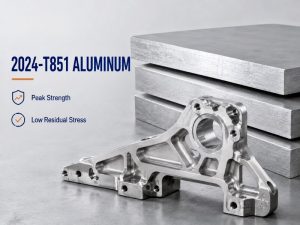
T851 est sélectionnée lorsqu'une pièce en plaque usinée nécessite la limite d'élasticité et la stabilité les plus élevées disponibles en 2024 et qu'une élongation de 5% est acceptable.
O est utilisée lorsque le formage est suffisamment sévère pour fissurer toute trempe T — former à l'état recuit, puis traiter thermiquement en solution et vieillir. La fiche technique de la tôle 2024-O couvre cette voie.
Un alliage différent est requis si l'assemblage doit être soudé par fusion, exposé sans protection en extérieur ou en milieu marin, ou doit conduire un courant significatif. Aucune des trempes 2024 ne résout ces limitations.
Travail avec le 2024-T3
Formation
Le T3 se forme, mais ce n'est pas du 5052. Prévoir un rayon de pliage minimal de l'ordre de 3t à 5t selon l'épaisseur et l'orientation, soit plusieurs fois ce que tolère une tôle 5xxx à la même épaisseur. Le pliage transversal au sens de laminage est plus tolérant que le pliage longitudinal, et les épaisseurs plus fortes nécessitent des rayons proportionnellement plus grands. Lorsqu'un design exige réellement un rayon serré, les solutions habituelles sont de former à l'état O puis de traiter thermiquement ensuite, ou de passer à un assemblage formé puis riveté plutôt qu'à une pièce pliée unique.
Assemblage
Le soudage par fusion du 2024 n'est pas une voie de production pratique : la zone affectée thermiquement est sujette à la fissuration à chaud et la trempe est détruite localement dans tous les cas. Le rivetage est la solution par défaut, avec le boulonnage et le collage structural comme deux autres voies acceptées. Le soudage par friction-malaxage fonctionne sur le 2024 et évite le problème de fusion, bien qu'il nécessite un bridage et un accès au joint que de nombreux assemblages ne peuvent pas offrir. Noter que les rivets en 2024 eux-mêmes (désignations DD) sont livrés à l'état fraîchement traité en solution et doivent être conservés au froid et posés dans un délai limité — cette contrainte s'applique au rivet, et non à la tôle T3 dans laquelle il est posé.
Usinage
Le 2024-T3 s'usine proprement. Un outillage carbure affûté, une vitesse de surface élevée et une avance modérée donnent un bon contrôle des copeaux et un fini brillant, et l'alliage maintient bien des tolérances serrées. Pour les sections épaisses où beaucoup de matière est enlevée, la plaque T351 est le meilleur point de départ car la relaxation des contraintes par étirage maintient la pièce plane.
Protection contre la corrosion et finition
La protection n'est pas optionnelle sur cet alliage. La tôle Alclad, avec de l'aluminium de haute pureté laminé sur les deux faces, est la réponse aérospatiale standard car le revêtement se corrode de manière sacrificielle et protège le cœur riche en cuivre. L'anodisation et les systèmes d'apprêt ou de peinture sont les alternatives pour le stock nu. Un point spécifique aux pièces critiques en fatigue : l'anodisation sulfurique conventionnelle entraîne un débit de fatigue mesurable, c'est pourquoi l'anodisation chromique mince était traditionnellement spécifiée pour les pièces de fuselage en 2024, et pourquoi les procédés borique-sulfurique et sulfurique à film mince ont pris le relais avec la restriction des chromates. Surveiller également les couples galvaniques — le 2024 en contact avec des fixations en acier ou de la fibre de carbone nécessite une couche isolante.
Avantages et limitations
| Avantage | Limitation |
| 483 MPa en traction à 2,78 g/cm³, l'un des meilleurs rapports résistance/poids de l'aluminium commercial | Faible résistance à la corrosion ; revêtement, anodisation ou peinture obligatoires en service |
| 138 MPa de résistance à la fatigue, bien adapté aux structures soumises à des charges cycliques | Non soudable par fusion ; les assemblages doivent être rivetés, boulonnés ou collés |
| ~18% d'élongation, suffisante pour le formage requis par les structures en tôle rivetée | Rayons de pliage de 3t à 5t ; les géométries plus serrées nécessitent un formage à l'état O et un traitement thermique ultérieur |
| S'usine proprement et maintient les tolérances | ~30% de conductivité IACS exclut son utilisation pour les pièces conductrices de courant |
| Largement spécifié et bien caractérisé, les données de conception sont donc faciles à obtenir | Coûte plus cher que le 5052 ou le 6061, et la finition ajoute à ce coût |
Conclusion
Le 2024-T3 combine une résistance élevée à la livraison, une bonne résistance à la fatigue et une ductilité suffisante pour les structures en tôle formée et rivetée, mais les compromis sont tout aussi définis : la protection contre la corrosion est obligatoire, le soudage par fusion n'est pas une voie de production pratique, et les rayons de pliage de 3t à 5t contraignent la géométrie — là où ces contraintes s'adaptent à la pièce, peu d'alliages rivalisent, et là où elles ne s'adaptent pas, le 6061 ou le 5052 est le choix le plus pratique à un coût total inférieur. L'approvisionnement de la trempe et de l'épaisseur correctes avec une documentation complète reste un défi d'achat courant.
Linsy fournit le 2024 en T3 et dans d'autres trempes standard sous forme de tôle, plaque, barre, tube et fil, avec des certificats de contrôle en usine sur chaque commande, une production personnalisée à faible quantité minimale de commande, et les certifications ISO 9001, ISO 14001 et ISO 45001, avec des rapports d'essai SGS disponibles sur demande et des délais typiques de 10 à 60 jours selon la forme et la quantité. Consulter la spécification 2024-T3 pour les données de propriétés certifiées par épaisseur et trempe, ou contacter Linsy pour confirmer la disponibilité du stock et les options de production personnalisée pour l'application visée.
Questions fréquemment posées
Le 2024-T3 est-il identique au 2024-T351 ?
Ils sont proches mais non interchangeables. Les deux sont traités en solution, écrouis et vieillis naturellement. En T351, l'écrouissage est un étirage contrôlé de 1,5 à 3% appliqué spécifiquement pour relaxer les contraintes résiduelles, et cette désignation s'applique normalement à la plaque. Le T3 est la trempe de tôle, où l'écrouissage est une passe de laminage ou d'aplatissement visant la résistance. Les résistances typiques se situent à quelques pour cent l'une de l'autre ; la raison de spécifier le T351 est la stabilité dimensionnelle pendant l'usinage, et non une résistance supplémentaire.
Le 2024-T3 peut-il être soudé ?
Pas par des méthodes de fusion dans un sens pratique de production. La zone affectée thermiquement est sujette à la fissuration à chaud, et la condition T3 est détruite localement par la chaleur de soudure dans tous les cas. Le rivetage, le boulonnage et le collage structural sont les voies acceptées. Le soudage par friction-malaxage est techniquement viable car il reste sous le point de fusion, mais il nécessite un bridage et un accès au joint que la plupart des assemblages en tôle ne peuvent pas fournir.
Combien coûte le 2024-T351 par rapport au T3 ?
La prime de prix du T351 par rapport au T3 est généralement de 5 à 15%, due à l'opération d'étirage supplémentaire. Pour les plaques épaisses (au-dessus de 25 mm), la prime se réduit car le T3 est rarement spécifié à ces épaisseurs — le T351 est la trempe aérospatiale par défaut. La véritable comparaison de coût n'est pas T351 vs T3, mais T351 vs le coût de mise au rebut d'une pièce en T3 déformée après usinage.
Quel rayon de pliage minimal dois-je prévoir pour la tôle 2024-T3 ?
Environ 3t à 5t, variant avec l'épaisseur et l'orientation du pli, les plis transversaux étant plus tolérants que les plis longitudinaux. Confirmer avec les données du fournisseur pour l'épaisseur spécifique avant de libérer l'outillage. Si le design nécessite quelque chose de plus serré, former la pièce à l'état O et la traiter thermiquement à l'état T après formage.
Le 2024-T3 nécessite-t-il un stockage réfrigéré ou un ré-vieillissement après livraison ?
Non. Le matériau T3 est vieilli naturellement à un état substantiellement stable avant expédition, il peut donc être stocké et usiné à température ambiante sans pénalité de résistance. L'exigence de réfrigération associée au 2024 s'applique aux rivets fraîchement traités en solution, qui sont une condition de produit entièrement différente.