O que é o Alumínio 2024?
2024 é o material de base à base de cobre da série 2xxx. O cobre em 3,8–4,9%, com magnésio em 1,2–1,8% e manganês em 0,3–0,9%, torna a liga tratável termicamente: precipitados finos formam-se no interior do metal e fixam as discordâncias, e é daí que vem a resistência. Em seus temperos mais resistentes, o 2024 suporta cargas que, de outra forma, exigiriam aço, com aproximadamente um terço da densidade.
O teor de cobre também impõe contrapartidas específicas. O 2024 está entre as ligas de alumínio menos resistentes à corrosão em uso comum, porque as fases ricas em cobre criam células galvânicas ao longo dos contornos de grão, portanto, o material sem revestimento necessita de cladding, anodização ou pintura em qualquer serviço úmido ou marinho. Também apresenta baixa soldabilidade por fusão, uma vez que a zona afetada pelo calor é propensa a trincas, razão pela qual as estruturas de 2024 são rebitadas ou aparafusadas. Esses limites pertencem à liga e não mudam com o tratamento térmico. O que muda — resistência, ductilidade e o quanto de conformação o material tolera antes de trincar — é definido inteiramente pelo tempero, e para trabalho em chapa esse tempero é quase sempre T3.
Compreendendo o Tempero T3
A designação T3 define uma sequência de três etapas: tratamento térmico de solução, trabalho a frio e envelhecimento natural até uma condição substancialmente estável.
| Etapa | Processo | Finalidade e resultado |
| Tratamento térmico de solução | Mantido próximo a 493 °C (920 °F) e, em seguida, temperado | Cobre e magnésio dissolvem-se na matriz de alumínio e ficam retidos em solução supersaturada |
| Trabalho a frio | Deformação controlada — para chapa, um passe de laminação ou achatamento | Aumenta a densidade de discordâncias sobre a estrutura temperada; esta etapa diferencia T3 de T4 |
| Envelhecimento natural | Precipitação à temperatura ambiente de aglomerados finos a partir do soluto retido | A maior parte da resistência se desenvolve nas primeiras 24 horas; substancialmente estável após aproximadamente quatro dias |
O resultado prático é uma chapa que chega com quase toda a sua resistência já desenvolvida, mantendo ainda cerca de 18% de alongamento. Isso é ductilidade suficiente para dobras em dobradeira, joggles e conformação por estiramento que o trabalho de chapas em estruturas aeronáuticas exige. Não é necessário tratamento térmico no chão de fábrica, nem armazenamento refrigerado: o material pode ser conformado e rebitado na condição de entrega.
T3, T4 e T351: Distinções Principais
Esses três temperos são intimamente relacionados e frequentemente confundidos em especificações e documentação de aquisição dentro da família 2024.
T4 omite a etapa de trabalho a frio — apenas tratamento de solução e envelhecimento natural. Resistência marginalmente menor, ductilidade marginalmente maior, e a condição usual para barra, vergalhão e fio de 2024. Consulte o guia 2024-T4 para o conjunto completo de dados.
T3 adiciona o trabalho a frio, razão pela qual é o tempero padrão para chapas em estruturas conformadas e rebitadas.
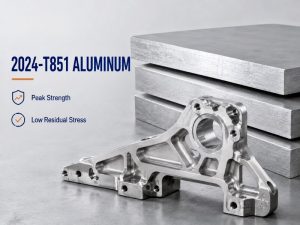
T351 aplica a mesma lógica à placa, exceto que o trabalho a frio é um estiramento controlado de 1,5–3% cuja finalidade é o alívio de tensões, não o aumento de resistência. Para placa espessa destinada a usinagem, em vez de chapa para conformação, o guia 2024-T351 é o mais relevante.
Propriedades Mecânicas do 2024-T3
Os valores abaixo são típicos para chapa nua de 2024-T3. A espessura e a forma do produto alteram esses valores, portanto, decisões de projeto devem referenciar os valores certificados no certificado de ensaio do laminador, em vez de uma média publicada.
| Propriedade | Valor típico | Notas |
| Densidade | 2,78 g/cm³ | Aproximadamente um terço do aço |
| Resistência à tração última | 483 MPa (70 ksi) | Chapa nua; Alclad apresenta valores menores |
| Limite de escoamento (0,2%) | 345 MPa (50 ksi) | O número do qual a maioria dos allowables de projeto depende |
| Alongamento na ruptura | ~18% | Chapa de 1,6 mm; diminui conforme a espessura aumenta |
| Resistência à fadiga | 138 MPa | A 5×10⁸ ciclos, viga rotativa |
| Resistência ao cisalhamento | 283 MPa | Relevante para dimensionamento de juntas rebitadas |
| Módulo de elasticidade | 73,1 GPa | Efetivamente constante entre os temperos do 2024 |
| Dureza | 120 HB | Carga de 500 kg, esfera de 10 mm |
| Condutividade térmica | 121 W/m·K | Menor que o do 6061, um efeito do cobre |
| Condutividade elétrica | ~30% IACS | Moderado a baixo; não é uma liga condutora |
| Faixa de fusão | 502–638 °C | Solidus a liquidus |
Dois números fazem a maior parte do trabalho aqui. A combinação 483/345 MPa é o que permite que um painel de pele em 2024-T3 substitua um painel de aço muito mais pesado, e a resistência à fadiga de 138 MPa é a razão pela qual a liga mantém uma posição em estrutura de fuselagem pressurizada que ligas mais novas e mais resistentes não tomaram dela. Uma pele de fuselagem sofre um ciclo de pressurização a cada voo; a resistência à iniciação de trincas ao longo de centenas de milhares desses ciclos importa mais do que a resistência máxima à tração.
Um detalhe de fornecimento que vale a pena confirmar antes de encomendar: o Alclad 2024-T3 não é tão resistente quanto o material nu. As camadas de revestimento de alumínio puro suportam pouca carga, portanto, os valores típicos do Alclad caem para cerca de 448 MPa de tração e 310 MPa de escoamento — um débito de aproximadamente 8–10%. Chapas finas perdem proporcionalmente mais. Se os allowables foram calculados com base nas propriedades do material nu, o material revestido não deve ser substituído sem reavaliar a margem.
Onde o 2024-T3 É Utilizado
O setor aeroespacial domina, e não por uma margem pequena. O comportamento à fadiga e a relação resistência-peso justificam a proteção contra corrosão e a união por rebites que a liga exige.
Peles de aeronaves. Chapa Alclad 2024-T3 é o material clássico para fuselagem e pele de asa inferior, conformada ao contorno e rebitada à subestrutura.
Caixilhos de fuselagem, longarinas e nervuras. Componentes conformados em chapa, onde a peça é dobrada ao formato antes da montagem, em vez de usinada a partir de bloco sólido.
Superfícies inferiores de asas. A asa inferior é uma estrutura de tração, e o 2024 supera o 7075 no crescimento de trincas por fadiga sob tração. As superfícies superiores, carregadas em compressão, mais frequentemente utilizam 7075. A comparação 2024 vs 7075 cobre essa divisão em detalhe.
Acessórios, suportes e ferragens. Peças usinadas ou conformadas onde a resistência por unidade de massa orienta o projeto.
Rodas de caminhão e manifolds hidráulicos. Os principais usos não aeroespaciais, ambos componentes de alta tensão que justificam o custo adicional de acabamento.
Estruturas de automobilismo e defesa. Conjuntos críticos em peso que operam em ambientes controlados ou protegidos.
Onde o 2024-T3 não se aplica: trabalho geral de chassis, ferragens marítimas, estruturas soldadas, painéis arquitetônicos ou qualquer coisa que conduza corrente elétrica. O 5052 e o 6061 lidam melhor com esses casos e custam menos para acabamento.
2024-T3 vs Outros Temperos do 2024
Todos os temperos do 2024 compartilham a mesma química. Apenas o histórico térmico e mecânico difere, e é esse histórico que determina as propriedades do material e sua adequação a uma determinada aplicação.
| Temperamento | Resistência à tração (MPa) | Limite de Escoamento (MPa) | Alongamento | Forma típica |
| O (recozido) | 186 | 76 | ~20% | Chapa para conformação severa |
| T3 | 483 | 345 | ~18% | Chapa, conformada e rebitada |
| T4 | 469 | 324 | ~19% | Barra, vergalhão, fio |
| T351 | ~470 | ~325 | ~19% | Placa para usinagem |
| T6 | ~475 | ~393 | ~10% | Raramente estocada como chapa |
| T851 | ≥455 | ≥400 | ~5% | Placa usinada, máxima estabilidade |
Observe o que a tabela não mostra: uma grande faixa de resistência à tração. Entre T3, T4, T351 e T6, a resistência última varia apenas alguns pontos percentuais. As diferenças significativas estão no limite de escoamento, ductilidade e comportamento dimensional — e são esses fatores que devem orientar a escolha.
Escolhendo o Têmpera
T3 é a escolha padrão quando a peça começa como chapa, é conformada e rebitada — a resistência é exigida na entrega, com alongamento suficiente restante para dobramento.
T4 aplica-se a barra, haste ou fio, ou quando a conformação é severa o suficiente para que o ponto extra de ductilidade seja relevante.
T351 é especificada para usinagem de placa espessa, onde a tensão residual puxaria a peça para fora da tolerância à medida que o material é removido.
T851 é selecionada quando uma peça de placa usinada necessita do maior limite de escoamento e estabilidade disponíveis na liga 2024, e o alongamento de 5% é aceitável.
O é utilizada quando a conformação é severa o suficiente para trincar qualquer têmpera T — conformar no estado recozido e, em seguida, tratar por solução e envelhecer. A folha de dados da chapa 2024-O cobre esse caminho.
Uma liga diferente é necessária se a montagem precisar ser soldada por fusão, ficar exposta sem proteção ao ar livre ou ao mar, ou precisar conduzir corrente elétrica significativa. Nenhuma das têmperas da 2024 resolve essas limitações.
Trabalhando com 2024-T3
Conformação
A T3 conforma, mas não é a 5052. Planeje um raio mínimo de dobra na faixa de 3t a 5t, dependendo da espessura e da orientação, várias vezes maior do que uma chapa da série 5xxx tolera na mesma espessura. Dobrar transversalmente à direção de laminação é mais tolerante do que dobrar ao longo dela, e espessuras maiores exigem raios proporcionalmente maiores. Quando um projeto realmente precisa de um raio apertado, as respostas usuais são conformar na condição O e tratar termicamente depois, ou migrar para uma montagem conformada e depois rebitada, em vez de uma única peça dobrada.
União
A soldagem por fusão da 2024 não é uma rota prática de produção: a zona afetada pelo calor é propensa a trincas a quente e a têmpera é destruída localmente de qualquer forma. A rebitagem é o padrão, com parafusamento e adesão estrutural como os outros dois caminhos aceitos. A soldagem por fricção e mistura (friction stir welding) funciona na 2024 e evita o problema de fusão, embora exija dispositivos de fixação e acesso à junta que muitas montagens não podem oferecer. Observe que os próprios rebites de 2024 (designações DD) são fornecidos em condição recém-tratada por solução e devem ser mantidos refrigerados e instalados dentro de uma janela limitada — essa restrição se aplica ao rebite, não à chapa T3 na qual ele é aplicado.
Usinagem
A 2024-T3 usina de forma limpa. Ferramentas de carboneto afiadas, alta velocidade de superfície e avanço moderado proporcionam bom controle de cavaco e acabamento brilhante, e a liga mantém tolerâncias apertadas com facilidade. Para seções espessas onde muito material é removido, a placa T351 é o melhor ponto de partida, pois o alívio de tensões por estiramento mantém a peça plana.
Proteção contra Corrosão e Acabamento
A proteção não é opcional nesta liga. A chapa Alclad, com alumínio de alta pureza laminado por ligação em ambas as faces, é a resposta padrão da indústria aeroespacial, pois o revestimento corrói de forma sacrificial e protege o núcleo rico em cobre. A anodização e sistemas de primer ou pintura são as alternativas para material sem revestimento. Um ponto específico para peças críticas à fadiga: a anodização convencional com ácido sulfúrico apresenta uma penalidade mensurável de fadiga, razão pela qual a anodização fina com ácido crômico era tradicionalmente especificada para peças estruturais de 2024, e pela qual os processos de ácido bórico-sulfúrico e sulfúrico de filme fino assumiram o lugar à medida que o uso de cromato é restringido. Também observe o pareamento galvânico — a 2024 em contato com fixadores de aço ou fibra de carbono necessita de uma camada isolante.
Vantagens e Limitações
| Vantagem | Limitação |
| 483 MPa de resistência à tração a 2,78 g/cm³, uma das melhores relações resistência-peso entre os alumínios comerciais | Baixa resistência à corrosão; revestimento, anodização ou pintura são obrigatórios em serviço |
| 138 MPa de resistência à fadiga, bem adequada a estruturas com carregamento cíclico | Não soldável por métodos de fusão; montagens devem ser rebitadas, parafusadas ou coladas |
| ~18% de alongamento, suficiente para a conformação que estruturas rebitadas de chapa necessitam | Raios de dobra de 3t a 5t; geometrias mais apertadas exigem conformação no têmpera O e tratamento térmico posterior |
| Usina de forma limpa e mantém tolerâncias | ~30% de condutividade IACS a exclui para peças condutoras de corrente |
| Amplamente especificada e bem caracterizada, facilitando a obtenção de dados de projeto | Custa mais do que a 5052 ou a 6061, e o acabamento adiciona a esse custo |
Conclusão
A 2024-T3 combina alta resistência na entrega, resistência à fadiga e ductilidade suficiente para estruturas conformadas e rebitadas de chapa, mas as contrapartidas são igualmente definidas: a proteção contra corrosão é obrigatória, a soldagem por fusão não é uma rota prática de produção, e os raios de dobra de 3t a 5t limitam a geometria — onde essas limitações se adequam à peça, poucas ligas competem, e onde não se adequam, a 6061 ou a 5052 são a escolha mais prática a menor custo total. A obtenção da têmpera e espessura corretas com documentação completa continua sendo um desafio comum de suprimento.
A Linsy fornece a liga 2024 nas têmperas T3 e outras padrão, em chapa, placa, barra, tubo e fio, com certificados de ensaio de fábrica em cada pedido, produção personalizada com MOQ baixo e certificações ISO 9001, ISO 14001 e ISO 45001, com relatórios de ensaio SGS disponíveis mediante solicitação e prazos típicos de entrega de 10 a 60 dias, dependendo da forma e da quantidade. Consulte a especificação da 2024-T3 para obter dados certificados de propriedades por espessura e têmpera, ou entre em contato com a Linsy para confirmar a disponibilidade de estoque e as opções de produção personalizada para a aplicação desejada.
Perguntas frequentes
A 2024-T3 é a mesma coisa que a 2024-T351?
São próximas, mas não intercambiáveis. Ambas são tratadas por solução, trabalhadas a frio e envelhecidas naturalmente. Na T351, o trabalho a frio é um estiramento controlado de 1,5–3% aplicado especificamente para aliviar a tensão residual, e a designação normalmente se aplica a placa. A T3 é o têmpera de chapa, onde o trabalho a frio é uma passada de laminação ou achatamento visando resistência. As resistências típicas ficam a poucos pontos percentuais uma da outra; a razão para especificar a T351 é a estabilidade dimensional durante a usinagem, não resistência adicional.
A 2024-T3 pode ser soldada?
Não por métodos de fusão em qualquer sentido prático de produção. A zona afetada pelo calor é propensa a trincas a quente, e a condição T3 é destruída localmente pelo calor da solda de qualquer forma. Rebitagem, parafusamento e adesão estrutural são as rotas aceitas. A soldagem por fricção e mistura é tecnicamente viável porque permanece abaixo do ponto de fusão, mas exige dispositivos de fixação e acesso à junta que a maioria das montagens de chapa não pode oferecer.
Quanto custa a 2024-T351 em comparação com a T3?
O prêmio de preço da T351 sobre a T3 é geralmente de 5–15%, impulsionado pela operação adicional de estiramento. Para placas espessas (acima de 25 mm), o prêmio diminui porque a T3 raramente é especificada nessas espessuras — a T351 é o têmpera aeroespacial padrão. A comparação real de custo não é T351 vs T3, mas T351 vs o custo de descartar uma peça T3 distorcida após a usinagem.
Qual raio mínimo de dobra devo considerar no projeto com chapa 2024-T3?
Aproximadamente 3t a 5t, variando com a espessura e a orientação da dobra, sendo as dobras transversais mais tolerantes do que as longitudinais. Confirme com os dados do fornecedor para a espessura específica antes de liberar a ferramentaria. Se o projeto precisar de algo mais apertado, conforme a peça na condição O e trate termicamente para T após a conformação.
A 2024-T3 precisa de armazenamento refrigerado ou re-envelhecimento após a entrega?
Não. O material T3 é envelhecido naturalmente até uma condição substancialmente estável antes do envio, portanto pode ser armazenado e trabalhado à temperatura ambiente sem penalidade de resistência. O requisito de refrigeração que as pessoas associam à 2024 se aplica a rebites recém-tratados por solução, que são uma condição de produto completamente diferente.