Che cos'è l'alluminio 8009?
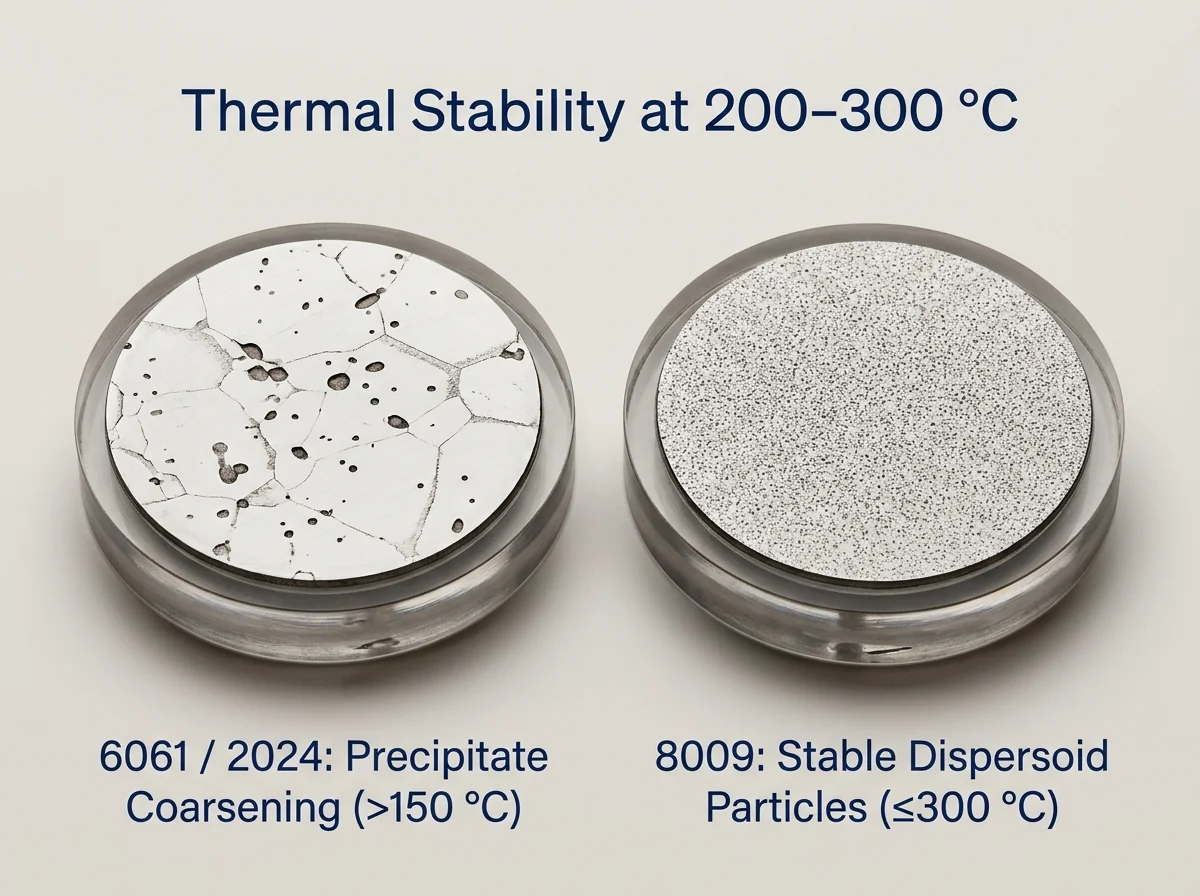
L'alluminio 8009 è una delle leghe della serie 8xxx — la serie che contiene ferro anziché rame, magnesio o zinco come aggiunta principale — ed esiste per un solo scopo: componenti che devono sopportare carichi in condizioni di esercizio a caldo, solitamente tra 150 °C e 300 °C. È l'intervallo in cui il 6061 e il 2024 hanno già perso gran parte della resistenza conferita loro dal trattamento termico.
La sua resistenza non deriva affatto dal trattamento termico. Deriva da un numero molto elevato di particelle fini — ferro, silicio e vanadio, miscelati nel metallo durante la produzione. È questa l'intera differenza tra l'8009 e le leghe che la maggior parte degli acquirenti conosce. Il metallo è prodotto da polvere raffreddata estremamente rapidamente invece di essere colato in un blocco solido nel modo usuale, e questo raffreddamento rapido è ciò che mantiene le particelle sufficientemente fini da svolgere la loro funzione.
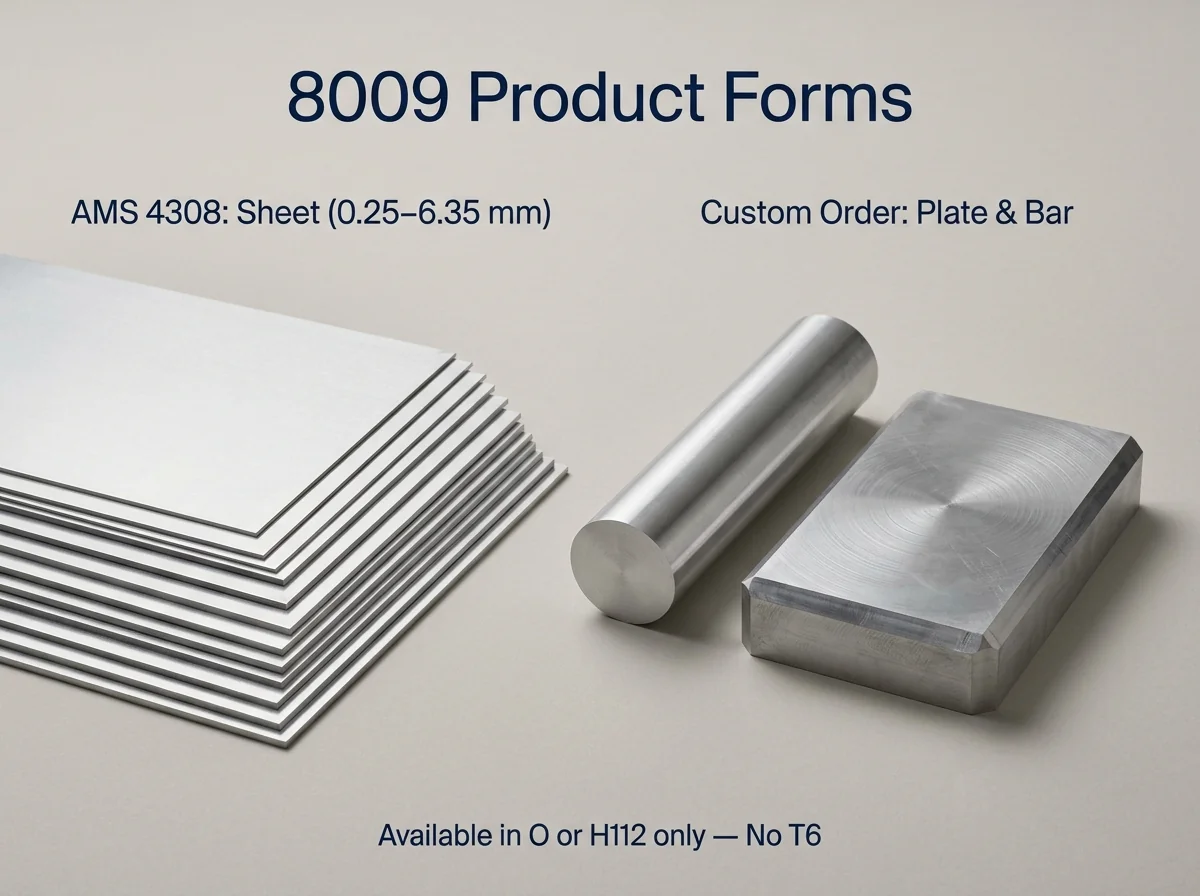
Il costo di questo vantaggio ricade sul lato dell'acquirente, non su quello ingegneristico. Pochissimi stabilimenti sono in grado di produrre la polvere, quindi il materiale non è un articolo da catalogo. Viene fornito in due stati anziché in una scala di tempre. E la specifica aerospaziale redatta per esso copre solo la lamiera, il che significa che qualsiasi spessore maggiore o forma diversa deve essere ordinato su disegno anziché su standard. Una volta che la lega si adatta alla vostra temperatura, ciò che resta è determinare lo stato in cui arriva.
Perché l'8009 mantiene la resistenza dove il 6061 e il 2024 si rammorbidiscono
Il 6061 e il 2024 ottengono la loro resistenza dal trattamento termico, e il trattamento termico è annullato dal calore. A partire da circa 150 °C, la struttura che li rendeva duri si decompone gradualmente e la resistenza se ne va con essa. Una staffa in 6061-T6 che è comodamente entro i limiti a banco può essere gravemente sovrasollecitata a 200 °C, e nulla nella scheda tecnica a temperatura ambiente ve lo segnala.
L'8009 funziona diversamente. Le particelle che gli conferiscono resistenza sono già nel metallo e sono stabili alle temperature di esercizio: non crescono e non si ridisciolgono nell'alluminio. Riscaldate il componente e quelle particelle continuano a trattenere il metallo dallo snervamento, allo stesso modo in cui facevano quando era freddo.
Ecco perché la resistenza diminuisce gradualmente invece di crollare bruscamente. Quanto ne rimane, e per quanto tempo, è ciò che mostra la tabella sottostante.
Proprietà dell'alluminio 8009 a temperatura ambiente e a temperatura elevata
| Proprietà | Valore | Base |
|---|---|---|
| Densità | 2,92 g/cm³ | Tipico |
| Resistenza a trazione, temperatura ambiente | 450 MPa | Tipico |
| Resistenza allo snervamento, temperatura ambiente | 385 MPa | Tipico |
| Allungamento | ~15% | Tipico |
| Modulo di trazione | 90 GPa | Tipico |
| Durezza | ~140 HB | Tipico |
| Conducibilità termica | ~115 W/m·K | Tipico |
| Espansione termica | ~19,0 µm/m·°C | Tipico |
A temperatura ambiente, l'8009 sopporta circa 450 MPa prima di rompersi e 385 MPa prima di smettere di recuperare elasticamente. Per confronto, il 6061-T6 — la lega più conosciuta dalla maggior parte delle officine — sopporta 310 MPa e 276 MPa sulle stesse due misure, e il 7075-T6 sopporta 572 MPa e 503 MPa. Quindi l'8009 è più resistente del 6061 a freddo e meno resistente del 7075, il che significa che la temperatura ambiente non è la ragione per acquistarlo. Altri due valori contano di più nella pratica. La densità è 2,92 g/cm³, circa l'8% più pesante del 6061 a causa del ferro, ma comunque ben al di sotto della metà del peso dell'acciaio. La durezza di circa 140 HB è vicina a quella del 7075, quindi un'officina che già lavora il 7075 non sarà sorpresa da come si taglia.
I valori alle temperature elevate sono la ragione per cui la lega esiste.
| Temperatura | Resistenza a trazione dopo 1.000 h | Resistenza allo snervamento dopo 1.000 h |
|---|---|---|
| 100 °C | 410 MPa | 370 MPa |
| 150 °C | 380 MPa | 350 MPa |
| 200 °C | 350 MPa | 310 MPa |
| 250 °C | 310 MPa | 275 MPa |
| 300 °C | 270 MPa | 240 MPa |
A 200 °C la lega sopporta ancora 350 MPa dopo mille ore a temperatura — circa il 78% di ciò che fa a freddo. A 250 °C mantiene 310 MPa, e a 300 °C mantiene ancora 270 MPa, che è poco al di sotto del valore iniziale del 6061-T6 a temperatura ambiente. La caduta da 200 °C a 300 °C è più ripida della caduta dalla temperatura ambiente a 200 °C, e questa è la lettura pratica: 200–300 °C è la finestra operativa, e la metà superiore richiede un margine di sicurezza maggiore della metà inferiore.
Questi sono valori tipici pubblicati, non i minimi garantiti da una specifica. Chiedete al fornitore i valori applicabili al calore che vi viene effettivamente offerto, e scrivete il valore su cui avete progettato nell'ordine di acquisto anziché lasciarlo implicito.
Tempre e forme di prodotto — Cosa copre effettivamente l'AMS 4308
L'AMS 4308 è la specifica di materiale aerospaziale per questa lega, pubblicata da SAE International. Fissa la chimica, lo stato e i valori di resistenza che il materiale deve soddisfare, ed è il documento su cui lavora un ispettore quando il materiale arriva. Quando un disegno indica "AMS 4308", è ciò che il fornitore si impegna a fornire.
La chimica si riduce a sei righe, e sono quelle che vale la pena verificare su un certificato.
| Elemento | Intervallo (% in peso) | Cosa fa |
|---|---|---|
| Ferro (Fe) | 8.4 – 8.9 | L'aggiunta principale; forma le particelle che mantengono la resistenza alle temperature elevate |
| Silicio (Si) | 1.7 – 1.9 | Lavora con il ferro e il vanadio per formare quelle particelle |
| Vanadio (V) | 1.1 – 1.5 | Mantiene quelle particelle stabili quando il componente lavora a caldo |
| Zinco (Zn) | 0,25 max | Impurezza — questa è la riga che smaschera un certificato errato |
| Ossigeno (O) | 0,30 max | L'impronta della via della polvere; una lega colata in lingotto non avrebbe un limite come questo |
| Alluminio | Equilibrio | Il resto |
Questi sono limiti tipici pubblicati, coerenti con la chimica 8,6Fe – 1,8Si – 1,3V indicata nell'AMS 4308B. Richiedete i valori certificati per il lotto che state quotando.
O (ricotto)
O è lo stato ricotto. Il metallo viene riscaldato e raffreddato lentamente di proposito affinché possa essere formatо — piegato, laminato o pressato nella forma — e rinuncia alla resistenza per farlo. Acquistate lo stato O quando il componente deve ancora essere formato dopo la ricezione, e prevedete di accettare valori di resistenza inferiori fino al completamento della formatura.
H112 / F (Come fabbricato)
H112 — spesso scritto F, per come fabbricato — è lo stato in cui si trova il materiale quando lascia lo stabilimento dopo essere stato lavorato a caldo, senza ulteriori trattamenti applicati. È la condizione strutturale predefinita e quella nominata nel titolo dell'AMS 4308, perché non c'è alcuna fase di invecchiamento da aggiungere o saltare: la resistenza che la lega possiede è la resistenza che il processo ha prodotto.
La questione della forma è dove la maggior parte degli ordini di acquisto sbaglia.
| Forma | Covered by | What has to be on the order |
|---|---|---|
| Sheet, 0.25–6.35 mm | AMS 4308B | Standard product — chemistry, state and mechanical values are fixed by the specification |
| Plate over 6.35 mm | No AMS coverage | Chemistry limits and mechanical values stated on the order |
| Barre e tondi | No AMS coverage | Chemistry limits and mechanical values stated on the order |
| Extrusion profile | No AMS coverage | Chemistry, values and section agreed per drawing |
| Tubo | No AMS coverage | Chemistry, values and dimensions agreed per drawing |
| Foil and strip below 0.25 mm | No AMS coverage | Chemistry and values stated on the order |
Only the first row has a specification standing behind it. Everything below that line is exactly as good as what the purchase order says, which is why the chemistry and the mechanical values have to be written down instead of referenced.
One more thing to settle before the RFQ goes out: 8009 has no T6 or T8 temper. A T6 or T8 designation means the alloy is hardened by a heat treatment cycle after forming, and this alloy does not harden that way — the particles are already in it and will not re-form. If an offer names T6 or T8 for 8009, the offer is describing a different material.
Two lines on the certificate catch most of the confusion. A zinc figure of 5–6% describes 7075, not 8009, which carries almost no zinc. And a strength figure far above the table above usually means the numbers were carried over from another grade rather than measured on that batch.
We buy 8009 billet, plate and bar from producers that run the powder route, then cut, machine and finish to drawing. For forms outside the AMS range, we quote against the chemistry and the properties your drawing names.
Where 8009 Is Used
Aerospace and Engine-Adjacent Structures
The reason 8009 appears in aerospace work is a weight comparison, not a strength comparison. Above 150 °C the usual alternatives are titanium, steel, and the few heat-resistant aluminiums such as 2618. Titanium is about 50% heavier for the same volume and steel close to three times. A part that can stay aluminium up to 300 °C removes that penalty for anything whose service temperature lands in the band — supersonic airframe skins that heat up in flight, rocket structure, thermal-protection hardware, and brackets and housings close to an engine where the metal soaks up radiant heat without seeing combustion.
The fit is specific rather than general. If the part runs below 150 °C, 7075 or 2024 gives more strength per kilogram and is easier to buy. If it runs above 350 °C, aluminium stops competing and the titanium or steel argument takes over. 8009 earns its place in the band where neither of those answers works.
High-Performance Automotive and Specialty Heat Exchangers
Turbocharger and exhaust-adjacent parts see the same problem in a smaller package: cyclic heating and cooling, with load on the part the whole time. A piston or a housing that softens a little more with every heat cycle loses its clearances before it loses its shape, which is why slow stretching under load at temperature — creep — decides the material here rather than peak strength.
Specialty heat exchangers and high-temperature tooling follow the same logic from the other direction — the part is hot by design, and the question is whether the wall keeps its dimensions over a long campaign. The limiting factor for cost here is usually the size of the part rather than the material: 8009 is expensive relative to 6061, and that premium is easiest to justify on small, highly loaded components.
8009 vs 6061, 2024, 2618 and 7075 — Choosing by Service Temperature
| Lega e tempera | Tensile, room temp | Yield, room temp | Practical service ceiling | What it is for |
|---|---|---|---|---|
| 7075-T6 | 572 MPa | 503 MPa | ~120 °C | Strongest at room temperature; wrong choice for a hot part |
| 2024-T3 | 483 MPa | 345 MPa | ~150 °C | Airframe skins and fatigue-critical structure |
| 6061-T6 | 310 MPa | 276 MPa | ~150 °C | The default general-purpose structural alloy |
| 2618-T61 | ~440 MPa | ~370 MPa | ~200 °C | Forged pistons and compressor parts |
| 8009 (H112) | 450 MPa | 385 MPa | 200–300 °C | Parts that must stay aluminium while running hot |
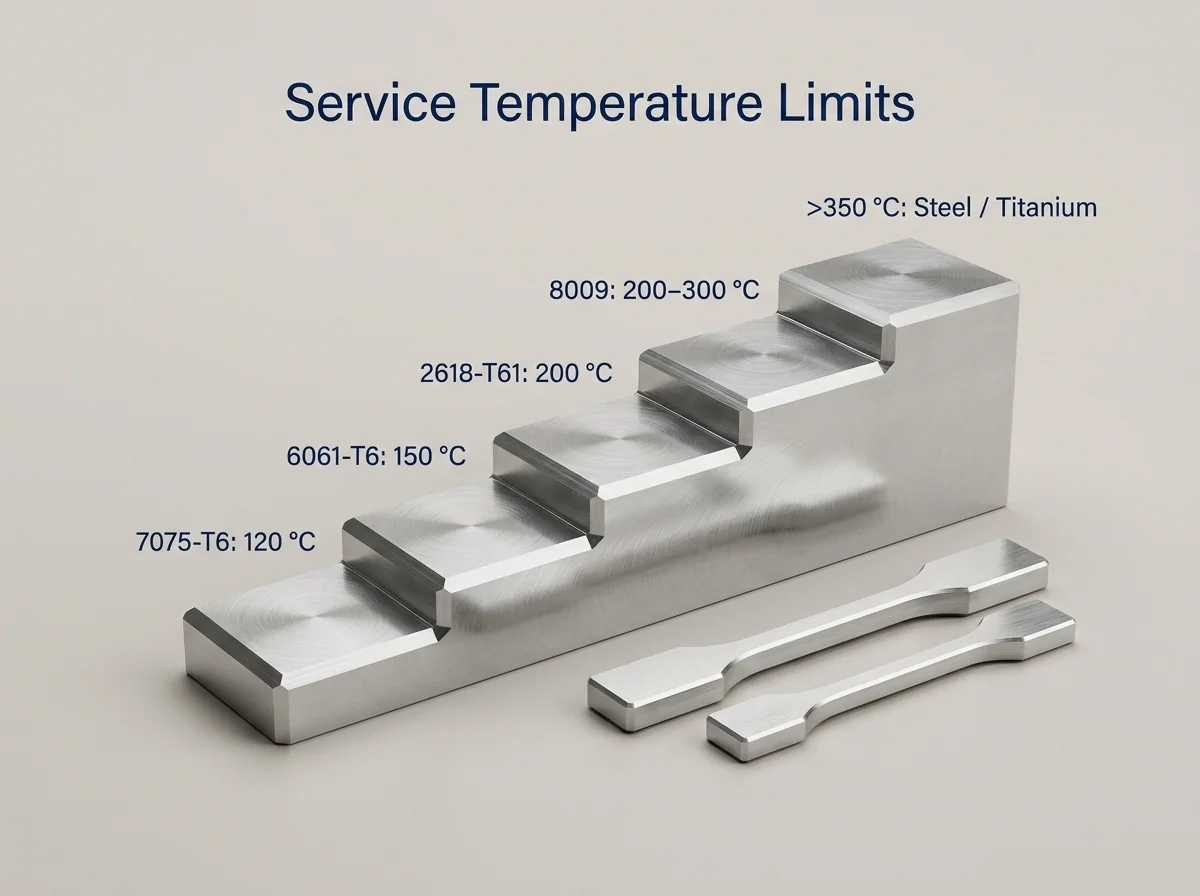
Room-temperature values above are the minimums published in ASTM B209 for sheet, except 2618, where they are typical forging values to AMS 4132. Service ceilings are practical design limits rather than values printed in any specification, and a specific duty cycle can justify going beyond them with the right testing.
Read that table by the fourth column, not the second. 7075 wins the room-temperature column and is the wrong material for a 250 °C part. 2618 is the right answer for a piston crown at 200 °C and stops being one above it. 8009 is the only grade here with a service ceiling above 200 °C.
That is also why the two alloys are easy to compare the wrong way round. Put the datasheets side by side and 7075 shows 572 MPa against 8009’s 450 MPa, which reads like 8009 is the weaker alloy. It is weaker — at room temperature, on a bench, which is not where the part works.
Working With 8009 — Machining, Joining and Finishing
involucri e staffe che richiedono un buon aspetto it cuts like a hard aluminium, not like 6061. At around 140 HB it behaves much closer to 7075, which means a shop that already runs 7075 will be comfortable and a shop that only runs 6061 should expect faster tool wear and lighter cuts. There is no free-machining version of this alloy, so how the chips break comes down to how the machine is set rather than to the metal.
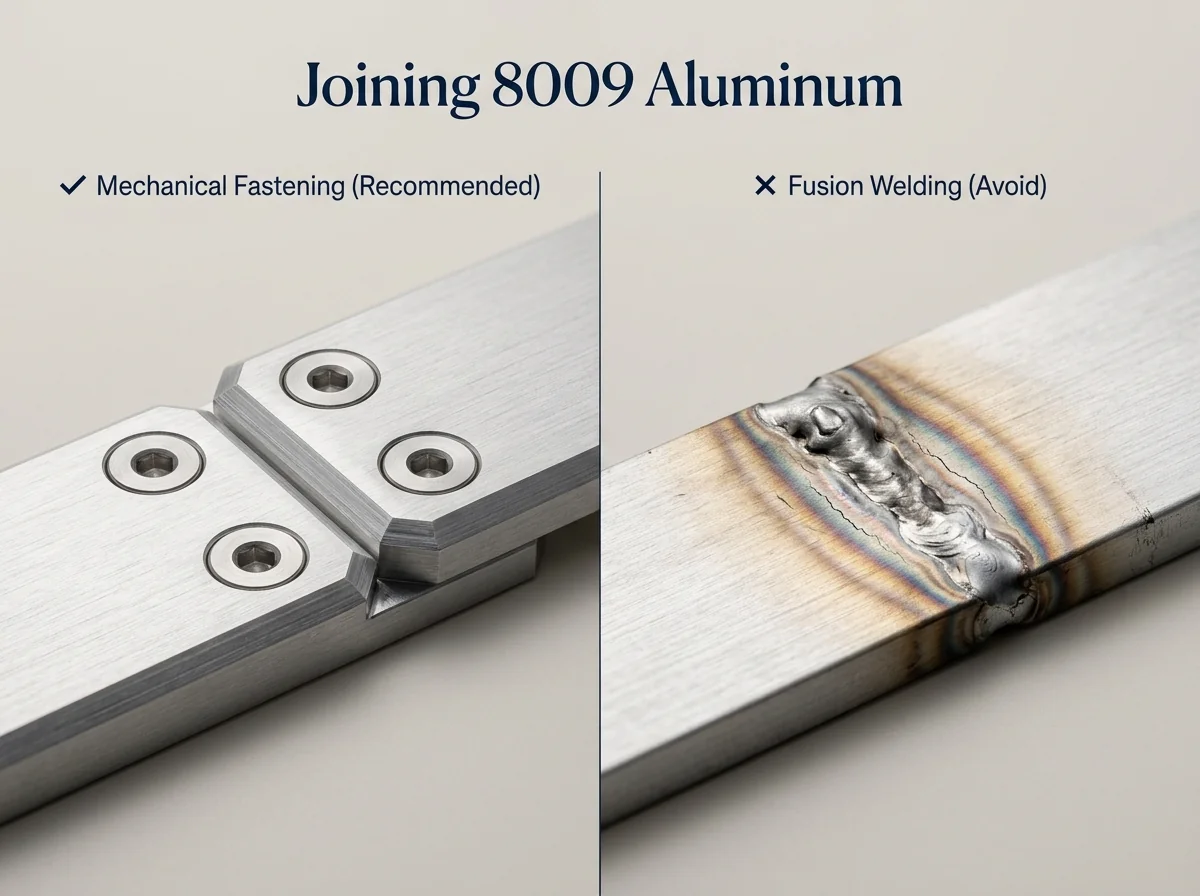
Giunzione: welding costs you the property you bought the alloy for. A fusion weld destroys the particle structure in the weld zone, and the joint loses the high-temperature strength that justified the material in the first place. For a load-bearing joint, plan on mechanical fastening, or on a joining method that does not melt the metal and has been qualified for this alloy; treat a fusion-welded joint as non-structural unless it has been tested and accepted on its own.
Protezione dalla corrosione: it holds up well in normal workshop and atmospheric service but it is not a marine alloy. Anodizing works, and so do chemical conversion coatings — a chemical surface treatment that leaves a protective layer on the metal. For a part that will see salt air or chemical exposure, specify the finish on the drawing rather than deciding it after the part is made.
Formazione: shape it in O, and accept that you cannot heat-treat the strength back afterwards. This is the biggest practical difference from the 2xxx and 7xxx grades, where forming in a soft state and then aging to full strength is routine. In 8009 the H112 values are set when the material is worked hot, not by a treatment you can repeat in your own shop — so a part that needs heavy forming either starts in O and stays softer, or is formed near-final and machined from H112.
Vantaggi e Limitazioni in Sintesi
| Dimensione | Vantaggio | Cosa costa |
|---|---|---|
| Strength above 200 °C | Holds 350 MPa at 200 °C and 270 MPa at 300 °C after 1,000 hours | Nothing comparable in the 6xxx or 7xxx families at that temperature |
| Room-temperature strength | 450 MPa tensile, comparable to 2618 | Below 7075 and 2024; not a reason to choose it |
| Peso | 2.92 g/cm³ — under half of steel, so it replaces hot steel parts directly | About 8% heavier than 6061 for the same volume |
| Fatigue at temperature | 160 MPa at 250 °C — published typical value — supports cyclic hot service | Cost per kilogram is several times 6061 |
| Lavorazione meccanica | Cuts predictably, close to 7075 | ~140 HB wears tooling faster than 6061 |
| Giunzione | Mechanical fastening and methods that do not melt the metal both work | Fusion welding removes the strength advantage locally |
| Supply | Available as billet, plate and bar from powder-route producers | Narrow producer base; lead time follows billet availability; sheet only under AMS 4308 |
| Formazione | O temper forms well | Formed parts cannot be re-hardened to H112 |
Conclusione
8009 solves a real problem — carrying load at 200 to 300 °C without moving to titanium or steel — but nothing about it is standard. One producer tier, a specification that covers sheet only, and just two usable states mean the buying problem replaces the engineering problem as soon as the alloy is chosen.
We buy 8009 billet, plate and bar from powder-route producers, then cut and machine to your drawing. Every order ships with an MTC, and SGS reports are available if your project needs them.
Send us the drawing with the form, state and quantity for a supply check and a cutting quote.
Domande frequenti
Can 8009 aluminum be used at 400 °C?
No — there is no published basis for 400 °C. Published 1,000-hour test values, rather than specification minimums, support 200–300 °C; above 350 °C the particle structure needs assessment against your duty cycle.
Does 8009 have a T6 temper?
No. 8009 is strengthened by particles already in the metal, so there is no solution-treat-and-age step to make T6 or T8. It ships in O or H112 only, and an offer naming T6 describes another alloy.
Can you supply 8009 in bar or tube when AMS 4308 covers sheet only?
Yes, as a drawing-controlled item. Outside the AMS thickness range there is no specification to point at, so chemistry and mechanical values travel on the purchase order, and the MTC reports what was tested.
What is the minimum order and lead time for 8009?
Low MOQ, typically 10–60 days. The date depends on billet availability and the cutting or machining you need, so it is confirmed with the quote rather than quoted in advance. Send the drawing, form, state and quantity.