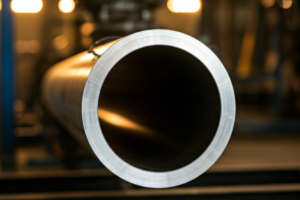
7075 Alüminyum Nedir?
7075, çinko, magnezyum ve bakır üzerine kurulu bir 7xxx serisi alaşımdır; burada MgZn₂ çökeltisi ana mukavemetlendirme fazıdır; çökelme sertleşmesi yoluyla, diğer hiçbir yaygın dövme alüminyumun eşleşemediği bir mukavemet seviyesine ulaşır ve bu da onu yüksek yük, ağırlık açısından kritik yapılar için kendi sınıfına yerleştirir. Bu en yüksek mukavemet, alaşımın kazanmak için tasarlandığı ödündür — ancak mukavemeti sağlayan aynı çinko açısından zengin, bakır içeren kimya, 7075'i aynı zamanda daha az korozyona dayanıklı ve füzyon yöntemleriyle pratikte kaynaklanamaz hale getirir.
Bu mukavemetin bedeli hizmette ortaya çıkar: nemli, denizcilik veya klorür ortamlarında, en yüksek sertliğe yaşlandırılmış 7075, sürekli çekme yükü altında çatlayabilir — hiçbir kaplamanın tamamen ortadan kaldıramadığı, gerilme korozyon çatlaması (SCC) adı verilen bir hasar modu. 7075 bu riske kasıtlı olarak aşırı yaşlandırılmış bir temper olan T73 ile yanıt verir; bu, korozyon ve uzun hizmet ömrünün yapıyı belirlediği yerlerde alaşımı güvenilir kılmak için en yüksek mukavemetten bir dilim feragat eder — ve T73 mü yoksa gerilme giderme uygulanmış kuzeni T7351 mi tercih edeceğiniz, bir sonraki bölümün açıkladığı karardır.
T73 Temperini Anlamak
“T73”, malzemenin çözeltiye alınarak ısıl işlem gördüğü, su verildiği, ardından aşırı yaşlandırıldığı iki aşamalı yapay yaşlandırma sürecinden geçtiği anlamına gelir. Alaşım, Zn/Mg/Cu'yu katı çözelti içinde çözmek için ısıtılır, aşırı doymuş halde hapsetmek için su verilir, ardından iki adımda yaşlandırılır — çökeltileri kabalaştıran daha yüksek sıcaklıkta bir aşama, ardından daha düşük sıcaklıkta bir stabilizasyon. Aşırı yaşlandırma, malzemeyi kasıtlı olarak en yüksek mukavemetin ötesine taşır, böylece tane sınırı çökeltileri kaba ve elektrokimyasal olarak etkisiz hale gelir; bu da taneler arası SCC için itici gücü azaltır. T73'ü tanımlayan adım, o ikinci aşırı yaşlandırma aşamasıdır — T73'ü en yüksek sertliğe yaşlandırılmış T6'dan ayıran şey budur.
Kullanıcının feragat ettiği şey T6 mukavemetinin ~–15’idir (UTS 505’e karşı 572 MPa; akma 435'e karşı 503 MPa), ancak geri aldığı şey belirleyicidir: SCC direnci orta düzeyden (T6) Mükemmel'e sıçrar, tuz spreyi ömrü T6'nın 500–1000 saatine karşı yaklaşık 1500–2000 saat çalışır, kırılma tokluğu T6 için ~20–24'e karşı yaklaşık 28–33 MPa·√m'ye yükselir ve uzama iyileşir, böylece malzeme daha az gevrekleşir ve hasara daha toleranslı olur. Korozyona maruz kalan veya döngüsel yük taşıyan her parça için bu değişim neredeyse her zaman değerlidir.
T73'ün kendisi içermediği gerilme giderme uygulanmıştır, bu nedenle ağır işlenmiş bir T73 plakası malzeme çıkarıldıkça hâlâ hareket edebilir. Bu boşluk “51” varyantının var olma nedenidir: T7351, su verme sonrası %1,5–3 oranında bir gerdirme ekler; T73'ün aşırı yaşlandırılmış korozyon direncini T651'nin işleme stabilitesiyle birleştirir. T7351, kalın, işlenmiş plakalar için havacılık standardıdır — hem korozyon direncine hem de CNC işçiliği sonrası boyutsal stabiliteye ihtiyaç duyduğunuzda başvurulacak seçenektir.
| Element | Tipik aralık (7075) |
|---|---|
| Çinko (Zn) | 5.1–6.1% |
| Magnezyum (Mg) | 2.1–2.9% |
| Bakır (Cu) | 1.2–2.0% |
| Krom (Cr) | 0.18–0.28% |
| Silisyum (Si) | Maks. %0,40 |
| Demir (Fe) | Maks. %0,50 |
| Manganez (Mn) | Maks. %0,30 |
| Titanyum (Ti) | Maks. %0,20 |
| Alüminyum (Al) | Denge |
Kimyasal bileşim diğer tüm 7075 temperleriyle aynıdır — fark tamamen ısıl işlemdedir, karışımda değil. Çinko birincil mukavemetlendirmeyi sağlar, bakır sertlik katar ve krom SCC direncini iyileştirir; T73 basitçe çökelti yapısını manipüle eder, böylece bakır kaynaklı korozyon hassasiyeti artık parçanın ömrünü kontrol etmez.
T73'ün T6'dan Farkı
T6, maksimum mukavemete ulaşmak için tek bir yapay yaşlandırma adımında (~120 °C) en yüksek sertliğe yaşlandırılır ve yalnızca orta düzeyde SCC direncine sahiptir. T73, alaşımı SCC dirençli ve daha tok yapmak için ~–15 daha düşük UTS ve akmayı kabul ederek ek aşırı yaşlandırma aşamasını çalıştırır. Bileşim aynıdır; yalnızca ısıl işlem farklıdır. Korozyon söz konusu olduğunda ve parça uzun bir hizmet ömrü boyunca dayanması gerektiğinde T73 kazanır; mukavemet her şey olduğunda ve ortam kuru ve kontrollü olduğunda T6 avantajı elinde tutar. Ailenin en yüksek mukavemetli, gerilme giderme uygulanmış tarafı için bkz. 7075-T651 tam kılavuzu.
7075-T73 Mekanik Özellikler
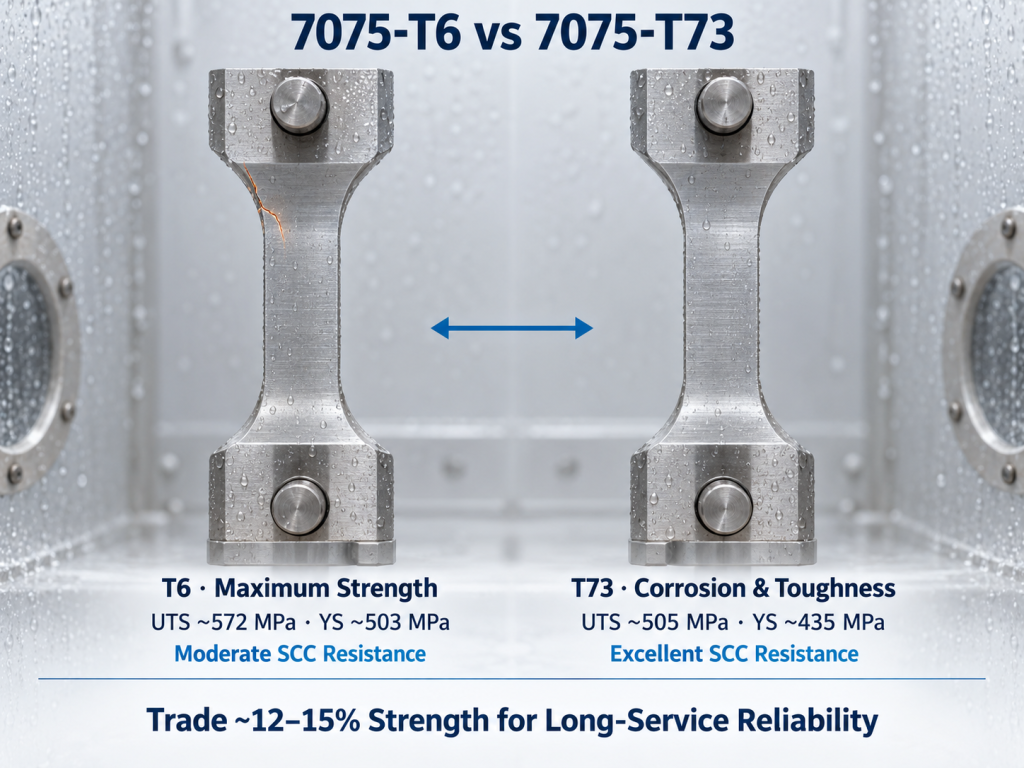
7075-T73, korozyon ve tokluk karşılığında en yüksek mukavemetten bir dilim feragat eder — aşağıdaki değerler plaka, sac ve çubuk için tipiktir.
| Mülkiyet | 7075-T73 | 7075-T6 (referans) |
|---|---|---|
| Yoğunluk | 2,81 g/cm³ | 2,81 g/cm³ |
| Çekme mukavemeti | ~505 MPa (73 ksi) | ~572 MPa (83 ksi) |
| Akma mukavemeti (%0,2 ofset) | ~435 MPa (63 ksi) | ~503 MPa (73 ksi) |
| Kopma uzaması | 13% | 11% |
| Yorulma mukavemeti | ~130–150 MPa | ~160 MPa |
| Brinell sertliği | ~135 HB | ~150 HB |
| Elastik (Young) modülü | ~71,7 GPa | ~71,7 GPa |
| Kesme mukavemeti | ~290 MPa | ~331 MPa |
| Kırılma tokluğu (KIC) | ~28–33 MPa·√m | ~20–24 MPa·√m |
| Termal iletkenlik | ~130 W/m-K | ~130 W/m-K |
| Elektriksel iletkenlik | ~–40 IACS | ~ IACS |
| Termal genleşme katsayısı | 23 µm/m·K | 23 µm/m·K |
~435 MPa akma en çok önem taşıyan değerdir: T6’nın 503'ünün yaklaşık altında, ancak yine de 6061-T6'nın akmasının yaklaşık 2,4 katı ve herhangi bir 6xxx sınıfının oldukça üzerinde. Bu düşüşle satın aldığınız şey kırılma tokluğu (~28–33'e karşı ~20–24 MPa·√m) ve orta yerine Mükemmel olan SCC direncidir, böylece bir T73 parçası çatlaklara ve korozyona T6'dan çok daha iyi tolerans gösterir. Yoğunluk, elastisite modülü ve termal genleşme alaşım düzeyinde özelliklerdir ve her 7075 temperinde aynıdır — ısıl işlemle yalnızca mukavemet ve korozyon davranışı değişir. Alaşımlar arası genel görünüm için bkz. 6061 vs 7075 karşılaştırma rehberimize.
7075-T73 Nerede Kullanılır
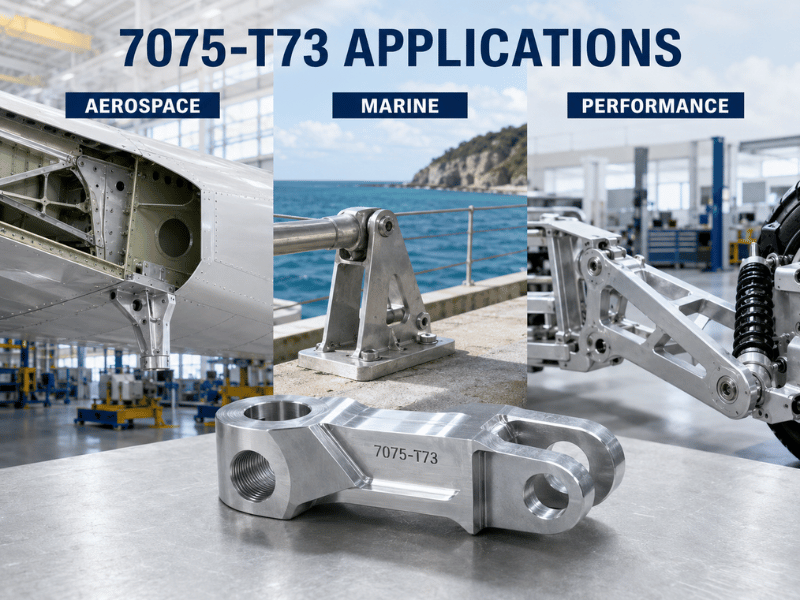
7075-T73, SCC, kırılma tokluğu veya uzun hizmet ömrünün yapıyı belirlediği yerlerde — ve kullanıcının oraya ulaşmak için T6'dan ~ daha az mukavemeti kabul edebildiği durumlarda — hak ettiği yeri kazanır. 7075 aralığının T6 ve T651'nin kuru, korunmuş, mukavemet açısından kritik rollere bıraktığı korozyona maruz kalan, hasara toleranslı ucuna sahiptir.
Korozyonlu veya Döngüsel Hizmetteki Havacılık Yapıları
Kanat kaplamaları ve plakaları, gövde çerçeveleri, bölmeler, iniş takımı bileşenleri ve helikopter rotor parçaları T73 kullanır çünkü aşırı yaşlandırılmış yapı onlarca yıllık uçuş boyunca SCC'ye ve çatlak büyümesine direnir. Bunlar, tek bir korozyon kaynaklı çatlağın kabul edilemez olduğu, yüksek değerli, denetlenmesi zor yapılardır; bu nedenle T73'ün tokluğu ve SCC marjı, kaybedilen en yüksek mukavemetten daha değerlidir. Bu rollerde işlenmiş kalın plaka için genellikle T7351 spesifikasyonu kullanılır.
Denizcilik, Açık Deniz ve Nemli Ortam Donanımları
Gemi ve tekne yapıları, açık deniz platformu braketleri, deniz havacılığı bileşenleri ve kıyı altyapısı T73 kullanır çünkü Mükemmel SCC ve eksfoliasyon direnci, T6'yı çatlatacak klorür maruziyetine dayanır. T73 (veya işlenmiş parçalar için T7351) T6 yerine tam da ortam ıslak olduğu için seçilir — T6'nın feragat ettiği mukavemet, sağlam kalmanın bedelidir. Havacılık ve denizciliğin ötesinde T73, hem mukavemet hem de korozyon direncinin gerekli olduğu yüksek performanslı spor malzemeleri ve otomotiv parçalarında görülür.
T73 vs Diğer 7075 Temperleri — Nasıl Seçilir
7075-T73 aşırı yaşlandırılmış, korozyon öncelikli seçenektir; diğer temperler mukavemeti farklı öncelikler (işleme stabilitesi, en yüksek mukavemet veya şekillendirilebilirlik) karşılığında değişir.
| Temper | İşlem | Çekme Dayanımı (MPa) | Akma Mukavemeti (MPa) | SCC direnci | İçin en iyisi | Kaçının |
|---|---|---|---|---|---|---|
| T73 | Çözelti + aşırı yaşlandırma (gerdirme yok) | ~505 | ~435 | Mükemmel | Korozyonlu, denizcilik, uzun hizmet ömürlü yapılar | Dar toleranslı işlenmiş kalın plaka (gerilme giderme yok) |
| T7351 | Çözelti + çekme + aşırı yaşlandırma | ~505 | ~435 | Mükemmel | Korozyonlu + hassas işlenmiş plaka | En yüksek mukavemet gereklidir |
| T651 | Çözelti + gerdirme + en yüksek sertliğe yaşlandırma | ~572 | ~503 | Orta düzeyde | Kuru, korunmuş, hassas işlenmiş plaka | Nemli, deniz veya klorür maruziyeti |
| T6 | Çözelti + en yüksek sertliğe yaşlandırma | ~572 | ~503 | Orta düzeyde | Maksimum mukavemet, kuru/kontrollü ortam | Korozyon veya döngüsel yük hizmeti |
| O | Tavlanmış | ~250 | ~110 | İyi | Şekillendirme, kesme, zorlu bükümler | Her türlü yük taşıma kullanımı |
T73 Ne Zaman Doğru Tercihtir
Parça sürekli neme, tuz spreyine veya klorüre maruz kaldığında ve kaplama ile tam olarak korunamadığında T73 seçin — SCC direnci için ~–15 akma mukavemetinden feragat edersiniz, karşılığında kat kat daha iyi SCC direnci ve T6'nın yaklaşık 2–3 katı tuz spreyi ömrü elde edersiniz. Parça döngüsel yük taşıdığında veya uzun bir hizmet ömrü boyunca çatlak büyümesine tolerans göstermesi gerektiğinde (uçak gövdesi, iniş takımı) T73 seçin — daha yüksek kırılma tokluğu ve hasar toleransı en yüksek mukavemetten daha önemlidir.
Başka Bir Temper Ne Zaman Daha Uygundur?
Parça kalın plakadan işlendiğinde T7351'e geçin ve korozyon görür — T73’ün SCC direncini artı CNC sırasında çarpılmasını önleyen gerdirme adımını korursunuz. Ortam kuru ve korunmuş olduğunda ve karara mukavemet veya işleme stabilitesi öncülük ettiğinde T6 veya T651'yi koruyun — T73 yalnızca feragat etmenize gerek olmayan mukavemete mal olur. Kaynakla birleştirilmesi veya dar yarıçaplarla şekillendirilmesi gereken her parça için 7075'i tamamen bırakın: 6061-T6 çok daha iyi kaynaklanır ve şekillendirilir (bkz. 6061-T6 tam kılavuzu), ve O temperi şiddetli şekillendirmeye uygun tek 7075 durumudur.
7075-T73 ile Çalışmak — Bilmeniz Gerekenler
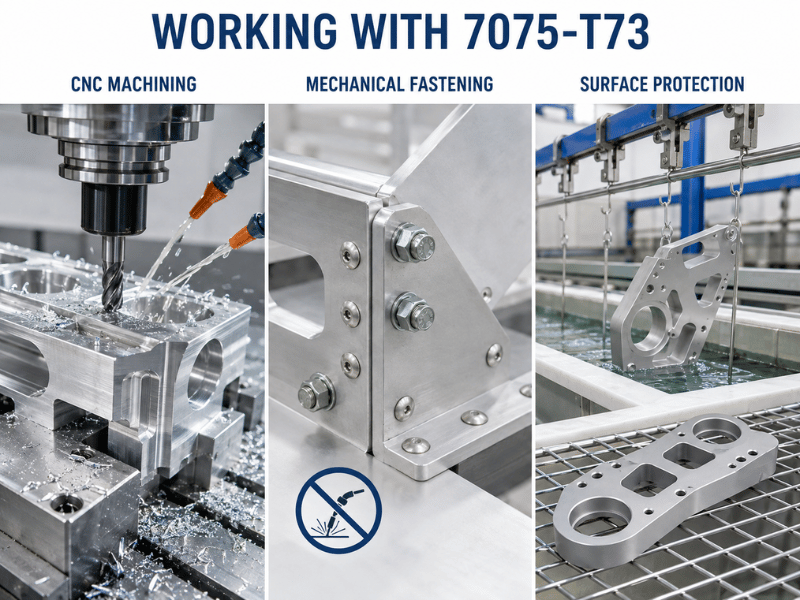
- İşleme. T73 iyi işlenir — biraz daha yumuşak yüzeyi T6'ya kıyasla biraz daha az takım aşınması anlamına gelir ve aşırı yaşlandırma kalıntı gerilmeyi düşürür, böylece kesim boyunca toleransı korur. Keskin karbür takımlar ve iyi soğutma sıvısı akışı kullanın; kalıp, fikstür ve uçak gövdesi işleri için temiz yüzeyler bekleyin, gerilme giderme uygulanmamış T6'dan daha iyi boyutsal stabilite ile.
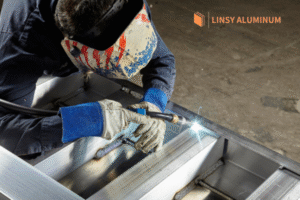
- Kaynak. 7075 kaynakla birleştirme için önerilmez — ark işlemleri sıcak çatlamaya neden olur, kaynak bölgesini –50 yumuşatır ve hizmette SCC'yi davet eden kalıntı gerilme bırakır. Yapısal bağlantılar için perçinleme, cıvatalama veya yapıştırıcı ile bağlama için tasarlayın; sürtünme karıştırma kaynağı (FSW) kritik olmayan dikişler için temel mukavemetin çoğunu koruyabilir, ancak kaynakla birleştirilmiş bir 7075 yük yolu hizmete dönmemelidir.
- Korozyon koruması. T73 zaten Mükemmel SCC ve eksfoliasyon direncine sahiptir, bu nedenle T6'dan daha az tamamlayıcı korumaya ihtiyaç duyar — ancak ağır denizcilik hizmetinde yine de anodizasyon (Tip II veya III), kromat dönüşüm kaplaması (Alodine), kaplama veya boya belirtin. T73, kaplamanın tek başına korozyon riskini taşımasına güvenilemediğinde seçilecek temperdir.
- Şekillendirilebilirlik. T73 zayıf şekillendirilebilirliğe sahiptir ve dar yarıçaplı bükümlerde çatlar; O temperinde şekillendirin, ardından şekillendirme sonrası bitmiş şekli T73'e ısıl işlem uygulayın — T73'ü doğrudan şekillendirmeyi beklemeyin. Aşırı yaşlandırılmış durum soğuk işlemle değil, ıs.
Artılar ve Sınırlamalar Bir Bakışta
| Boyut | Avantaj | Sınırlama |
|---|---|---|
| Dayanım-ağırlık oranı | High (~435 MPa yield, ~2.4× 6061-T6) | T6/T651 zirvesinin ~ altında |
| SCC direnci | Mükemmel (tuzlu su spreyi 1500–2000 saat) | Aşırı deniz ortamında hâlâ kaplama gerektirir |
| Kırılma tokluğu | ~28–33 MPa·√m, çatlaklara toleranslı | — |
| Talaşlı İmalat | İyi; T6'dan daha düşük kalıntı gerilme | T7351 belirtilmediği sürece gerilme giderme uygulanmaz |
| Korozyon | Mükemmel eksfoliasyon + SCC direnci | Bunu elde etmek için zirve mukavemetinden feragat eder |
| Kaynaklanabilirlik | Kritik olmayan bağlantılar için FSW uygulanabilir | Füzyon kaynağı önerilmez |
| Stok Durumu | Plaka, sac, çubuk, boru olarak stoklanır | İnce cidar ve özel ekstrüzyonlar daha az yaygındır |
Sonuç
Ödünleşim açıktır: 7075-T73, Mükemmel gerilme-korozyon çatlaması direnci, daha yüksek kırılma tokluğu ve daha iyi hasar toleransı sunmak için T6’nın zirve mukavemetinin ~–15'inden feragat eder — korozyon, döngüsel yük veya uzun hizmet ömrü yapıyı belirlediğinde doğru tercih, T6 veya T651'in kazandığı kuru, mukavemet-kritik rollerde ise yanlış tercihtir. Klorür veya nem söz konusu olduğunda T73 veya T7351 seçin; ortam kontrol altındaysa ve zirve mukavemet veya işleme stabilitesi karara öncülük ediyorsa T6 veya T651 seçin.
At Linsy Alüminyum, 7075-T73'ü plaka, sac, çubuk ve boru olarak stokluyoruz; T7351 ve diğer 7075 temperleri (T6, T651) çeşitli formlarda mevcuttur. Her sipariş bir Fabrika Test Sertifikası ile birlikte gönderilir ve talep üzerine SGS kompozisyon, mekanik ve ultrasonik (kalın plaka) raporları temin edilebilir. Ekibimiz çiziminizi inceler, aşırı spesifikasyon vermeden önce SCC riskini işaretler ve parçanın işlenip işlenmediğine bağlı olarak T73 ile T7351 arasında öneride bulunur. Çizimi ve gereksinimleri gönderin, size bir sınıf uygunluk incelemesi ve teklif döndüreceğiz.
Sıkça Sorulan Sorular
7075-T73, T6'dan daha mı zayıf?
Evet, yaklaşık –15 kadar — UTS ~572'den ~505 MPa'ya ve akma dayanımı ~503'ten ~435 MPa'ya düşer. Kazandığınız şey SCC direnci (Mükemmel'e karşı orta), kırılma tokluğu (~28–33'e karşı ~20–24 MPa·√m) ve daha iyi hasar toleransıdır; bu nedenle herhangi bir korozif veya uzun ömürlü parça için daha düşük mukavemet doğru ödünleşimdir.
7075-T73 ile T7351: hangisini seçmeliyim?
Her ikisi de aynı aşırı yaşlandırılmış korozyon direncini taşır; T7351, %1,5–3 oranında bir gerilme giderme gerdirmesi ekler. Parça kalın plakadan CNC ile işlendiğinde T7351'i seçin, çünkü gerdirme malzeme çıkarılırken parçanın çarpılmasını önler. Şekillendirme veya bitirme hafif olduğunda ve işleme stabilitesi belirleyici faktör olmadığında düz T73'ü seçin.
7075-T73 kaynak yapılabilir mi?
Füzyon kaynağı ile değil. Ark işlemleri sıcak çatlamaya neden olur, kaynak bölgesini –50 yumuşatır ve serviste SCC riski bırakır, bu nedenle yapısal 7075 bağlantıları perçinlenir, cıvatalanır veya yapıştırılır. Sürtünme karıştırma kaynağı kritik olmayan dikişler için çalışabilir ve temel mukavemetin çoğunu korur, ancak füzyon kaynaklı bir 7075 yük yolu servise dönmemelidir.
7075-T73 deniz veya dış mekân kullanımı için uygun mu?
Evet — klorürde Mükemmel SCC ve eksfoliasyon direnci nedeniyle deniz, açık deniz ve kıyı hizmeti için tercih edilen 7075 temperidir. Şiddetli maruziyette hâlâ anodizasyon, Alodine veya boyadan fayda görür, ancak T6'nın aksine, yalnızca kaplamaya riski taşıması için güvenilmeyeceği için özellikle spesifiye edilir.
Linsy 7075-T73 stokluyor mu ve teslim süresi nedir?
Evet. Stok plaka, sac, çubuk ve boru envanterden sevk edilir; stokta olmayan boyutlar ve temperler (T7351 dahil) özel üretimle çalışır ve alaşım, boyutlar ve işlemeye bağlı olarak tipik teslim süresi 10–60 gündür. Linsy düşük-MOQ özel üretimi destekler, bu nedenle karışık spesifikasyonlu veya bulunması zor 7075 siparişleri nadiren bir projeyi engeller.