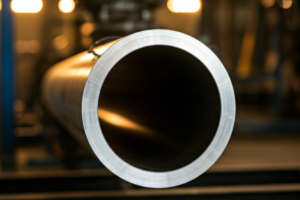
O Que É o Alumínio 7075?
O 7075 é uma liga da série 7xxx baseada em zinco, magnésio e cobre, na qual o precipitado MgZn₂ é a principal fase de endurecimento; ela ganha resistência por meio de endurecimento por precipitação até um nível que nenhum outro alumínio forjado comum iguala, o que a coloca em uma classe própria para estruturas de alta carga e peso crítico. Essa resistência máxima é o trade-off que a liga foi projetada para vencer — mas a mesma química rica em zinco e contendo cobre que impulsiona a resistência também torna o 7075 menos resistente à corrosão e efetivamente não soldável por métodos de fusão.
O custo dessa resistência se manifesta em serviço: em ambientes úmidos, marinhos ou com cloretos, o 7075 no estado de envelhecimento máximo pode trincar sob carga de tração sustentada — um modo de falha chamado corrosão sob tensão (SCC) que nenhum revestimento elimina completamente. O 7075 responde a esse risco com um revenido deliberadamente sobre-envelhecido, T73, que abre mão de uma parcela da resistência máxima para tornar a liga confiável onde a corrosão e a longa vida em serviço decidem o projeto — e se o T73 ou seu primo aliviado de tensões T7351 é a sua escolha é a decisão que a próxima seção explica.
Entendendo o Temperamento T73
“T73” significa que o material é submetido a tratamento térmico de solubilização, têmpera, e então sobre-envelhecido por meio de um processo de envelhecimento artificial em dois estágios. A liga é aquecida para dissolver o Zn/Mg/Cu em solução sólida, temperada para retê-los supersaturados, e então envelhecida em duas etapas — um estágio de temperatura mais alta que engrosse os precipitados, seguido por uma estabilização em temperatura mais baixa. O sobre-envelhecimento deliberadamente leva o material além da resistência máxima para que os precipitados de contorno de grão cresçam grosseiros e eletroquimicamente inativos, o que reduz a força motriz para SCC intergranular. A etapa que define o T73 é esse segundo estágio de sobre-envelhecimento — é o que separa o T73 do T6 no estado de envelhecimento máximo.
O que o usuário abre mão é ~12–15% da resistência do T6 (UTS 505 vs 572 MPa; limite de escoamento 435 vs 503 MPa), mas o que recebe em troca é decisivo: a resistência à SCC salta de moderada (T6) para Excelente, a vida em névoa salina dura aproximadamente 1500–2000 h versus 500–1000 h do T6, a tenacidade à fratura sobe para cerca de 28–33 MPa·√m versus ~20–24 para o T6, e o alongamento melhora de modo que o material é menos frágil e mais tolerante a danos. Para qualquer peça que viva em corrosão ou suporte carga cíclica, esse trade-off quase sempre vale a pena.
O T73 em si é não aliviado de tensões, então uma chapa de T73 fortemente usinada ainda pode se movimentar conforme o material é removido. Essa lacuna é a razão pela qual a variante “51” existe: o T7351 adiciona um estiramento de 1,5–3% após a têmpera, combinando a resistência à corrosão do sobre-envelhecimento do T73 com a estabilidade de usinagem do T651. O T7351 é o padrão aeroespacial para chapas grossas usinadas — é a escolha quando você precisa tanto de resistência à corrosão quanto de estabilidade dimensional após o trabalho de CNC.
| Elemento | Faixa típica (7075) |
|---|---|
| Zinco (Zn) | 5.1–6.1% |
| Magnésio (Mg) | 2.1–2.9% |
| Cobre (Cu) | 1.2–2.0% |
| Cromo (Cr) | 0.18–0.28% |
| Silício (Si) | 0,40% máx |
| Ferro (Fe) | 0,50% máx |
| Manganês (Mn) | 0,30% máx |
| Titânio (Ti) | 0,20% máx |
| Alumínio (Al) | Equilíbrio |
A química é idêntica a todos os outros temperamentos do 7075 — a diferença está inteiramente no tratamento térmico, não na composição. O zinco fornece o endurecimento primário, o cobre adiciona dureza, e o cromo melhora a resistência à SCC; o T73 simplesmente manipula a estrutura de precipitados para que a suscetibilidade à corrosão impulsionada pelo cobre não controle mais a vida da peça.
Como o T73 Difere do T6
O T6 é envelhecido ao máximo em uma única etapa de envelhecimento artificial (~120 °C) para atingir resistência máxima, com apenas resistência moderada à SCC. O T73 executa a etapa extra de sobre-envelhecimento, aceitando ~12–15% menos UTS e limite de escoamento para tornar a liga resistente à SCC e mais tenaz. A composição é a mesma; apenas o tratamento térmico difere. Quando a corrosão está em cena e a peça deve sobreviver a uma longa vida em serviço, o T73 vence; quando a resistência é tudo e o ambiente é seco e controlado, o T6 mantém a vantagem. Para o lado da família com resistência máxima e alívio de tensões, veja nosso guia completo do 7075-T651.
Propriedades Mecânicas do 7075-T73
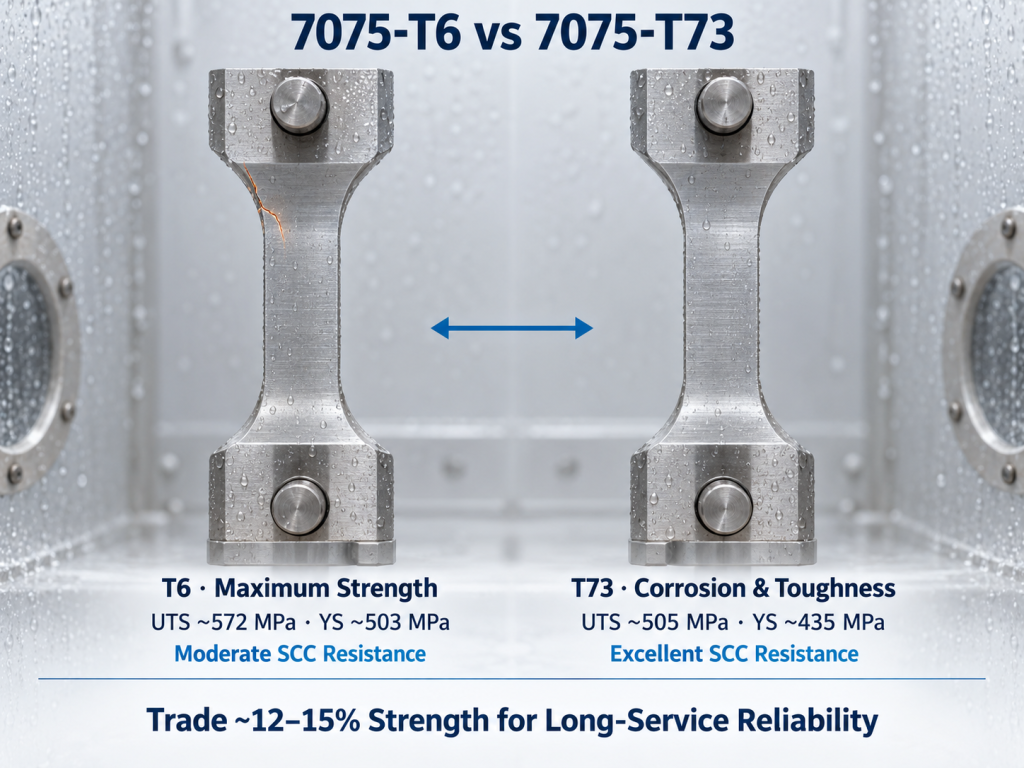
O 7075-T73 troca uma parcela da resistência máxima por corrosão e tenacidade — os números abaixo são típicos para chapa grossa, chapa fina e barra.
| Propriedade | 7075-T73 | 7075-T6 (referência) |
|---|---|---|
| Densidade | 2,81 g/cm³ | 2,81 g/cm³ |
| Resistência à tração última | ~505 MPa (73 ksi) | ~572 MPa (83 ksi) |
| Resistência ao escoamento (deslocamento de 0,2%) | ~435 MPa (63 ksi) | ~503 MPa (73 ksi) |
| Alongamento na ruptura | 13% | 11% |
| Resistência à fadiga | ~130–150 MPa | ~160 MPa |
| Dureza Brinell | ~135 HB | ~150 HB |
| Módulo elástico (módulo de Young) | ~71,7 GPa | ~71,7 GPa |
| Resistência ao cisalhamento | ~290 MPa | ~331 MPa |
| Tenacidade à fratura (KIC) | ~28–33 MPa·√m | ~20–24 MPa·√m |
| Condutividade térmica | ~130 W/m-K | ~130 W/m-K |
| Condutividade elétrica | ~33–40% IACS | ~33% IACS |
| Coeficiente de expansão térmica | 23 µm/m·K | 23 µm/m·K |
O limite de escoamento de ~435 MPa é o número que mais importa: cerca de 15% abaixo dos 503 do T6, mas ainda aproximadamente 2,4× o limite de escoamento do 6061-T6 e bem acima de qualquer grau 6xxx. O que você compra com essa redução é tenacidade à fratura (~28–33 versus ~20–24 MPa·√m) e resistência à SCC que é Excelente em vez de moderada, de modo que uma peça em T73 tolera trincas e corrosão muito melhor que o T6. Densidade, módulo e expansão térmica são propriedades do nível da liga e idênticas em todos os temperamentos do 7075 — apenas a resistência e o comportamento frente à corrosão mudam com o tratamento térmico. Para o panorama entre ligas, veja nosso guia de comparação 6061 vs 7075.
Onde o 7075-T73 É Usado
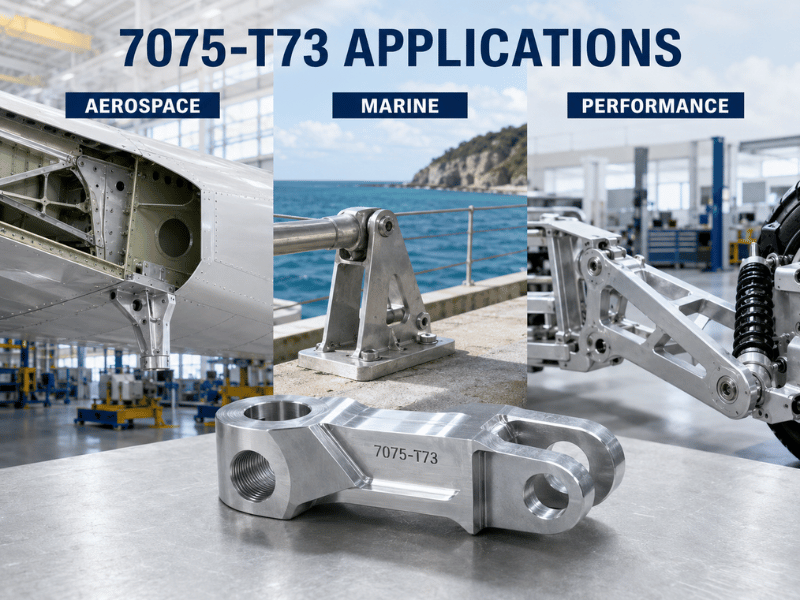
O 7075-T73 conquista seu lugar onde quer que a SCC, a tenacidade à fratura ou a longa vida em serviço decidam o projeto — e onde o usuário pode aceitar ~15% menos resistência que o T6 para chegar lá. Ele domina a extremidade do intervalo do 7075 exposta à corrosão e tolerante a danos, que o T6 e o T651 deixam para funções secas, protegidas e críticas em resistência.
Estruturas Aeroespaciais em Serviço Corrosivo ou Cíclico
Revestimentos e painéis de asa, quadros de fuselagem, anteparas, componentes de trem de pouso e peças de rotor de helicóptero usam T73 porque a estrutura sobre-envelhecida resiste à SCC e ao crescimento de trincas ao longo de décadas de voo. Essas são estruturas de alto valor e difíceis de inspecionar, onde uma única trinca impulsionada por corrosão é inaceitável, então a tenacidade e a margem de SCC do T73 valem mais do que a resistência máxima perdida. Para chapas grossas usinadas nessas funções, o T7351 é a especificação usual.
Ferragens Marinhas, Offshore e para Ambientes Úmidos
Estruturas de navios e barcos, suportes de plataformas offshore, componentes de aeronaves marítimas e infraestrutura costeira usam T73 porque a Excelente resistência à SCC e à esfoliação sobrevive à exposição a cloretos que trincaria o T6. O T73 (ou T7351 para peças usinadas) é escolhido em vez do T6 precisamente porque o ambiente é úmido — a resistência que o T6 abre mão é o preço de permanecer intacto. Além do aeroespacial e marinho, o T73 aparece em artigos esportivos de alto desempenho e peças automotivas onde tanto resistência quanto resistência à corrosão são necessárias.
T73 vs Outros Temperamentos do 7075 — Como Escolher
O 7075-T73 é a opção sobre-envelhecida, com prioridade para corrosão; os outros temperamentos trocam resistência por prioridades diferentes (estabilidade de usinagem, resistência máxima ou conformabilidade).
| Temperamento | Tratamento | Resistência à tração (MPa) | YS (MPa) | Resistência à SCC | Melhor para | Evitar quando |
|---|---|---|---|---|---|---|
| T73 | Solubilização + sobre-envelhecimento (sem estiramento) | ~505 | ~435 | Excelente | Estruturas corrosivas, marinhas, de longa vida em serviço | Chapa grossa usinada com tolerância apertada (sem alívio de tensões) |
| T7351 | Solubilização + estiramento + sobre-envelhecimento | ~505 | ~435 | Excelente | Chapa usinada de precisão + resistente à corrosão | Resistência máxima é necessária |
| T651 | Solubilização + estiramento + envelhecimento máximo | ~572 | ~503 | Moderado | Chapa seca, protegida e usinada com precisão | Exposição úmida, marinha ou a cloretos |
| T6 | Solução + envelhecimento de pico | ~572 | ~503 | Moderado | Resistência máxima, ambiente seco/controlado | Serviço com corrosão ou carga cíclica |
| O | Recozido | ~250 | ~110 | Bom | Conformação, corte em branco, dobras severas | Qualquer uso com suporte de carga |
Quando o T73 é a escolha certa
Escolha o T73 quando a peça enfrenta umidade contínua, névoa salina ou cloretos e não pode ser totalmente protegida por revestimento — você troca ~12–15% de limite de escoamento por resistência à SCC que é ordens de magnitude melhor e uma vida em névoa salina cerca de 2–3× a do T6. Escolha o T73 quando a peça suporta carga cíclica ou deve tolerar propagação de trinca ao longo de uma longa vida em serviço (fuselagem, trem de pouso) — a maior tenacidade à fratura e tolerância a danos importam mais do que a resistência de pico.
Quando Outro Tempero se Ajusta Melhor
Avance para o T7351 quando a peça é usinada a partir de chapa grossa e apresenta corrosão — você mantém a resistência à SCC do T73 mais a etapa de estiramento que impede a deformação durante o CNC. Mantenha o T6 ou T651 quando o ambiente é seco e protegido e a resistência ou a estabilidade de usinagem lidera a decisão — o T73 só custaria resistência que você não precisa abrir mão. Para qualquer peça que precise ser soldada por fusão ou conformada com raios apertados, deixe o 7075 de lado por completo: o 6061-T6 solda e conforma muito melhor (veja nosso guia completo do 6061-T6), e o temperamento O é o único estado do 7075 adequado para conformação severa.
Trabalhando com 7075-T73 — O que você precisa saber
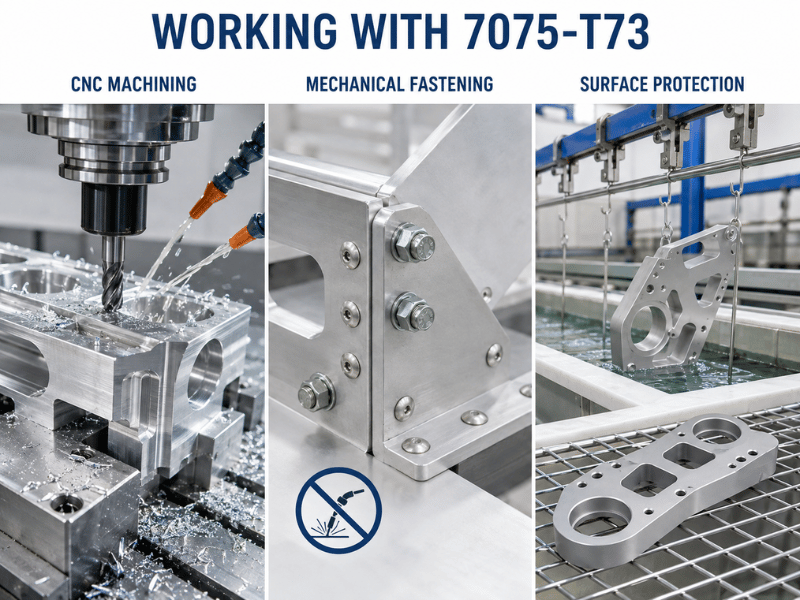
- Usinagem. O T73 usina bem — sua superfície ligeiramente mais macia significa um pouco menos de desgaste da ferramenta do que o T6, e o superenvelhecimento reduz a tensão residual, de modo que mantém a tolerância durante o corte. Use ferramentas de metal duro afiadas e bom fluxo de refrigerante; espere acabamentos limpos para trabalho de moldes, dispositivos e fuselagem, com melhor estabilidade dimensional do que o T6 sem alívio de tensões.
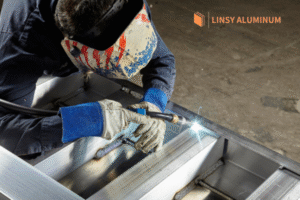
- Soldagem. O 7075 não é recomendado para soldagem por fusão — processos a arco causam trincas a quente, amolecem a zona de solda em 40–50% e deixam tensão residual que convida à SCC em serviço. Para juntas estruturais, projete para rebitagem, parafusamento ou colagem adesiva; a soldagem por fricção e mistura (FSW) pode reter a maior parte da resistência base para costuras não críticas, mas um caminho de carga em 7075 soldado por fusão não deve retornar ao serviço.
- Proteção contra corrosão. O T73 já possui excelente resistência à SCC e à esfoliação, então precisa de menos proteção suplementar do que o T6 — mas em serviço marinho severo ainda especifique anodização (Tipo II ou III), revestimento de conversão por cromato (Alodine), clad ou pintura. O T73 é o temperamento a escolher quando o revestimento sozinho não pode ser confiável para carregar o risco de corrosão.
- Conformabilidade. O T73 tem baixa conformabilidade e trinca sob dobras de raio apertado; conforme no temperamento O, depois trate termicamente a forma acabada para T73 após a conformação — não espere conformar o T73 diretamente. A condição superenvelhecida é fixada pelo tratamento térmico, não por trabalho a frio.
Vantagens e Limitações em Resumo
| Dimensão | Vantagem | Limitação |
|---|---|---|
| Relação resistência-peso | Alta (~435 MPa de escoamento, ~2,4× o 6061-T6) | ~15% abaixo do pico do T6/T651 |
| Resistência à SCC | Excelente (névoa salina 1500–2000 h) | Ainda precisa de revestimento em ambiente marinho extremo |
| Tenacidade à fratura | ~28–33 MPa·√m, tolerante a trincas | — |
| Usinagem | Boa; tensão residual menor que o T6 | Não aliviado de tensões, a menos que especificado T7351 |
| Corrosão | Excelente resistência à esfoliação + SCC | Abre mão da resistência de pico para obtê-la |
| Soldabilidade | FSW viável para juntas não críticas | Soldagem por fusão não recomendada |
| Disponibilidade | Estocado como chapa grossa, chapa fina, barra, tubo | Extrusões de parede fina e especiais menos comuns |
Conclusão
O trade-off é claro: o 7075-T73 abre mão de ~12–15% da resistência de pico do T6 para entregar excelente resistência à corrosão sob tensão, maior tenacidade à fratura e melhor tolerância a danos — a escolha certa sempre que corrosão, carga cíclica ou longa vida em serviço decidem o projeto, e a escolha errada em funções secas e críticas para resistência, onde o T6 ou T651 vencem. Escolha o T73 ou T7351 quando cloretos ou umidade estão no cenário; escolha o T6 ou T651 quando o ambiente é controlado e a resistência de pico ou a estabilidade de usinagem lidera a decisão.
Em Alumínio Linsy, mantemos 7075-T73 em chapa grossa, chapa fina, barra e tubo, com T7351 e outros temperamentos do 7075 (T6, T651) disponíveis em diversas formas. Todo pedido é enviado com Certificado de Teste de Usina, e relatórios de composição, mecânicos e ultrassônicos (chapa grossa) da SGS estão disponíveis sob solicitação. Nossa equipe analisa seu desenho, sinaliza risco de SCC antes que você superespecifique e recomenda T73 versus T7351 com base em se a peça é usinada. Envie o desenho e os requisitos, e retornaremos uma análise de adequação de grau e cotação.
Perguntas frequentes
O 7075-T73 é mais fraco que o T6?
Sim, em cerca de 12–15% — a UTS cai de ~572 para ~505 MPa e o escoamento de ~503 para ~435 MPa. O que você ganha é resistência à SCC (Excelente versus moderada), tenacidade à fratura (~28–33 versus ~20–24 MPa·√m) e melhor tolerância a danos, então para qualquer peça corrosiva ou de longa vida a resistência menor é a troca certa.
7075-T73 vs T7351: qual devo escolher?
Ambos possuem a mesma resistência à corrosão superenvelhecida; o T7351 adiciona um estiramento de alívio de tensões de 1,5–3%. Escolha o T7351 quando a peça é usinada por CNC a partir de chapa grossa, porque o estiramento impede que ela empena à medida que o material é removido. Escolha o T73 simples quando a conformação ou o acabamento é leve e a estabilidade de usinagem não é o fator decisivo.
O 7075-T73 pode ser soldado?
Não por soldagem por fusão. Processos a arco causam trincas a quente, amolecem a zona de solda em 40–50% e deixam risco de SCC em serviço, então juntas estruturais de 7075 são rebitadas, parafusadas ou coladas. A soldagem por fricção e mistura pode funcionar para costuras não críticas e retém a maior parte da resistência base, mas um caminho de carga em 7075 soldado por fusão não deve retornar ao serviço.
O 7075-T73 é bom para uso marinho ou ao ar livre?
Sim — é o temperamento preferido do 7075 para serviço marinho, offshore e costeiro por sua excelente resistência à SCC e à esfoliação em cloretos. Ele ainda se beneficia de anodização, Alodine ou pintura em exposição severa, mas diferentemente do T6 ele é especificado justamente porque o revestimento sozinho não pode ser confiável para carregar o risco.
A Linsy estoca 7075-T73, e qual é o prazo de entrega?
Sim. Chapa grossa, chapa fina, barra e tubo em estoque são enviados do inventário; tamanhos e temperamentos fora de estoque (incluindo T7351) são produzidos sob encomenda com prazo típico de 10–60 dias, dependendo da liga, dimensões e processamento. A Linsy oferece suporte à produção personalizada com MOQ baixo, então pedidos de 7075 com especificações mistas ou mais difíceis de encontrar raramente bloqueiam um projeto.