What Is 7021 Aluminum?
7021 is a heat-treatable Al-Zn-Mg alloy of the 7xxx family, registered as EN AW-7021 (AlZn5.5Mg1.5) and as UNS A97021. It is the 7xxx grade to reach for when the part has to hold tolerance through heavy machining, or has to be welded and still reach a 7xxx strength class — two things 7075 cannot do.
The trade it makes is copper. 7075 carries 1.2–2.0% copper, which buys its peak strength and costs it weldability and stress-corrosion performance. 7021 caps copper at 0.25%, gives up roughly 30% of that strength, and in exchange machines cleanly, stays flat through deep cuts and can be fusion welded — a combination the rest of the 7xxx family does not offer.
Chemical Composition of 7021
The limits below are the registered values under EN 573-3. A range outside them on a certificate came from a different standard, not from a different 7021.
| Element | Weight % | Role |
| Silicon (Si) | 0.25 max | Impurity limit |
| Iron (Fe) | 0.40 max | Impurity limit |
| Copper (Cu) | 0.25 max | Ceiling that keeps the alloy weldable |
| Manganese (Mn) | 0.10 max | Impurity limit |
| Magnesium (Mg) | 1.2 – 1.8 | Strengthening element |
| Chromium (Cr) | 0.05 max | Impurity limit |
| Zinc (Zn) | 5.0 – 6.0 | Primary strengthening element |
| Titanium (Ti) | 0.10 max | Grain refiner |
| Zirconium (Zr) | 0.08 – 0.18 | Raises recrystallization temperature; supports weldability |
| Others, each / total | 0.05 / 0.15 | — |
| Aluminium (Al) | Remainder | Base metal |
Only three rows are deliberate additions — zinc, magnesium and zirconium; every other element is a ceiling on what may be present. Copper is the row to check first, because this grade caps it at 0.25%. Aluminium is registered as the remainder, not as a fixed range.
Mechanical Properties by Temper
7021 is ordered mainly in T6 and T651. EN 485-2 covers sheet, strip and plate; EN 755-2 covers extruded bar, tube and profiles.
| Property | Value | Condition |
| Tensile strength, Rm | 400 MPa min (≈410 MPa typical) | T6, sheet and plate, EN 485-2 |
| Proof strength, Rp0.2 | 350 MPa min | T6, sheet and plate, EN 485-2 |
| Elongation, A / A50 | 10% min / 8% min | T6, sheet and plate, EN 485-2 |
| Hardness | ≈120 HBW | T6 |
| Physical property | Value |
| Density | 2.80 g/cm³ |
| Elastic modulus | 70 GPa |
| Thermal conductivity | 125 – 155 W/m·K |
| Thermal expansion | 23 µm/m·K |
A 350 MPa proof strength is roughly 27% above 6061-T6 and about 30% below 7075-T6 — a genuine 7xxx grade without being a peak-strength one. Thermal conductivity carries the other commercially decisive number: 125–155 W/m·K is what lets an aluminium mould cycle faster than a steel one.
Thin gauge runs above the plate minimum — anodising-quality sheet from 1.5 to 3 mm is routinely tested at 460–480 MPa for T6 and T651. Read the EN 485-2 minimums as design values and the thinner figures as mill performance; the certificate for your heat decides which applies.
Where 7021 Is Used
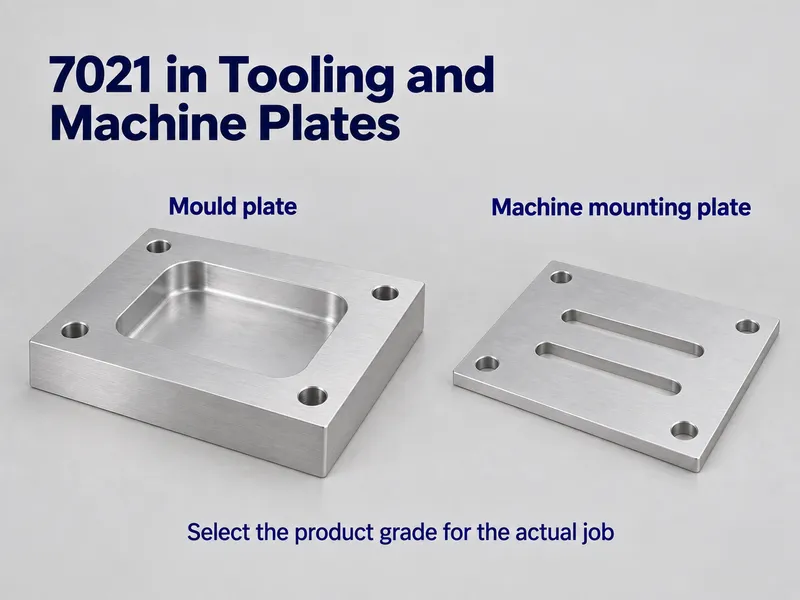
Three application groups account for most of the grade, and each follows from the same property — low residual stress in the plate, plus free machining.
Moulds and Tooling Plate
The core market. Injection and blow moulds, thermoforming and resin-transfer tooling all use 7021 cavity plates, as do base plates and machine fixture tables. Low internal stress is the reason: a deep cavity holds its shape instead of creeping as material comes off, and the argument against steel tooling is cycle time rather than strength.
Machined and Hydraulic Components
Manifold blocks, valve bodies, mounting plates and drive components use the same cutting behaviour — short chips, clean finish, tool life that holds on long runs. Where the cut is deep or asymmetric, specify T651.
Welded Assemblies
7021 is one of the few Al-Zn-Mg alloys that can be fusion welded, which follows from the copper ceiling and the zirconium addition. Where a part needs 7xxx strength and a welded joint, that is why the grade gets specified. In volume welded structure, 7005 or 7020 is usually the cheaper route.
7021 Temper Options
7021 is supplied in three conditions, each addressing a different processing requirement.
| Temper | Treatment | Strength class | Best for | Avoid when |
| T6 | Solution heat-treated and artificially aged | EN 485-2 minimums | Moulds, general structural and welded parts supplied ready to use | Deep machining where residual stress matters |
| T651 | T6 plus a controlled 1–3% stress-relief stretch | Same class as T6 | Heavily machined parts: deep pockets, asymmetric cuts, tight flatness | Not needed where only light trimming or drilling is involved |
| T62 | Solution-treated and aged after forming or fabrication | Equivalent to T6 | Assemblies aged as a finished part rather than supplied aged | Ordering raw stock — specify T6 or T651 |
7021 vs 7075 vs 6061
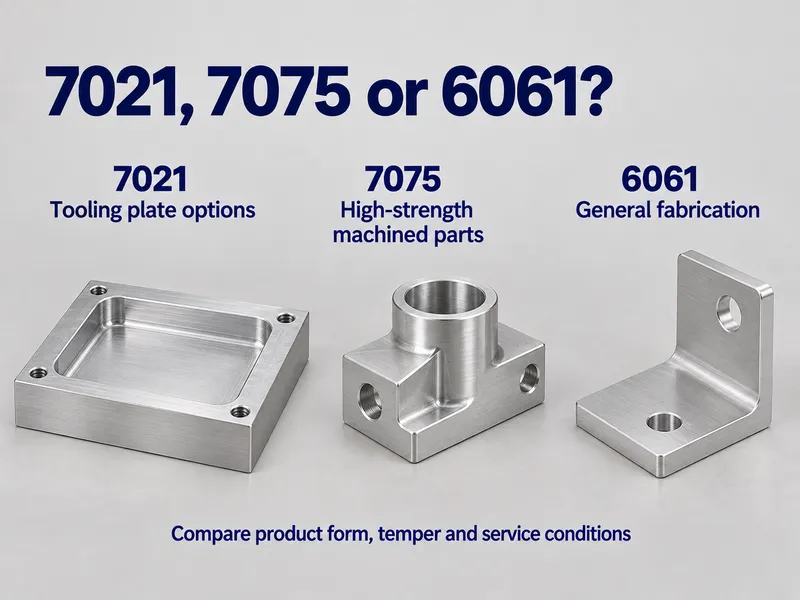
These three alloys cover most high-strength aluminium decisions.
| Property | 7021-T6 | 7075-T6 | 6061-T6 |
| Tensile strength | 400 MPa min (≈410 typical) | 572 MPa typical | 310 MPa typical |
| Proof strength | 350 MPa min | 503 MPa typical | 276 MPa typical |
| Elongation | 10% min | ~11% | 12–17% |
| Density | 2.80 g/cm³ | 2.81 g/cm³ | 2.70 g/cm³ |
| Residual stress / stability | Very low; tooling-plate grade | High; moves during heavy machining | Moderate |
| Machinability | Excellent; short chips, good polish | Good | Good |
| Weldability | Good, with qualified MIG/TIG and 5356 or 5183 filler | Not recommended for fusion welding | Excellent, all common processes |
| Corrosion resistance | Moderate; needs coating or anodizing | Limited; needs coating or cladding | Good |
| Typical applications | Moulds, tooling plate, machined and hydraulic parts, welded assemblies | High-stress machined parts, airframe structure | General fabrication, marine, architectural |
The 7021 column is the EN 485-2 minimum; the 7075 and 6061 columns are published typical values. Compare the ordering rather than the decimals, and confirm the figures that apply to your own form and thickness on the mill certificate.
Working with 7021
Machining
Machining is the reason the grade exists, and 7021 performs at the top of the range for a 7xxx alloy. Chips break short, surface finish is clean, and carbide tooling at moderate to high spindle speeds holds up well. High-speed steel works for shallow features but carbide is where the economics sit.
For deep pockets, asymmetric cuts or tight flatness tolerances, specify T651 rather than T6. The stress-relief stretch is applied before you cut, so the plate does not relieve itself into a warp partway through the job. For trimming, drilling and light milling, T6 is stable enough.
Welding
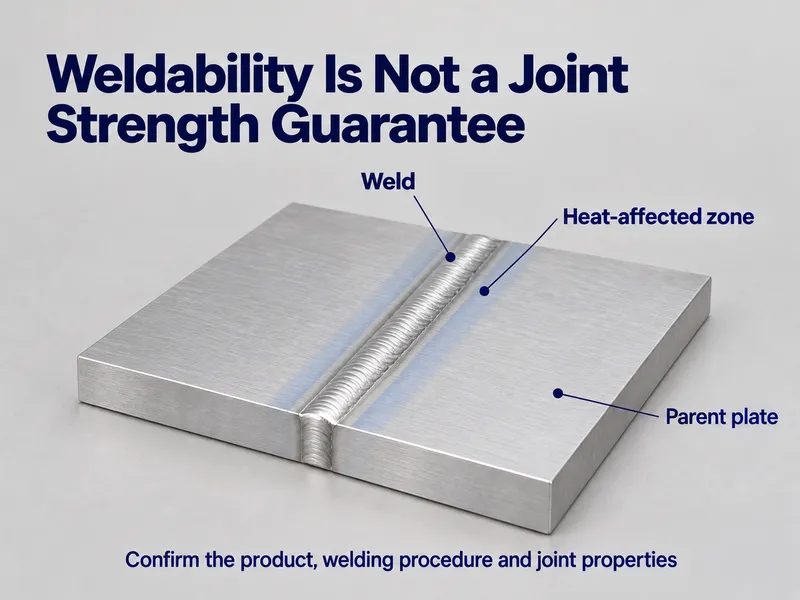
7021 can be fusion welded, and that is the differentiator — it follows from the copper ceiling and the zirconium addition. Filler is a 5xxx grade, 5356 or 5183, which keeps enough magnesium in the pool to resist solidification cracking.
Past the filler choice it is a procedure question rather than a material one: the fabricator has to qualify the welding procedure for this alloy instead of inheriting one written for a 6xxx job. Expect the weld, not the parent plate, to be the strength-limiting feature, and size the section accordingly.
Corrosion Protection
Like most zinc-rich aluminium, 7021 has moderate corrosion resistance and needs protection for exterior or humid service. Three approaches cover most cases.
- Anodizing. Sulfuric acid anodizing builds a controlled oxide barrier. Expect the layer to be less uniform than on a 6xxx alloy, and confirm the finish class on a sample before releasing a decorative part.
- Paint systems. Conversion coating, epoxy primer and a polyurethane topcoat is the standard industrial build. Surface preparation is what determines whether the coating stays on.
- Design for drainage. Avoid pockets, crevices and flat upward faces where water sits. Geometry choices prevent more corrosion than any coating repairs.
Service Temperature Limit
7021 is precipitation-hardened, so its strength depends on the hardening phase staying as it was aged. Continuous service above about 100–120 °C starts to over-age the temper and pull proof strength down, while short excursions to roughly 200 °C are tolerable without being a design rating.
Zirconium slows the process compared with 7075, but neither alloy is a high-temperature choice. For sustained heat, look at a heat-resistant grade instead.
Pros and Limitations at a Glance
| Factor | Advantage | Limitation |
| Stability under machining | Very low residual stress; tooling-plate grade | — |
| Machinability | Short chips, clean finish, good polishability | Specify T651 for deep or uneven material removal |
| Strength | 350 MPa proof minimum in T6 — a genuine 7xxx class | ~30% below 7075-T6, where proof strength governs |
| Weldability | One of the few 7xxx alloys that can be fusion welded | Needs its own qualified procedure; some heat-affected-zone loss is unavoidable |
| Corrosion resistance | Adequate once anodized or painted | Bare alloy not suitable for unprotected humid or marine service |
| Thermal conductivity | 125–155 W/m·K; faster mould cycling than steel | — |
| Service temperature | Stable to about 100–120 °C | Not a high-temperature alloy |
| Availability | Standard in plate and bar, plus extruded forms | Less widely stocked than 6061; confirm before designing around it |
Go/No-Go
Use these thresholds to decide whether 7021 belongs in the design before comparing it with anything else.
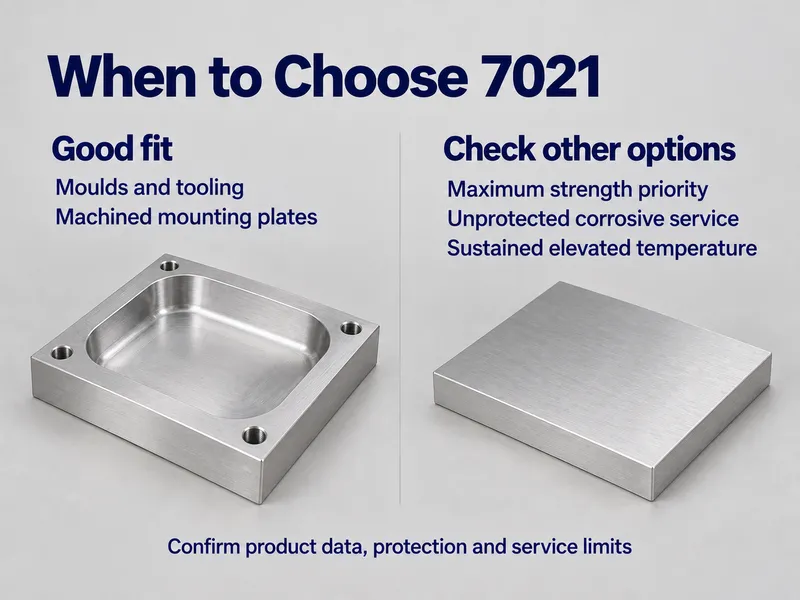
Choose 7021 when:
- The part is a mould, cavity plate or tooling plate that has to stay flat through deep or uneven cuts — specify T651 where the material removal is heavy or asymmetric.
- The part must be welded and needs 7xxx-level strength that 6061 cannot supply.
- You want faster mould cycling than steel, backed by 125–155 W/m·K thermal conductivity.
- Machining cost per part matters more than the last few percent of proof strength.
Avoid 7021 when:
- Maximum strength decides the design and nothing is welded — 7075-T6 gives about 30% more proof strength, which settles bolted and riveted machined parts.
- 276 MPa proof strength is enough — 6061-T6 buys free corrosion resistance, easy welding and far wider availability, and stability matters less where the cuts stay light.
- The part will sit unprotected in humid, marine or chemical service — go to a 5xxx or 6xxx alloy instead.
- Continuous service runs above about 120 °C, where over-aging erodes the temper.
- The part needs heavy forming after aging — 7021-T6 is not a forming alloy; form in O temper and heat treat afterwards.
- There is nothing to machine and no weld to make — the alloy’s advantages have nowhere to land.
Conclusion
7021 occupies a specific place in the 7xxx family. It gives up roughly 30% of 7075’s proof strength and its copper-derived corrosion performance, and in exchange it machines cleanly, holds its shape through heavy cuts, and can be welded — a combination no other 7xxx alloy offers in quite the same package. That is worth paying for on a mould cavity, a manifold block or a large machined plate, and not worth paying for on a part where the design load is the only thing that matters.
We supply 7021 in T6 and T651 as plate, bar, tube and block, with an MTC on every order. Our in-house CNC machining, welding and anodizing cover the machining and joining steps this grade is usually specified for, and low-MOQ custom sizes are produced to order.
Send us your drawing, form and temper, and we will confirm what we can supply against the standard you name.
Frequently Asked Questions
What is the minimum order for 7021 plate, and what lead time should I plan?
Made-to-drawing sizes are low-MOQ custom production, typically 10–60 days depending on form, temper and quantity. Standard plate and bar sizes ship from stock.
What documents come with a 7021 order?
A mill test certificate reporting the chemistry and mechanical results for the heat, included with every shipment. Where a project needs independent verification, SGS reports can be arranged on request at additional testing cost.
Can you machine 7021 mould plates and supply finished parts?
Yes — cavity plates, manifold blocks and fixture plates are machined in-house, so material and machining are quoted together.
Can 7021 replace 7075 in an existing mould design?
Only if the design is not strength-limited. 7021 gives up roughly 30% of 7075’s proof strength, so a cavity sized on 7075 wall thicknesses needs rechecking. Where machining time, flatness and weldability drive the choice rather than peak strength, the swap usually pays.